
Written by Arthur Simitian | PartsAdvisory
If you have ever sold ABS control modules at scale, you know the joke: the part bolts in, the connector clicks, the customer starts the car, and the dash lights up like a Christmas tree. Then the return shows up marked "defective." The module is not defective. The listing was incomplete, the buyer guessed, or the vehicle needed programming and nobody said it out loud.
ABS Control Module is a safety-critical ECU that sits at the intersection of brakes, chassis control, and the vehicle network. It is not a simple brake part. It is a computer with VIN, calibration, and hardware revision baggage. If you treat it like a commodity, the returns will treat you like a commodity too.
This rewrite is a catalog playbook. It is written for ACES/PIES teams, marketplace teams, and anyone who has to decide what to list, how to title it, what attributes to require, and how to prevent "bolts in but does not work" failures. The goal is not to write longer listings. The goal is to write listings that are specific enough that the right buyer buys once.
In one sentence
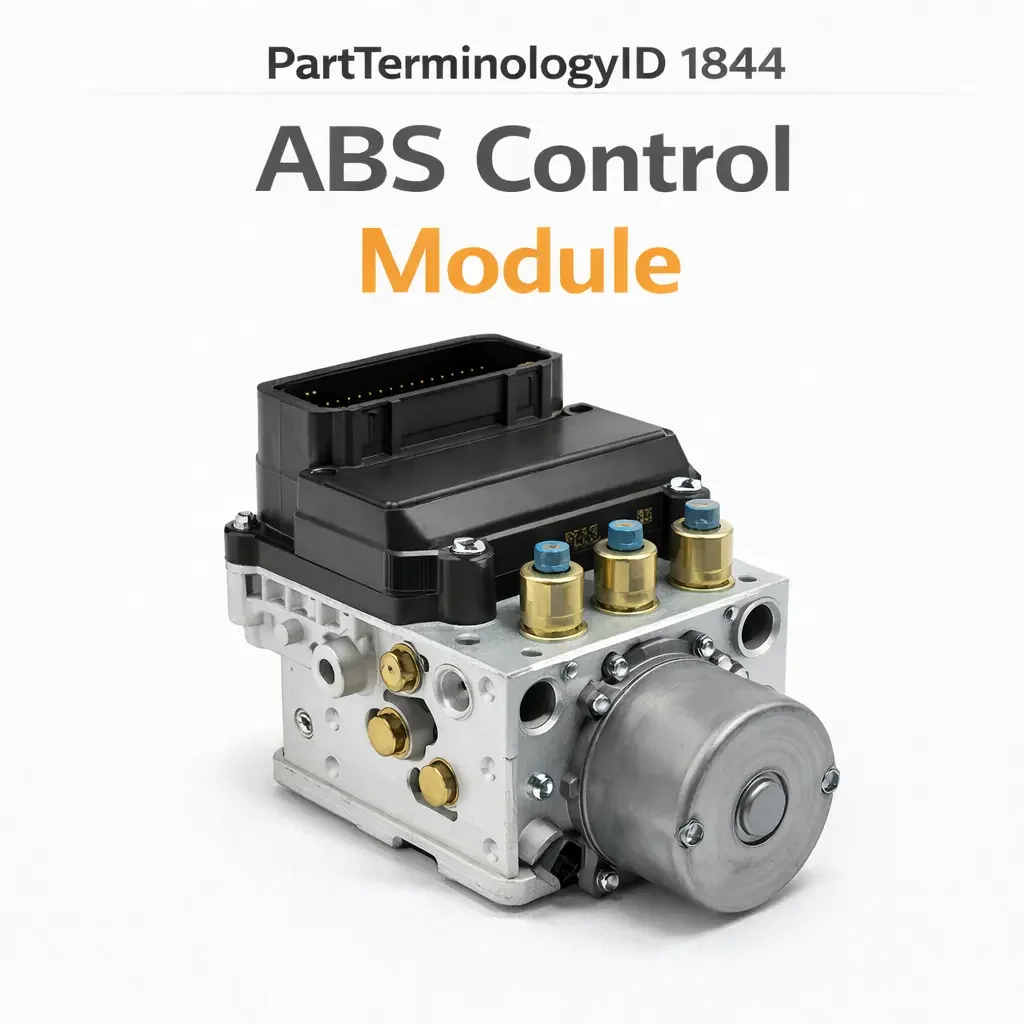
ABS Control Module (PartTerminologyID 1844) is the electronic controller that interprets wheel speed and vehicle dynamics inputs and commands the ABS hydraulic unit to modulate brake pressure, and on most modern vehicles it also runs traction control and stability control functions.
Status in New Databases
PIES/PCdb: PartTerminologyID 1844, ABS Control Module.
PIES 8.0 / PCdb 2.0: No change.
Why this part explodes return rates
The core problem is language. "ABS control module" sounds like one thing, but the market uses the phrase to mean at least three different things: the electronic module only, the hydraulic modulator only, or the combined assembly. If the listing does not state the scope in plain English, a portion of buyers will order the wrong component even when the year, make, model looks correct.
The second problem is variability inside the same year. ABS systems change mid-year, suppliers change, harness connectors change, and software calibrations change. Two modules can look identical and still be incompatible because the vehicle expects a specific hardware revision or a specific calibration.
The third problem is programming. Many modules require coding or flashing after installation. Buyers do not like surprises after the car is already torn apart, and shops do not like surprises when a car is stuck on a lift. If the listing does not disclose programming requirements up front, the part gets blamed for the process.
Finally, because this part touches safety systems, a buyer is quick to return it even if the underlying root cause was a wheel speed sensor, corrosion in the connector, a power or ground problem, or a damaged tone ring. Diagnosis is harder than clicking "add to cart." If your listing invites guessing, you will get guess-driven returns.
What this part is, and what it is not
Start with the mental model. A modern ABS system is a loop: sensors report what the wheels and vehicle are doing, the controller decides, and the hydraulic unit executes by opening and closing valves and running a pump.
In practice, most vehicles break the ABS system into three primary components that get mixed up constantly:
1. ABS Control Module (the computer): the microprocessor, memory, and software calibration. This is PartTerminologyID 1844.
2. ABS Hydraulic Control Unit (the valve block and pump assembly): the solenoids and pump motor that physically change brake pressure. This is a different PartTerminologyID.
3. Wheel speed sensors (and often tone rings or encoder bearings): the inputs at each wheel. These are different PartTerminologyIDs.
On many vehicles, the electronic module bolts onto the hydraulic unit as a single assembly. On some vehicles, the electronic module can be separated and replaced independently. On other vehicles, the unit is effectively non-serviceable and is replaced as a complete modulator assembly. Your catalog has to reflect which architecture applies to a given application, because the buyer cannot infer it from the phrase "ABS module".
What it is not: it is not a wheel speed sensor, not an ABS relay, not an ABS pump motor by itself, and not a generic "brake computer." Those confusions matter because the symptoms overlap. A wheel speed sensor fault can shut down ABS and stability control just like a module fault can.
Why the ABS control module now talks to everything
On older vehicles, ABS was mostly about preventing wheel lockup during panic stops. On modern vehicles, the ABS controller became the brain that manages brake-based stability and traction interventions. It can request engine torque reduction, control braking at individual wheels for yaw correction, and coordinate with steering and chassis sensors.
NHTSA requires electronic stability control (ESC) on light vehicles under FMVSS No. 126, and the braking system controller is central to how ESC executes. That matters because a replacement ABS controller is no longer a standalone brake part. It is a networked safety controller that must match the vehicle's sensor suite and communication expectations.
Translation for the catalog team: once a vehicle has traction control and stability control integrated into the ABS module, the number of possible calibrations increases. Drivetrain, tire size, brake package, and even option content can affect the module part number and the required programming.
The naming problem you have to solve in catalog
Even when PartTerminologyID is correct, the market uses many names. Buyers search using whatever their scan tool, dashboard message, or service manual calls it. Here are common naming patterns you should anticipate in search and listing copy:
· ABS control module, ABS module, ABS computer, ABS ECU.
· EBCM (Electronic Brake Control Module), especially on GM.
· DSC module (Dynamic Stability Control) on some European brands.
· ESP module (Electronic Stability Program) in Bosch-branded language.
· VSA modulator-control unit on some Honda and Acura platforms.
· Brake control module, stability control module, traction control module.
Catalog implication: do not rely on one label. In PIES, you can preserve the correct terminology while still including searchable synonyms in descriptions, bullets, and metadata. The key is to be precise about what is being sold, and flexible about what customers call it.
Fitment variables you cannot ignore
Year, make, model is not enough. If you want to reduce returns, you have to decide which fitment variables will be required at listing time, and which will be handled as buyer verification steps. The following variables are the ones that repeatedly break interchangeability:
ABS system manufacturer and architecture: Vehicle manufacturers source ABS systems from suppliers like Bosch, Continental (including legacy Teves architectures), Delphi, and Kelsey-Hayes. The supplier change alone can make modules non-interchangeable, even within the same model year.
Build date splits and plant splits: Mid-year changes are common. Supplier swaps, connector updates, and calibration updates happen without the badge changing. A model year that spans two ABS systems is a trap if you do not carry a date split or OE number split.
Drivetrain and axle configuration: FWD, RWD, AWD, and 4WD variants can carry different hydraulic channel counts, different yaw control logic, and different part numbers. On trucks and vans, wheelbase and axle count variants can also matter.
Brake package: Rotor size, rear disc vs rear drum, and performance packages can change brake pressure targets and stability logic. The module may need a different calibration even if the connector looks the same.
Tire size and speed rating packages: Stability control calibrations are sensitive to rolling radius assumptions. Some OEMs tie calibration to specific tire size packages, especially in performance trims.
Sensor suite: The ABS controller may interface with steering angle sensors, yaw rate sensors, lateral acceleration sensors, and pressure sensors. If the vehicle has ESC, the expectations for those sensors and the network messages are stricter.
Connector pinout and hardware revision: Externally similar connectors can have different pin assignments across revisions. If you do not match the OE number and revision suffix, you can create no-communication failures.
Programming requirement: Even if the hardware is correct, an unprogrammed or incorrectly coded module can leave ABS, traction control, and stability control disabled with warning lights on.
Hardware revision vs software calibration, the difference that matters
Aftermarket teams often speak about "the part number," but with ABS controllers there are usually at least two layers: the hardware revision and the software calibration.
Hardware revision is the physical electronics. A revision can change processor type, circuit layout, CAN message handling, or connector pinout. Two revisions can share the same housing and mounting pattern, which is why buyers get fooled. The label, including suffix and revision markers, is what you trust.
Software calibration is the behavior. It defines intervention thresholds, wheel slip targets, stability aggressiveness, brake force distribution maps, and how the controller coordinates with the engine ECU for torque reduction. A mismatched calibration can produce subtle problems that do not always throw an immediate fault. The car can appear to work, but the system response in a real event can be wrong.
For catalog teams, this is why listing by year range alone is reckless. You need OE number matching, revision suffix capture, and a clear programming statement. Those three prevent most avoidable returns.
Programming and coding, what buyers actually need to know
The phrase "programming required" is often used loosely. Buyers and shops interpret it differently. If you want fewer returns, say what it means.
Common programming steps include one or more of the following:
· VIN write: the module is assigned to the vehicle by writing the VIN into the controller.
· Variant coding: the module is configured for drivetrain, brake package, and option content.
· Flash programming: the module receives an updated calibration file from OEM service information.
· Sensor learning and resets: steering angle zero point, yaw sensor calibration, brake pressure sensor calibration, and pump bleed procedures may be required after install.
The practical point: even if the module is correct, the vehicle may not accept it or may not clear warning lights until these steps are completed. That is not a defect. It is the process.
Remanufacturers sometimes offer pre-programming if the buyer provides VIN at the time of order. That can reduce install friction, but it does not eliminate all post-install procedures because some calibrations and sensor learns are performed on the vehicle.
Used modules are the hardest case. They can contain donor VIN data and may not be reprogrammable on every platform. Some platforms allow VIN rewrite, others effectively lock the controller. Your listing should not guess. It should instruct the buyer to match OE number and confirm whether programming is possible for their platform before buying used.
Scope matters: module only vs hydraulic unit vs complete assembly
This is the first line of defense for returns. State the scope with zero ambiguity in the title, the first bullet, and the first photo caption.
Use simple phrases buyers understand:
· Electronic control module only (computer only).
· Hydraulic modulator only (valve block and pump, no electronics).
· Complete ABS module and hydraulic unit assembly (computer plus hydraulic unit).
Then reinforce with an image callout. The photo should show exactly what is included. If you can, include a second image that shows the unit installed on the vehicle or next to the hydraulic block so the buyer can orient themselves.
If you sell module only, call out whether the hydraulic unit must be reused. If you sell a complete assembly, call out whether brake line ports match the vehicle and whether a scan tool bleed procedure is required.
Condition strategy: new, reman, and used are not interchangeable business models
New: Usually the lowest return risk, usually the highest price. Often includes the most straightforward programming path because the OEM expects new modules to be flashed and coded in service.
Reman: The most common aftermarket approach. A good reman program tests communication, repairs known failure points, and provides warranty coverage. A bad reman program is a recycled module with a sticker and a short warranty. The difference shows up as repeat returns and reputational damage.
Used: Lowest cost, highest risk. Used modules are attractive to DIY buyers because the price is low, but they have the highest variability. You can reduce risk by listing the exact OE number, revision suffix, donor vehicle details, and a clear statement about whether VIN coding is required and whether it is known to be possible on the platform.
Core charges: Many reman programs use cores. If you charge a core, state the core terms plainly. Buyers will tolerate core charges, but they do not tolerate surprise core policies after checkout.
Diagnosis reality: why 'no communication' is a trap code
ABS warning lights do not mean the ABS module is bad. They mean the system is disabled. The root cause can be a sensor, wiring, a tone ring, a power supply issue, or a true module failure.
One of the most common return narratives is "no communication with ABS module." Sometimes the module is dead. Sometimes the power and ground are missing. Sometimes the scan tool cannot talk because the vehicle uses a protocol the tool does not support. The buyer replaces the module and nothing changes, then returns it.
Your content can prevent the shotgun approach by giving buyers a quick pre-check list:
· Confirm ABS fuses and relays, and confirm power and ground at the module connector.
· Check for wheel speed sensor codes and inspect sensor wiring at the wheel and at the module.
· Inspect the module connector for corrosion, pin push-out, and water intrusion.
· Verify the OE number and revision on the original module label before ordering.
If the buyer cannot do these steps, they should not be buying this part without a shop involved. It sounds harsh, but it is true. This is safety-critical and expensive.
Common failure patterns, without turning the listing into a repair manual
You do not need to diagnose the car in your product description, but you do need to set realistic expectations about symptoms and causes.
Common symptom families include: ABS warning light that stays on, traction control and stability control disabled messages, intermittent ABS activation, pump motor faults, and lost communication codes. These symptoms can be caused by the module, but they can also be caused by sensors and wiring. That is why the listing should recommend diagnosis with a scan tool before replacement.
From an aftermarket standpoint, many module failures fall into predictable buckets: internal electronics faults, relay failures, pump driver circuit failures, and water intrusion or corrosion at the connector. The point is not to scare the buyer. The point is to justify why OE number matching and programming disclosure matters.
ACES and PIES catalog blueprint for PartTerminologyID 1844
If you want this category to behave, treat it like an ECU category, not like a generic brake component.
Core identity:
· PartTerminologyID: 1844 (ABS Control Module).
· Brand, part number, and condition (new, reman, used).
· Sold as: module only, hydraulic unit only, or complete assembly.
· Quantity and any core charge.
· Warranty terms (especially for reman).
Fitment discipline:
· Require OE number, including revision suffix, as a primary verification attribute. Year range fitment can exist, but OE number matching should be front and center.
· Require ABS supplier or system type attribute when known. If supplier is not known, require the buyer to match by label or casting number on their original unit.
· Capture build date splits where the OE number indicates a mid-year change.
· Capture drivetrain and brake package splits when the OE numbers differ.
Program and install disclosures:
· Programming required: yes or no, and what type (coding, VIN write, flash).
· Required tools: dealer scan tool, pass-thru programming, or equivalent aftermarket scan tool. Avoid claiming that a basic OBD code reader can do it.
· Post-install procedures: bleed routine, steering angle calibration, yaw calibration, if applicable.
A practical attribute checklist you can enforce
This is the short list of attributes that actually prevents returns. If you are building a schema, these are the ones that deserve required status or at least gated validation:
Physical and identification attributes:
· OE part number (vehicle manufacturer number) and revision suffix.
· Supplier number, if present (Bosch, Continental, etc).
· Connector count and connector keying notes (even a simple "1 connector" is better than nothing).
· Mounting style (bolts to hydraulic unit, remote mount).
· Included components (module only, modulator only, complete).
Commerce and condition attributes:
· Condition (new, reman, used).
· Core charge and terms.
· Warranty length and whether labor is covered (most do not, but say it).
Programming attributes:
· Programming required (yes or no).
· VIN-specific programming (yes or no, and if VIN can be provided at order time for pre-programming).
· Calibration type (ESC/TC equipped, ABS only, if the product is explicitly for one).
Fitment clarifiers:
· Build date split, when known.
· ABS option codes (for example, stability control equipped) when the vehicle platform uses clear RPO style splits.
Listing language that reduces returns
You do not need to sound like a service manual. You need to sound like someone who has seen this return story before. Here are patterns that work:
Title templates:
· "ABS Control Module, Reman, Matches OE [OE NUMBER], Module Only or Complete, Programming Required".
· "ABS Control Module (EBCM), Matches OE [OE NUMBER], VIN Coding Required, Verify Label".
First bullet templates:
· "Scope: Electronic control module only. Bolts to the hydraulic unit. Reuses your existing hydraulic modulator."
· "Programming: VIN coding and setup may be required after installation. Verify access to an OEM-level scan tool or programming service."
Verification callout:
· "Match by OE number and revision on your original module label. Year, make, model alone is not enough for this category."
If you sell used:
· "Used modules may contain donor VIN data and may require reprogramming. Some vehicles do not allow VIN overwrite. Match OE number and confirm programming capability before purchase."
This is not legalese. It is honesty. It protects the buyer and the seller.
Photos, the underrated return reducer
For ABS modules, photos do real work. A clean photo of the label, including OE number and revision, reduces returns more than a paragraph of copy. If you can only add one thing, add a readable label photo.
A recommended photo set:
· Full unit, top view.
· Connector close-up (showing keying and pin cavities).
· Label close-up (OE number and revision).
· If complete assembly: brake port view showing port count and layout.
Cross-sell that actually serves the repair
This category has legitimate attach opportunities, and the best ones are not gimmicks. They are parts and services the buyer often needs during diagnosis and installation:
· Wheel speed sensors (front and rear), especially when the code points to a sensor circuit.
· ABS hydraulic modulator, if the listing is module only and the buyer discovers internal valve block issues.
· ABS pump motor relay or fuse links on platforms where they are common failure points.
· Connector pigtail or harness repair kits when the connector is corroded or pins are damaged.
· Correct DOT brake fluid and a reminder that ABS systems are sensitive to contaminated fluid.
· Programming service, pass-thru device rental, or a clear recommendation to a shop that can code the module.
Frame the cross-sell as "commonly needed during ABS system diagnosis and repair." That language feels helpful, not pushy.
The safety line you should not be afraid to say
ABS, traction control, and stability control are safety systems. When the ABS light is on, base brakes usually still work, but the driver has lost active safety intervention. That is a meaningful change in risk, especially in wet or emergency braking scenarios. The listing should say so, calmly.
Also, because this is safety-critical, do not encourage DIY installation without the required tools. A buyer can install a module physically and still end up with a disabled system if they cannot perform programming and calibrations. It is better to lose a sale than to create a bad outcome and a predictable return.
Final take
ABS Control Module (PartTerminologyID 1844) is one of the most application-specific electronic components in the brake system. The correct way to sell it is to treat it like an ECU: match by OE number and revision, state the supplier or system type when known, disclose scope (module only vs complete), and be explicit about programming and post-install procedures.
If you do those things, you cut the majority of returns. If you do not, you will keep receiving modules back labeled "defective" that were never defective. They were just wrong for the car, wrong for the calibration, or unprogrammed.
The OE label is your truth source
Every ABS controller has a label. That label is more valuable than any fitment table because it tells you what the vehicle actually has, not what the VIN decoder thinks it has.
For catalog accuracy, treat the OE label as the primary key. Capture the vehicle manufacturer OE number and any revision suffix, and if the supplier number is present (Bosch, Continental, etc), capture that too. When buyers return modules, the most common pattern is that the module they ordered matched the vehicle on paper, but did not match the label on the original unit.
If you are building a workflow, this is the simplest one that works: require the buyer to match the OE number on their existing module before ordering. If the buyer cannot access the label, ask them to provide a photo. If they cannot provide a photo, force the listing to be explicit that fitment is not guaranteed by year, make, model alone.
Yes, this adds friction. That friction is cheaper than a return on a $300 to $1,500 safety controller, and it is far cheaper than a chargeback and a bad review that says your parts do not work.
Operational tip: If you sell on marketplaces, put the label photo in the first three images, not image seven. Buyers on mobile often never scroll that far.
Five repeat return scenarios, and the language that stops them
Scenario 1: buyer needed the electronic module only, but ordered the complete assembly. This usually happens when the phrase "ABS module" is used without clarifying what is included. Prevention language: "This listing includes the electronic controller and the hydraulic unit as one assembly. If your hydraulic unit is good and you only need the computer, this is not the right part."
Scenario 2: buyer ordered the electronic module only, but their vehicle uses a non-serviceable integrated unit. They receive a piece that cannot be installed. Prevention language: "Some vehicles use a non-separable ABS unit. Verify your original module can be removed from the hydraulic unit before ordering a module-only replacement."
Scenario 3: buyer matched year, make, model, but the vehicle had a mid-year ABS supplier change. The part bolts in and does not communicate. Prevention language: "Multiple ABS system types exist for this model year. Match by OE number and revision, or verify ABS supplier (Bosch vs Continental/Teves) before ordering."
Scenario 4: buyer installed the right hardware but did not program it. Dash lights remain on, return filed as defective. Prevention language: "Programming, coding, or VIN setup may be required after installation. This is normal. Verify access to an OEM-level scan tool or programming service before purchase."
Scenario 5: buyer diagnosed poorly and replaced the module when the root cause was a wheel speed sensor, wiring damage, or connector corrosion. Prevention language: "ABS and stability faults can be caused by sensors and wiring. Diagnose with a scan tool and verify power and ground at the module before replacing the controller."
Notice the theme: each prevention line is short, specific, and tied to a real failure mode. That is how you protect conversion while reducing returns.
How to model fitment splits without turning ACES into chaos
Catalog teams often overreact to ABS complexity by trying to encode every possible variation into ACES fitment rows. That path does not scale. The goal is not to model the entire vehicle network. The goal is to prevent the known incompatible combinations from cross-matching.
Start with the splits that are objectively incompatible: different ABS supplier, different connector, different OE number family, different integrated vs separable architecture. Those splits typically align with OE number changes and can be enforced by verification steps.
Then model the splits that affect calibration: drivetrain, brake package, stability control equipped vs ABS-only. These splits often map to option packages or submodel changes. If you have reliable OE number mapping, prefer OE number matching to avoid exploding your ACES rows.
Finally, accept that some fits cannot be resolved by metadata alone. For those, build a buyer-facing verification path. Examples: "match the OE number on your original module label" or "verify the part number on the hydraulic unit." In a world of VIN-specific coding, you sometimes have to bring the buyer into the verification loop.
This is not weakness. It is honest cataloging of a networked safety controller.
Programming workflow, explained like an operator
Shops and DIY buyers do not need a lecture on CAN messages. They need to know what will happen after they install the part.
Here is the typical sequence on a modern vehicle with stability control: install the unit, reconnect battery, clear codes, perform coding or variant configuration if required, run a bleed routine for the hydraulic unit, and then perform sensor calibrations (steering angle and yaw). Some vehicles also require a brake pressure sensor calibration or a drive cycle to finalize the setup.
A listing that simply says "programming required" leaves too much to interpretation. Instead, call out what the buyer should plan for: "Coding and setup with an OEM-level scan tool may be required. Some vehicles require an automated bleed and steering angle calibration after install."
Also be clear about what you are not providing. Most sellers are not providing programming. If you are not providing it, say so. If you are providing VIN pre-programming through a reman supplier, say what the buyer must supply at checkout and what steps still remain after install.
This transparency reduces returns because it prevents the buyer from discovering the reality after the part is already on the bench.
Reman supplier quality, how to separate real from sticker-reman
The reman market for ABS controllers ranges from excellent to borderline fraudulent. If you are a seller, you need a simple rubric to evaluate suppliers.
Red flags: no description of testing, no communication test, no mention of pump driver testing when applicable, inconsistent labeling, very short warranty, and no core handling discipline. Another red flag is a supplier that will not disclose whether they clear fault memory and reset learned values.
Positive signals: documented test procedures, bench testing of communication and outputs, repair of known failure points, sealing and moisture protection steps, and the ability to support VIN pre-programming when the platform allows it.
From a catalog standpoint, your product description should align with the reality of the reman process. If the supplier repairs the controller electronics but does not rebuild the hydraulic unit, do not imply the entire assembly is remanufactured unless it is. Overselling the scope creates the exact kind of returns you are trying to prevent.
Finally, track return reasons by supplier. ABS controllers are expensive enough that you can justify a quality scoreboard. If one supplier creates repeat returns labeled "no communication" or "won't program," that supplier is not a supplier, it is a liability.
E-commerce listing anatomy for ABS controllers
If you only remember one thing, remember this: fitment for an ABS control module is an identification problem, not a marketing problem.
A high-performing listing has five elements in the first screen of content: (1) Scope, module only vs complete assembly. (2) OE number and revision match requirement. (3) Programming disclosure. (4) Condition, new vs reman vs used, plus core if applicable. (5) A clear photo of the label.
Everything else is secondary. Fabric type, finish, and "premium quality" language does not move the buyer in this category. The buyer wants the right part the first time and wants to avoid being stuck with a car that will not clear warning lights.
If you have room for one additional element, include a short "How to verify" section with three steps: locate the module, read the label, match the OE number. That one box reduces returns because it shifts the buyer from guessing to matching.
Also, be careful with generic compatibility claims. The most dangerous sentence in this category is: "Fits [year range] [make] [model]." If you use it, it must be paired with the verification statement in the same breath.
When to offer repair services instead of replacement
Some platforms have well-known failure modes where the electronics fail but the hydraulic unit is fine. In those cases, buyers are often open to repair services, especially when the OE part is discontinued or backordered.
If you sell repair services, do not pretend they are the same as a replacement module. They are a different product type with different expectations: the buyer sends their original unit, you repair it, and send it back. The benefit is preserved VIN and calibration, and often no coding required beyond clearing codes. The downside is downtime and shipping risk.
Catalog and marketplace teams can treat this as a safety valve for the category. When replacement inventory is unstable, repair services can catch demand and protect customer outcomes. Just be explicit: turnaround time, what is repaired, what is not repaired, warranty terms, and what symptoms the service addresses.
This is also a cross-sell opportunity. A buyer shopping a replacement module because they fear programming can be offered a repair service that preserves their original coding. That is not upsell. That is problem solving.
Packaging and handling, the boring part that still matters
ABS controllers fail returns for dumb reasons too: damaged pins, cracked housings, missing seals, and static or impact damage during shipping.
Treat packaging like you would treat an ECU. Use anti-static packaging where appropriate, immobilize the unit so it cannot bounce, protect the connector, and ensure the label remains readable. If the unit includes a gasket or seal, include it or state clearly that it is not included.
Add a warehouse check step: verify the OE number on the label against the pick ticket before it goes into the box. This is the category where one wrong pick creates a guaranteed return.
If you are a larger operation, photograph the label at pack-out. It creates a record that can resolve disputes and reduces fraud on high-dollar electronics.