
Brake Hydraulic Line (PartTerminologyID 1820): The Hard Line Nobody Thinks About Until It Rusts Through
Written by Arthur Simitian | PartsAdvisory
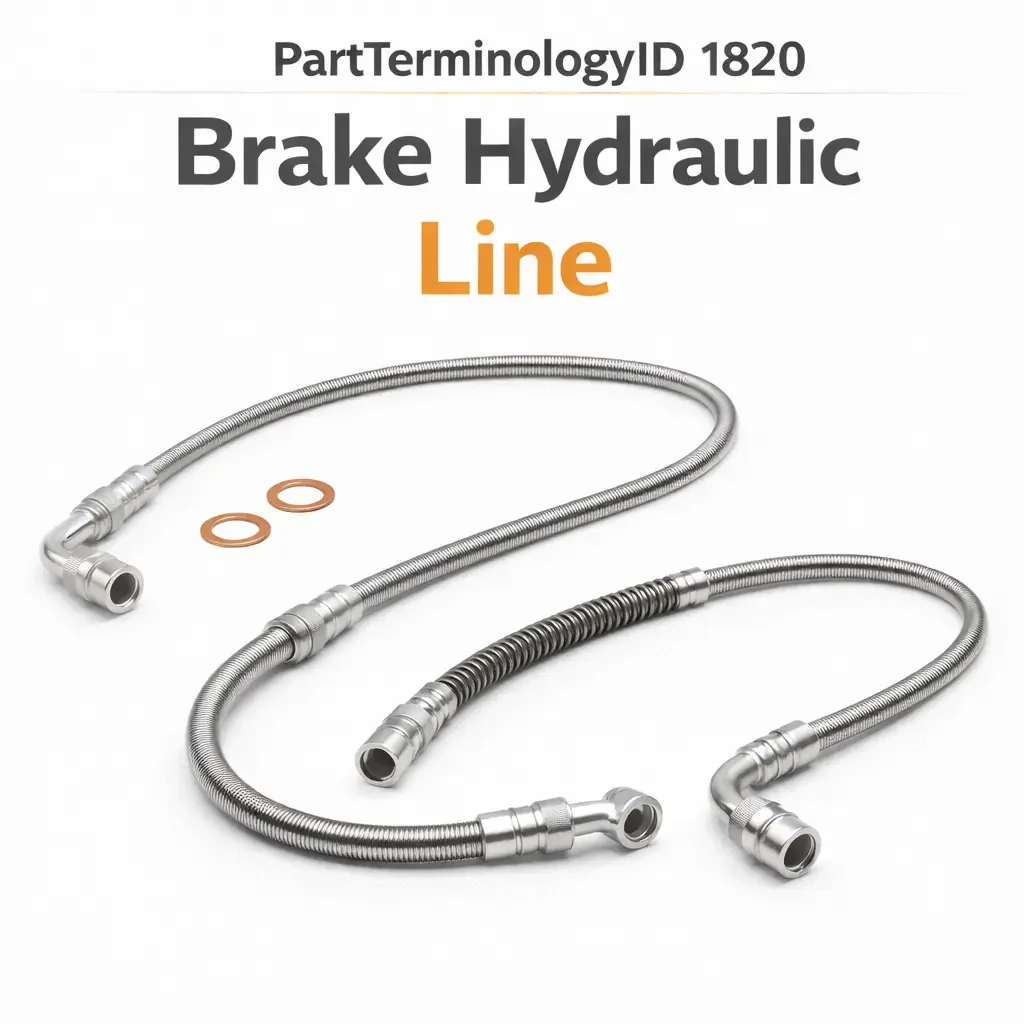
PartTerminologyID 1820, Brake Hydraulic Line, is the rigid steel tube that carries pressurized brake fluid from the master cylinder to the flexible brake hoses at each wheel, or between ABS components, junction blocks, and proportioning valves. It is the fixed backbone of the brake hydraulic system.
Unlike the flexible brake hose (PartTerminologyID 1792) that moves with the suspension and steering, the hard line is mounted to the vehicle body, frame, or subframe with clips and brackets. It does not flex. It does not move. It just carries pressure, quietly, for years, until corrosion eats through the wall and brake fluid starts dripping onto the driveway.
That is when buyers go looking for a replacement. And that is when the listing problems start.
Buyers order the wrong line because:
they assume all brake lines for a given vehicle are the same length and shape
they do not verify which circuit the line serves (front, rear, diagonal, ABS feed, proportioning valve to rear axle)
they confuse pre-bent, vehicle-specific lines with universal bulk tubing
they do not verify fitting type, thread size, and flare style at each end
they miss ABS vs. non-ABS routing differences
they order a single line when the vehicle uses a unique line that branches or includes a junction
Sellers get caught because many listings describe the line with nothing more than "brake line" and a vehicle fitment. No circuit position, no line length, no fitting specs, no flare type, no mention of whether the line is pre-bent to match OE routing or sold as straight tubing that requires shop fabrication.
Status in New Databases
PIES/PCdb: PartTerminologyID 1820, Brake Hydraulic Line
PIES 8.0 / PCdb 2.0: No change
What This Part Actually Is
A brake hydraulic line is a rigid metal tube, typically steel or steel with a protective coating (zinc, nickel-copper, or polymer), with flared fittings on each end that connect to other brake components using threaded unions. The line is formed to follow a specific routing path along the vehicle's underside and is secured with clips or brackets at intervals.
Two product types exist in the aftermarket
Pre-bent, vehicle-specific lines are formed to match the OE routing for a specific vehicle, circuit, and position. They arrive ready to install with the correct bends, length, and end fittings. These are direct replacements.
Universal bulk tubing is sold in straight lengths (typically 3/16" or 1/4" O.D.) with or without pre-flared ends. The installer must cut, bend, flare, and fit the tubing to the vehicle. This requires tools, skill, and time. It is a viable option for custom or repair work, but it is not a direct replacement.
If the listing does not specify which type the buyer is receiving, confusion is guaranteed. A buyer expecting a pre-bent line who receives a 60-inch straight tube with no fittings will return it immediately.
Brake Hydraulic Line is NOT:
a flexible brake hose (PartTerminologyID 1792), which is the rubber hose at each wheel
a brake vacuum hose (PartTerminologyID 1812), which carries vacuum to the booster
a clutch hydraulic line
a pre-assembled brake line kit that includes hoses, fittings, and hardware (though some kits exist)
The Flare Type Problem
The single most technical fitment detail in this category is the flare type at each end of the line. Brake line fittings use flared tube ends that seat into the mating component to create a leak-free seal under high pressure.
Two common flare types
Double flare (SAE/inverted flare): the standard in most domestic and many Asian vehicles. The tube end is folded over twice to create a strong, smooth seating surface.
Bubble flare (DIN/ISO): common on European vehicles and some Asian platforms. The tube end is formed into a rounded bubble shape that seats differently than a double flare.
These two flare types are not interchangeable. A double-flare fitting will not seal properly in a bubble-flare seat, and vice versa. Cross-threading or forced installation can crack the fitting, strip the threads, or create a slow leak that compromises braking.
If the listing does not specify flare type, the buyer has no way to verify compatibility before installation. This is especially problematic on vehicles where both flare types exist across different model years or markets.
Fitting thread sizes
Common brake line fitting threads include 3/16" tube with 3/8"-24 nuts, 1/4" tube with 7/16"-24 nuts, and metric sizes like M10 x 1.0 and M12 x 1.0. The fitting thread must match the port on the master cylinder, ABS modulator, junction block, proportioning valve, or hose connection at the other end.
Top Return Scenarios
Scenario 1: "This is straight tubing, not a pre-bent line"
Buyer expected a formed, ready-to-install line and received bulk tubing.
Prevention language: "Pre-bent, vehicle-specific brake line [or straight universal tubing, requires cutting, bending, and flaring]. Verify product type before ordering."
Scenario 2: "Fittings don't match"
Flare type or thread size does not match the mating component.
Prevention language: "Flare type: [double flare / bubble flare]. Fitting thread: [3/8"-24 / M10 x 1.0] at each end. Verify flare style and thread size before ordering."
Scenario 3: "Wrong circuit, wrong length"
Buyer ordered a front brake line but needed the rear, or the line runs to the wrong junction point.
Prevention language: "Circuit: [master cylinder to front left / proportioning valve to rear axle / ABS modulator to front right]. Line length: [X inches]. Verify circuit routing on your vehicle."
Scenario 4: "Line doesn't match my ABS-equipped vehicle"
Non-ABS line shipped for a vehicle with ABS, or vice versa. ABS vehicles route lines through the modulator, changing line length and endpoint locations.
Prevention language: "Designed for [ABS / non-ABS] equipped vehicles. ABS and non-ABS brake line routing differs. Verify your brake system configuration."
What to Include in the Listing
Core essentials
PartTerminologyID: 1820
component: Brake Hydraulic Line
product type: pre-bent vehicle-specific or universal bulk tubing
circuit position: which two components the line connects
quantity: 1
Fitment essentials
year/make/model/submodel
ABS vs. non-ABS
brake system layout (front/rear split, diagonal split)
production date splits if routing changed mid-year
Dimensional and interface essentials
tube O.D. (3/16" or 1/4" most common)
line length
flare type at each end (double flare or bubble flare)
fitting thread size at each end
material and coating (steel, nickel-copper, polymer-coated, stainless)
fittings included: yes/no
Image essentials
full line showing shape and bends (for pre-bent lines)
close-up of each end fitting showing flare type
routing diagram or position reference
length callout
Catalog Checklist for ACES/PIES Teams
PartTerminologyID = 1820
require product type attribute (pre-bent vs. universal)
require flare type at both ends
require fitting thread size at both ends
require circuit position (which components the line connects)
require line length
enforce ABS vs. non-ABS split
differentiate clearly from PartTerminologyID 1792 (Brake Hydraulic Hose)
flag vehicles where flare type changed across model years or markets
FAQ (Buyer Language)
Is this a pre-bent line or straight tubing?
Check the listing. Pre-bent lines are formed to match your vehicle's routing and install without modification. Universal tubing requires cutting, bending, and flaring with specialized tools.
What is the difference between double flare and bubble flare?
Double flare folds the tube end over twice and is standard on most domestic vehicles. Bubble flare forms a rounded end and is common on European vehicles. They are not interchangeable and will leak if mismatched.
Do I need to bleed the brakes after replacing a line?
Yes. Any time the hydraulic circuit is opened, air enters the system. A full brake bleed is required after line replacement.
Can I replace just one line, or do I need to replace all of them?
You can replace a single failed line. However, if one line has corroded through, adjacent lines are likely in similar condition. Inspect all lines and replace any that show significant corrosion, pitting, or wall thinning.
Cross-Sell Logic
Brake Line Fitting Kit (nuts, unions)
Brake Hydraulic Hose (PartTerminologyID 1792)
Brake Line Clip and Bracket Kit
Brake Fluid (correct DOT specification)
Brake Bleeder Kit
Brake Line Flaring Tool (if selling universal tubing)
Frame as "commonly needed during brake line replacement."
Final Take for PartTerminologyID 1820
Brake Hydraulic Line (PartTerminologyID 1820) is a category where two details prevent most returns: specifying whether the line is pre-bent or universal tubing, and publishing the flare type at each end.
A buyer who receives straight tubing when they expected a formed line will return it. A buyer who receives double-flare fittings for a bubble-flare vehicle will either return it or, worse, force the connection and create a leak in a safety-critical system. Both outcomes are preventable with listing data that most sellers currently omit.