
Written by Arthur Simitian | PartsAdvisory
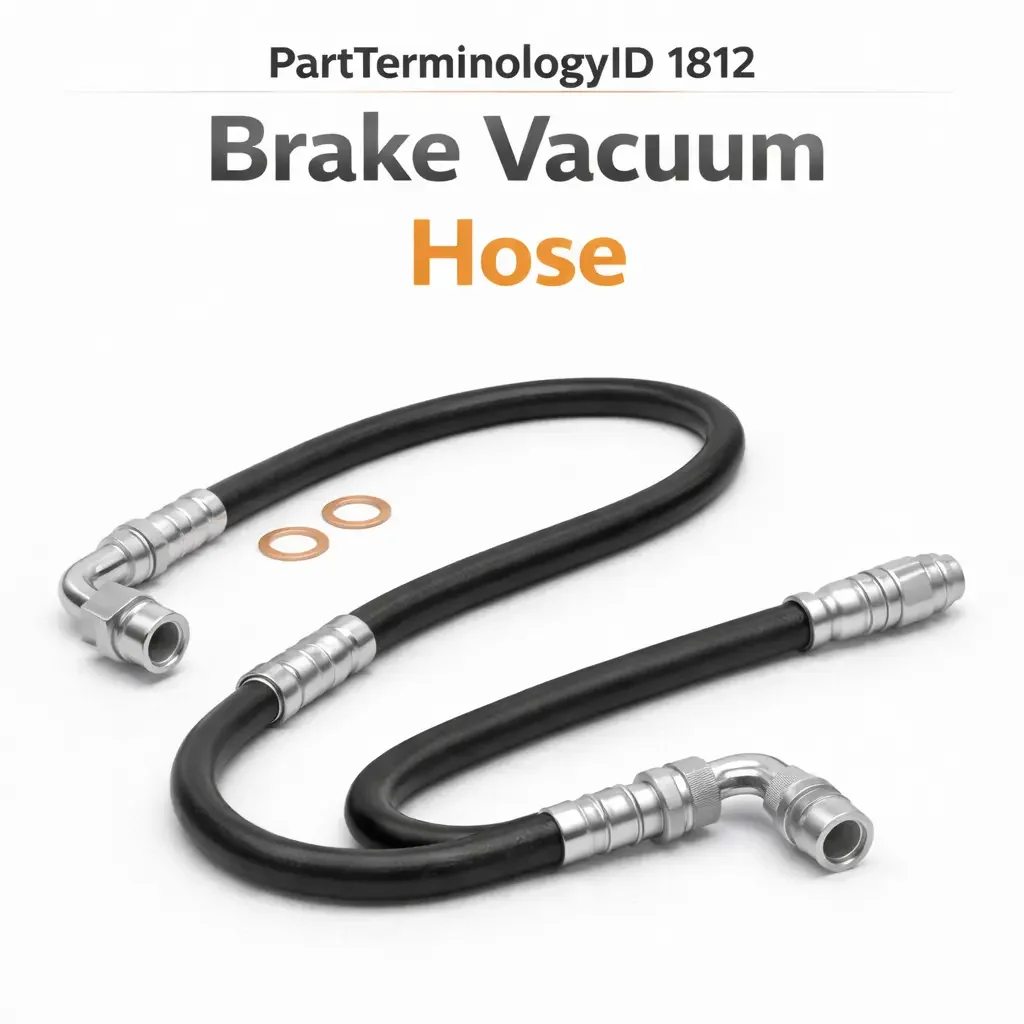
PartTerminologyID 1812, Brake Vacuum Hose, is the flexible hose that carries engine vacuum from the intake manifold (or vacuum pump on diesel and some turbocharged vehicles) to the brake booster. It is the supply line that makes power-assisted braking possible. Without it, the driver gets a rock-hard brake pedal and dramatically increased stopping distances.
The hose itself is simple. It is a length of reinforced rubber or silicone tubing, typically 3/8" to 1/2" inside diameter, routed through the engine bay from the vacuum source to the booster. It may include integrated connectors, a check valve, or inline fittings depending on the platform.
The listing problems are not simple.
Buyers order the wrong hose because:
they do not verify hose I.D., length, or connector type at each end
they confuse this hose with the brake hydraulic hose (PartTerminologyID 1792), which carries brake fluid to the wheels
they do not account for check valve integration (some hoses include the check valve as a molded-in, non-serviceable component)
they miss connector differences at the booster end vs. the manifold end
they order generic vacuum hose by the foot when the application requires a molded hose with specific bends, connectors, or branches
they do not realize that diesel and turbocharged vehicles use a vacuum pump instead of manifold vacuum, which may require a different hose with different fittings
Sellers get caught because listings for Brake Vacuum Hose frequently omit hose I.D., length, connector configuration, and whether the check valve is included. The buyer sees "brake vacuum hose," confirms the vehicle fitment, and orders. The hose arrives with the wrong end fittings, the wrong length, or without the integrated check valve the application requires.
Status in New Databases
PIES/PCdb: PartTerminologyID 1812, Brake Vacuum Hose
PIES 8.0 / PCdb 2.0: No change
What This Part Actually Is
The brake vacuum hose is the flexible conduit in the vacuum brake assist circuit. It transfers vacuum from the engine's intake manifold to the brake booster diaphragm. The booster uses this vacuum to multiply the force the driver applies to the brake pedal, reducing the effort needed to stop the vehicle.
Where it runs
The hose routes from a vacuum port on the intake manifold (or from a vacuum pump on engines that do not produce sufficient manifold vacuum) through the engine bay to the brake booster mounted on the firewall. Depending on the vehicle, the hose may be a single straight run, a molded shape with specific bends, or a multi-branch assembly that also feeds vacuum to other components like a vacuum reservoir or brake booster sensor.
Two categories of replacement hose
Molded/application-specific hoses are designed for a specific vehicle. They have a fixed length, pre-formed bends, and integrated connectors or check valves. They are direct replacements that match the OE routing exactly.
Generic bulk vacuum hose is sold by the foot in standard I.D. sizes. It works for simple straight-run applications where the original hose had no molded features, but it does not include connectors, check valves, or formed bends.
If the listing does not specify which type the buyer is getting, the wrong product ships.
Brake Vacuum Hose is NOT:
a brake hydraulic hose (PartTerminologyID 1792), which carries pressurized brake fluid to calipers or wheel cylinders
a brake vacuum hose connector (PartTerminologyID 1804), which is the fitting that joins the hose to the booster or manifold
a brake booster check valve (though some hoses include one)
a heater hose, fuel vapor hose, or general-purpose vacuum line (different materials, different ratings)
The most damaging confusion is between this part and PartTerminologyID 1792. "Brake hose" returns both categories in many searches. One carries vacuum. The other carries pressurized brake fluid. They are not interchangeable in any way, and shipping the wrong one is a safety failure.
Why Check Valve Integration Is the Key Listing Detail
The brake booster circuit requires a one-way check valve that maintains vacuum in the booster when manifold vacuum drops (during hard acceleration, at high altitude, or if the engine stalls). This check valve can be located in one of three places:
At the booster, pressed into a grommet on the booster shell
Inline, as a separate component spliced into the vacuum hose
Integrated into the hose, molded as a non-serviceable part of the hose assembly
On vehicles where the check valve is integrated into the hose, replacing the hose with a plain length of tubing eliminates the check valve from the system. The brakes will work under normal driving, but the driver will lose vacuum reserve, meaning the pedal will go hard immediately if manifold vacuum drops.
If the listing does not specify whether the hose includes an integrated check valve, the buyer cannot determine whether they need this hose, a separate check valve, or both.
Top Return Scenarios
Scenario 1: "Hose doesn't include the check valve"
Buyer's original hose had an integrated check valve. Replacement is plain tubing.
Prevention language: "This hose [includes / does not include] an integrated check valve. If your original hose has a molded-in check valve, verify that this replacement matches."
Scenario 2: "Connectors don't fit my booster or manifold"
End fittings (barb size, quick-connect, push-in) do not match.
Prevention language: "Booster end: [push-in / barb / quick-connect, X" O.D.]. Manifold end: [barb / threaded, X" O.D.]. Verify both connection types before ordering."
Scenario 3: "Hose is too short or too long"
Hose length does not match the routing distance on the buyer's vehicle.
Prevention language: "Hose length: [X inches]. Designed for [specific vehicle and engine]. Verify routing distance in your engine bay."
Scenario 4: "I ordered a brake vacuum hose and received a brake fluid hose"
Buyer searched "brake hose" and received a hydraulic hose instead of a vacuum hose, or vice versa.
Prevention language: "This is a vacuum supply hose for the brake booster assist circuit. It does not carry brake fluid. For brake hydraulic hoses, see PartTerminologyID 1792."
What to Include in the Listing
Core essentials
PartTerminologyID: 1812
component: Brake Vacuum Hose
scope: hose only, or hose with check valve, or hose with connectors (be explicit)
quantity: 1
Fitment essentials
year/make/model/submodel
engine type (gas naturally aspirated, gas turbo, diesel)
vacuum source (intake manifold or vacuum pump)
production split notes if the booster or manifold changed mid-year
Dimensional and interface essentials
hose inside diameter
hose length (end to end)
connector type at each end (barb, push-in, quick-connect, open cut end)
connector size at each end
check valve included: yes/no
molded shape or straight
material (rubber, silicone, reinforced)
Image essentials
full hose laid out showing overall shape and length
both end connections clearly visible
check valve location marked (if integrated)
scale reference or measurement callout
Catalog Checklist for ACES/PIES Teams
PartTerminologyID = 1812
require hose I.D. and length attributes
require connector type at both ends
require check valve inclusion attribute (yes/no)
enforce engine type and vacuum source splits
differentiate clearly from PartTerminologyID 1792 (Brake Hydraulic Hose) and PartTerminologyID 1804 (Brake Vacuum Hose Connector)
flag molded vs. generic hose type in product metadata
FAQ (Buyer Language)
Is this the same as a brake line or brake hose?
No. This hose carries vacuum to the brake booster for power assist. It does not carry brake fluid. Brake hydraulic hoses (PartTerminologyID 1792) carry pressurized fluid to the calipers or wheel cylinders.
Does this hose include the check valve?
It depends on the application and listing. Some hoses include an integrated check valve. Others are plain hose with no valve. Check the listing details and compare to your original hose.
Can I use generic vacuum hose from the parts store?
For simple straight-run applications with barb fittings at each end, generic vacuum hose of the correct I.D. may work. For applications with molded bends, integrated check valves, or specific connectors, use the application-specific replacement hose.
My brake pedal is hard after replacing this hose. What happened?
If the replacement hose does not include a check valve and your original did, the booster will lose vacuum reserve under certain conditions. Verify that a check valve is present in the circuit, either integrated into the hose or installed as a separate component.
Cross-Sell Logic
Brake Vacuum Hose Connector (PartTerminologyID 1804)
Brake Booster Check Valve
Brake Booster Grommet
Hose Clamp Kit
Brake Booster Assembly
Frame as "commonly inspected together during brake vacuum system service."
Final Take for PartTerminologyID 1812
Brake Vacuum Hose (PartTerminologyID 1812) is a low-cost part with two listing traps that drive most returns: failing to specify whether the check valve is integrated, and failing to distinguish this vacuum hose from the brake hydraulic hose (PartTerminologyID 1792).
State the hose I.D., the length, the connector types at both ends, and whether the check valve is included. That is enough to prevent the buyer from ordering the wrong hose, losing their vacuum reserve, or accidentally ordering a pressurized brake fluid line when they needed an air path to the booster.