
Written by Arthur Simitian | PartsAdvisory
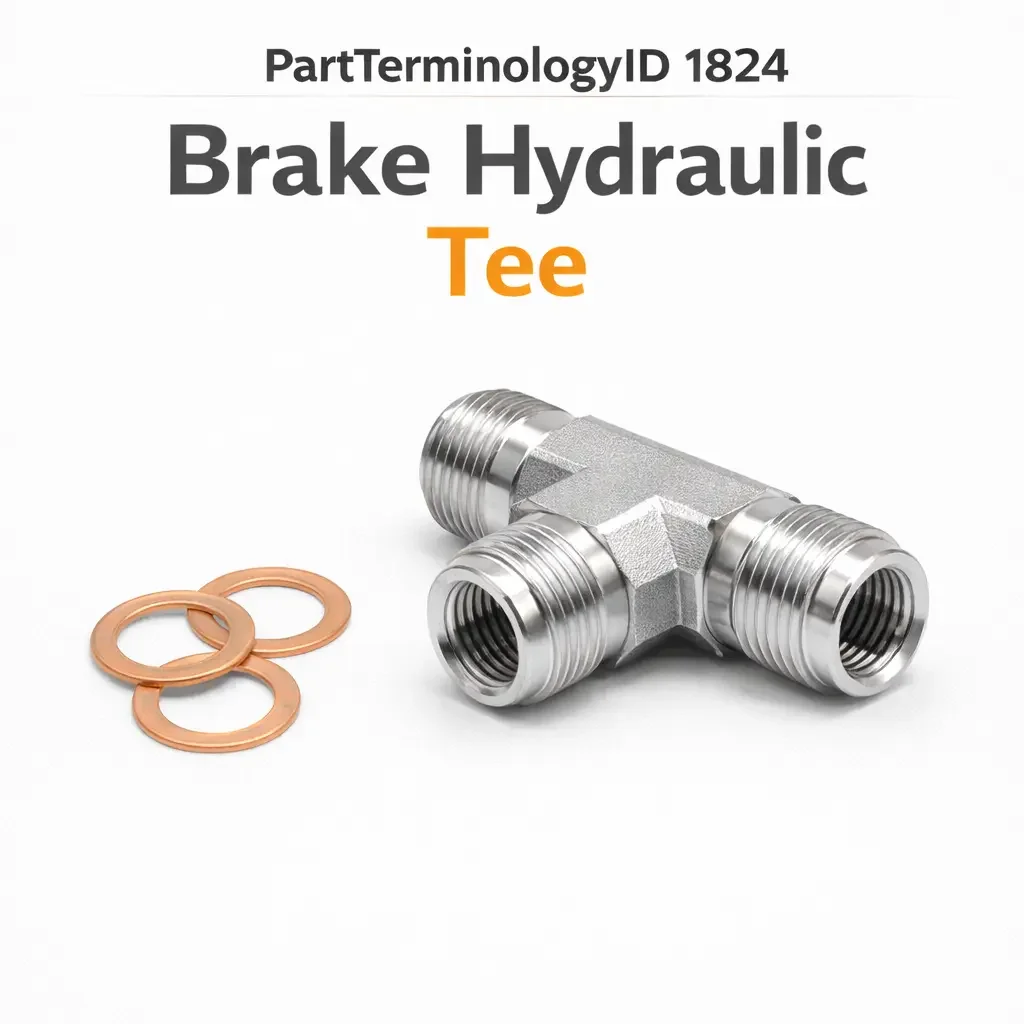
PartTerminologyID 1824, Brake Hydraulic Tee, is a small brass or steel fitting that splits a single brake hydraulic line into two lines, or joins two lines into one. It is a junction point in the brake hydraulic circuit, typically mounted to the frame, body, or a bracket somewhere between the master cylinder and the wheels.
The tee fitting allows one pressure source to feed two destinations. A common application is splitting the rear brake circuit from a single line running down the vehicle's centerline into two lines, one for each rear wheel. On some vehicles, the tee is mounted on the rear axle housing or near the rear subframe. On others, it is located under the floor pan midway along the vehicle.
It is a simple part. A body with three threaded ports, each accepting a brake line fitting. It does not regulate pressure, does not contain any moving parts, and does not wear out under normal conditions. Buyers replace it when the threads strip, when corrosion makes it impossible to remove a brake line fitting without cracking the tee body, or when the vehicle is getting a complete brake line replacement and the old tee is too corroded to reuse.
The listing problems come from the fact that "brake hydraulic tee" describes a fitting geometry, not a specific part. The thread size, thread pitch, port orientation, flare type, and mounting style vary by vehicle, and most listings do not specify any of them.
Buyers order the wrong tee because:
they assume all brake tees are the same (three ports, how different can they be)
they do not verify thread size and pitch at each port
they do not verify flare type (double flare vs. bubble flare) at each port
they miss that some tees have ports of different sizes (one larger inlet, two smaller outlets)
they confuse the brake hydraulic tee with a brake proportioning valve, distribution block, or combination valve
they do not verify the mounting style (bracket-mounted, frame-mounted, threaded into a block)
Sellers get caught because listings for this part routinely omit thread specifications, flare type, port sizes, and mounting configuration. The buyer sees "brake tee," confirms the vehicle, and orders. The fitting arrives with the wrong thread pitch, the wrong flare seat, or ports oriented in the wrong direction for the vehicle's line routing.
Status in New Databases
PIES/PCdb: PartTerminologyID 1824, Brake Hydraulic Tee
PIES 8.0 / PCdb 2.0: No change
What This Part Actually Is
A brake hydraulic tee is a passive, unpressurized junction fitting. It has no internal valves, springs, pistons, or metering components. It simply provides three ports so that one brake line can branch into two.
The fitting body is typically brass (for corrosion resistance) or steel (for strength), and may be plated with zinc, nickel, or cadmium for additional corrosion protection. Each port has internal threads that accept a brake line fitting nut, and the seat at the bottom of each port is machined to match a specific flare type.
What it is NOT
a proportioning valve (which meters pressure to the rear brakes based on load or deceleration)
a combination valve (which integrates a metering valve, proportioning valve, and pressure differential switch)
a distribution block (which may have four or more ports and route lines to multiple circuits)
a brake line union or coupler (which has two ports and joins two lines end to end, PartTerminologyID 1828 or similar)
The confusion between tee fittings and proportioning valves is the most common misidentification. On many vehicles, the proportioning valve is located in the same area as the tee (near the rear axle or under the floor), and both have multiple brake lines connected to them. A buyer who does not know the difference may order a tee when they need a proportioning valve, or vice versa. The proportioning valve contains internal metering components and is a significantly different (and more expensive) part.
Why Thread Specs Are the Entire Fitment Story
Brake hydraulic fittings in the aftermarket use a handful of common thread sizes, but "a handful" is enough to create incompatibility.
Common brake fitting thread sizes
3/8" to 24 UNF (used with 3/16" brake tubing, common on domestic vehicles)
7/16" to 24 UNF (used with 1/4" brake tubing)
M10 x 1.0 (common on European and some Asian vehicles)
M12 x 1.0 (used on some European vehicles for larger lines)
10mm x 1.0 bubble flare (DIN/ISO standard)
A tee fitting designed for 3/8" to 24 threads with double flare seats will not properly seal a line with M10 x 1.0 threads and a bubble flare. The threads may engage partially (the O.D. of 3/8" to 24 and M10 x 1.0 are close enough to start threading), but the flare seat geometry is wrong and the connection will leak under pressure. This is a brake fluid leak in a safety-critical system.
Mixed port sizes
Some brake hydraulic tees have ports of different sizes. The inlet port (from the master cylinder or proportioning valve) may be a larger thread size than the two outlet ports (to the individual wheels). A listing that specifies only one thread size, or no thread size at all, does not give the buyer enough information to verify compatibility.
Port orientation
The three ports on a tee fitting can be oriented in different configurations: all three in the same plane (flat tee), one port perpendicular to the other two (right-angle tee), or various angled arrangements. The port orientation must match the brake line routing on the vehicle, or the lines will not connect without bending them into positions that stress the fittings and create leak points.
Top Return Scenarios
Scenario 1: "Threads don't match my brake lines"
Thread size or pitch mismatch between the tee ports and the existing brake line fittings.
Prevention language: "Port 1 (inlet): [3/8" to 24 / M10 x 1.0]. Ports 2 and 3 (outlets): [3/8" to 24 / M10 x 1.0]. Flare type: [double flare / bubble flare]. Verify thread size and flare type at all three connections."
Scenario 2: "I ordered a tee but I need a proportioning valve"
Buyer identified a multi-line junction on the vehicle and assumed it was a tee. The actual part is a proportioning valve or combination valve.
Prevention language: "This is a passive tee fitting with no internal valving. It does not regulate brake pressure. If your vehicle has a metering or proportioning device at this location, see [proportioning valve / combination valve] listings."
Scenario 3: "Ports are oriented wrong for my lines"
The tee body port angles do not match the brake line approach angles on the vehicle.
Prevention language: "Port configuration: [flat tee / right-angle tee / offset]. Verify port orientation against your vehicle's line routing before ordering."
Scenario 4: "Mounting bracket doesn't match"
The tee includes a mounting tab or bracket that does not align with the vehicle's mounting point.
Prevention language: "Mounting: [bracket-mounted with [X]mm bolt spacing / body-mounted with clip / threaded into block]. Verify mounting style."
What to Include in the Listing
Core essentials
PartTerminologyID: 1824
component: Brake Hydraulic Tee
function: passive junction fitting (no internal valving)
quantity: 1
Fitment essentials
year/make/model/submodel
circuit position (front split, rear split, or specific location description)
ABS vs. non-ABS (ABS-equipped vehicles may route lines differently, changing the tee location or eliminating it entirely)
Dimensional and interface essentials
thread size and pitch at each port (specify inlet vs. outlets if different)
flare type at each port (double flare or bubble flare)
port orientation (flat, right-angle, offset)
body material (brass, steel, plated steel)
mounting style (bracket, clip, threaded)
mounting bolt spacing or clip size (if bracket-mounted)
Image essentials
all three ports visible with thread callouts
port orientation clearly shown
mounting bracket or tab visible
scale reference for overall size
Catalog Checklist for ACES/PIES Teams
PartTerminologyID = 1824
require thread size and pitch at all three ports
require flare type at all three ports
require port orientation attribute
require mounting style attribute
enforce ABS/non-ABS split (ABS vehicles may not use a tee at this location)
differentiate clearly from proportioning valves, combination valves, and distribution blocks
flag applications where port sizes differ between inlet and outlets
FAQ (Buyer Language)
Is this the same as a proportioning valve?
No. A brake hydraulic tee is a passive fitting that splits one line into two. It has no internal components and does not regulate pressure. A proportioning valve contains internal metering components that reduce pressure to the rear brakes under hard braking.
How do I know what thread size my brake lines use?
Check the fitting nuts on your existing brake lines. Domestic vehicles commonly use 3/8" to 24 or 7/16" to 24 (SAE). European vehicles commonly use M10 x 1.0 or M12 x 1.0 (metric). If you are unsure, a thread pitch gauge at any auto parts store will identify the size.
Can I use a universal tee from the hardware store?
No. Brake hydraulic tees must be rated for brake system pressures (up to 2,000 PSI or more) and must have flare seats machined to match brake line flare types. General-purpose plumbing or pneumatic tee fittings are not safe for brake hydraulic systems.
Do I need to bleed the brakes after replacing the tee?
Yes. Any time the brake hydraulic circuit is opened, air enters the system. A full brake bleed is required after replacing any hydraulic fitting.
Cross-Sell Logic
Brake Hydraulic Line (PartTerminologyID 1820)
Brake Line Fitting Nuts
Brake Line Flare Tool
Brake Fluid (correct DOT specification)
Brake Bleeder Kit
Brake Line Clip and Bracket Kit
Frame as "commonly needed during brake line and fitting replacement."
Final Take for PartTerminologyID 1824
Brake Hydraulic Tee (PartTerminologyID 1824) is a five-dollar part that generates twenty-dollar returns when the listing omits thread specs and flare type. The buyer cannot verify compatibility without knowing the thread size, thread pitch, and flare type at each port. The seller cannot prevent returns without publishing them.
State the threads. State the flare type. State the port orientation. Clarify that it is a passive junction, not a proportioning valve. That is the entire return prevention strategy for this PartTerminologyID.