
Brake Vacuum Hose Connector (PartTerminologyID 1804): Small Fitting, Big Confusion
Written by Arthur Simitian | PartsAdvisory
PartTerminologyID 1804, Brake Vacuum Hose Connector, is the fitting that joins the vacuum hose to the brake booster, the intake manifold, or an intermediate vacuum line in the power brake assist circuit. It is the physical connection point that allows engine vacuum to reach the brake booster so the driver gets power-assisted braking.
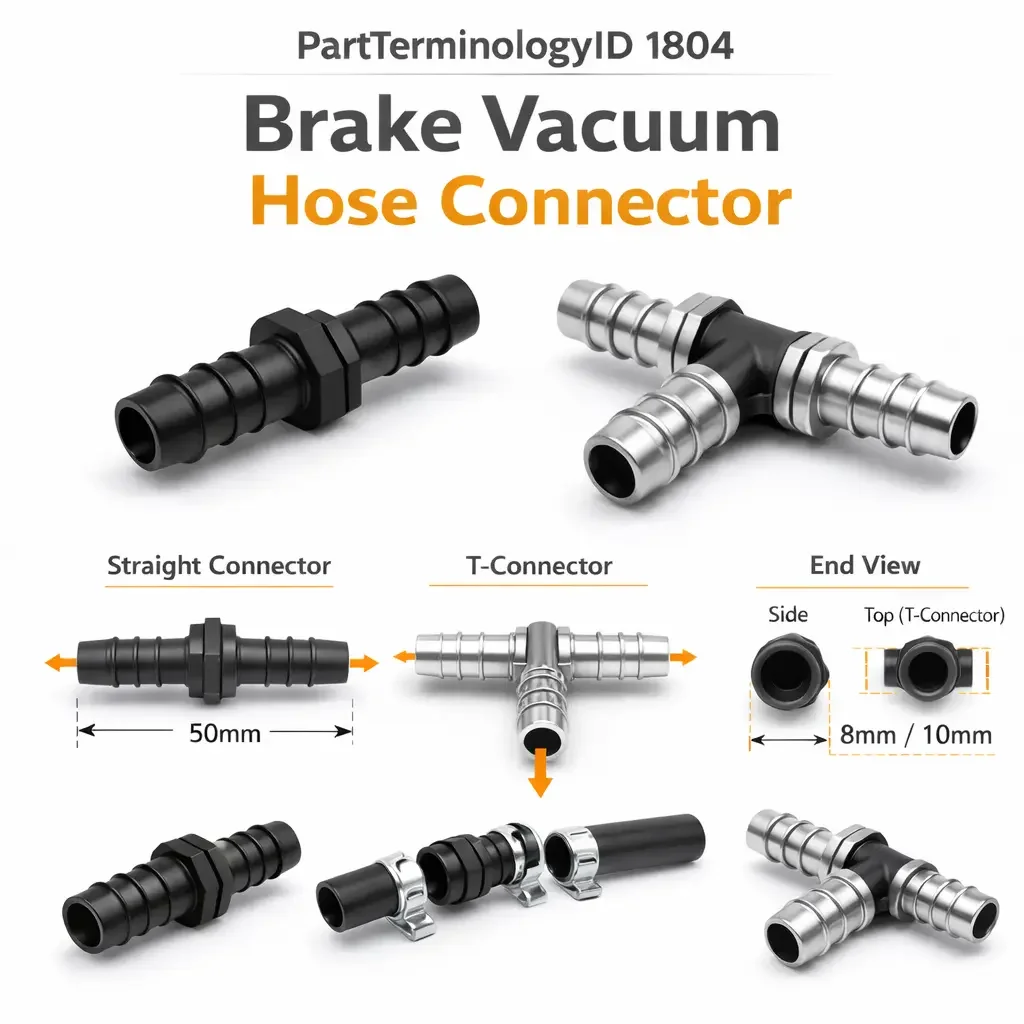
It is a small part. A plastic or metal connector, often with a barbed end on one side and a push-in, threaded, or quick-connect interface on the other. It may include a grommet seat, an O-ring, or a locking tab depending on the platform.
When it cracks, breaks, or does not seal, the booster loses vacuum. The brake pedal gets hard. The driver loses power assist. And in many cases, a vacuum leak at this connector also causes drivability problems, rough idle, lean fuel trims, and check engine lights, because the leak introduces unmetered air into the intake system.
The part costs between $3 and $25 in most applications. The diagnostic chase it causes when it fails or when the wrong connector ships can cost hours.
Buyers order the wrong connector because:
they confuse the connector with the check valve, the grommet, or the full vacuum hose assembly
they do not verify barb diameter, connection style, or fitting angle (straight vs. 90-degree)
they match by vehicle only and miss booster or manifold variant differences
they do not realize that some connectors are integrated into the vacuum hose and are not sold separately
they order a connector when the real failure is the grommet that seals the connector to the booster
Sellers get caught because listings for this part rarely specify barb size, connection type, fitting angle, or what the connector is designed to mate with on each end. The title says "brake vacuum hose connector" and the buyer is left guessing whether it connects the hose to the booster, the hose to the manifold, or something in between.
Status in New Databases
PIES/PCdb: PartTerminologyID 1804, Brake Vacuum Hose Connector
PIES 8.0 / PCdb 2.0: No change
What This Part Actually Is
The brake vacuum hose connector is the interface fitting in the vacuum supply circuit that delivers engine vacuum (or vacuum pump output on diesel and some turbocharged vehicles) to the brake booster. Depending on the system design, this connector may be located:
at the brake booster, where the vacuum hose inserts into the booster shell through a grommet
at the intake manifold, where the vacuum source port connects to the hose
inline, as a junction between two sections of vacuum hose or between the hose and a check valve
Common designs
Barb fitting: a ridged tube that the vacuum hose pushes onto and is secured with a clamp. Common at the manifold end.
Push-in fitting with grommet: the connector pushes into a rubber grommet seated in the booster shell. Common at the booster end.
Quick-connect fitting: a plastic connector with a release tab that snaps into a mating port. Common on newer vehicles.
Threaded fitting: screws into a port on the manifold or a vacuum distribution block.
90-degree elbow: routes the hose at an angle where straight-line routing is not possible due to engine bay packaging.
Brake Vacuum Hose Connector is NOT:
a brake booster check valve (which is a one-way valve that maintains vacuum in the booster, sometimes integrated into the connector or hose, sometimes a separate part)
a brake booster grommet (the rubber seal that the connector passes through into the booster shell)
a complete brake vacuum hose assembly (some hoses include the connector and check valve as a non-serviceable unit)
a hydraulic brake fitting of any kind
This is the primary source of misorders. The buyer needs one of these four parts, searches "brake vacuum connector," and lands on whatever listing appears first. If the listing does not clearly define what the part is and what it is not, the wrong part ships.
The Connector vs. Check Valve vs. Grommet Problem
The brake booster vacuum interface typically involves three components working together:
The connector (PartTerminologyID 1804) that physically joins the hose to the booster or manifold
The check valve that prevents vacuum from escaping the booster when manifold vacuum drops
The grommet that seals the connector into the booster shell
On some vehicles, all three are separate, individually serviceable parts. On others, the check valve is built into the connector. On still others, the connector, check valve, and a section of hose are sold as a single non-serviceable assembly.
If the listing does not specify which of these configurations the part covers, the buyer cannot determine whether it solves their problem. A buyer whose check valve has failed will order a connector and discover it does not include the valve. A buyer whose grommet is leaking will order a connector and discover the grommet is sold separately.
Top Return Scenarios
Scenario 1: "This doesn't include the check valve"
Buyer expected a connector with integrated check valve and received a plain barb fitting.
Prevention language: "Connector only. Check valve not included. For applications with an integrated check valve connector, verify part number against OE configuration."
Scenario 2: "Barb size doesn't match my hose"
Connector barb diameter does not match the vacuum hose I.D.
Prevention language: "Barb outside diameter: [X inches]. Designed for [X I.D.] vacuum hose. Verify hose inside diameter before ordering."
Scenario 3: "Fitting doesn't seat in my booster grommet"
Connector O.D. at the booster end does not match the grommet bore.
Prevention language: "Booster end outside diameter: [X inches]. Verify grommet bore size. Grommet sold separately if worn or damaged."
Scenario 4: "I need a 90-degree and this is straight"
Fitting angle does not match the routing requirement.
Prevention language: "Straight fitting [or 90-degree elbow]. Verify original connector angle before ordering."
What to Include in the Listing
Core essentials
PartTerminologyID: 1804
component: Brake Vacuum Hose Connector
scope: connector only, or connector with check valve, or connector with grommet (be explicit)
quantity: 1
Fitment essentials
year/make/model/submodel
booster type (vacuum, hydroboost vehicles do not use this part)
engine type (diesel or turbo vehicles may use a vacuum pump circuit with different fittings)
production split notes if the booster or manifold changed mid-year
Dimensional and interface essentials
barb O.D. (hose end)
booster end O.D. or connection type (push-in, threaded, quick-connect)
fitting angle (straight, 90-degree, 45-degree)
material (plastic, metal, brass)
check valve included: yes/no
grommet included: yes/no
hose clamp included: yes/no
Image essentials
connector shown from both ends
barb end clearly visible with diameter reference
booster/manifold end clearly visible showing connection method
side profile showing fitting angle
Catalog Checklist for ACES/PIES Teams
PartTerminologyID = 1804
require connection type at both ends
require barb diameter and fitting angle
require check valve inclusion attribute (yes/no)
require grommet inclusion attribute (yes/no)
enforce booster type qualifier (vacuum-assisted only)
enforce engine type splits (gas vs. diesel, naturally aspirated vs. turbo)
clearly differentiate from check valve, grommet, and complete hose assembly categories
FAQ (Buyer Language)
Is the check valve included with this connector?
It depends on the listing. Some connectors include an integrated check valve. Others are plain fittings with no valve function. Always verify whether the listing specifies check valve inclusion.
Do I need to replace the grommet too?
If the grommet is cracked, hardened, or no longer seals around the connector, yes. A new connector in a worn grommet will still leak vacuum. Inspect the grommet during connector replacement.
My brake pedal is hard. Is this the part I need?
A hard brake pedal usually indicates loss of vacuum assist. The cause could be a failed check valve, a cracked connector, a torn grommet, a split vacuum hose, or a failed booster diaphragm. Diagnose the specific failure point before ordering.
Can a vacuum leak at this connector cause engine problems?
Yes. A vacuum leak at the brake booster circuit introduces unmetered air into the intake system, which can cause rough idle, lean fuel trims, and check engine lights.
Cross-Sell Logic
Brake Booster Check Valve
Brake Booster Grommet
Brake Vacuum Hose
Hose Clamp Kit
Brake Booster Assembly (if diaphragm has failed)
Frame as "commonly inspected together during brake vacuum system diagnosis."
Final Take for PartTerminologyID 1804
Brake Vacuum Hose Connector (PartTerminologyID 1804) is a sub-$25 part that lives in a three-part ecosystem with the check valve and the grommet. Most returns in this category happen because the listing does not make clear which of those three components the buyer is getting.
State the connection type, the barb size, the fitting angle, and whether the check valve and grommet are included or sold separately. That is enough to keep a $5 connector from generating a $50 return and a one-star review.