
Written by Arthur Simitian | PartsAdvisory
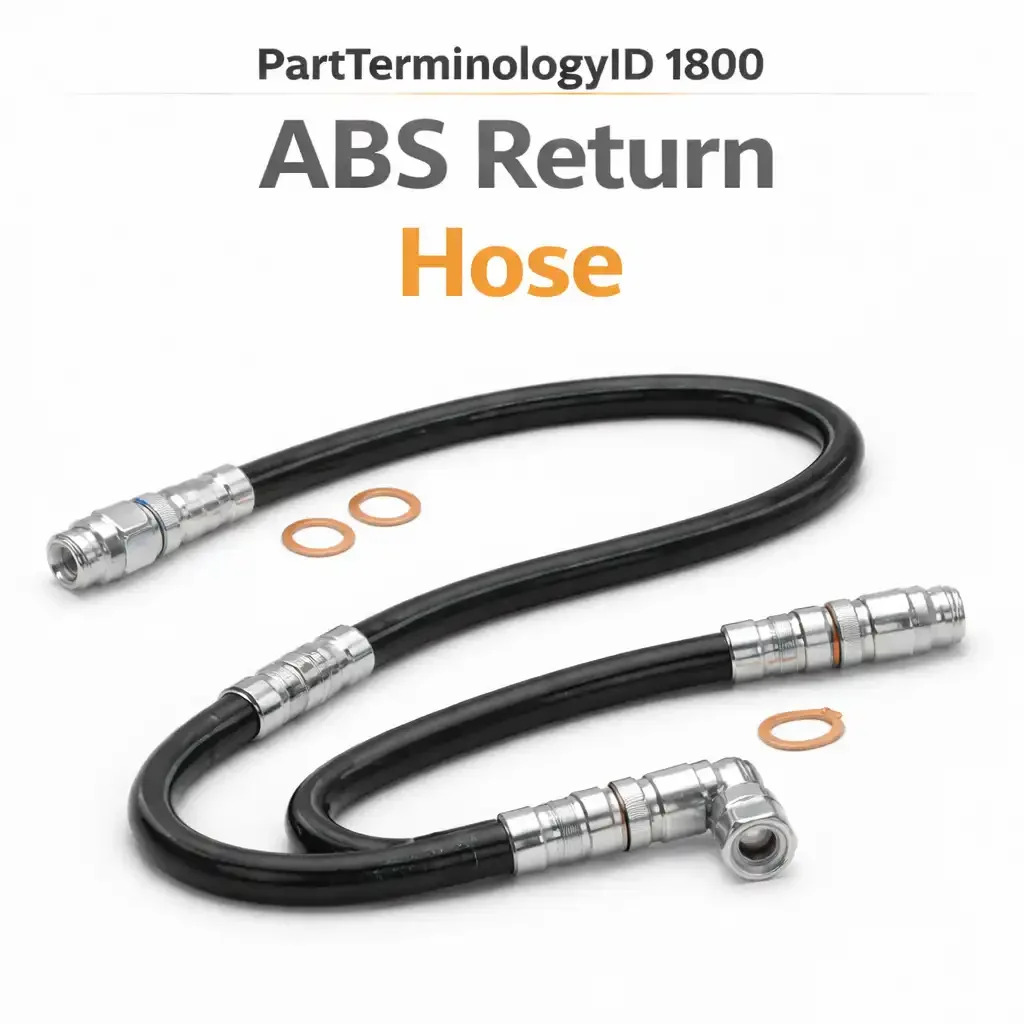
PartTerminologyID 1800, ABS Return Hose, is the low-pressure hydraulic hose that carries brake fluid back from the ABS modulator or hydraulic control unit to the master cylinder reservoir. It is the return path in the ABS hydraulic circuit, completing the loop that the ABS pressure hose (PartTerminologyID 1796) starts.
Where the pressure hose delivers fluid under high force from the pump to the modulator, the return hose brings depressurized fluid back to the reservoir at low pressure. It is a simpler hose in terms of pressure rating. It is not a simpler hose in terms of getting the listing right.
Buyers order the wrong hose because:
they confuse the return hose with the ABS pressure hose (PartTerminologyID 1796), which operates on the high-pressure side of the same circuit
they confuse it with a standard brake hydraulic hose (PartTerminologyID 1792) that runs to a wheel
they do not verify fitting type, hose diameter, or connection style at each end
they do not account for ABS system manufacturer differences within the same vehicle platform
they order based on vehicle year/make/model without confirming which ABS module revision is installed
Sellers get caught because listings for ABS Return Hose rarely distinguish it from the pressure hose, rarely specify the fitting configuration, and almost never identify the ABS system manufacturer or module type. The buyer sees "ABS hose," assumes it is the one they need, and discovers on arrival that it connects to the wrong port.
Status in New Databases
PIES/PCdb: PartTerminologyID 1800, ABS Return Hose
PIES 8.0 / PCdb 2.0: No change
What This Part Actually Is
The ABS return hose is a flexible rubber or reinforced hose that connects the return port on the ABS hydraulic modulator to the brake fluid reservoir or to a return line leading back to the reservoir. In systems with a remote ABS pump and accumulator, the return hose may also route depressurized fluid from a pressure relief circuit back to the reservoir.
Because it operates on the low-pressure side of the ABS circuit, the return hose is typically lighter in construction than the pressure hose. It may use push-on barb fittings, hose clamps, or low-pressure threaded connections rather than the high-strength crimped or banjo fittings found on the pressure side.
ABS Return Hose is NOT:
an ABS pressure hose (PartTerminologyID 1796), which delivers high-pressure fluid from the pump to the modulator
a standard brake hydraulic hose (PartTerminologyID 1792), which connects the hard line to the caliper or wheel cylinder
a reservoir supply hose feeding the master cylinder
a vacuum hose for the brake booster
The most common misorder in this category is the buyer receiving the pressure hose when they needed the return hose, or vice versa. Both are "ABS hoses." Both connect to the ABS module. But they serve opposite functions, operate at different pressures, and use different fittings.
Why the Pressure Hose vs. Return Hose Confusion Persists
Most ABS hydraulic units have at least two external hose connections: one for pressurized fluid delivery and one for fluid return. On many platforms, these two hoses look similar in photographs, are similar in length, and are located inches apart on the same module.
The only reliable way to tell them apart is by fitting type, hose diameter, and port location on the ABS unit. If the listing does not specify which port the hose connects to, the buyer has a 50/50 chance of ordering the wrong one.
This is compounded by the fact that many parts catalogs list both hoses under generic "ABS hose" descriptions with no circuit position qualifier. The buyer searches, finds a result, checks the vehicle fitment, and orders. The fitment is correct. The hose is wrong. It connects to the other port.
ABS system manufacturer matters
Just as with the pressure hose, the return hose configuration depends on the ABS system manufacturer. Bosch, Teves, Kelsey-Hayes, Nippon, and Sumitomo systems all use different modulator layouts, port positions, and fitting styles. The same vehicle may have been equipped with different ABS suppliers across production years or across trim levels.
If the listing does not identify the ABS system manufacturer or module type, the buyer cannot validate the hose against their vehicle.
Top Return Scenarios
Scenario 1: "This is the pressure hose, not the return hose"
Buyer needed the low-pressure return line and received the high-pressure delivery hose.
Prevention language: "Low-pressure ABS return hose. Connects modulator return port to reservoir. This is not the high-pressure delivery hose (PartTerminologyID 1796)."
Scenario 2: "Fittings don't match my ABS module"
Connection style or diameter does not match the return port on the buyer's ABS unit.
Prevention language: "Verify ABS module manufacturer and return port configuration before ordering. Connection type: [push-on barb / threaded / quick-connect]. Hose I.D.: [X inches]."
Scenario 3: "Hose diameter is wrong"
Return hose I.D. does not match the port barb or the reservoir inlet, causing a loose fit or inability to connect.
Prevention language: "Hose inner diameter: [X inches]. Designed for [specific ABS system type]. Verify port diameter on your ABS modulator before ordering."
Scenario 4: "I thought this was a regular brake hose"
Buyer searched "brake hose" and received an ABS return line instead of a wheel-position hose.
Prevention language: "This is an ABS system return hose, not a wheel-position brake hose. For standard brake hydraulic hoses, see PartTerminologyID 1792."
What to Include in the Listing
Core essentials
PartTerminologyID: 1800
component: ABS Return Hose
circuit position: low-pressure return (be explicit)
quantity: 1
Fitment essentials
year/make/model/submodel
ABS system manufacturer and type
ABS module part number cross-reference (where available)
production date range if the ABS module changed mid-year
Dimensional and interface essentials
hose length
hose inner diameter
fitting type at each end (push-on barb, threaded, quick-connect, clamp)
fitting size at each end
included hardware (clamps, fittings, adapters)
Image essentials
full hose with both ends visible
close-up of each connection point
hose shown in relation to the ABS module, identifying which port it connects to
Catalog Checklist for ACES/PIES Teams
PartTerminologyID = 1800
require circuit position attribute (low-pressure return)
require ABS system type/manufacturer attribute
require hose I.D. and length
require fitting type at both ends
enforce ABS module revision splits within YMM
clearly differentiate from PartTerminologyID 1796 (ABS Pressure Hose) and PartTerminologyID 1792 (Brake Hydraulic Hose)
flag applications where pressure and return hoses are frequently confused
FAQ (Buyer Language)
What is the difference between the ABS return hose and the ABS pressure hose?
The pressure hose (PartTerminologyID 1796) carries high-pressure fluid from the ABS pump to the modulator. The return hose (PartTerminologyID 1800) carries low-pressure fluid back from the modulator to the reservoir. They connect to different ports on the ABS module and use different fittings.
How do I know which hose I need?
Identify the port on your ABS module where the leak or damage is located. The return port is typically the low-pressure connection leading back toward the reservoir. Check the fitting type and hose diameter at that port and match to the listing specs.
Do I need to bleed the brakes after replacing this hose?
Yes. Any time the ABS hydraulic circuit is opened, the system must be bled. Some ABS systems require a scan tool to cycle the modulator valves during the bleed procedure.
Can I use generic rubber hose as a replacement?
For low-pressure return lines with push-on barb fittings, some technicians use generic brake-rated rubber hose cut to length. However, the hose must be rated for brake fluid compatibility and the I.D. must match the port exactly. Using the application-specific replacement hose is always the safer choice.
Cross-Sell Logic
ABS Pressure Hose (PartTerminologyID 1796)
ABS Pump and Motor Assembly
Brake Fluid (correct DOT specification)
Hose Clamp Kit
ABS Module Seal Kit (where available)
Frame as "commonly inspected or replaced during ABS hydraulic service."
Final Take for PartTerminologyID 1800
ABS Return Hose (PartTerminologyID 1800) is the low-pressure counterpart to the ABS pressure hose, and it suffers from the same catalog problem: listings that say "ABS hose" without specifying which side of the circuit the hose serves.
The fix is simple. State the circuit position (return, not pressure). State the fitting type and hose diameter. Identify the ABS system manufacturer. That is enough to eliminate the 50/50 guessing game that drives most returns in this category.