
Written by Arthur Simitian | PartsAdvisory
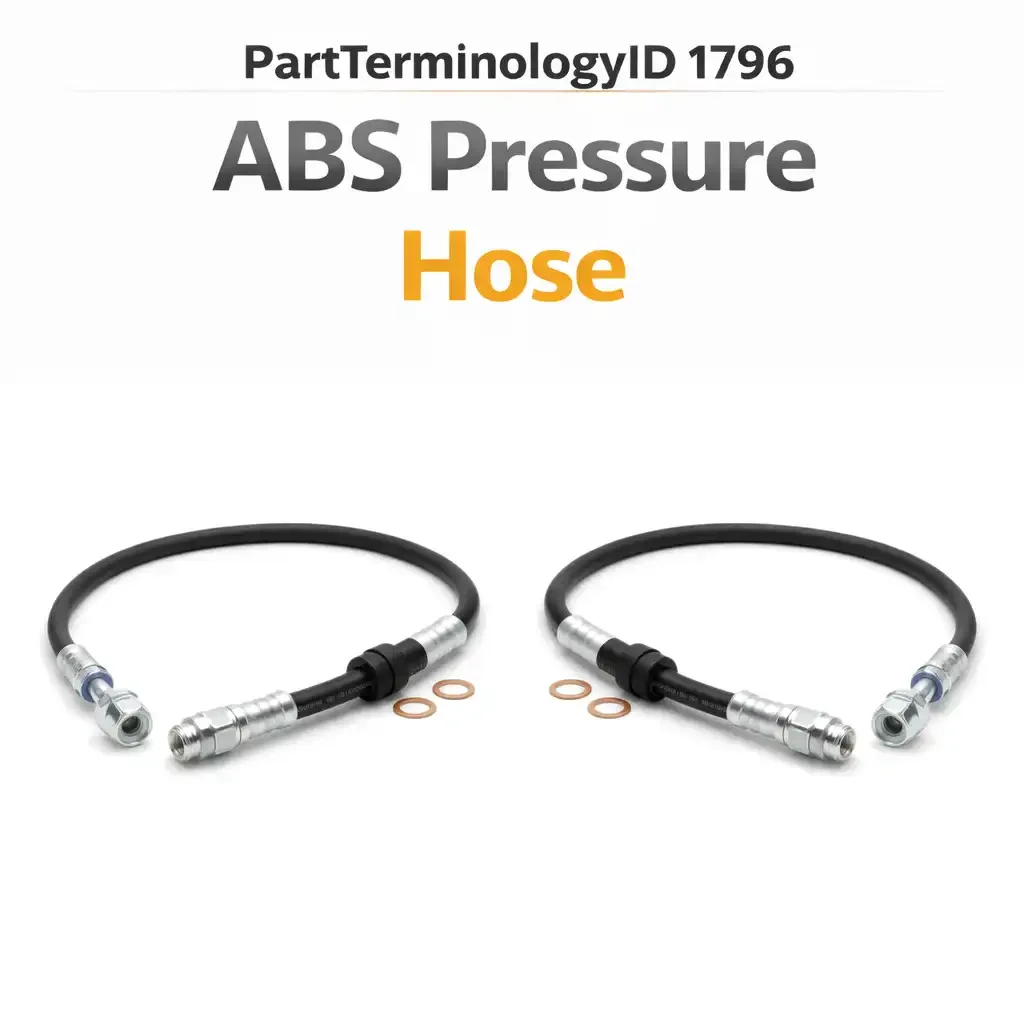
PartTerminologyID 1796, ABS Pressure Hose, is the hydraulic hose that carries high-pressure brake fluid between ABS system components, typically from the ABS pump or motor assembly to the hydraulic modulator, accumulator, or master cylinder assembly, depending on system architecture.
This is not a standard brake hose running to a wheel. This is a pressure hose operating inside the ABS hydraulic unit's high-pressure circuit, often at pressures far exceeding those in the normal pedal-to-caliper path. When it leaks, cracks, or fails, the ABS system loses pressure, brake assist may be compromised, and the vehicle may display ABS and brake warning lights simultaneously, a combination that sends most drivers straight to the dealer.
The part is rare in general consumer searches. It shows up when an ABS pump replacement exposes a cracked or weeping hose that was hidden behind the unit, or when a technician diagnosing a persistent ABS warning light finds fluid loss at the pressure hose connection.
Buyers order the wrong hose because:
they confuse this with a standard brake hydraulic hose (PartTerminologyID 1792)
they do not verify ABS system type (integral vs. non-integral, add-on vs. OE)
they miss fitting type, thread size, or banjo configuration at each end
they do not account for hose length or routing differences across ABS module revisions within the same platform
they order a low-pressure supply hose when they need the high-pressure delivery hose, or vice versa
Sellers get caught because this is a niche category with thin coverage. Listings that exist tend to be sparse: a part number, a vehicle fitment, and nothing else. No pressure rating, no fitting spec, no distinction between the supply side and the pressure side of the ABS circuit.
Status in New Databases
PIES/PCdb: PartTerminologyID 1796, ABS Pressure Hose
PIES 8.0 / PCdb 2.0: No change
What This Part Actually Is
In ABS systems that use a remote or semi-integral hydraulic pump and accumulator, the ABS pressure hose is the flexible or semi-rigid line that delivers pressurized brake fluid from the pump to the modulator valve body or accumulator. Some systems use a single high-pressure hose; others use a supply hose (low pressure, from the reservoir to the pump inlet) and a delivery hose (high pressure, from the pump outlet to the modulator or accumulator).
PartTerminologyID 1796 typically refers to the high-pressure side, the hose that carries pressurized fluid after the pump has built system pressure.
Construction
ABS pressure hoses are built to a higher specification than standard brake hoses:
reinforced inner tube rated for high-pressure brake fluid
braided or multi-layer reinforcement for burst resistance
steel or high-strength crimped fittings (banjo, threaded, or specialty connections)
shorter lengths with tight routing in confined engine bay spaces
ABS Pressure Hose is NOT:
a standard brake hydraulic hose (PartTerminologyID 1792), which runs from hard line to caliper or wheel cylinder
an ABS sensor wire or harness
an ABS modulator or pump assembly
a low-pressure reservoir supply hose (though some listings conflate the two)
This last distinction, high-pressure delivery hose vs. low-pressure supply hose, is where most catalog-level mismatches originate.
Why This Category Is Difficult to List Well
Limited aftermarket coverage
Many ABS pressure hoses are only available from the OE manufacturer or from specialty remanufacturers. Aftermarket coverage is thin because the volume is low and the application specificity is high. That means the listings that do exist carry outsized weight, and outsized return risk when they are wrong.
ABS system architecture varies dramatically
There is no universal ABS layout. Systems range from simple add-on modulators (which may not use a separate pressure hose at all) to fully integral units where the pump, accumulator, master cylinder, and modulator are a single assembly connected by internal passages and one or two external hoses.
The same vehicle platform may have used different ABS suppliers (Bosch, Teves, Kelsey-Hayes, Nippon, Sumitomo) across production years, and each supplier's system uses different hose configurations, fittings, and pressure ratings.
High-pressure safety context
A leaking ABS pressure hose is not a nuisance leak. It is a safety failure. The system operates at pressures that can exceed 2,000 PSI in some accumulator-based designs. A blown hose sprays brake fluid at dangerous pressure, disables ABS function, and may reduce or eliminate power brake assist on systems where the accumulator provides boost pressure.
This makes listing accuracy a safety issue, not just a return-rate issue.
Top Return Scenarios
Scenario 1: "This is a supply hose, not a pressure hose"
Buyer receives the low-pressure inlet hose instead of the high-pressure outlet hose.
Prevention language: "High-pressure ABS delivery hose, pump outlet to modulator/accumulator. Not the low-pressure reservoir supply line."
Scenario 2: "Fittings don't match my ABS unit"
Banjo bolt size, thread pitch, or fitting angle differs from the buyer's ABS module.
Prevention language: "Verify ABS module manufacturer (Bosch / Teves / Kelsey-Hayes / etc.) and fitting configuration before ordering. Fitting type: [banjo / threaded / specialty]. Thread: [size x pitch]."
Scenario 3: "Hose is the wrong length"
ABS module revision within the same platform changed the pump or accumulator location by an inch, changing required hose length.
Prevention language: "Hose length: [X inches]. Designed for [specific ABS module or production date range]. Verify pump/modulator mounting position."
Scenario 4: "I thought this was a regular brake hose"
Buyer searched "brake hose" and landed on the ABS pressure hose listing.
Prevention language: "This is an ABS system high-pressure hose, not a wheel-position brake hose. For standard brake hydraulic hoses, see PartTerminologyID 1792."
What to Include in the Listing
Core essentials
PartTerminologyID: 1796
component: ABS Pressure Hose
circuit position: high-pressure delivery / low-pressure supply (be explicit)
quantity: 1
Fitment essentials
year/make/model/submodel
ABS system manufacturer and type (Bosch ABS 5.3, Teves Mark IV, Kelsey-Hayes RWAL, etc.)
ABS module part number cross-reference (where available)
production date range (if ABS module changed mid-year)
Dimensional and interface essentials
hose length
fitting type at each end (banjo, threaded, quick-connect)
fitting thread size and pitch at each end
pressure rating (if available)
included hardware (banjo bolt, O-rings, crush washers)
Image essentials
full hose with both fittings visible
close-up of each end fitting
routing context showing where the hose connects on the ABS assembly
Catalog Checklist for ACES/PIES Teams
PartTerminologyID = 1796
require ABS system type/manufacturer attribute
require circuit position attribute (high-pressure / low-pressure)
require fitting type and thread spec for both ends
require hose length
enforce ABS module revision splits within YMM
clearly differentiate from PartTerminologyID 1792 (Brake Hydraulic Hose)
flag applications where supply and pressure hoses are frequently confused
FAQ (Buyer Language)
Is this the same as a regular brake hose?
No. This hose operates within the ABS hydraulic unit's high-pressure circuit, not between the hard line and the wheel brake. Standard brake hoses are PartTerminologyID 1792.
How do I know which ABS system my vehicle has?
Check the ABS module for a manufacturer label (Bosch, Teves, Kelsey-Hayes, etc.) and a part number. This information is typically stamped or printed on the modulator housing.
Do I need to bleed the ABS system after replacing this hose?
Yes. The high-pressure circuit must be depressurized before removal and the system must be bled after installation. Some ABS systems require a scan tool to cycle the ABS valves during bleeding.
Can I use a standard brake hose as a substitute?
No. Standard brake hoses are not rated for ABS pump output pressures and may use different fittings. Always use a hose rated for the ABS system's operating pressure.
Cross-Sell Logic
ABS Pump and Motor Assembly
ABS Accumulator
Brake Fluid (correct DOT specification)
Banjo Bolt and O-Ring Kit
ABS Module Seal Kit (where available)
Frame as "commonly inspected or replaced during ABS pump service."
Final Take for PartTerminologyID 1796
ABS Pressure Hose (PartTerminologyID 1796) is a low-volume, high-stakes category where listing gaps create safety-adjacent returns. The part is niche, the fitment is specific to the ABS system manufacturer and module revision, and the consequences of shipping the wrong hose go beyond inconvenience.
Publish the ABS system type, the circuit position (high-pressure vs. supply), the fitting specs, and the hose length. That is the minimum that keeps a $30 hose from turning into a $300 diagnostic nightmare for the buyer, and a warranty claim for the seller.