
Written by Arthur Simitian | PartsAdvisory
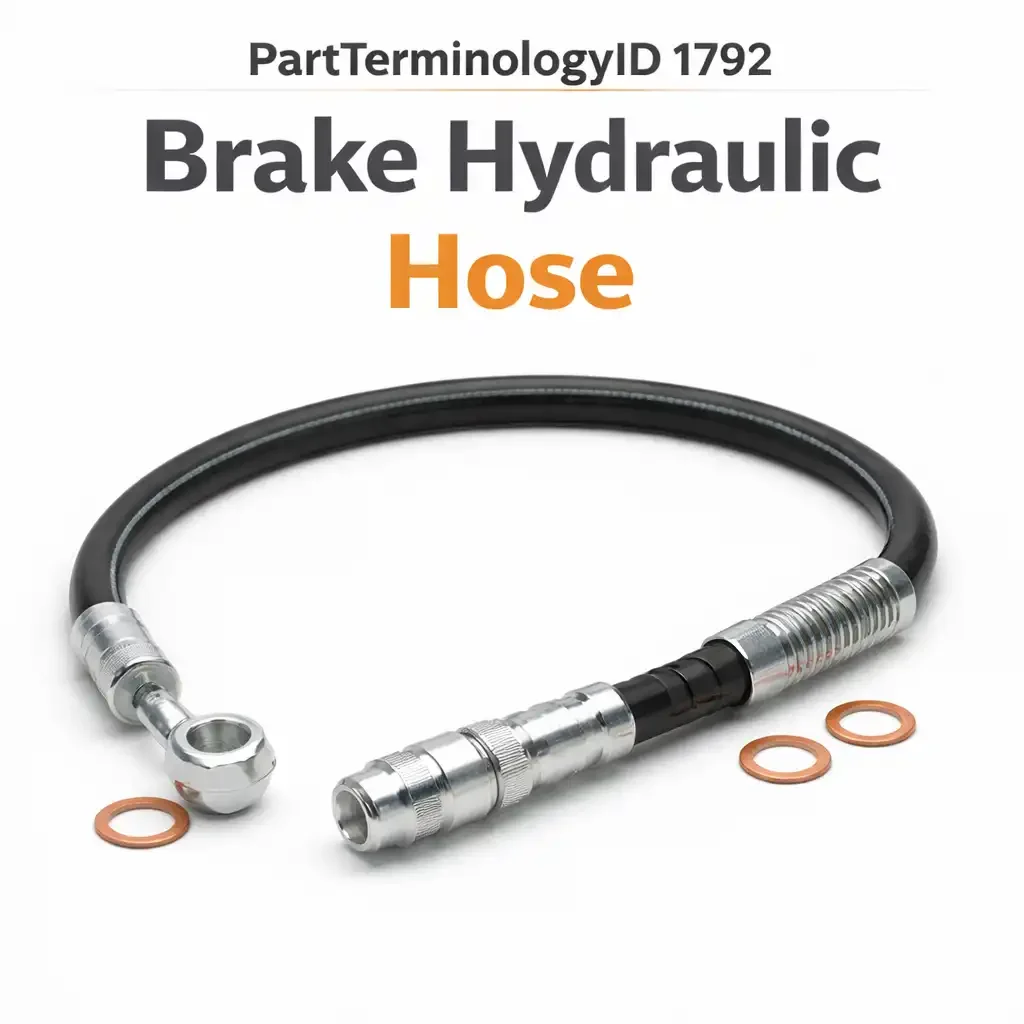
PartTerminologyID 1792, Brake Hydraulic Hose, is the flexible rubber hose that bridges the gap between the vehicle's rigid steel brake lines and the moving brake components at each wheel. It exists because the wheels move, they steer, they travel with the suspension, and a rigid line cannot flex with them. The hose absorbs that movement while maintaining sealed, pressurized brake fluid delivery to the caliper or wheel cylinder.
It is a safety-critical part. When the listing gets the fittings, length, or position wrong, the consequences are not a noise complaint or a return. They are a brake system that cannot be connected, a vehicle that cannot stop, or a hose that contacts the tire under full suspension travel and fails catastrophically.
Buyers order the wrong hose because:
they match by year/make/model only and miss fitting type, thread size, or hose length differences
they do not verify banjo vs. threaded fitting at each end
they confuse front and rear hoses, which often have different lengths and fitting configurations
they do not account for ABS vs. non-ABS routing differences
they order a hose for a disc brake caliper when their vehicle has rear drums and a wheel cylinder connection
they ignore mounting bracket and clip differences that affect hose routing
Sellers get caught because many listings for Brake Hydraulic Hose still describe the part with nothing more than a vehicle fitment, a vague position callout, and no fitting detail at all.
Status in New Databases
PIES/PCdb: PartTerminologyID 1792, Brake Hydraulic Hose
PIES 8.0 / PCdb 2.0: No change
Why This Category Is Higher Risk Than Its Price Suggests
A brake hydraulic hose costs between $8 and $40 in most applications. But every hose replacement requires disconnecting the brake hydraulic system, which means brake bleeding after installation. If the wrong hose arrives, the buyer loses the part cost, the brake fluid, and the time spent partially disassembling the brake system, then has to reassemble, order again, and bleed again.
That is why wrong-hose returns generate disproportionate negative reviews and warranty claims. The buyer is not just inconvenienced. They are stuck with a vehicle that cannot be driven until the correct part arrives.
The hidden challenge
Brake Hydraulic Hose sits at the intersection of:
Fitting precision (thread size, thread type, banjo vs. male/female, fitting angle)
Length sensitivity (too short causes stress under suspension travel; too long allows contact with tires, suspension, or exhaust)
Position and routing complexity (front left vs. front right vs. rear center vs. rear individual, each may differ)
System variant splits (ABS vs. non-ABS, disc vs. drum, single-piston vs. multi-piston caliper)
This is a category where a 2mm thread pitch difference makes the hose completely unusable.
What Brake Hydraulic Hose Actually Is (and Isn't)
A Brake Hydraulic Hose is a flexible, reinforced rubber hose with metal fittings crimped or swaged onto each end. One end connects to the rigid steel brake line mounted to the vehicle body or frame. The other end connects to the brake caliper, wheel cylinder, or an intermediate junction.
Construction
inner tube: synthetic rubber rated for brake fluid compatibility (DOT 3/4/5.1)
reinforcement: braided textile or wire layers for pressure resistance and expansion control
outer cover: rubber or EPDM for abrasion and weather protection
end fittings: crimped steel (banjo, male threaded, female threaded, or flare depending on application)
Brake Hydraulic Hose is NOT:
a rigid steel brake line (hard line)
a clutch hydraulic hose (different system, sometimes different fluid, though some vehicles share a reservoir)
a braided stainless steel performance hose (different PartTerminologyID or product category)
a universal hose that can be cut to length (end fittings are factory-crimped)
The Fitting Problem That Drives Most Returns
The single highest return driver in PartTerminologyID 1792 is end fitting mismatch.
Banjo vs. threaded
Some calipers use a banjo bolt connection. Others use a direct-thread female fitting. The hose end must match. A banjo-end hose cannot thread into a caliper with a female port, and vice versa.
Thread size and pitch
Common fitting threads include 10mm x 1.0, 3/8"-24, 7/16"-24, and M10 x 1.25, among others. A hose with 10mm x 1.0 fittings will not seal on a 3/8"-24 port. The threads may start but will cross-thread or leak.
Left vs. right
On many vehicles, the front left and front right hoses are mirror images, same length, but the fitting angles or bracket orientation differ. If the listing does not specify left/right and the buyer installs a right-side hose on the left, routing may force the hose into contact with the tire or suspension.
Top Return Scenarios
Scenario 1: "Fitting doesn't match my caliper"
Root cause: Listing lacks fitting type and thread specification.
Prevention language: "Caliper end: banjo fitting [or M10 x 1.0 female threaded]. Line end: 3/8"-24 inverted flare female. Verify both connection types before ordering."
Scenario 2: "Hose is too short / too long"
Root cause: Listing does not specify hose length, or vehicle has a suspension lift or lowering modification.
Prevention language: "Hose length: [X inches]. Designed for stock suspension geometry. Modified suspension may require a different length hose."
Scenario 3: "Hose rubs on the tire at full lock or full droop"
Root cause: Wrong hose for the position, or routing bracket/clip missing or incorrectly installed.
Prevention language: "Verify correct left/right position. Route hose through OE mounting bracket. Check for tire clearance at full steering lock and full suspension travel before driving."
Scenario 4: "ABS connector doesn't line up"
Root cause: Vehicle has ABS and the hose routes to an ABS junction block, not directly to the caliper. Non-ABS hose shipped.
Prevention language: "This hose is designed for [ABS / non-ABS] equipped vehicles. Verify brake system configuration before ordering."
What to Include in the Listing
Core essentials
PartTerminologyID: 1792
component: Brake Hydraulic Hose
position: front left / front right / rear left / rear right / rear center
quantity: 1 hose per listing (state explicitly)
Fitment essentials
year/make/model/submodel
brake system type: ABS / non-ABS
brake type at wheel: disc / drum
suspension notes (stock height only, or compatible with specific lift kits)
Dimensional and interface essentials
hose length (end to end, including fittings)
fitting type, each end separately (banjo, male thread, female thread, inverted flare)
fitting thread size and pitch, each end
mounting bracket included: yes/no
banjo bolt and washers included: yes/no
Image essentials
full hose with both fittings visible
close-up of each end fitting with thread visible
bracket/clip detail
installed routing photo or diagram (if available)
Catalog Checklist for ACES/PIES Teams
PartTerminologyID = 1792
require fitting type and thread spec for both ends
require hose length attribute
require position (specific wheel, not just "front" or "rear")
enforce ABS / non-ABS split
enforce disc / drum split at wheel position
flag left/right mirror-image hoses as separate applications
validate bracket and banjo bolt inclusion metadata
FAQ (Buyer Language)
Do I need to bleed the brakes after replacing a hose?
Yes. Any time the hydraulic system is opened, air enters and must be bled out for proper brake function.
Can I use this hose if I have a suspension lift?
Stock-length hoses are designed for stock suspension travel. A lifted vehicle may need a longer hose to avoid stress at full droop. Verify length against your suspension geometry.
Does the hose come with the banjo bolt and washers?
It depends on the listing. Many hoses ship without banjo hardware. Always check the listing scope and order banjo bolts and crush washers separately if not included.
How do I know if I need the ABS or non-ABS version?
Check where the hose connects. If it routes to a junction block mounted on the frame or strut tower (ABS modulator), you need the ABS version. If it routes directly from the hard line to the caliper, you likely need the non-ABS version.
Cross-Sell Logic
Banjo Bolt and Crush Washer Kit
Brake Fluid (DOT 3 / DOT 4 / DOT 5.1)
Brake Bleeder Kit
Brake Caliper or Wheel Cylinder
Brake Hard Line (if corrosion is present)
Frame as "commonly needed during brake hose replacement."
Final Take for PartTerminologyID 1792
Brake Hydraulic Hose (PartTerminologyID 1792) is a safety-critical part where listing precision is not optional. A wrong fitting, a missing thread spec, or an ambiguous position callout does not just create a return, it creates a vehicle that cannot be driven until the correct part arrives.
Publish both fitting types, both thread specs, the exact length, the exact position, and the ABS/non-ABS qualifier. That is the minimum for this category. Anything less is inviting safety-adjacent returns that damage buyer trust far beyond the cost of the hose.