
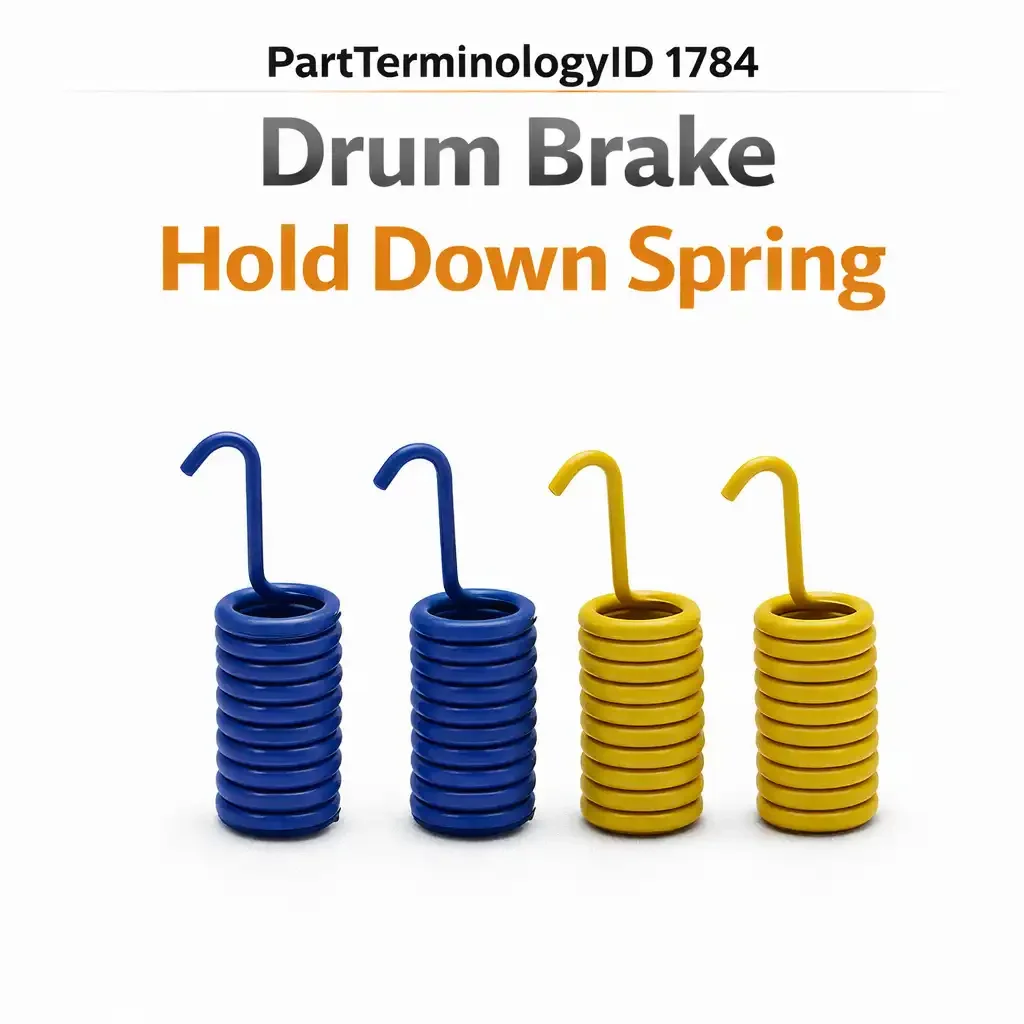
Drum Brake Hold Down Spring (PartTerminologyID 1784): The Other Hold Down Spring - and Why Catalog Teams Keep Confusing It with PartTerminologyID 1780
Written by Arthur Simitian | PartsAdvisory
PartTerminologyID 1784, Drum Brake Hold Down Spring,
Exists in the PCdb right next to PARTTERMINOLOGYID 1780 (Drum Brake Shoe Spring Hold Down Spring), and that proximity is exactly where the problems begin.
Both categories describe springs that hold brake shoes against the backing plate inside a drum brake assembly. Both are small. Both are cheap. Both fail silently from heat cycling. And both get confused with each other constantly - by buyers, by sellers, and by catalog teams who are not sure why two separate PARTTERMINOLOGYIDs exist for what appears to be the same function.
Here is the difference that matters:
PARTTERMINOLOGYID 1780 specifically refers to the coil spring that compresses over the hold down pin as part of the pin-spring-retainer assembly. It is defined in context with the pin and the retainer cup.
PARTTERMINOLOGYID 1784 covers hold down springs that may use a different retention design - hook-and-eyelet springs, flat clip springs, or other non-pin-based configurations that secure the shoe to the backing plate. These designs are common on older vehicles, certain import platforms, and specific backing plate configurations where the pin-and-cup system is not used.
In some catalog implementations, PARTTERMINOLOGYID 1784 is also used as the broader, design-neutral category for any hold down spring regardless of retention method, while PARTTERMINOLOGYID 1780 is reserved for the specific pin-style coil spring.
The practical impact for aftermarket teams: if your catalog maps these two PARTTERMINOLOGYIDs interchangeably, buyers will receive the wrong spring design. A hook-style spring will not work in a pin-and-cup system. A pin-style coil spring will not attach to an eyelet backing plate. And both will come back as "doesn't fit."
Status in New Databases
PIES/PCdb: PartTerminologyID 1784 - Drum Brake Hold Down Spring
PIES 8.0 / PCdb 2.0: No change
Why Two PARTTERMINOLOGYIDs Exist for Hold Down Springs
The PCdb maintains separate PartTerminologyIDs because the aftermarket has multiple hold down spring designs that are not interchangeable.
Pin-and-cup coil spring (typically PARTTERMINOLOGYID 1780)
The most common modern design. A small coil spring compresses over a pin that passes through the backing plate. A retainer cup locks onto the pin head. This is the system found on most domestic and import drum brakes from the 1970s onward.
Hook-and-eyelet spring (often mapped to PARTTERMINOLOGYID 1784)
An older design where a spring with a hook end attaches to an eyelet or anchor point on the backing plate. No pin, no retainer cup. The spring pulls the shoe toward the plate rather than compressing over a post. Common on pre-1970s domestic vehicles, some European platforms, and certain specialty applications.
Flat clip or wire-form spring (also mapped to PARTTERMINOLOGYID 1784)
Some platforms use a flat stamped spring or wire-form clip that snaps over the shoe web and engages the backing plate directly. No pin, no coil, no hook. The spring tension comes from the clip's formed shape.
Why this matters for catalog teams
If your ACES data maps a hook-style spring under PARTTERMINOLOGYID 1780, or a pin-style coil spring under PARTTERMINOLOGYID 1784, the buyer gets a part that physically cannot attach to their backing plate. The return is guaranteed, the buyer is frustrated, and the root cause is a category mapping decision made months earlier by someone who did not know the difference.
The Returns This Creates
Scenario 1: "This spring doesn't match what I took off"
Buyer's vehicle uses a hook-and-eyelet hold down system. Listing under PARTTERMINOLOGYID 1784 shipped a pin-style coil spring, or vice versa.
Root cause: PARTTERMINOLOGYID mapping error or listing that does not specify spring design type.
Prevention language: "Hook-and-eyelet style hold down spring [or coil-over-pin style]. Verify original spring design before ordering."
Scenario 2: "Thought this was a hold down kit"
Buyer expected the full assembly - springs plus pins plus retainers.
Root cause: Same scope confusion that plagues PARTTERMINOLOGYID 1780 and PARTTERMINOLOGYID 1772.
Prevention language: "Spring only. Pins, retainers, and cups sold separately. For the complete hold down kit, see PARTTERMINOLOGYID 1772."
Scenario 3: "Spring tension feels wrong"
Buyer installs the spring but the shoe still moves or rattles.
Possible causes: wrong spring rate for the application, spring designed for a different drum size, or buyer reused worn anchor hardware.
Prevention language: "Designed for [X-inch] drum brake applications. Verify drum diameter and backing plate configuration. Replace all hold down hardware as a set."
What to Include in the Listing
Core essentials
PARTTERMINOLOGYID: 1784
component: Drum Brake Hold Down Spring
design type: coil / hook-and-eyelet / flat clip / wire-form - this is the critical field
scope: spring only
quantity: sold individually, per pair, or per axle set - state clearly
Fitment essentials
year/make/model/submodel
drum diameter qualifier
position: front / rear
brake package or backing plate design notes
Dimensional essentials
spring type and design (coil, hook, clip)
free height or free length
wire gauge or wire diameter
coil O.D. (if coil type)
hook span or attachment geometry (if hook type)
material and finish
Image essentials
spring photographed clearly showing attachment method (hook ends, coil shape, clip form)
scale reference
installed context photo showing how it attaches to the backing plate
comparison image if the vehicle has a known PARTTERMINOLOGYID 1780 vs. 1784 confusion risk
Catalog Checklist for ACES/PIES Teams
PartTerminologyID = 1784
critically: do not merge PARTTERMINOLOGYID 1784 and PARTTERMINOLOGYID 1780 applications- validate that each application is mapped to the correct spring design
require spring design type attribute (coil / hook / clip)
require position (front / rear)
enforce drum size splits
require dimensional attributes (height/length, wire gauge, O.D. or span)
validate against backing plate design to confirm retention method
flag any application that appears under both PARTTERMINOLOGYID 1780 and PARTTERMINOLOGYID 1784 for manual review
FAQ (Buyer Language)
What is the difference between PARTTERMINOLOGYID 1780 and PARTTERMINOLOGYID 1784?
PARTTERMINOLOGYID 1780 typically refers to the coil spring used in a pin-and-cup hold down system. PARTTERMINOLOGYID 1784 covers hold down springs that may use alternative designs - hook-and-eyelet, flat clips, or other non-pin configurations. They are not interchangeable.
How do I know which type my vehicle uses?
Remove the drum and inspect the hold down system. If you see a pin passing through the backing plate with a small coil spring and retainer cup, that is the pin-style system (PARTTERMINOLOGYID 1780). If you see a spring with hooks attaching directly to the backing plate, that is typically PARTTERMINOLOGYID 1784.
Should I replace these during a brake job?
Yes. Like all drum brake springs, hold down springs lose tension over time from heat exposure. Weak springs allow shoe movement that causes noise, uneven wear, and drag.
Can I upgrade from hook-style to pin-style?
Not without modifying the backing plate. The retention method is determined by the backing plate design. Use the spring type that matches your existing hardware.
Cross-Sell Logic
Drum Brake Shoe Hold Down Kit (PARTTERMINOLOGYID 1772)
Drum Brake Shoe Spring Hold Down Pin (PARTTERMINOLOGYID 1776)
Drum Brake Hardware Kit (PARTTERMINOLOGYID 1752)
Brake Shoe Set
Brake Drum (PARTTERMINOLOGYID 1744)
Frame as "replace together during drum brake service."
Final Take for PARTTERMINOLOGYID 1784
Drum Brake Hold Down Spring (PartTerminologyID 1784) is a category that exists because not all hold down springs work the same way. The pin-style coil spring is not the only design in the field, and treating all hold down springs as interchangeable is how catalog teams create returns they cannot explain.
The fix is precise category mapping, a clear design-type attribute in every listing, and enough visual and dimensional detail for the buyer to confirm the spring matches their backing plate before checkout. Get the PARTTERMINOLOGYID mapping right, and this category stays quiet - exactly like the spring is supposed to.