
Written by Arthur Simitian | PartsAdvisory
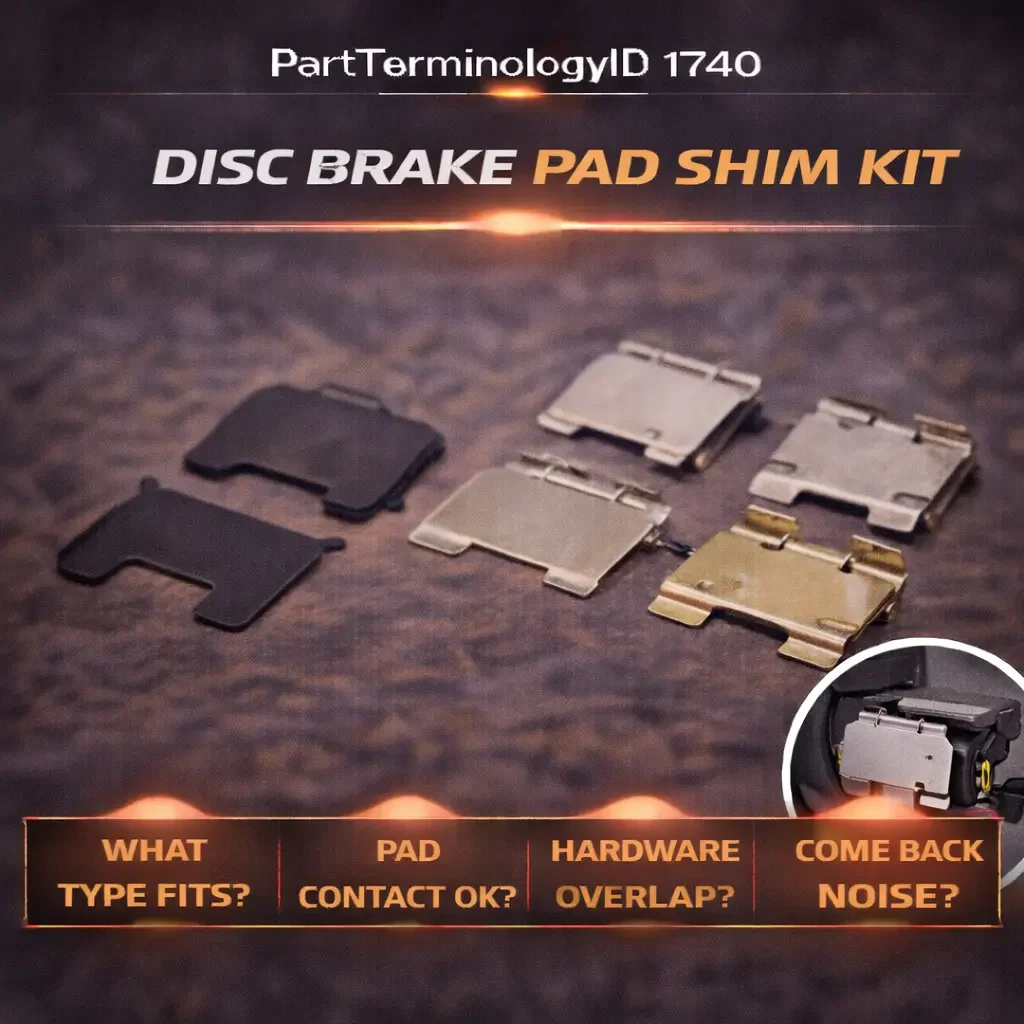
The disc brake pad shim kit is a set of thin multi-layer metal, rubberized-metal, or adhesive-backed damping plates that attach to the back of the brake pad backing plate (the side facing the caliper piston and caliper body) to absorb and dissipate the high-frequency vibration that produces brake squeal. Brake squeal is not a friction problem - it is a vibration problem. When the pad contacts the rotor under braking, the pad-rotor interface generates vibration at frequencies typically between 1,000 and 16,000 Hz. If that vibration transmits through the pad backing plate to the caliper piston and caliper body, the caliper acts as a resonance chamber and amplifies the vibration into audible squeal. The shim breaks this transmission path by decoupling the pad backing plate from the caliper piston, absorbing the vibration energy before it reaches the caliper.
This is the product that buyers order after they have already installed new pads without shims and the brakes are squealing. The shim kit is a reactive purchase in most cases - the buyer did not think they needed shims until the noise started. This makes the shim kit both a standalone product (PartTerminologyID 1740) and an argument for buying pad sets (PartTerminologyID 1684) and hardware kits (PartTerminologyID 1736) that include shims from the start.
PIES/PCdb: PartTerminologyID 1740 - Disc Brake Pad Shim Kit
PIES 8.0 / PCdb 2.0: No change
What Disc Brake Pad Shim Kit Means in the Aftermarket
Shim types
Multi-layer steel (MLS) shims. Two or three thin stainless steel layers with a rubber or viscoelastic damping layer sandwiched between them. The steel layers provide structure and heat resistance. The damping layer absorbs vibration energy and converts it to heat. MLS shims are the highest-performing shim type and are standard OE equipment on many Japanese and European vehicles. They clip onto or are riveted to the pad backing plate.
Rubberized steel shims. A single steel layer with a rubber or elastomer coating on one or both sides. The rubber provides both the damping function and a friction surface that prevents the shim from shifting on the backing plate. These are common OE equipment on many domestic vehicles and are the most common aftermarket replacement shim.
Adhesive-backed shims. A damping layer (rubber, Teflon, or composite) with a peel-and-stick adhesive on one side. The buyer peels the backing and sticks the shim to the back of the brake pad. These are the simplest to install but the least durable - the adhesive can fail from heat cycling, allowing the shim to shift or fall off.
Titanium shims. A premium option used on some performance and European applications. Titanium provides excellent heat shielding (protecting the caliper piston and brake fluid from pad heat) in addition to vibration damping. These are significantly more expensive and application-specific.
How shims work
The shim performs two functions:
Vibration damping. The damping layer (rubber, viscoelastic material, or the interface between dissimilar metal layers) absorbs the vibrational energy generated at the pad-rotor interface. Without the shim, this energy transfers directly from the pad backing plate to the caliper piston (a metal-to-metal contact with excellent vibration transmission). With the shim, the energy is absorbed by the damping layer before it reaches the piston, preventing the caliper from resonating.
Thermal insulation. The shim provides a partial thermal barrier between the pad backing plate (which can reach 400-600 degrees F during heavy braking) and the caliper piston. This is particularly relevant for phenolic pistons (PartTerminologyID 1724), which can absorb heat and moisture, and for the brake fluid behind the piston, which has a finite boiling point. By reducing heat transfer to the piston, the shim helps protect both the piston material and the brake fluid.
OE shims versus aftermarket
Many OE brake pad assemblies come with shims permanently attached to the backing plate - either spot-welded, riveted, or bonded during manufacturing. When these OE pads are replaced with aftermarket pads that do not include shims, the vibration damping is lost, and the brakes may squeal even though the new pads are otherwise correct for the application. This is the most common origin of the "my new pads squeal" complaint documented in PartTerminologyID 1684.
Some aftermarket pad sets include shims (molded on, clipped on, or packaged separately in the box). Others do not. Some disc brake hardware kits (PartTerminologyID 1736) include shims. The standalone shim kit (this product, PartTerminologyID 1740) fills the gap when neither the pad set nor the hardware kit included shims, or when the buyer wants to add shims after the fact.
What Is Included
A disc brake pad shim kit typically contains:
4 shims (one per pad, enough for one axle) or 2 shims (one per pad for one caliper)
On some applications, the inboard and outboard shims are different (the inboard shim contacts the caliper piston; the outboard shim contacts the caliper body or caliper fingers)
The listing must specify the quantity and whether the shims are the same for inboard and outboard pads or different. On vehicles where the inboard and outboard shims differ, receiving a kit of four identical shims when two different shapes are needed will result in a return.
Top Return Causes
1) Shims do not fit the brake pad backing plate
The shim dimensions (length, width, hole pattern) do not match the buyer's brake pad backing plate. This occurs when the vehicle has multiple caliper/pad options and the shim was designed for a different pad shape.
Prevention: Pad compatibility in the fitment details. Shim dimensions and hole pattern in the specifications. "Verify the shim dimensions match your brake pad backing plate before installation. These shims are designed for [OE pad shape / specific caliper type]."
2) Shims already included with the pad set or hardware kit
The buyer's pad set (PartTerminologyID 1684) arrived with shims pre-installed or packaged in the box, or the hardware kit (PartTerminologyID 1736) included shims. The buyer orders a separate shim kit they do not need. Duplicate purchase.
Prevention: Cross-reference with pad set and hardware kit listings. "Verify whether your replacement brake pads or hardware kit already includes anti-squeal shims before ordering this kit separately."
3) Adhesive-backed shims fall off after installation
The buyer installs adhesive-backed shims and they peel off the backing plate during the first few heat cycles. The adhesive was not rated for brake temperatures, the backing plate surface was not properly cleaned before application, or the adhesive was applied to a surface contaminated with brake dust or grease.
Prevention: "Clean the pad backing plate surface thoroughly with brake cleaner and allow to dry completely before applying adhesive-backed shims. The surface must be free of grease, brake dust, and debris for proper adhesion. Adhesive-backed shims may release under extreme brake temperatures. For applications with sustained high temperatures (towing, performance driving), clip-on or riveted shims are recommended."
4) Shims installed on the wrong side of the pad
The buyer installs the shim between the friction material and the rotor (the braking surface) instead of between the backing plate and the caliper piston. This prevents the pad from contacting the rotor properly and can cause braking failure.
Prevention: "Install shims on the BACK of the brake pad (the steel backing plate side facing the caliper piston), NOT on the friction material surface. Shims must never contact the rotor."
5) Shims do not eliminate the squeal
The buyer installs shims and the brakes still squeal. The noise source is not pad-to-piston vibration transmission (which shims address) but a different cause: worn abutment clips (pads rattling in the bracket), glazed rotor surface, incorrect pad formulation, or caliper slide pin binding causing uneven pad contact. The buyer returns the shims as "did not fix the noise."
Prevention: "Anti-squeal shims address vibration-induced squeal caused by pad-to-caliper energy transfer. If squeal persists after shim installation, inspect: abutment clips for wear (replace with new clips, see hardware kit PartTerminologyID 1736), rotor surface for glazing (resurface or replace), pad formulation compatibility with rotor, and caliper slide pin movement (clean and re-grease pins)."
Catalog Checklist for Attributes
Core taxonomy: Component: disc brake pad anti-squeal shim kit. Shim type: multi-layer steel (MLS), rubberized steel, adhesive-backed, titanium. Quantity: per axle (4 shims) or per caliper (2 shims). Position: front, rear. Inboard/outboard differentiation (same or different). Separate from disc brake pad set (PartTerminologyID 1684 - may include shims), disc brake hardware kit (PartTerminologyID 1736 - may include shims), caliper (PartTerminologyID 1704).
Fitment: Year, make, model, submodel, trim, engine. Brake package. Position (front/rear). Caliper type. Pad shape compatibility.
Specifications: Shim type (MLS, rubberized, adhesive, titanium). Material layers. Dimensions (length, width, thickness). Attachment method (clip-on, adhesive, friction-fit). Inboard and outboard differentiation.
Included components: Number of shims. Inboard and outboard identified (if different). Adhesive pre-applied (yes/no). Retaining clips (if applicable).
Installation notes: Install on back of pad (backing plate side facing caliper), not on friction surface. Clean backing plate with brake cleaner before installation. For adhesive shims, surface must be completely dry and clean. Do not apply grease between shim and backing plate (the shim replaces the grease as the damping layer). Verify shim does not interfere with pad movement in the bracket.
Images: Shim kit showing all pieces with inboard/outboard identified. Shim installed on pad backing plate (reference). Cross-section showing shim position between pad and caliper piston.
FAQ
Do I need shims if my brake pads already have them attached?
No. If your replacement pads have shims pre-installed (molded on, riveted, or clipped), you do not need a separate shim kit. Adding a second shim on top of the pad's integral shim can change the pad thickness and interfere with caliper piston retraction.
Can I use brake grease instead of shims?
Brake grease (applied to the back of the pad backing plate) provides some vibration damping and is better than nothing. However, grease is a temporary solution - it burns off or migrates over time, especially under high heat. Shims provide permanent, consistent damping for the life of the pad set. Many technicians use both: a thin film of brake grease on the backing plate, then the shim over it, though some shim manufacturers advise against grease between the shim and the backing plate because the shim is designed to work as the damping interface.
Why did my brakes squeal after installing new pads?
The most common cause is missing anti-squeal shims. If your OE pads had shims and the replacement pads did not, you have lost the vibration damping layer. Install shims (this product) and verify the hardware kit (abutment clips, anti-rattle clips) is in good condition. Other causes include incomplete pad bed-in (perform the 30-stops-from-30-mph procedure), glazed rotors, and contaminated friction surfaces.
Final Take for Aftermarket Teams
Disc Brake Pad Shim Kit (PartTerminologyID 1740) is a reactive noise-fix product that would be unnecessary if every pad set and hardware kit included shims. The catalog teams that reduce returns on this product do three things. First, they cross-reference the shim kit in every pad set listing that does not include shims, with a note that the buyer's OE pads likely had shims and the replacement may squeal without them. Second, they specify the shim dimensions and pad compatibility so the buyer receives shims that fit their pad shape. Third, they set realistic expectations: shims address vibration-transmission squeal, not every source of brake noise, and if the noise persists after shim installation, the cause is elsewhere in the brake assembly (hardware, rotor, caliper, or pad formulation).