
Disc Brake Hardware Kit (PartTerminologyID 1736): The $15 Kit That Prevents the $150 Comeback
Written by Arthur Simitian | PartsAdvisory
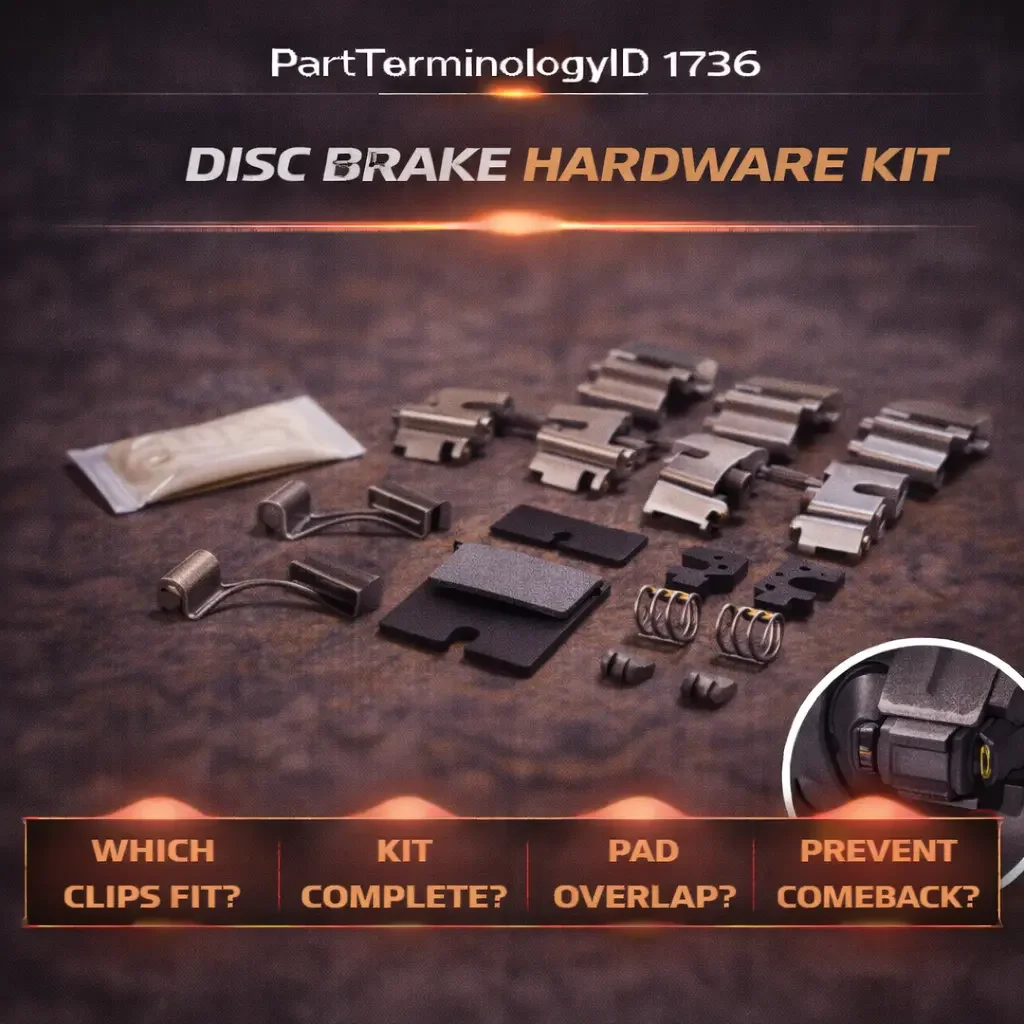
The disc brake hardware kit is a set of stainless steel abutment clips, anti-rattle clips, pad retainer springs, anti-squeal shims, and related small components that ensure the brake pads sit correctly in the caliper bracket, move freely during braking, retract properly when the brakes are released, and operate quietly. These are the components that wear out alongside the brake pads but are routinely left in place during pad replacement because they "still look okay" - even though they have lost their spring tension, corroded to the bracket, or worn grooves into the abutment surfaces.
The disc brake hardware kit is the most under-ordered product in the brake category relative to its importance. Every brake pad replacement should include new hardware. Every one. Reused hardware that has lost spring tension allows the pads to rattle (noise), cock sideways (uneven wear), bind in the bracket (drag and premature wear), or fail to retract from the rotor (drag, heat, accelerated pad and rotor wear). The $15 hardware kit prevents the noise complaint, the uneven wear comeback, and the premature pad failure that costs the shop or the DIY buyer far more in warranty labor, replacement parts, and customer dissatisfaction.
PIES/PCdb: PartTerminologyID 1736 - Disc Brake Hardware Kit
PIES 8.0 / PCdb 2.0: No change
What Disc Brake Hardware Kit Means in the Aftermarket
The components
A disc brake hardware kit can contain any combination of the following components, depending on the vehicle application and the kit manufacturer:
Abutment clips (slide clips, guide clips). Stainless steel clips that snap onto the caliper bracket's pad abutment surfaces (the ledges where the pad ears rest). The clips provide a smooth, low-friction surface for the pad ears to slide on during braking and release. They also act as a shim between the pad ears and the bracket, taking up the clearance and preventing rattle. Over time, the clips lose their spring tension, flatten against the bracket, corrode (despite being stainless - the bracket beneath them corrodes and lifts them), or accumulate brake dust and debris that restricts pad movement.
Anti-rattle clips (pad retainer clips). Spring-steel clips that press against the top of the brake pads, holding them firmly against the abutment clips and preventing vertical movement (rattle) in the bracket. On some designs, the anti-rattle clip also provides a return force that helps the pad retract slightly from the rotor when the brakes are released.
Pad retainer springs (spreader springs). On some caliper designs, a spring sits between the two pads and pushes them apart, helping maintain clearance between the pads and rotor when the brakes are not applied. This reduces drag and keeps the pads from lightly contacting the rotor during driving.
Anti-squeal shims (backing plate shims). Thin multi-layer metal or rubberized-metal plates that adhere or clip to the back of the brake pad backing plate. They dampen the high-frequency vibration that causes brake squeal by decoupling the pad from the caliper piston. Some shims are pre-applied to the pad (included with the pad set, PartTerminologyID 1684); others are separate components included in the hardware kit. Some vehicles use both pad-mounted shims and separate bracket-mounted shims.
Slide pin boots and grease. Some hardware kits include replacement rubber boots for the caliper slide pins and a packet of brake-specific silicone grease. These address the slide pin sealing that prevents the contamination and binding described in PartTerminologyID 1704, 1714, and 1716. Other hardware kits do not include pin boots, limiting the kit to pad-side hardware only.
Banjo bolt washers. Some kits include copper or aluminum crush washers for the brake hose connection. These are needed if the brake hose was disconnected during the service, but not for a standard pad replacement where the hose remains connected.
Why the hardware matters more than most buyers think
The hardware kit addresses the root cause of the three most common brake complaints after a pad replacement: noise, uneven pad wear, and premature pad failure.
Noise. Brake squeal and rattle are almost never the fault of the brake pads themselves. They are caused by the pads vibrating against worn contact surfaces (the bracket abutment surfaces without fresh clips), the pads moving vertically in the bracket (missing or worn anti-rattle clips), or the pads transmitting vibration to the caliper (missing or worn anti-squeal shims). New pads on old hardware will frequently be noisier than old pads on old hardware, because the new pad's thicker friction material changes the vibration frequency and the worn hardware cannot dampen it.
Uneven pad wear. When abutment clips lose their spring tension or corrode to the bracket, the pad ears bind on one side. The pad wears at an angle (tapered wear) or wears more on one end than the other. The buyer sees uneven wear and blames the pads. The actual cause is the worn clips that prevented the pad from sliding freely.
Premature pad failure. When pads cannot retract from the rotor because the hardware is not providing return force, the pads drag lightly against the rotor during normal driving. This constant light contact generates heat and wears the pad continuously, reducing pad life from 50,000 miles to 20,000 or 30,000 miles. The buyer perceives the new pads as low quality when the actual cause is the old hardware holding the pads in contact with the rotor.
What Is Included
Hardware kit contents vary by manufacturer, application, and price tier:
Basic kit: Abutment clips only (typically 4 clips for one axle, 2 per bracket). The most common and least expensive configuration.
Standard kit: Abutment clips plus anti-rattle clips and/or pad retainer springs. Covers the pad-side hardware for proper pad positioning and noise control.
Complete kit: Abutment clips, anti-rattle clips, pad retainer springs, anti-squeal shims, slide pin boots, pin grease, and any application-specific clips or springs. The most comprehensive configuration, covering both pad-side and caliper-side hardware.
The listing must itemize the kit contents, because "disc brake hardware kit" means different things to different manufacturers. A buyer who orders a basic kit expecting pin boots and shims will have an incomplete repair. A buyer who orders a complete kit when they only need abutment clips overspends.
Top Return Causes
1) Kit does not match the caliper bracket
The vehicle has multiple caliper/bracket options (standard versus heavy-duty, different caliper manufacturers) and the hardware kit's clip dimensions, spring configurations, or attachment points do not match the buyer's bracket.
Prevention: Caliper type and brake package in the fitment details. "Fits vehicles with [standard / heavy-duty / performance] brake package and [OE caliper manufacturer] calipers. Verify your caliper bracket before ordering."
2) Hardware already included with the brake pads
Some brake pad sets (PartTerminologyID 1684) include abutment clips and/or anti-squeal shims. The buyer orders a separate hardware kit and discovers the pad set already included the same components. Duplicate purchase.
Prevention: Cross-reference with the pad set listing. "Verify whether your replacement brake pad set already includes abutment clips or shims before ordering a separate hardware kit."
3) Kit contents do not match buyer expectations
The buyer orders a "hardware kit" expecting a complete set of all hardware components and receives abutment clips only. Or the buyer expects pin boots and receives only pad-side hardware.
Prevention: Itemized contents in the listing: "Includes: 4 stainless steel abutment clips, 2 anti-rattle clips, 1 grease packet. Does NOT include: slide pin boots, anti-squeal shims, pad retainer springs." A photo showing all kit contents laid out and labeled.
4) Clips do not fit the bracket abutment surfaces
The abutment clips are dimensionally correct for the application but do not snap onto the bracket properly because the bracket's abutment surfaces are worn or corroded. The clips sit loosely, rattle, or fall off. The buyer perceives wrong-size clips when the actual issue is a worn bracket (PartTerminologyID 1714).
Prevention: "If new abutment clips do not snap securely onto the bracket, inspect the bracket's abutment surfaces for wear or corrosion. Grooved or corroded bracket surfaces may not retain new clips properly. See [bracket cross-reference, PartTerminologyID 1714] if bracket surfaces are worn."
5) Anti-squeal shims not compatible with the pad set
The hardware kit includes anti-squeal shims that do not match the backing plate dimensions or attachment method of the buyer's chosen pad set. Shims may be adhesive-backed (stick to the pad backing plate), clip-on, or friction-fit. If the shim style does not match the pad's backing plate, the shim cannot be installed or will fall off during use.
Prevention: Shim compatibility in the listing: "Anti-squeal shims designed for [OE-specification / specific pad set] backing plates. Verify pad backing plate dimensions and shim attachment method before ordering."
Catalog Checklist for Attributes
Core taxonomy: Kit type: basic (abutment clips only), standard (clips plus anti-rattle hardware), complete (clips, springs, shims, pin boots, grease). Coverage: per caliper, per axle (most common). Position: front, rear. Separate from disc brake pad set (PartTerminologyID 1684 - may include some hardware), caliper repair kit (PartTerminologyID 1720 - caliper-side rebuild components), caliper bracket (PartTerminologyID 1714), caliper bushing (PartTerminologyID 1716).
Fitment: Year, make, model, submodel, trim, engine. Brake package. Position (front/rear). Caliper manufacturer (OE caliper type determines clip geometry).
Specifications: Material (stainless steel, spring steel, rubberized metal). Component count and types. Abutment clip dimensions. Shim type (adhesive, clip-on, friction-fit). Pin boot size (if included).
Included components: Itemized list with quantities. Abutment clips (quantity). Anti-rattle clips (quantity). Pad retainer springs (quantity). Anti-squeal shims (quantity, type). Slide pin boots (quantity). Pin grease (yes/no). Banjo bolt washers (yes/no).
Installation notes: Remove old clips and clean bracket abutment surfaces with wire brush before installing new clips. Apply thin film of brake-specific grease to abutment clip contact surfaces. Verify pads slide freely on new clips before installing caliper. Do not grease friction surfaces. Replace all hardware on both sides of the axle.
Images: All kit components laid out with each item labeled. Abutment clips installed on bracket (reference). Anti-rattle clips in position. Shims on pad backing plate (if included).
FAQ
Do I really need to replace brake hardware every time I change pads?
Yes. Hardware loses spring tension, corrodes, and accumulates debris over the life of a set of brake pads. Reused hardware is the most common cause of brake noise, uneven pad wear, and premature pad failure after an otherwise correct pad replacement. The cost of the hardware kit ($10 to $25) is negligible compared to the cost of diagnosing and correcting the noise complaint, uneven wear, or premature failure that worn hardware causes.
My new pads squeal. Is it the pads or the hardware?
Almost always the hardware. If the pad set did not include anti-squeal shims and you did not install new ones, the pads are transmitting vibration to the caliper and creating squeal. If the abutment clips are worn and the pads are not sitting squarely against the rotor, the inconsistent contact generates noise. Install new hardware (especially shims and abutment clips) before returning the pads as defective.
What is the difference between a disc brake hardware kit and a caliper repair kit?
A disc brake hardware kit (this product, PartTerminologyID 1736) contains pad-side components: abutment clips, anti-rattle clips, shims, and sometimes pin boots. It is used during pad replacement. A caliper repair kit (PartTerminologyID 1720) contains caliper-side rebuild components: piston seal, dust boot, and sometimes a piston. It is used to rebuild a caliper with a sticking piston. They are different products for different repairs, though both may be needed if you are rebuilding a caliper and replacing pads at the same time.
Final Take for Aftermarket Teams
Disc Brake Hardware Kit (PartTerminologyID 1736) is the most under-ordered product in the brake category and the most common root cause of post-pad-replacement noise complaints. The catalog teams that reduce comebacks and returns do three things. First, they cross-reference the hardware kit in every pad set listing (PartTerminologyID 1684) with a note that hardware replacement is recommended with every pad change. Second, they itemize the kit contents so the buyer knows exactly what is in the box and what is not. Third, they note that abutment clips that do not snap securely onto the bracket indicate a worn bracket (PartTerminologyID 1714), not wrong clips - redirecting the buyer to the correct diagnosis before they return the hardware kit.