
Written by Arthur Simitian | PartsAdvisory
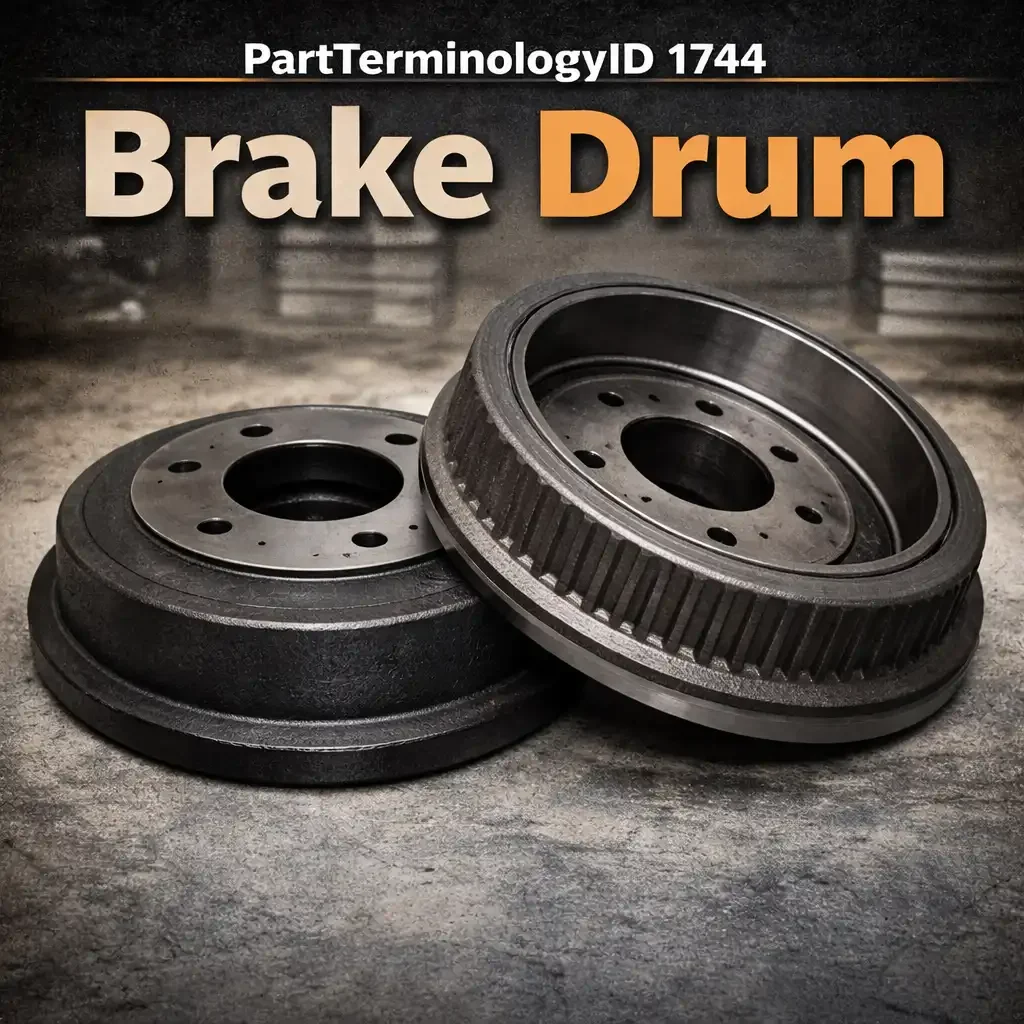
PartTerminologyID 1744, Brake Drum, is one of those categories that looks simple to almost everyone except the teams who get blamed when it goes wrong.
A brake drum is just cast iron, right?
A round shell.
A friction surface.
A part that should be easy to buy, easy to install, easy to catalog.
That is what people assume.
But this category keeps generating avoidable returns because the part itself is simple while the application context is not.
Buyers order the wrong drum because:
they match by year/make/model only
they ignore drum inside diameter and max diameter spec
they confuse drum-only with drum-and-hub configurations
they do not account for rear brake package differences
they mix old hardware with new drums and blame the drum
they install one side only and get uneven braking behavior
Sellers get trapped because many listings for Brake Drum still look like this:
title with little technical detail
no drum dimensions
no hub/bearing/stud clarity
no note on shoes/hardware/wheel cylinder condition
no statement about axle-pair replacement
no warning about rear brake package options
The result is a part that physically installs but performs poorly, a part that appears to fit but creates noise or pulsation, or a part that never had the right dimensions to begin with.
This is the PartsAdvisory field guide for PartTerminologyID 1744: Brake Drum, built for catalog teams, fitment teams, and sellers who want fewer returns, cleaner ACES/PIES behavior, and better conversion.
Status in New Databases
PIES/PCdb: PartTerminologyID 1744 - Brake Drum
PIES 8.0 / PCdb 2.0: No change
Why Brake Drum Is Still a High-Risk Category in 2026
People talk about drum brakes as if they are disappearing.
They are not gone. They are still common in:
rear axle applications on light trucks
economy passenger vehicles
fleet and commercial use
older vehicles with large active populations
trailer and utility derivatives in adjacent channels
The category is large enough to matter and technical enough to punish weak listing quality.
The hidden challenge
Brake Drum sits at the intersection of:
Fitment complexity (rear brake package splits, axle variants, production changes)
Dimensional sensitivity (diameter, width, depth, bore, critical tolerance windows)
Service-stack dependency (shoe condition, springs/hardware, cylinder, adjustment)
So even when the drum is manufactured correctly, the buyer experience can still fail if the catalog context is incomplete.
That is why this category behaves like a data-quality category, not just a brake component category.
What Brake Drum Actually Is (and Isn't)
A Brake Drum is the rotating friction component in a drum brake assembly.
The brake shoes expand outward against the machined inner drum surface to generate braking torque.
Core construction
Most aftermarket drums are:
cast iron (common)
machined on inside braking surface
ventless in many passenger designs
sometimes integrated with hub geometry in certain applications
Brake Drum is not:
a disc rotor
a brake shoe set
a full hardware kit
automatically "hub included"
a guaranteed one-size replacement by vehicle year alone
The buyer confusion starts when listings blur these boundaries.
The Brake Drum Family Tree That Buyers Don't See
The term "Brake Drum" sounds like a single category. In practice, there are multiple product subtypes.
1) Drum-only (slip-on style)
The drum mounts over a separate hub interface and is retained by wheel/lug arrangement.
Common confusion: buyer expects studs or bearings included.
2) Drum-and-hub assembly style
The assembly may include hub integration, wheel studs, and in some platforms bearing-related interface details.
Common confusion: buyer orders drum-only equivalent for a hub-style requirement.
3) Rear-position variants with axle package splits
Two drums can exist for the same year/make/model with different:
inside diameter
shoe width compatibility
depth dimensions
parking brake linkage context
ABS-related adjacent design differences
Common confusion: "My vehicle is this exact model, why doesn't it fit?"
4) Heavy-duty and towing package variants
The vehicle family may include standard and heavy-duty brake package splits.
Common confusion: buyer uses base trim assumptions for an upgraded axle package.
The Dimensions That Matter (and Why Returns Happen Without Them)
The fastest way to reduce returns in PartTerminologyID 1744 is to stop treating the drum as a generic part and start treating it as a dimensional part.
Must-have dimensions in listings
nominal inside diameter (new spec)
maximum machine diameter / discard limit
braking surface width
overall drum depth / hat depth
center bore
bolt pattern context (where applicable)
pilot and hub interface notes
If your listing hides these, you push all the risk to the buyer.
When buyers carry the risk, they return the part.
Why max machine diameter matters
A buyer may measure an old drum and get a value larger than nominal because it was previously machined.
If your listing only shows nominal and not service/discard context, the buyer assumes mismatch and returns a correct part, or orders the wrong part trying to match the worn dimension.
Width mismatch = silent failure path
Drum brake behavior depends on shoe contact geometry.
If the braking surface width and shoe compatibility do not align, the setup may:
under-contact
overheat edges
wear unevenly
create noise or chatter
reduce expected braking performance
That turns into "bad part" returns when the root cause is compatibility detail missing from listing data.
Top Return Scenarios in Brake Drum (PartTerminologyID 1744)
Scenario 1: "Doesn't fit" due to wrong depth or offset
The part appears close, but backing plate or hardware geometry does not line up correctly.
Root cause: incomplete dimensional listing and unmodeled package split.
Prevention language to include:
"Verify drum depth and hub interface dimensions against the original unit before installation."
Scenario 2: Buyer orders drum-only but needs assembly variant
Part arrives with no studs or bearing interface expected by buyer.
Root cause: ambiguous "Brake Drum" title without assembly scope.
Prevention language:
"Scope: Drum only (no hub/studs/bearings unless explicitly stated)."
Scenario 3: Pulsation complaint after installation
Buyer blames drum quality immediately.
Possible causes beyond drum:
improper hub mating surface prep
lateral runout stack-up from rust or debris
one-side-only replacement
worn shoe or hardware causing uneven contact
wheel cylinder imbalance
improper adjustment or break-in behavior
Prevention language:
"Replace in axle pairs; inspect shoes, hardware, wheel cylinders, and adjuster function during service."
Scenario 4: Brake noise after drum replacement
Noise is treated as a defective drum claim.
Possible causes:
glazed shoes
weak return springs
worn contact pads on backing plate
out-of-adjustment shoes
contaminated friction material
parking brake linkage drag
Prevention language:
"Brake drum replacement should be paired with hardware and shoe condition inspection to prevent noise/comeback."
Scenario 5: Wrong diameter selected from shortcut search
Buyer picks based on broad fitment without brake package validation.
Root cause: listing lacks clear dimension and package filters.
Prevention language:
"Vehicle fitment may include multiple rear brake packages. Verify drum I.D., shoe width, and package notes before ordering."
What to Include in the Listing (The Practical Version)
If you want this category to perform in marketplaces and reduce post-sale friction, your listing has to answer buyer questions before checkout.
Core listing essentials
PartTerminologyID reference: PartTerminologyID 1744
component type: Brake Drum
position: rear/front if applicable
quantity per box (1 or pair)
assembly scope (drum-only vs integrated style)
Fitment essentials
year/make/model/submodel/engine where applicable
brake package notes
production split notes
axle configuration notes
wheel size package notes (if relevant to fitment)
Dimensional essentials
nominal drum I.D.
max machining/discard diameter
braking width
overall depth
center bore
key mounting interface dimensions
Service compatibility essentials
shoe width compatibility statement
hardware replacement recommendation
axle-pair replacement note
installation and adjustment note
Image essentials
front and rear angle shots
machined braking surface close-up
dimension callout image
packaging scope image (what is included)
comparison image where multiple variants exist
Catalog Checklist for ACES/PIES Teams
For structured data teams, PartTerminologyID 1744 should be treated as a high-precision category.
Taxonomy and product identity
PartTerminologyID = 1744
Product Type = Brake Drum
Component class = friction surface (drum system)
Required attribute discipline
position
nominal diameter
max diameter/discard spec
width
depth
bore
finish/coating
package quantity
assembly scope metadata
Fitment governance
enforce brake package splits
enforce production cutoff logic
enforce rear axle option mapping
cross-check against shoe/hardware pairings
avoid generalized "fits all trims" assumptions
Data QA controls to reduce returns
validation rule: dimension fields cannot be empty for PartTerminologyID 1744
validation rule: assembly scope must be explicit
validation rule: position must be explicit where required
validation rule: avoid duplicate applications with conflicting dimensions
validation rule: review edge-case applications with multiple brake packages
Install Notes That Should Be in the Content (Not Buried in PDFs)
You do not need to write a full repair manual in every listing, but you need practical notes that stop common failures.
Install checklist (buyer-facing)
clean hub and mating surfaces thoroughly
verify no rust scale affecting runout
compare drum dimensions with removed unit
inspect shoes for contamination and uneven wear
inspect/replace worn hardware springs and clips
inspect wheel cylinder for leaks or seizure
adjust shoes correctly after installation
replace drums in axle pairs
road-test and verify pedal feel/noise
Why these notes matter commercially
Every one of these reduces "part is bad" returns that are actually service-stack problems.
FAQ (Buyer Language)
Is Brake Drum the same thing as a rotor?
No. A rotor is used with pads and calipers in disc systems. A drum is used with shoes in drum systems.
Can I replace only one drum?
Technically possible, but not recommended. Axle-pair replacement improves balance and consistency.
Do all brake drums include studs or bearings?
No. Many are drum-only. Some assemblies differ by application. Listing must explicitly state included components.
Why does my new drum still make noise?
Noise can come from shoes, hardware, adjusters, backing plate contact points, contamination, or cylinder issues, not just drum condition.
What does "maximum diameter" mean?
It is the service/discard limit. If machining pushes beyond that value, the drum should be replaced.
The "So What" for Aftermarket Teams
PartTerminologyID 1744 is not a category where generic copy performs well.
It rewards teams that combine fitment precision with buyer clarity.
If you improve these three areas, returns drop fast:
Dimension-first listing content
Clear package scope (what is included / not included)
Practical service context (pair replacement + hardware/shoe inspection)
The goal is not only fewer returns.
The goal is cleaner trust signals, fewer support tickets, and higher repeat conversion from serious buyers who are tired of guessing.
Cross-Sell Logic That Actually Helps (Without Looking Pushy)
Brake Drum buyers often need adjacent components.
Cross-sell should be relevance-first, not upsell-first.
Recommended cross-sell logic
Brake Shoe Set (matching width/position)
Drum Brake Hardware Kit
Wheel Cylinder
Adjuster Kit (where applicable)
Parking brake service components (where applicable)
Add this as "recommended during service," not "you also need this."
That framing reduces friction and improves completion rate.
Common Copy Mistakes That Trigger Avoidable Returns
Mistake 1: "Direct fit, no modifications required" with no dimension context
Sounds helpful. Creates liability.
Mistake 2: Using only YMM fitment with no package split notes
This is where high-return claims begin.
Mistake 3: No mention of drum-only vs assembly scope
Guaranteed confusion.
Mistake 4: No max diameter/service note
Leads to wrong comparisons against worn or machined drums.
Mistake 5: No pair-replacement recommendation
Creates imbalance complaints blamed on product quality.
Better Listing Framework (You Can Reuse)
Use this skeleton for PartTerminologyID 1744 posts:
What it is (plain language)
What is included / not included
Key dimensions (with labels)
Fitment/package caveats
Top return causes and prevention
Install notes and pair replacement recommendation
FAQ for buyer uncertainty
Final recommendation and CTA
This flow reduces cognitive load and support burden.
Suggested Compatibility Checklist Block
Every PartTerminologyID 1744 listing should answer:
Position: Rear/Front
Nominal Drum Diameter: (in/mm)
Max Service Diameter: (in/mm)
Braking Width: (in/mm)
Overall Depth: (in/mm)
Center Bore: (in/mm)
Package Scope: Drum only or integrated assembly
Included Components: Studs/bearings/races yes/no
Fitment Notes: Brake package/trim/production split
Service Notes: Replace in pairs; inspect shoes/hardware/cylinder
If these are present, your return risk drops dramatically.
Final Take for PartTerminologyID 1744
Brake Drum (PartTerminologyID 1744) is a category where "simple product, complex fitment reality" causes most of the pain.
The winners in this category do not rely on generic fitment language.
They document dimensions, scope, and service context clearly enough that a buyer can self-validate before checkout.
That is what turns a brake drum listing from a return magnet into a conversion asset.