
Written by Arthur Simitian | PartsAdvisory
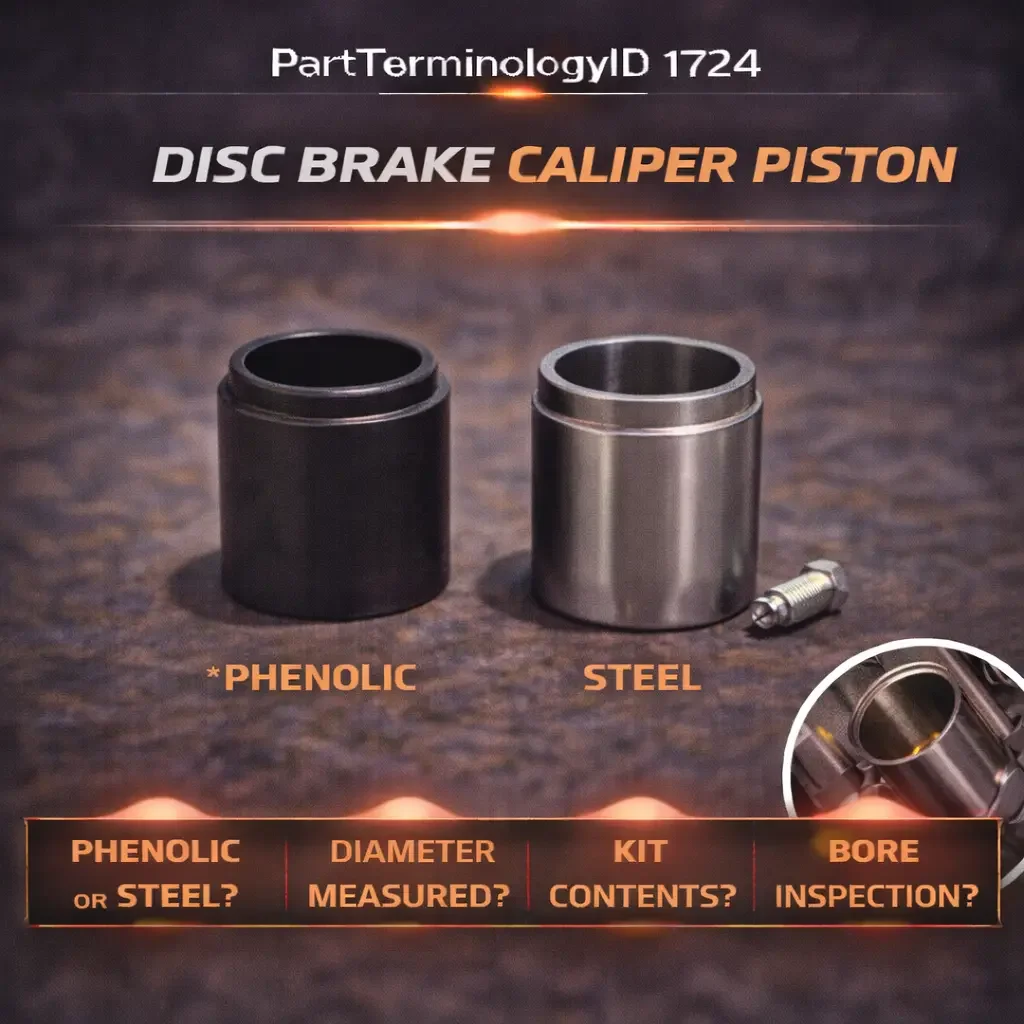
The disc brake caliper piston is the cylindrical component inside the caliper bore that converts hydraulic brake fluid pressure into mechanical force, pushing the inner brake pad against the rotor. When the driver presses the brake pedal, pressurized fluid forces the piston outward from the bore. When the pedal is released, the square-cut seal in the bore retracts the piston a fraction of a millimeter, creating the running clearance between the pad and rotor. The piston is the moving interface between the hydraulic system and the mechanical friction system, and its ability to slide freely in the bore is what determines whether the brake applies cleanly, releases cleanly, or drags.
The caliper piston is sold as a standalone replacement component for buyers who are rebuilding an existing caliper (using a repair kit from PartTerminologyID 1720 that does not include a piston, or supplementing a basic seal kit with a new piston). It is also sold for buyers who are upgrading from one piston material to another - most commonly replacing a phenolic (plastic composite) piston with a steel piston to eliminate the moisture-absorption swelling problem that plagues phenolic pistons on certain platforms.
This is a precision component with tight dimensional requirements. The piston outer diameter must match the bore inner diameter within thousandths of an inch. A piston that is too large will bind. A piston that is too small will leak past the seal. The piston must be perfectly cylindrical (not tapered, not oval) and its outer surface must be smooth (not scored, not pitted, not corroded). These requirements make piston selection a measurement-driven process, not a "looks about right" process.
PIES/PCdb: PartTerminologyID 1724 - Disc Brake Caliper Piston
PIES 8.0 / PCdb 2.0: No change
What Disc Brake Caliper Piston Means in the Aftermarket
Piston materials and their failure modes
This was introduced in PartTerminologyID 1704 (Disc Brake Caliper) and is expanded here because the piston material is the primary selection criterion when ordering a standalone replacement piston:
Phenolic (plastic composite). A heat-resistant thermoset plastic reinforced with fibers. Phenolic pistons are lighter than steel and act as thermal insulators, reducing heat transfer from the brake pad to the brake fluid. This keeps the fluid cooler and improves fade resistance. GM, Ford, and Chrysler used phenolic pistons extensively from the 1980s through the 2000s.
The failure mode is moisture absorption. Phenolic is a hygroscopic material - it absorbs moisture from the brake fluid and from the atmosphere (through a torn dust boot). As the piston absorbs moisture, it swells. The swelling is not uniform - the open end of the piston (the end that faces outward, closer to the boot) swells more than the closed end (deeper in the bore), creating a taper. A tapered piston binds in the cylindrical bore. The degree of swelling depends on the phenolic formulation and the cure cycle during manufacturing. Properly cured, high-quality phenolic swells minimally over its service life. Improperly cured phenolic (a documented problem with some aftermarket and remanufactured pistons) can swell significantly within months, causing seizure.
Phenolic pistons can also crack under extreme heat or impact. A cracked piston will leak brake fluid internally and eventually fail to hold pressure.
Steel. The traditional piston material. Steel pistons are strong, dimensionally stable (they do not swell from moisture), and precisely machinable. They do not absorb moisture. Their disadvantage is thermal conductivity - steel transfers heat from the pad to the brake fluid much more efficiently than phenolic, which means the brake fluid reaches higher temperatures sooner under sustained heavy braking. Steel pistons are also heavier, contributing marginally to unsprung weight.
Steel pistons corrode if the dust boot fails and moisture contacts the outer surface. Corrosion creates a rough surface that drags through the bore seal, causing the piston to stick and the seal to wear prematurely. However, unlike phenolic swelling, steel corrosion is an external-contamination failure, not an inherent material failure. A steel piston in a caliper with intact boots and clean fluid will last indefinitely.
Aluminum. Used primarily on fixed calipers and performance applications. Lighter than steel, moderate thermal conductivity. Aluminum can corrode if exposed to moisture, though less aggressively than steel in most conditions. Uncommon as a standalone aftermarket replacement piston for passenger vehicle floating calipers.
The phenolic-to-steel upgrade
One of the most common reasons buyers purchase a standalone caliper piston is to upgrade from phenolic to steel. This is particularly prevalent on Ford Super Duty trucks, GM full-size trucks, and other platforms where phenolic piston swelling has caused repeated caliper seizure problems. The buyer purchases a steel piston (such as the Carlson 7964 series, a well-known aftermarket steel replacement for GM phenolic pistons) and installs it in the existing caliper with a new seal kit (PartTerminologyID 1720).
The upgrade eliminates the moisture-absorption swelling failure mode entirely. The trade-off is increased heat transfer to the brake fluid, which may slightly reduce fade resistance under sustained heavy braking (towing, mountain driving). For most drivers, this trade-off is acceptable because the swelling failure mode is more dangerous than the marginal fade difference.
For catalog teams, the phenolic-to-steel upgrade is a cross-sell opportunity: the buyer ordering a steel replacement piston also needs a caliper repair kit (PartTerminologyID 1720) for the new seals and boots, and should be recommended a brake fluid flush to remove the moisture-contaminated fluid that contributed to the original phenolic piston's swelling.
Piston measurement
The piston's outer diameter is the critical specification. Common passenger vehicle caliper piston diameters range from approximately 38mm to 70mm (1.5 to 2.75 inches), with the exact diameter specific to the caliper model. The buyer must know the piston diameter for their caliper, which can be determined by:
Measuring the old piston with a caliper or micrometer
Looking up the OE caliper specification by year/make/model/caliper manufacturer
Measuring the bore inner diameter (the piston OD is slightly smaller than the bore ID, with the seal providing the sealing contact)
A piston that is even 0.5mm off-specification will either bind in the bore or fail to seal. This is not a component where "close enough" works.
What Is Included
A standalone caliper piston is sold as a single piston for one caliper. The listing typically includes only the piston itself. It does not include the piston seal, dust boot, or any other rebuild components. These must be ordered separately (typically as part of a caliper repair kit, PartTerminologyID 1720).
Some manufacturers sell the piston packaged with a seal and boot as a "piston kit." The listing must clearly state whether seals and boots are included or not, because a buyer who orders a piston-only listing and does not have new seals will need to reuse the old seal (not recommended) or place a second order.
Top Return Causes
1) Wrong piston diameter
The buyer orders a piston that does not match their caliper bore diameter. The piston is too large (will not enter the bore) or too small (will not seal). This occurs when the vehicle has multiple caliper options with different piston diameters and the buyer does not verify which caliper is on their vehicle.
Prevention: Piston diameter in the title and specifications: "Disc Brake Caliper Piston - 60mm Diameter." Caliper manufacturer in the fitment: "Fits [Akebono / TRW / Brembo] caliper." "Measure your existing piston or caliper bore to verify diameter before ordering."
2) Wrong material (buyer expected phenolic, received steel, or vice versa)
The buyer orders a piston expecting the same material as their original and receives a different material. Or the buyer wants a steel upgrade but receives a phenolic replacement.
Prevention: Piston material in the title: "Steel Caliper Piston" or "Phenolic Caliper Piston." If the listing is a steel upgrade for a phenolic application, state explicitly: "Steel replacement piston for calipers originally equipped with phenolic pistons. Eliminates moisture-absorption swelling. See installation notes regarding increased heat transfer."
3) Seals and boots not included
The buyer orders the piston expecting it to include new seals and a dust boot. The piston arrives alone. The buyer cannot complete the rebuild without seals.
Prevention: "Piston ONLY - piston seal and dust boot NOT included. Order a caliper repair kit [cross-reference PartTerminologyID 1720] for the seals and boots required to complete the rebuild."
4) Caliper bore too damaged for the new piston
The buyer orders a new piston to fix a sticking caliper, but the actual problem is bore corrosion (pitting, scoring) that the new piston will not fix. A new piston in a damaged bore will stick or leak just like the old piston.
Prevention: "A new piston will not correct a corroded or pitted caliper bore. Before ordering, inspect the bore for pitting and scoring. If the bore cannot be restored to a smooth finish with a brake cylinder hone, the caliper must be replaced [cross-reference PartTerminologyID 1704]."
5) Phenolic piston arrived swollen or out-of-spec
Some aftermarket phenolic pistons are manufactured with inconsistent cure cycles, resulting in pistons that arrive already slightly swollen or that swell rapidly after installation. The buyer installs the piston and it binds within months.
Prevention: Difficult to address through listing content (this is a manufacturing quality issue), but noting the piston material and recommending measurement before installation helps: "Measure the new piston outer diameter and compare to the caliper bore specification before installation. The piston should be [specification]mm +/- 0.05mm. If the new piston measures oversize, do not install."
Catalog Checklist for Attributes
Core taxonomy: Component: caliper piston (individual). Material: steel, phenolic, aluminum. Position: front, rear. Quantity: per piston (1), per caliper (1 for single-piston, 2+ for multi-piston). Separate from caliper repair kit (PartTerminologyID 1720 - may or may not include piston), disc brake caliper (PartTerminologyID 1704 - complete replacement), caliper bracket (PartTerminologyID 1714).
Fitment: Year, make, model, submodel, trim, engine. Brake package. Position (front/rear). Caliper manufacturer (Akebono, TRW, Brembo, Continental). Piston diameter (mm). OE piston material (for upgrade cross-reference).
Specifications: Piston outer diameter (mm, to hundredths). Piston length/depth. Material (steel, phenolic, aluminum). Weight. Surface finish (chrome-plated steel, bare steel, coated).
Included components: Piston only, or piston with seal and boot. Explicit statement of what is NOT included.
Installation notes: Measure piston diameter before installation. Inspect and hone caliper bore. Lubricate piston and seal with clean brake fluid. Seat dust boot fully. Flush brake fluid after rebuild. For phenolic-to-steel upgrades: note increased heat transfer to fluid.
Images: Piston showing material and surface finish. Diameter measurement reference. Piston profile (closed end versus open end orientation).
FAQ
Should I upgrade from phenolic to steel?
If your vehicle has experienced repeated phenolic piston seizure from swelling, a steel upgrade eliminates that failure mode. The trade-off is slightly more heat transfer to the brake fluid, which could reduce fade resistance during sustained heavy braking (towing, mountain descents). For most daily driving, the trade-off is favorable. If you tow heavy loads in mountainous terrain, consider more frequent brake fluid flushes to offset the increased fluid temperature.
How do I measure my caliper piston?
Remove the piston from the caliper bore. Clean it thoroughly. Measure the outer diameter with a caliper or micrometer at multiple points: near the open end, at the middle, and near the closed end. If the measurements differ (the piston is tapered), the piston has swollen unevenly and must be replaced. Compare the measurements to the OE specification for your caliper.
Can I reuse my old piston with a new seal kit?
If the piston is not scored, not corroded, not tapered, and measures within OE specification, it can be reused. Phenolic pistons should be measured carefully for swelling - even a few thousandths of an inch of taper can cause binding. Steel pistons should be inspected for corrosion pitting on the outer surface. When in doubt, the low cost of a new piston ($10 to $30) makes replacement a worthwhile precaution during a rebuild.
Final Take for Aftermarket Teams
Disc Brake Caliper Piston (PartTerminologyID 1724) is a precision replacement component where returns are driven by wrong diameter, wrong material, missing seals, and the expectation that a new piston will fix a damaged bore. The catalog teams that handle this product well put the piston diameter and material in the title, cross-reference the caliper repair kit (PartTerminologyID 1720) for the seals and boots that the piston-only listing does not include, and include the bore inspection advisory that redirects buyers with corroded bores to a replacement caliper (PartTerminologyID 1704) before they order a piston they cannot use.