
Disc Brake Caliper Repair Kit (PartTerminologyID 1720): The Rebuild Option That Saves the Casting
Written by Arthur Simitian | PartsAdvisory
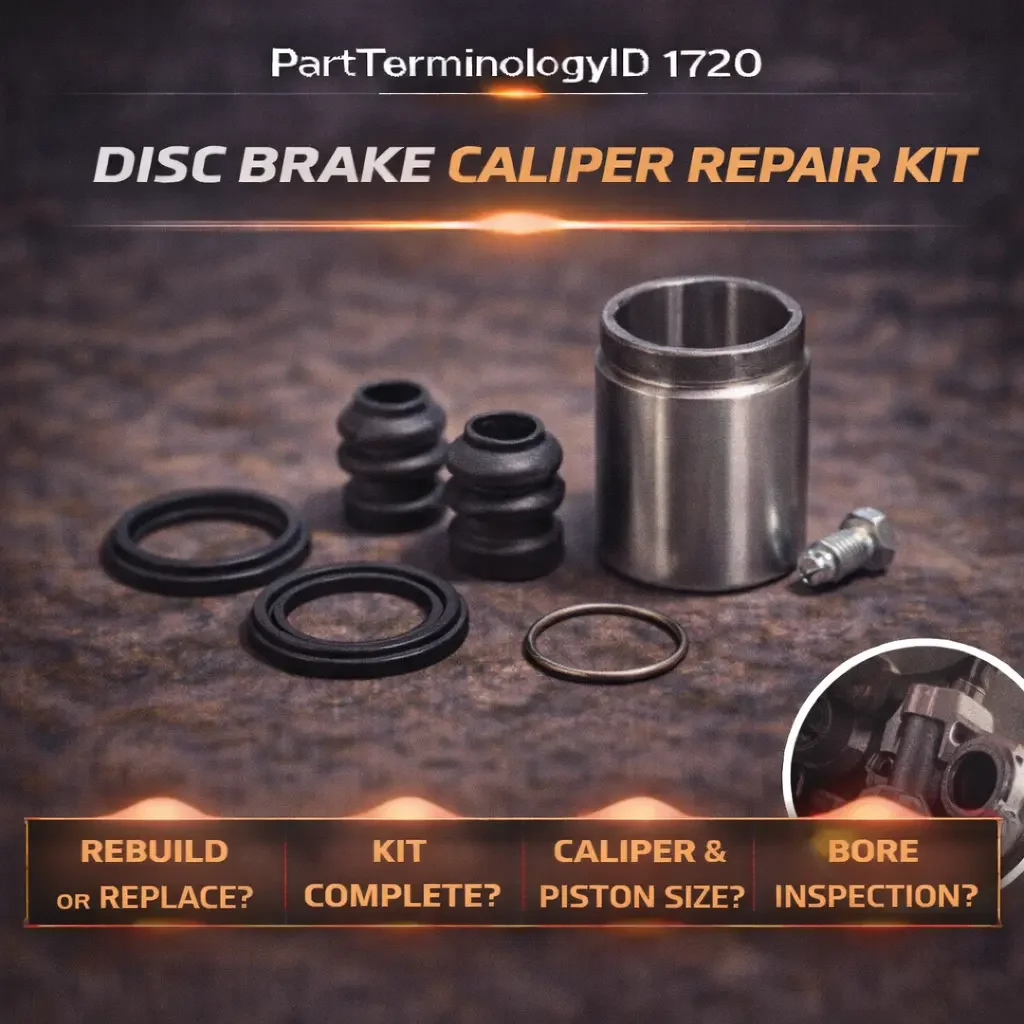
The disc brake caliper repair kit is a collection of rubber seals, dust boots, and sometimes pistons and hardware needed to rebuild an existing caliper in place rather than replacing it with a new or remanufactured unit. A typical kit includes the piston seal (square-cut seal that sits in a groove inside the caliper bore and provides both the hydraulic seal and the piston retraction mechanism), the piston dust boot (the external rubber bellows that seals the bore opening and prevents road contamination from reaching the piston), and may also include slide pin boots, slide pin bushings, bleeder screw cap, and caliper-specific hardware depending on the manufacturer and the completeness of the kit.
The caliper repair kit exists because the caliper casting itself is a durable, expensive component that often outlasts its rubber seals and boots. A cast iron or aluminum caliper body that has a clean, un-pitted bore can be rebuilt multiple times with new seals and boots at a fraction of the cost of a new or remanufactured caliper. This makes the repair kit attractive to professional technicians who have the skills to disassemble, inspect, clean, and reassemble a caliper, and to fleet operators who maintain vehicles in-house.
However, the repair kit is not a universal solution. If the caliper bore is pitted, scored, or corroded beyond what honing can correct, no seal kit will restore the caliper to proper function. The new seal will ride over the pits and grooves, leaking fluid or allowing the piston to stick. This diagnostic judgment - whether the bore is rebuildable or the caliper must be replaced - is the central challenge of this product category and the primary driver of returns.
PIES/PCdb: PartTerminologyID 1720 - Disc Brake Caliper Repair Kit
PIES 8.0 / PCdb 2.0: No change
What Disc Brake Caliper Repair Kit Means in the Aftermarket
What the kit rebuilds
The repair kit addresses the wear components inside the caliper:
Piston seal (square-cut seal). This is the most critical component in the kit. The piston seal sits in a machined groove inside the caliper bore. It performs two functions: it seals hydraulic pressure behind the piston (preventing brake fluid from leaking past the piston), and it provides the piston retraction mechanism. When the brakes are applied, the piston moves outward and the seal deforms slightly in its groove. When the brakes are released, the seal relaxes back to its original shape, pulling the piston a fraction of a millimeter back into the bore. This tiny retraction is what creates the running clearance between the pad and rotor. A worn, hardened, or damaged seal either leaks fluid (visible at the dust boot or on the inner pad), fails to retract the piston (causing brake drag), or does both.
Piston dust boot. The external rubber bellows that covers the gap between the piston and the bore opening. The boot prevents road water, salt, mud, and debris from entering the bore and contacting the piston and seal. A torn boot is the single most common entry point for the contamination that causes piston seizure. On many vehicles, the dust boot is the first component to fail, and replacing it before bore contamination occurs can prevent the far more expensive caliper replacement.
Slide pin boots. The rubber boots that seal the slide pin bores in the caliper bracket. Some repair kits include these; others cover only the piston-side components. Slide pin boot failure allows moisture into the pin bore, causing the pin binding and uneven pad wear described in PartTerminologyID 1704 and 1714.
Bleeder screw and cap. Some kits include a new bleeder screw (the valve used to purge air from the caliper during brake bleeding). Bleeder screws corrode and seize in the caliper body, often snapping during removal. A new bleeder in the kit eliminates one potential complication during the rebuild.
Piston. Some repair kits include a new piston (steel or phenolic). Others include only the seals and boots, requiring the original piston to be reused if it is in acceptable condition. A kit with a new piston is more expensive but provides a more complete rebuild, especially on calipers with phenolic pistons that may have swelled from moisture absorption (documented in PartTerminologyID 1704).
When to rebuild versus replace
This is the judgment call that determines whether the repair kit is the right product:
Rebuild when the caliper bore is clean and smooth (no pitting, no scoring, no visible corrosion), the piston is dimensionally correct (not swollen, not tapered, not scored), and the caliper casting is structurally sound (no cracks, no warping). A light haze of surface discoloration in the bore is acceptable and can be addressed with a brake cylinder hone. The bore must be perfectly smooth after honing - any remaining pits or grooves will destroy the new seal.
Replace when the bore is pitted or corroded (visible craters or rough texture that honing cannot remove), the piston is scored, swollen, or out-of-round, the casting is cracked or warped, or the bleeder screw is seized and breaks off in the caliper body (removing a broken bleeder often requires drilling and tapping, which can compromise the casting). Also replace when the labor cost of disassembly, inspection, honing, and reassembly exceeds the cost difference between the repair kit and a new or reman caliper - which is increasingly the case as quality reman calipers have become more affordable.
The aftermarket trend has shifted toward replacement rather than rebuild for passenger vehicles. New and reman loaded calipers (PartTerminologyID 1704) are widely available at price points ($50 to $150) that make the labor economics of rebuilding questionable for a one-off repair. The repair kit remains viable for fleet operations (where multiple calipers are rebuilt in batch), for vehicles with expensive or hard-to-source calipers (European performance vehicles, classic vehicles, heavy-duty trucks), and for professional technicians who have the tools and experience to do the rebuild efficiently.
What Is Included
Repair kit contents vary significantly by manufacturer and product tier:
Basic kit: Piston seal and dust boot only. The buyer reuses the original piston, slide pin boots, and bleeder screw. This is the minimum kit for a caliper that has a good piston and bore but needs new seals.
Standard kit: Piston seal, dust boot, slide pin boots (2), and possibly pin bushings. Covers the piston-side rebuild plus the slide pin sealing, which addresses the two most common failure modes (piston sticking and slide pin binding).
Complete kit: Piston seal, dust boot, new piston, slide pin boots, pin bushings, bleeder screw, bleeder cap, and caliper-specific hardware (anti-rattle clips, pad retainer springs). This is the most comprehensive rebuild option, approaching the component content of a new caliper minus the casting.
Per-caliper versus per-axle: Some kits contain components for one caliper; others contain components for both calipers on one axle. The listing must specify the coverage.
The listing must itemize the kit contents clearly, because the buyer's decision to purchase the repair kit versus a replacement caliper depends entirely on what the kit includes. A buyer who orders a basic kit (seal and boot only) expecting a new piston will not have the components needed if their piston is scored or swollen.
Top Return Causes
1) Bore is too damaged to rebuild
The buyer orders the repair kit, disassembles the caliper, discovers the bore is pitted or corroded beyond honing, and cannot use the kit. They need a replacement caliper instead.
Prevention: "Before ordering, inspect the caliper bore for pitting, scoring, or corrosion. This kit is for calipers with clean, rebuildable bores. If the bore has visible craters or rough texture that a brake cylinder hone cannot smooth, the caliper must be replaced. See [replacement caliper cross-reference, PartTerminologyID 1704]."
2) Kit does not include the piston
The buyer's piston is scored or swollen and needs replacement. The kit includes only seals and boots, not a piston. The buyer cannot complete the rebuild.
Prevention: "This kit [includes / does not include] a replacement piston. If your piston is scored, swollen, or out-of-round, order a kit that includes a new piston or order the piston separately."
3) Kit contents do not match the caliper
The buyer's caliper uses a different seal size, boot style, or piston diameter than what is in the kit. This occurs when the vehicle has multiple caliper options (different manufacturers: Akebono versus TRW, different piston diameters, different bore configurations) and the buyer orders the kit for the wrong caliper variant.
Prevention: Caliper manufacturer and piston diameter in the fitment details. "Fits [Akebono / TRW / Brembo / Continental] caliper with [XX]mm piston. Verify your caliper manufacturer and piston diameter before ordering."
4) Buyer lacks the tools or skills for the rebuild
Caliper rebuilding requires specific tools (brake cylinder hone, piston removal tool or compressed air, seal pick set, dust boot installation tool or improvised equivalent) and specific cleanliness standards (any debris in the bore will score the new seal and cause leaks). The buyer purchases the kit, realizes they cannot properly complete the rebuild, and returns the kit.
Prevention: This is not preventable through listing content alone, but a note helps set expectations: "Caliper rebuilding requires specific tools and skills. The bore must be honed to a smooth finish, the piston and seal must be installed with absolute cleanliness, and the dust boot must be fully seated to prevent contamination. If you are not equipped for this repair, consider a replacement caliper [cross-reference PartTerminologyID 1704] as a simpler alternative."
5) Duplicate purchase - loaded caliper already includes all rebuild components
The buyer orders a loaded replacement caliper (which comes fully assembled with new seals, boots, piston, and pads) and also orders a repair kit. The repair kit is unnecessary.
Prevention: Cross-reference with loaded caliper listing. "If you are purchasing a replacement caliper (new or remanufactured), you do not need this repair kit. The replacement caliper includes new seals, piston, and boots."
Catalog Checklist for Attributes
Core taxonomy: Kit type: basic (seal and boot), standard (seal, boot, pin boots), complete (seal, boot, piston, pin boots, bleeder, hardware). Coverage: per caliper, per axle. Position: front, rear. Separate from disc brake caliper (PartTerminologyID 1704 - the replacement unit), caliper bracket (PartTerminologyID 1714), caliper bushing (PartTerminologyID 1716 - may be included in some kits), caliper hardware kit (pad-side hardware, different from caliper-side rebuild components).
Fitment: Year, make, model, submodel, trim, engine. Brake package. Position (front/rear). Caliper manufacturer (Akebono, TRW, Brembo, Continental, etc.). Piston diameter. Caliper bore diameter.
Specifications: Piston seal inner diameter. Dust boot type and dimensions. Piston included (yes/no, material if included). Slide pin boot included (yes/no). Bleeder screw included (yes/no). Pin bushing included (yes/no).
Included components: Itemized list of every component in the kit. Quantity of each component. Explicit notation of what is NOT included (piston, pin boots, bleeder) if the kit is a basic or standard configuration.
Installation notes: Inspect bore before ordering - if pitted, replace caliper instead. Hone bore with brake cylinder hone before installing new seal. Clean all components with brake cleaner. Lubricate piston seal and bore with clean brake fluid before assembly. Seat dust boot fully. Lubricate slide pins with silicone grease only. Bleed brakes after reassembly. Flush brake fluid system.
Images: All kit components laid out with each item labeled. Seal and boot detail showing size and profile. Piston (if included) showing material and finish.
FAQ
Is it better to rebuild my caliper or replace it?
For most passenger vehicle applications, replacement is more practical. Quality new and remanufactured calipers are widely available at price points that make the labor economics of rebuilding marginal for a single caliper. Rebuilding makes sense for fleet operations, expensive or hard-to-source calipers (European performance vehicles, classic vehicles), or when you have the tools and experience to do the job efficiently. Always inspect the bore before committing to a rebuild - if the bore is pitted, a new caliper is the only correct repair.
Can I use this kit on a caliper with a corroded bore?
Only if the corrosion is limited to light surface discoloration that can be removed with a brake cylinder hone. After honing, the bore must be perfectly smooth with no visible pits, grooves, or rough spots. Any remaining imperfection will shred the new seal and cause the same leak or sticking that prompted the rebuild. If honing does not produce a smooth bore, the caliper must be replaced.
Does this kit include brake pads?
No. Caliper repair kits include internal caliper components (seals, boots, possibly pistons). Brake pads are a separate product (PartTerminologyID 1684). If you are rebuilding the caliper, you should also install new pads and inspect or replace the rotor at the same time.
Final Take for Aftermarket Teams
Disc Brake Caliper Repair Kit (PartTerminologyID 1720) is a rebuild-oriented product where returns are driven by the gap between the buyer's expectations and the caliper's actual condition. The buyer orders the kit expecting to save money by rebuilding, then discovers the bore is too damaged, the piston is not included, or they lack the tools for the job. The catalog teams that reduce these returns do three things: they itemize every component in the kit (especially whether a piston is included), they include a pre-purchase bore inspection advisory, and they cross-reference the replacement caliper (PartTerminologyID 1704) as the alternative when the bore is not rebuildable. That cross-reference turns a potential return into a redirect to the correct product.