
Written by Arthur Simitian | PartsAdvisory
The disc brake caliper is the hydraulic clamping device that straddles the brake rotor and houses the brake pads. When the driver presses the brake pedal, pressurized brake fluid forces a piston (or pistons) out of the caliper bore, pushing the inner brake pad against the rotor. On a floating caliper design (the most common type on passenger vehicles), the reaction force simultaneously pulls the caliper body inward on its slide pins, pressing the outer brake pad against the opposite side of the rotor. The rotor is now squeezed between two pads, and the resulting friction slows the wheel.
The caliper is the most complex and the most expensive single component in the disc brake system. It is a precision hydraulic cylinder that must hold pressures exceeding 1,000 PSI, move a piston in and out of a machined bore with sub-thousandths tolerances, seal against both brake fluid leakage and external contamination, slide freely on guide pins despite exposure to road salt, water, heat, and debris, and do all of this reliably for 100,000 miles or more without routine maintenance beyond periodic brake fluid changes.
In the aftermarket, the disc brake caliper generates a high dollar-per-return cost because the product itself is expensive ($50 to $300+ per caliper depending on application, quality, and configuration), the return reasons are often misdiagnosis rather than product defect, and the product configurations (new versus remanufactured, loaded versus unloaded, with bracket versus without bracket) create ordering confusion that the buyer does not discover until the box is open and the old caliper is already off the vehicle.
This post covers the product in the depth the category demands: how floating versus fixed calipers differ, what loaded versus unloaded means and why it drives returns, the remanufactured caliper quality problem, the two seizure mechanisms (piston versus slide pin) and why they matter for diagnosis, and how catalog teams can reduce returns on the most expensive brake component buyers regularly order.
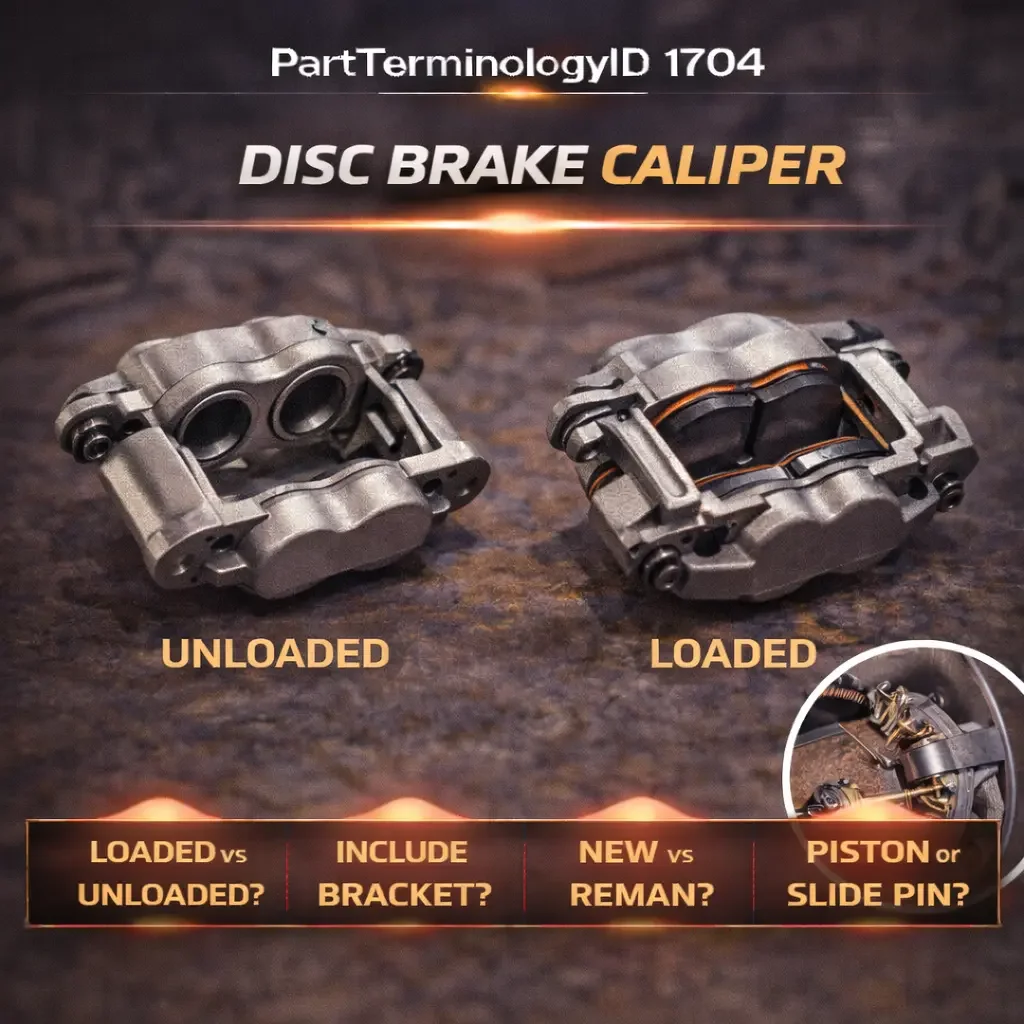
PIES/PCdb: PartTerminologyID 1704 - Disc Brake Caliper
PIES 8.0 / PCdb 2.0: No change
What Disc Brake Caliper Means in the Aftermarket
Floating versus fixed calipers
Floating (sliding) calipers are used on the vast majority of passenger vehicles. A floating caliper has a single piston (sometimes two pistons on the same side) on the inboard side only. The caliper body is mounted on two slide pins (guide pins) that allow the entire caliper to move laterally (side to side) relative to the rotor. When the piston pushes the inner pad against the rotor, the caliper body slides inward on its pins, pulling the outer pad against the rotor from the opposite side. This design requires only one or two pistons, keeps costs down, and simplifies packaging.
The slide pins are the Achilles' heel of the floating caliper. They are steel pins that slide inside rubber-booted, grease-filled bores in the caliper bracket. When the boots tear, the grease washes out and moisture enters, corroding the pins and binding the caliper. A seized slide pin prevents the caliper from centering over the rotor, causing the inner pad (piston side) to wear dramatically faster than the outer pad, uneven braking, noise, and brake drag.
Fixed calipers do not move. They are rigidly bolted to the steering knuckle or axle, and they use pistons on both sides of the rotor (two, four, six, or even eight pistons total). Fixed calipers provide more even pad wear, higher clamping force, and better pedal feel, but they are larger, heavier, more expensive, and used primarily on performance vehicles, heavy-duty trucks, and premium/luxury applications. Fixed calipers do not have slide pins, so they do not suffer from slide pin seizure - but they can still suffer from piston seizure, and with multiple pistons, the failure modes multiply.
In the aftermarket, floating calipers represent roughly 90% or more of replacement caliper sales. The rest of this post focuses on floating calipers unless otherwise noted.
The caliper mounting bracket
The caliper mounting bracket (also called the caliper anchor, caliper support, or caliper carrier) is the stationary component that bolts to the steering knuckle or axle flange. The slide pins are pressed into or threaded into the bracket, and the caliper body slides on these pins. The brake pads sit in the bracket, held by abutment clips, and the caliper clamps over them.
The bracket is a critical but frequently overlooked component. Its pad abutment surfaces (the ledges where the pad ears rest) wear over time, creating grooves that allow the pads to cock sideways, bind, or rattle. The slide pin bores corrode internally. The bracket bolt holes can strip or elongate. A worn bracket is one of the most common causes of brake noise and uneven pad wear that is misattributed to the pads or caliper.
Whether the bracket is included with the caliper is a major product configuration variable and a major source of returns.
Piston materials
Caliper pistons are made from three materials, each with different failure characteristics:
Steel pistons. The strongest and most thermally conductive piston material. Steel pistons transfer heat from the pad to the brake fluid more efficiently, which can cause brake fluid to boil sooner under severe braking (brake fade). Steel pistons corrode if the dust boot fails and moisture enters. Corrosion creates a rough surface that drags through the bore seal, causing the piston to stick.
Phenolic (plastic composite) pistons. A heat-resistant plastic composite that is lighter than steel and acts as a thermal insulator, reducing heat transfer from the pad to the brake fluid. This improves fade resistance by keeping the fluid cooler. However, phenolic pistons can absorb moisture over time, causing them to swell and bind in the bore. The degree of swelling depends on the phenolic formulation and cure cycle during manufacturing. Improperly cured phenolic pistons (a documented problem with some remanufactured calipers) can swell significantly, causing seizure within months. Phenolic pistons are used on many GM, Ford, and Chrysler applications from the 1980s onward.
Aluminum pistons. Used primarily on fixed calipers and performance applications. Aluminum is lightweight and a moderate heat conductor. Aluminum pistons can corrode if exposed to moisture, though less aggressively than steel. They are uncommon in standard aftermarket replacement calipers.
The piston material matters for remanufactured caliper quality because some remanufacturers substitute cheaper phenolic formulations or reuse worn steel pistons, both of which can cause premature seizure.
Product Configurations
This is where the aftermarket caliper category creates the most confusion. The buyer must understand four configuration variables:
New versus remanufactured
New calipers are manufactured from new castings with new pistons, new seals, new dust boots, new slide pins (if applicable), and new bleeder screws. They carry no core charge and require no core return. New calipers are available from OE manufacturers (Akebono, TRW, Brembo, Continental) and from aftermarket manufacturers (Raybestos, Cardone, Centric, A1 Cardone, BBB Industries, Nugeon). Quality varies significantly between manufacturers.
Remanufactured (reman) calipers are rebuilt from used caliper cores. The casting is cleaned, inspected, and machined if necessary. The piston bore is honed. New seals, dust boots, and bleeder screws are installed. The piston may be new or reused depending on the remanufacturer's standards. The caliper is pressure-tested and packaged. Reman calipers are sold on an exchange basis with a core charge - the buyer pays the core charge upfront and receives a credit when they return their old caliper.
Reman caliper quality is the single most contentious issue in the aftermarket brake category. A high-quality remanufacturer rejects damaged castings, uses new OE-equivalent pistons, hones bores to factory tolerance, replaces all rubber components, and pressure-tests every unit. A low-quality remanufacturer salvages as much as possible, may reuse worn steel pistons or substitute inferior phenolic pistons, uses cheaper seals and boots, and performs minimal inspection. The result is a caliper that works initially but seizes within months to two years - a documented pattern reported by technicians across multiple vehicle platforms, most notoriously on Ford Super Duty trucks with phenolic pistons.
The price difference between a budget reman caliper ($30 to $60) and a quality reman or new caliper ($80 to $200) often does not reflect the quality difference to the buyer until the caliper seizes and they are paying for a second replacement plus labor. This mirrors the quality stratification documented in wheel hub assemblies (PartTerminologyID 1636) and disc brake pad sets (PartTerminologyID 1684).
Loaded versus unloaded
Loaded calipers include the caliper body, piston, seals, dust boot, slide pins, pin boots, pin grease, bleeder screw, and pre-installed brake pads. Some loaded calipers also include the mounting bracket. A loaded caliper is a bolt-on assembly - the buyer removes the old caliper, bolts on the loaded caliper, connects the brake hose, bleeds the brakes, and the job is done. Loaded calipers are the preferred configuration for DIY buyers and for professional technicians who want to minimize labor time.
Unloaded calipers include the caliper body, piston, seals, dust boot, bleeder screw, and possibly slide pins and pin boots, but do not include brake pads or the mounting bracket. The buyer must transfer the bracket from the old caliper (if the bracket is shared between old and new), install their own pads, and install new pad hardware.
The loaded versus unloaded distinction is the highest-return configuration variable in the caliper category. The buyer who orders an unloaded caliper expecting it to arrive with pads installed is missing pads and cannot complete the job. The buyer who orders a loaded caliper with pads but without the bracket is missing the bracket and cannot mount the caliper to the vehicle. The buyer who orders a loaded caliper expecting to reuse their existing pads now has duplicate pads they did not want.
With bracket versus without bracket
This is an extension of the loaded/unloaded question but important enough to separate. On floating calipers, the mounting bracket is a separate component from the caliper body. Some caliper listings include the bracket; others do not. If the listing does not include the bracket, the buyer must transfer the old bracket to the new caliper. If the old bracket is corroded, has worn pad abutment surfaces, or has damaged slide pin bores, the buyer now needs a bracket they did not order.
When returning a reman caliper for core credit, the core must typically include the bracket if the replacement caliper included one. If the buyer received a caliper with bracket but their old caliper's bracket is in poor condition, they may receive reduced core credit.
Semi-loaded
Some manufacturers use the term "semi-loaded" to describe a caliper that includes slide pins, pin boots, and pin grease but not brake pads or the bracket. This intermediate configuration addresses the slide pin seizure problem (new pins and boots are pre-installed) without including the pads or bracket.
The Two Seizure Mechanisms
Caliper seizure is the primary reason calipers are replaced, and understanding the two distinct seizure mechanisms is essential for accurate diagnosis, correct part selection, and return prevention.
Piston seizure
The piston seizes in the caliper bore. This happens when corrosion (from moisture in the brake fluid or external moisture entering through a torn dust boot) creates a rough surface on the piston or bore wall. The piston either will not extend (the brake does not apply fully on that wheel) or will not retract (the brake drags continuously on that wheel).
Symptoms of piston seizure: the vehicle pulls to one side under braking (if the piston will not extend) or pulls to the opposite side during cruising (if the piston will not retract and is dragging). The inner brake pad wears dramatically faster than the outer pad (or wears completely away while the outer pad appears nearly new). The affected wheel may emit a burning smell, and the wheel/rotor may be significantly hotter than the opposite side after driving.
Piston seizure requires caliper replacement (or rebuild). Slide pin service will not fix it. New pads will not fix it. The buyer who replaces pads on a caliper with a seized piston will wear through the new inner pad within weeks and return the pads as "defective."
Slide pin seizure
The slide pins seize in the caliper bracket bores. This happens when the pin boots tear (allowing moisture and debris into the bore), the pin grease dries out or washes away, or corrosion binds the pin to the bore. The caliper body cannot slide laterally to center itself over the rotor.
Symptoms of slide pin seizure: uneven pad wear (inner pad wears faster than outer, though less dramatically than piston seizure), reduced braking on the affected wheel, noise (the pads do not sit squarely against the rotor), and possible slight brake drag. The symptoms can be subtle and may develop gradually.
Slide pin seizure does not necessarily require caliper replacement. If the piston is functioning correctly, the slide pins can be removed, cleaned (or replaced), re-greased with brake-specific silicone lubricant, and reinstalled with new pin boots. However, if the bracket's pin bores are corroded or scored beyond serviceability, the bracket must be replaced. This is where the "with bracket" versus "without bracket" configuration matters - a buyer replacing a caliper for slide pin seizure who receives a caliper without a bracket may still have the original problem.
The diagnostic distinction matters for returns
If the buyer's caliper is dragging because of seized slide pins but they order a new caliper without a bracket and transfer the old bracket (with its corroded pin bores), the new caliper will seize on the old bracket's pins within months. The buyer returns the caliper as "defective caliper that seized just like the old one" when the actual problem was the bracket they transferred.
Conversely, if the buyer's caliper is dragging because of a seized piston but they only service the slide pins (clean, re-grease, new boots), the drag will continue because the piston is the problem, not the pins.
The listing cannot diagnose the buyer's problem, but it can help by clearly stating whether the bracket is included and recommending that both the caliper and bracket be replaced together for a complete repair.
The Core Charge and Core Return Process
Remanufactured calipers are sold on an exchange basis. The buyer pays a core charge (typically $20 to $80 depending on the caliper) in addition to the caliper price. When the buyer returns their old caliper (the "core"), the core charge is refunded. If the core is not returned within the specified timeframe, or if the core is incomplete (missing the bracket, missing the bleeder screw) or non-rebuildable (cracked casting, severely corroded bore), the core charge refund may be reduced or denied.
The core return process generates its own set of returns and complaints:
Missing bracket on core return. The replacement caliper included the bracket. The buyer's old caliper bracket was not returned with the core. Core credit is reduced or denied.
Non-rebuildable core. The buyer's old caliper casting is cracked, severely pitted, or has a damaged bore. The core is rejected. The buyer feels they should receive core credit because they returned "a caliper."
Core return logistics. The buyer must package the old caliper (which is greasy, dirty, and heavy), arrange return shipping, and wait for the core credit to be processed. Some buyers find this process more trouble than the core credit is worth and simply absorb the core charge as part of the cost, which increases the effective price of the reman caliper.
For catalog teams, the core charge and return process should be clearly explained in the listing: the core charge amount, the return timeframe, the condition requirements for full core credit, and whether the bracket must be included in the core return.
The Brake Fluid Factor
Brake fluid is hygroscopic - it absorbs moisture from the atmosphere through microscopic pores in brake hoses and through the master cylinder reservoir seal. Over time, this moisture accumulates in the brake fluid. The moisture causes two problems: it lowers the boiling point of the brake fluid (increasing fade risk), and it causes internal corrosion of the caliper bore, piston, and other metal components in the hydraulic system.
Regular brake fluid flushes (every 2-3 years or as specified by the vehicle manufacturer) are the single most effective preventive measure against caliper piston seizure. Fresh brake fluid contains less than 1% moisture. Brake fluid that has not been changed in 5+ years may contain 3-5% moisture - enough to cause visible corrosion inside the caliper bore.
This matters for catalog teams because a buyer who replaces a seized caliper without flushing the brake fluid is installing a new caliper with old, moisture-contaminated fluid. The contaminated fluid will begin corroding the new caliper bore immediately. The buyer will be back in 2-3 years with another seized caliper. A listing note recommending brake fluid flush with caliper replacement helps prevent this cycle and reduces long-term warranty returns.
Top Return Causes
1) Loaded versus unloaded confusion
The buyer orders an unloaded caliper expecting pads to be included, or orders a loaded caliper and does not want/need the included pads. The buyer orders a caliper without bracket expecting the bracket to be included.
Prevention: Configuration clearly stated in the title: "Disc Brake Caliper - Loaded with Pads and Bracket" or "Disc Brake Caliper - Unloaded, Without Pads or Bracket." List every included component: caliper body, piston, seals, dust boot, slide pins, pin boots, pin grease, bleeder screw, brake pads (yes/no), mounting bracket (yes/no), pad hardware (yes/no).
2) Wrong caliper for the brake package
The vehicle has multiple brake package options (standard versus heavy-duty, single-piston versus dual-piston, standard versus performance/Brembo), and the buyer orders the wrong caliper. The caliper does not match the bracket, the rotor diameter, or the pad shape.
Prevention: Brake package in the fitment details: "Fits vehicles with standard brake package. Not for heavy-duty or performance brake package." Caliper piston diameter, bracket bolt spacing, and rotor diameter compatibility in the specifications.
3) Reman caliper seizes within months
A budget remanufactured caliper seizes from bore corrosion, piston swelling (phenolic), or seal failure. The buyer returns the caliper under warranty. This is a product quality issue, not a fitment issue.
Prevention: Difficult to address through listing content, but quality tier designation helps: "Premium remanufactured - new OE-equivalent piston, honed bore, pressure-tested" versus "Economy remanufactured." If selling budget reman calipers, a higher warranty return rate should be expected and planned for.
4) New caliper seizes on old corroded bracket
The buyer replaces the caliper but transfers the old bracket with corroded slide pin bores. The new caliper's pins bind in the old bracket. The buyer perceives a defective caliper.
Prevention: "For best results, replace the caliper and mounting bracket together. If reusing the existing bracket, inspect the slide pin bores for corrosion and scoring. Corroded bracket bores will cause the new caliper to bind regardless of the new slide pins and boots."
5) Caliper replaced but brake fluid not flushed
The buyer installs a new caliper and fills it with old, moisture-contaminated brake fluid. The contaminated fluid begins corroding the new bore immediately. The caliper seizes within 1-2 years.
Prevention: "Flush the entire brake hydraulic system with fresh DOT-specified brake fluid when replacing a caliper. Old, moisture-contaminated brake fluid is the primary cause of caliper bore corrosion and piston seizure. Brake fluid should be flushed every 2-3 years as preventive maintenance."
6) Core charge not understood, buyer returns the new caliper instead of the core
The buyer does not understand the core exchange process. They return the new caliper instead of the old caliper for core credit, or they do not return any core and are surprised by the non-refunded core charge.
Prevention: Core charge explanation: "This caliper includes a $XX.XX core charge. Return your old caliper within [timeframe] for a full core refund. The core must include the mounting bracket (if your replacement caliper includes one) and must be rebuildable (no cracked castings). Do not return the new caliper as a core - return your old removed caliper."
7) Single caliper replaced when both sides should be replaced
The buyer replaces one seized caliper but not the opposite side. The opposite caliper, which has been operating in the same environment, seizes months later. More significantly, replacing one caliper with a new unit (which has a fresh piston and pins that move freely) while leaving the opposite caliper (which has a piston and pins that are partially corroded) creates a braking imbalance - the new side responds faster and more completely than the old side, causing a pull under braking.
Prevention: "For balanced braking performance, replace calipers on both sides of the same axle simultaneously. If one caliper has seized from corrosion, the opposite caliper is likely in similar condition and approaching failure."
8) Bleeder screw position incorrect after installation
Calipers must be installed with the bleeder screw at the highest point of the caliper bore so that air can be bled from the top of the hydraulic circuit. If the caliper is installed with the bleeder at the bottom or side, air becomes trapped in the bore and cannot be bled out, resulting in a spongy pedal and reduced braking. Some calipers are side-specific (left and right) because the bleeder position must be at the top on both sides of the vehicle.
Prevention: Side specified in the title: "Left (Driver Side)" or "Right (Passenger Side)." "Install the caliper with the bleeder screw at the highest point. If the bleeder is not at the top after installation, verify that the correct side caliper was ordered."
Installation Considerations That Affect Returns
Brake hose sealing washers
The brake hose connection to the caliper uses copper or aluminum crush washers (banjo bolt washers) that seal the connection. These washers are designed to deform once under torque, filling the microscopic surface irregularities between the hose fitting, the banjo bolt, and the caliper port to create a fluid-tight seal at pressures exceeding 1,000 PSI. Once deformed, they cannot reliably seal a second time. These washers must be replaced every time the hose is disconnected. Reusing old washers risks a brake fluid leak that may not appear immediately but develops under hard braking when system pressure peaks. Many caliper listings do not include these washers, and the buyer may not have them on hand. A $2 pair of washers missing from the parts order can stall a caliper installation.
Caliper bracket bolt torque
The caliper mounting bracket bolts are among the highest-torque fasteners in the brake system (typically 75 to 130 ft-lbs depending on the application). These bolts secure the bracket to the steering knuckle or axle flange and bear the full braking load. Under-torqued bracket bolts can loosen during driving, allowing the entire caliper and bracket assembly to shift on the knuckle - a catastrophic failure. Over-torqued bracket bolts can strip the threads in the knuckle (especially on aluminum knuckles). Many bracket bolts use threadlocker from the factory and should be reinstalled with fresh threadlocker. The caliper slide pin bolts (smaller bolts that hold the caliper body to the bracket) have lower torque specifications (typically 25 to 40 ft-lbs) and should not be confused with the bracket bolts.
Brake bleeding
After connecting the brake hose to the new caliper, the system must be bled to remove air. Air in the hydraulic system causes a spongy pedal and reduced braking force. Bleeding requires either a helper (one person pumps the pedal, the other opens and closes the bleeder) or a vacuum bleeder tool. The buyer who cannot bleed the brakes after caliper installation will have a non-functional brake system and may attribute the spongy pedal to the new caliper.
Slide pin lubrication
On floating calipers, the slide pins must be lubricated with brake-specific silicone grease. Do not use petroleum-based grease (it will swell the rubber pin boots), chassis grease (wrong consistency, will not withstand brake temperatures), or anti-seize compound (too thin, will not provide adequate lubrication). Loaded calipers with pre-installed pins typically come pre-greased. Unloaded calipers may require the buyer to grease the pins during installation.
Pad break-in
If the caliper arrives loaded with new pads, the pads require a bed-in procedure (same as described in PartTerminologyID 1684 - 30 moderate stops from 30 mph) before full braking performance is achieved.
Compatibility Checklist for Buyers
1) Confirm your vehicle's brake package. Standard, heavy-duty, performance, or OE upgraded. Piston count (single, dual, multi-piston). Rotor diameter. This information is in the owner's manual or on the vehicle's build sheet.
2) Determine your configuration. Loaded (with pads and possibly bracket - bolt on and go) or unloaded (transfer your own pads and bracket). With bracket or without bracket. New or remanufactured.
3) Confirm the side. Left (driver) or right (passenger). Calipers are side-specific because of bleeder screw position and brake hose connection location.
4) Plan for both sides. Replace calipers on both sides of the same axle for balanced braking. If one has seized, the other is approaching failure.
5) Plan for brake fluid flush. Fresh DOT-specified brake fluid for the entire system, not just the new caliper. Old fluid will corrode the new caliper.
6) Have supplies ready. New copper/aluminum crush washers for the brake hose connection. Brake-specific silicone grease for slide pins (if unloaded caliper). Brake cleaner. Fresh brake fluid. Brake bleeder tool or a helper for manual bleeding. Torque wrench for bracket bolts and banjo bolt.
7) Understand the core charge. If purchasing a remanufactured caliper, know the core charge amount, the return timeframe, and the condition requirements. Save the packaging for core return shipping.
Catalog Checklist for Attributes
Core taxonomy: Configuration: loaded (with pads), unloaded (without pads), semi-loaded. Bracket: included, not included. Condition: new, remanufactured. Caliper type: floating (sliding), fixed. Piston count: single, dual, multi. Piston material: steel, phenolic, aluminum. Position: front, rear. Side: left (driver), right (passenger). Separate from caliper mounting bracket (if sold separately), brake pads (PartTerminologyID 1684), brake rotor (separate PartTerminologyID), caliper repair/rebuild kit (separate PartTerminologyID).
Fitment: Year, make, model, submodel, trim, engine, brake package. Position (front/rear). Side (left/right). Caliper manufacturer and model (Akebono, TRW, Brembo, Continental, etc.). Piston diameter. Bracket bolt spacing. Rotor diameter compatibility. Brake hose connection type (banjo bolt size).
Specifications: Caliper body material (cast iron, aluminum). Piston material (steel, phenolic, aluminum). Piston diameter. Piston count. Slide pin diameter and length. Bleeder screw size and thread. Overall caliper dimensions. Weight.
Included components: Caliper body with piston, seals, dust boot, bleeder screw. Slide pins and pin boots (yes/no). Pin grease (yes/no). Brake pads (yes/no - if loaded). Mounting bracket (yes/no). Pad hardware/abutment clips (yes/no). Brake hose crush washers (yes/no). Core charge amount (if reman).
Installation notes: Side-specific installation (bleeder screw at top). Brake hose crush washer replacement. Slide pin lubrication (brake-specific silicone grease only). Brake system bleeding required. Brake fluid flush recommended. Pad bed-in procedure (if loaded). Replace both sides for balanced braking. Core return instructions (if reman).
Images: Caliper assembly showing all included components. Bleeder screw position. Slide pin and boot detail. Bracket (if included). Piston and bore (for new calipers showing clean bore condition). Brake hose connection point.
FAQ
Should I buy a loaded or unloaded caliper?
If you are replacing the caliper and need new pads anyway (which is almost always the case - the old pads have been worn by the seized caliper), buy loaded. It saves time and ensures the pads are matched to the caliper. If you have specific pads you want to use (performance pads, ceramic upgrade, etc.), buy unloaded and install your own pads.
Should I buy new or remanufactured?
Quality reman calipers from reputable remanufacturers are a cost-effective option. Budget reman calipers from unknown remanufacturers carry higher risk of premature seizure from inferior pistons, seals, or bore preparation. If budget allows, new calipers eliminate the core charge hassle and the risk of reman quality variance.
Do I need to replace both calipers?
Strongly recommended. If one caliper has seized, the opposite side is operating in the same environment and is likely approaching the same failure. Replacing one caliper also creates a braking imbalance between the new side (fresh, free-moving piston) and the old side (partially corroded, sluggish piston). Replace both for balanced, predictable braking.
Why did my replacement caliper seize so quickly?
Most common causes: old brake fluid not flushed (moisture-contaminated fluid corrodes the new bore), old bracket reused with corroded pin bores (new pins bind in old bracket), or low-quality remanufactured caliper with inferior piston material or inadequate bore preparation. Flush the brake fluid and replace the bracket with the caliper to prevent recurrence.
What grease do I use on the slide pins?
Brake-specific silicone grease only. Do not use petroleum-based grease (swells rubber boots), chassis grease (wrong temperature rating), white lithium grease (breaks down at brake temperatures), or anti-seize (too thin). The correct product is typically labeled "synthetic caliper grease" or "silicone brake grease" and is rated for the temperature range of brake components (400-600 degrees F).
Final Take for Aftermarket Teams
Disc Brake Caliper (PartTerminologyID 1704) is the most expensive per-unit brake component in the aftermarket, and its return rate reflects the configuration complexity (loaded versus unloaded, with bracket versus without, new versus reman, left versus right) more than any product defect rate.
The catalog teams that reduce these returns do six things consistently. First, they state the full configuration in the title: loaded or unloaded, with or without bracket, new or remanufactured, left or right. That single line of title clarity prevents the majority of configuration-mismatch returns. Second, they itemize every included component in the listing, because "loaded caliper" means different things to different manufacturers (some include the bracket, some do not, some include pad hardware, some do not). Third, they specify the brake package in the fitment details, because vehicles with multiple brake options generate the highest wrong-caliper return rate. Fourth, they explain the core charge and core return process for remanufactured calipers, including the bracket requirement and the condition standards. Fifth, they recommend replacing both calipers on the same axle for balanced braking and to prevent the return that comes when the opposite caliper seizes three months after the first one was replaced. Sixth, they recommend a brake fluid flush with every caliper replacement, because that single maintenance step is the most effective prevention against the warranty return that arrives 18 months later with the same seizure problem on a caliper that should have lasted ten years.