
Drum Brake Self-Adjuster Cable (PartTerminologyID 1700): The Cable That Keeps the Pedal From Hitting the Floor
Written by Arthur Simitian | PartsAdvisory
The drum brake self-adjuster cable is a short steel cable (typically 4 to 8 inches long) inside the drum brake assembly that connects the anchor pin at the top of the backing plate to the self-adjuster lever at the bottom, providing the mechanical linkage that automatically advances the star wheel adjuster as the brake shoes wear. When the brakes are applied (typically in reverse), the secondary shoe moves outward and pulls the adjuster cable taut, which lifts the adjuster lever. When the brakes are released, the lever drops back and - if the shoes have worn enough to create excess clearance - the lever catches the next tooth on the star wheel and advances it one click, pushing the shoes slightly closer to the drum. This incremental adjustment maintains consistent shoe-to-drum clearance and prevents the brake pedal from gradually sinking toward the floor as the shoes wear.
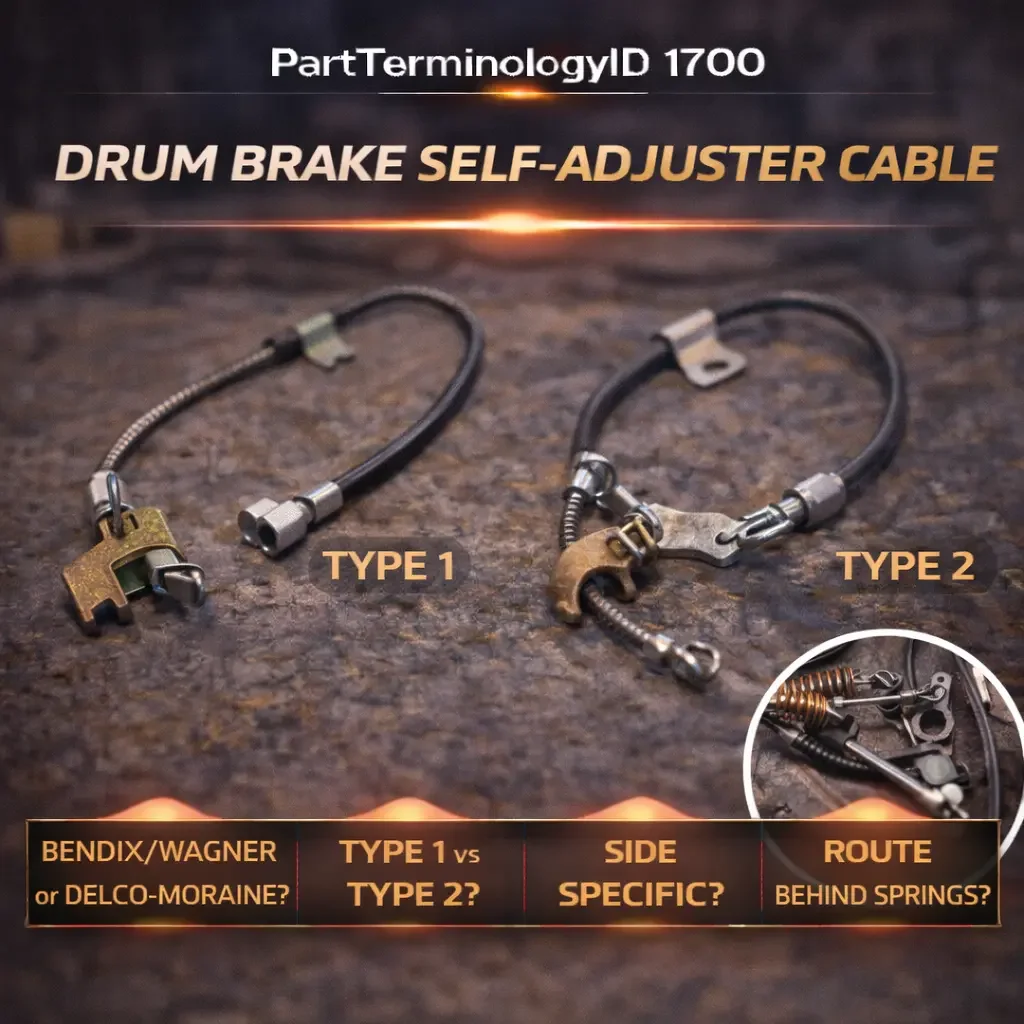
This is a low-profile, low-cost component (typically $3 to $10) that generates returns primarily through misidentification and routing errors. The cable is specific to the drum brake design type (Bendix/Wagner Type 1 versus Type 2 versus Delco-Moraine), the side of the vehicle (some applications use mirror-image cables), and the cable guide configuration. It is also one of the most frequently overlooked components during drum brake shoe replacement (PartTerminologyID 1688) - the technician reuses the old cable because it "looks fine," but the cable has stretched, frayed internally, or corroded at the anchor pin end, and the self-adjuster stops functioning within weeks of the shoe replacement.
PIES/PCdb: PartTerminologyID 1700 - Drum Brake Self-Adjuster Cable
PIES 8.0 / PCdb 2.0: No change
What Drum Brake Self-Adjuster Cable Means in the Aftermarket
The product
The self-adjuster cable is a short, formed steel cable with specific end fittings: one end loops over the anchor pin at the top of the drum brake backing plate (often routed behind the upper return springs), and the other end hooks into the self-adjuster lever near the bottom of the assembly. A cable guide (a small stamped steel channel, sometimes called a "half moon" guide) holds the cable in the correct path along the secondary shoe web, preventing the cable from shifting out of alignment with the adjuster lever.
The cable works in conjunction with three other self-adjuster components: the adjuster lever (a pivoting arm that engages the star wheel teeth), the adjuster lever spring (which provides return force to the lever), and the star wheel adjuster screw assembly (PartTerminologyID covered separately, the threaded mechanism that sets shoe-to-drum clearance). All four components must function correctly for automatic adjustment to occur. A failed cable means no automatic adjustment, which means progressively increasing shoe-to-drum clearance, which means a progressively longer brake pedal, which means reduced braking effectiveness.
Cable versus link self-adjuster designs
Not all drum brake self-adjusters use a cable. There are two primary design families:
Cable-type (Bendix/Wagner). Uses the steel cable described above. The cable routes from the anchor pin, through the cable guide on the secondary shoe, to the adjuster lever. This is the most common design on American passenger vehicles from the 1960s through the 2000s, and the design that PartTerminologyID 1700 covers. There are two sub-types: Type 1 uses a cable with a hook end that attaches to the adjuster lever, with a separate spring connecting the lever to the primary shoe. Type 2 uses a cable with an integrated spring and guide that attaches to the lever, with the lever pinned to the secondary shoe.
Link-type (Delco-Moraine). Uses a rigid stamped steel link instead of a cable. The link connects from the anchor pin to a spring-loaded lever assembly. The link does not stretch or fray like a cable, but the lever assembly pivot can wear. Link-type adjusters are a separate product from cable-type adjusters, though buyers sometimes confuse them.
The listing must clearly identify which design the cable fits. A cable for a Bendix/Wagner Type 1 system will not work in a Delco-Moraine link-type system, and vice versa. This is the most common misidentification in the category.
Why the cable fails
Fraying. The steel cable is multi-strand. Individual strands break from fatigue (repeated cycling) and corrosion. As strands break, the cable stretches incrementally. A stretched cable does not pull the adjuster lever far enough to engage the star wheel, and the self-adjuster stops functioning. The cable may appear intact on visual inspection because the outer strands hide the broken inner strands.
Corrosion at the anchor pin end. The loop end of the cable wraps around the anchor pin, which is exposed to brake dust, moisture, and heat. Corrosion at this junction can freeze the cable loop on the anchor pin, preventing the cable from sliding freely when the brakes are applied and released.
Cable guide displacement. The cable guide is a small stamped part that clips to the secondary shoe web. If the guide shifts or falls off (common during shoe replacement if the technician does not reinstall it correctly), the cable changes its effective path, altering the geometry so the adjuster lever does not engage the star wheel properly.
Incorrect routing during reassembly. The cable must route behind the upper return springs and through the cable guide in a specific path. If the cable is routed in front of the return springs or bypasses the guide, the cable length geometry changes and the self-adjuster will not function. This is the most common installation error, and it is nearly invisible once the drum is reinstalled - the brake appears to work normally until the shoes wear and the pedal begins to sink.
What Is Included
The self-adjuster cable is typically sold as a single cable for one wheel. Some listings sell the cable with the cable guide; others sell the cable alone. The buyer needs one cable per wheel (two per axle, left and right).
The listing should specify:
Cable only, or cable with guide
Quantity (one cable or two)
Whether the adjuster lever and adjuster lever spring are included (they usually are not - these are separate components or part of a brake hardware kit)
Cross-reference with the drum brake hardware kit, which often includes the self-adjuster cable, guide, lever, lever spring, and all other brake hardware. If the buyer is purchasing a complete hardware kit with their shoes (PartTerminologyID 1688), they may not need a separate self-adjuster cable.
Top Return Causes
1) Wrong adjuster design type (cable-type versus link-type)
The buyer orders a cable for a drum brake that uses a link-type adjuster (Delco-Moraine), or orders a link when they have a cable-type system (Bendix/Wagner). The parts are not interchangeable.
Prevention: Self-adjuster design type in the title or description: "Fits Bendix/Wagner cable-type self-adjuster" or "Not for Delco-Moraine link-type adjuster." Include a reference image showing the cable-type versus link-type for visual identification.
2) Already included in the brake hardware kit
The buyer orders a complete brake hardware kit with their shoes, then orders a separate self-adjuster cable, not realizing the hardware kit includes the cable. This is a duplicate purchase, not a defect, but it generates a return.
Prevention: Cross-reference the brake hardware kit part number. "Verify whether your brake hardware kit already includes the self-adjuster cable before ordering separately."
3) Wrong side (left versus right)
On some applications, the self-adjuster cable is mirror-image for the left and right sides (different hook orientation or cable guide attachment). The buyer orders the wrong side.
Prevention: Side specified in the title if application-specific: "Left (Driver Side)" or "Right (Passenger Side)." If the cable is universal (same for both sides), state "Fits both left and right."
4) Cable routing error after installation - self-adjuster does not function
The cable is installed but routed incorrectly (in front of the return springs instead of behind, or bypassing the cable guide). The self-adjuster does not advance the star wheel. The buyer perceives a defective cable.
Prevention: "Route the cable behind the upper return springs and through the cable guide on the secondary shoe web. After installation, verify self-adjuster operation: pull the adjuster lever away from the star wheel - it should advance one click and spring back. If it does not, check cable routing and guide position."
5) Cable appears to fit but is for a different sub-type
Bendix/Wagner Type 1 and Type 2 cables may have similar overall lengths but different end fitting configurations. The buyer installs a Type 1 cable in a Type 2 system (or vice versa) and the adjuster lever does not engage correctly.
Prevention: Adjuster sub-type in the fitment details. Include the end fitting description: "Anchor pin loop with hook end for adjuster lever (Type 1)" versus "Anchor pin loop with integrated spring and guide (Type 2)."
Catalog Checklist for Attributes
Core taxonomy: Self-adjuster design: cable-type (Bendix/Wagner Type 1, Type 2), not for link-type (Delco-Moraine). Position: front drum brake (rare), rear drum brake (common). Side: left, right, universal. Separate from self-adjuster link (different product), self-adjuster lever (different component), star wheel adjuster screw, drum brake hardware kit (may include this cable).
Fitment: Year, make, model, submodel, trim. Drum brake design type and self-adjuster type. Side (left, right, universal). Drum diameter (may affect cable length).
Specifications: Cable overall length. End fitting types (anchor pin loop, hook, integrated spring). Cable guide included (yes/no). Cable material (steel, stainless steel).
Included components: Cable (quantity - one or two). Cable guide (yes/no). Adjuster lever spring (yes/no, usually no).
Installation notes: Route cable behind upper return springs. Route through cable guide on secondary shoe web. Verify cable guide position on shoe web. Test adjuster lever engagement after assembly. One cable per wheel, two per axle.
Images: Cable assembly showing both end fittings. Cable guide (if included). Installation routing diagram showing cable path relative to return springs, anchor pin, cable guide, and adjuster lever.
FAQ
How do I know if my self-adjuster cable needs replacement?
If the brake pedal gradually sinks lower with each application over weeks or months, the self-adjuster is not compensating for shoe wear. The cable is the most common failure point. Inspect the cable for fraying (individual broken strands), stretching (cable feels loose when shoes are at normal wear), or corrosion at the anchor pin end. If in doubt, replace the cable - it is inexpensive and the labor to access it (drum removal, shoe removal) is the same labor required for shoe replacement.
Can I reuse the old self-adjuster cable when replacing shoes?
You can, but it is not recommended. The cable has been cycling for the full life of the old shoes and may have internal fraying not visible on the surface. Best practice is to replace all brake hardware, including the self-adjuster cable, with every shoe replacement. A complete brake hardware kit typically includes the cable and is the most economical way to replace everything at once.
My self-adjuster is not working after I reassembled the brakes. What did I do wrong?
The most common cause is incorrect cable routing. The cable must pass behind the upper return springs and through the cable guide on the secondary shoe. If routed in front of the springs or outside the guide, the cable geometry changes and the adjuster lever will not engage the star wheel. Also verify: the star wheel adjuster screw is oriented correctly (threads facing the correct direction for the side of the vehicle), the adjuster lever is properly seated on its pivot, and the adjuster lever spring is connected to the correct shoe.
Final Take for Aftermarket Teams
Drum Brake Self-Adjuster Cable (PartTerminologyID 1700) is a low-cost, high-importance component where returns are driven by design type confusion (cable versus link, Type 1 versus Type 2), duplicate purchases (hardware kit already includes it), and post-installation routing errors that the buyer perceives as a defective cable.
The catalog teams that avoid these returns do three things. First, they specify the self-adjuster design type (Bendix/Wagner cable-type, with sub-type if applicable) and explicitly exclude link-type systems. Second, they cross-reference the complete brake hardware kit to prevent duplicate purchases. Third, they include a routing note - cable behind upper return springs, through the cable guide - because that single instruction prevents the most common reason a new self-adjuster cable fails to function after installation.