
Written by Arthur Simitian | PartsAdvisory
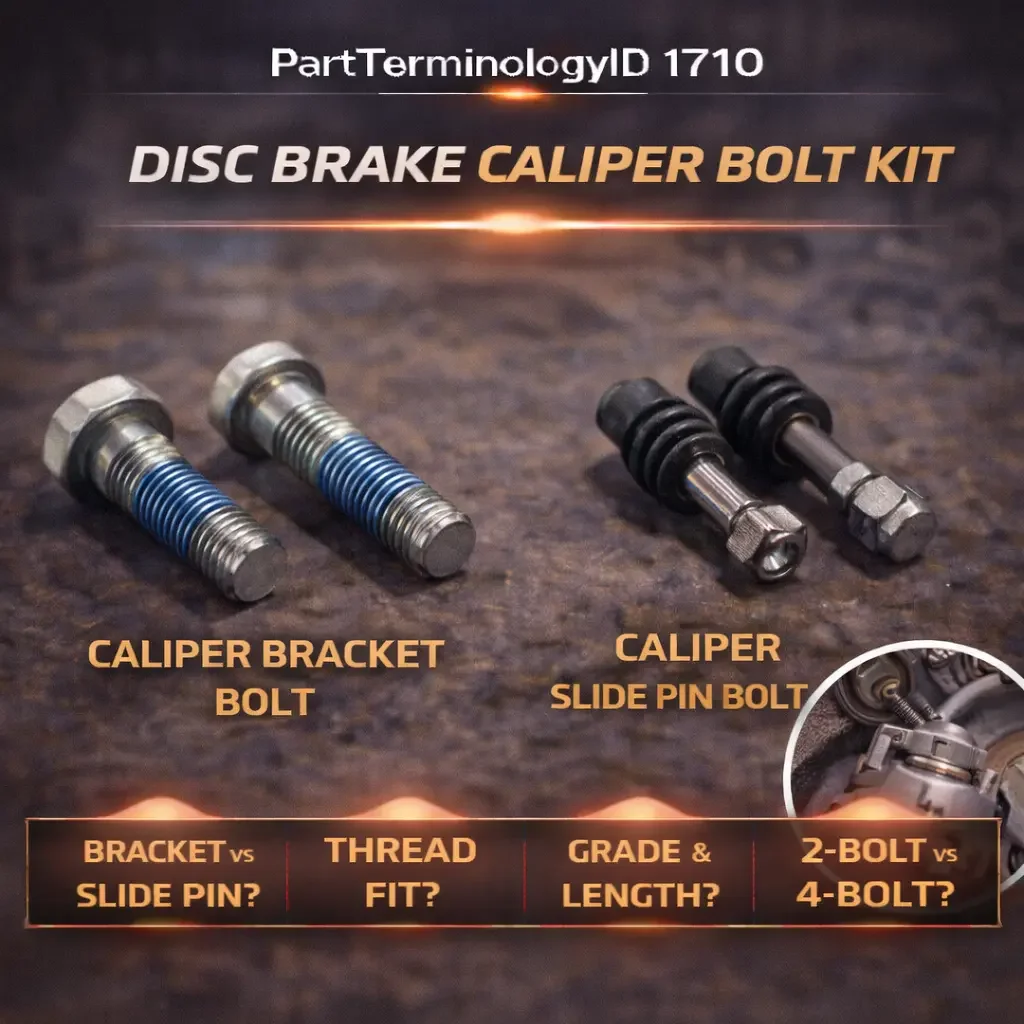
The disc brake caliper bolt kit is a set of fasteners - typically two bolts per caliper, four per axle - that secure the caliper mounting bracket to the steering knuckle or axle flange. These are the structural bolts that bear the full braking load: every pound of clamping force the caliper exerts on the rotor creates a reaction force that these bolts must resist. They are not the slide pin bolts (which hold the caliper body to the bracket and allow it to float) - they are the bracket-to-knuckle bolts that anchor the entire brake assembly to the vehicle's suspension.
This distinction is the single most important thing to understand about this PartTerminologyID, because confusing caliper bracket bolts with caliper slide pin bolts is the primary source of returns and misapplication in this category. The two bolt types are different in size, torque specification, thread pitch, material grade, and function. Installing a slide pin bolt where a bracket bolt belongs is a safety-critical error that can result in the bracket separating from the knuckle under braking.
The caliper bolt kit is a low-cost, low-glamour product ($5 to $25 per kit) that exists because the OE bracket bolts are frequently damaged during caliper service: corroded threads from salt exposure, rounded hex heads from improper tool use, threads stripped in the knuckle from over-torquing, or bolts stretched from repeated removal and reinstallation. On some applications, the OE bolts use a one-time-use threadlocker patch or a torque-to-yield design that requires replacement after each removal.
PIES/PCdb: PartTerminologyID 1710 - Disc Brake Caliper Bolt Kit
PIES 8.0 / PCdb 2.0: No change
What Disc Brake Caliper Bolt Kit Means in the Aftermarket
The two bolt types in a disc brake system
A floating caliper disc brake assembly uses two distinct sets of bolts, and the catalog must never confuse them:
Caliper bracket bolts (mounting bolts). These are the large, high-torque bolts (typically M12 or M14, torqued to 75-130 ft-lbs) that secure the caliper mounting bracket to the steering knuckle or axle flange. They are structural fasteners that bear the full braking load. They are typically Grade 10.9 or 12.9 metric bolts or Grade 8 SAE bolts. Many OE bracket bolts have a factory-applied threadlocker (a dry patch of threadlocking compound on the threads) that activates when the bolt is torqued. This threadlocker is consumed during the first installation and may not provide adequate locking force on reinstallation. Some manufacturers specify that bracket bolts be replaced with every removal; others specify fresh liquid threadlocker on reinstallation.
Caliper slide pin bolts (guide pin bolts). These are the smaller bolts (typically M8 or M10, torqued to 25-40 ft-lbs) that hold the caliper body to the mounting bracket and serve as the slide pins (or secure the slide pins). On some designs, the slide pin bolt IS the slide pin - the bolt shaft slides in a bore in the bracket with a rubber boot sealing the bore. On other designs, the slide pin is a separate component and the bolt simply retains it. These bolts are covered under caliper hardware or caliper slide pin kits, not under this PartTerminologyID.
PartTerminologyID 1710 - Disc Brake Caliper Bolt Kit - covers the bracket-to-knuckle mounting bolts. The listing must make this clear, because the buyer who searches for "caliper bolts" may need either type, and receiving bracket bolts when they need slide pin bolts (or vice versa) is the most common return in this category.
Why the bolts need replacement
Corrosion. Bracket bolts are exposed to road salt, water, and brake dust. The threads corrode, making removal difficult and increasing the risk of thread stripping in the aluminum or cast iron knuckle. Corroded bolt heads become rounded during removal, requiring extraction tools, which damages the bolt beyond reuse.
Threadlocker depletion. OE bolts with factory threadlocker patches lose their locking ability after the first removal. The bolt can be reinstalled, but it may not resist vibration-induced loosening as well as the original installation. Some technicians apply fresh liquid threadlocker (typically medium-strength, blue Loctite 243 or equivalent) on reinstallation. Others prefer to replace the bolt with a new one that has a fresh threadlocker patch.
Thread damage. Over-torquing the bracket bolt can strip the threads in the knuckle (especially aluminum knuckles on modern vehicles). Under-torquing can allow the bolt to loosen. Repeated removal and reinstallation cycles elongate the bolt holes slightly and work-harden the bolt threads, reducing clamping force.
Torque-to-yield designs. Some OE bracket bolts are torque-to-yield (TTY) fasteners designed to stretch permanently when torqued to specification. These bolts must be replaced after every removal because they have already been plastically deformed and will not achieve the correct clamping force on reinstallation. TTY bracket bolts are becoming more common on newer vehicles.
Upgrade or conversion. Buyers performing brake upgrades (larger calipers, different bracket geometry) may need longer or different-thread bolts to accommodate the new bracket or caliper configuration.
What Is Included
A disc brake caliper bolt kit typically contains:
Two bracket-to-knuckle bolts (enough for one caliper / one side)
Washers (if the application uses them between the bolt head and the bracket)
New threadlocker patches on the bolt threads (on some kits)
Some kits contain four bolts (enough for both calipers on one axle). The listing must specify the quantity: "2-bolt kit (one caliper)" or "4-bolt kit (one axle, both calipers)."
The kit does not typically include the slide pin bolts, the caliper body, the bracket, or any brake pads or hardware. If the buyer needs slide pin bolts, they need a caliper slide pin kit or caliper hardware kit, not this product.
Top Return Causes
1) Bracket bolts versus slide pin bolts confusion
The buyer needs slide pin bolts (smaller, lower torque, hold caliper body to bracket) and orders bracket bolts (larger, high torque, hold bracket to knuckle), or vice versa. The bolts are the wrong size for the intended application.
Prevention: The title must specify: "Disc Brake Caliper BRACKET Bolt Kit - Bracket to Knuckle Mounting Bolts." The description should explicitly state: "These bolts secure the caliper mounting bracket to the steering knuckle. These are NOT the slide pin bolts that hold the caliper body to the bracket. For slide pin bolts, see [cross-reference]." Include bolt dimensions (thread size, length, head style) for buyer verification.
2) Wrong thread size or length
The bolt thread diameter, pitch, or length does not match the knuckle's threaded bore. This occurs when the vehicle has had a brake upgrade, a different knuckle installed, or when the year/make/model has multiple knuckle options with different thread specifications.
Prevention: Bolt specifications in the listing: thread size (M12x1.5, M14x2.0, etc.), bolt length (under head), head size and style (hex, 12-point, flanged), and grade (10.9, 12.9). "Verify the bolt thread size and length match your knuckle bore before installation."
3) Buyer does not realize bolts need replacement
The buyer is replacing pads or a caliper and does not order new bracket bolts. During disassembly, the bolt heads round off, the threads strip, or the bolt snaps. The buyer now needs bolts urgently but did not order them. This is not a return issue for this PartTerminologyID but a missed-sale issue. However, once the buyer does order replacement bolts, they may order the wrong type under time pressure.
Prevention: Cross-reference in the caliper listing (PartTerminologyID 1704) and pad listing (PartTerminologyID 1684): "Inspect caliper bracket bolts during brake service. Replace if corroded, damaged, or if OE bolts have one-time-use threadlocker."
4) Kit quantity confusion (one caliper versus one axle)
The buyer orders a 2-bolt kit expecting it to cover both calipers (one axle) when it only covers one caliper. They discover mid-job that they need a second kit for the other side.
Prevention: Quantity in the title: "2-Bolt Kit (1 Caliper)" or "4-Bolt Kit (1 Axle, Both Calipers)." "Each caliper requires 2 bracket bolts. Order 2 kits for a complete axle set if purchasing the 2-bolt configuration."
5) Bolt grade too low for the application
The buyer substitutes a generic hardware store bolt (Grade 5 or 8.8) for an OE Grade 10.9 or 12.9 bracket bolt. The lower-grade bolt has less tensile strength and may stretch or fail under braking loads. While this is an installation decision rather than a catalog issue, listings that do not specify the bolt grade leave the buyer without the information needed to verify the replacement is adequate.
Prevention: Bolt grade clearly stated: "Grade 10.9 metric (equivalent to SAE Grade 8)." "Do not substitute lower-grade hardware. Caliper bracket bolts are safety-critical structural fasteners that must meet or exceed OE grade specifications."
Catalog Checklist for Attributes
Core taxonomy: Bolt type: caliper bracket-to-knuckle mounting bolt. NOT slide pin bolts (different product). Position: front, rear. Quantity: per caliper (2 bolts) or per axle (4 bolts). Separate from caliper slide pin kit, caliper hardware kit, caliper body (PartTerminologyID 1704), caliper mounting bracket.
Fitment: Year, make, model, submodel, trim, engine. Brake package (standard, heavy-duty, performance). Position (front/rear). Knuckle material (cast iron, aluminum - affects thread engagement requirements).
Specifications: Thread size and pitch (M12x1.5, M14x2.0, etc.). Bolt length (under head). Head size and style (hex, 12-point, flanged hex). Bolt grade (8.8, 10.9, 12.9, or SAE equivalent). Threadlocker (factory patch, requires liquid threadlocker, or none). Washer included (yes/no). Material (alloy steel, zinc-plated, phosphate-coated).
Included components: Number of bolts. Washers (if applicable). Threadlocker type (if factory-applied).
Installation notes: Torque specification. Threadlocker requirement (new patch, liquid threadlocker, or dry). Thread cleaning in knuckle bore before installation. Do not substitute lower-grade bolts. Replace both sides for consistency. TTY bolts must not be reused.
Images: Bolt(s) showing thread, head style, and any threadlocker patch. Bolt dimensions annotated. Reference showing bolt position on caliper bracket/knuckle assembly (to distinguish from slide pin bolts).
FAQ
Are caliper bracket bolts the same as caliper slide pin bolts?
No. Bracket bolts (this product) are larger, higher-torque bolts that secure the mounting bracket to the steering knuckle. Slide pin bolts are smaller bolts that hold the caliper body to the bracket or serve as the slide pins. They are different sizes, different torque specifications, and different functions. Do not interchange them.
Do I need to replace the bracket bolts every time I do a brake job?
Not necessarily, but inspect them. If the bolts have factory threadlocker patches (a visible colored coating on the threads), the locking ability is reduced after the first removal. If the bolts show corrosion, thread damage, or rounded heads, replace them. If the bolts are torque-to-yield (TTY) design, they must be replaced after every removal. When in doubt, the low cost of the bolt kit ($5 to $25) makes replacement a sensible precaution on a safety-critical fastener.
Can I use bolts from the hardware store instead of a caliper bolt kit?
Only if the replacement bolts match the OE thread size, length, head style, and grade exactly. Caliper bracket bolts are typically Grade 10.9 or 12.9 metric, which is not commonly stocked at general hardware stores. Using a lower-grade bolt risks fastener failure under braking loads. A vehicle-specific caliper bolt kit ensures the correct grade, dimensions, and threadlocker for the application.
Final Take for Aftermarket Teams
Disc Brake Caliper Bolt Kit (PartTerminologyID 1710) is a low-cost, safety-critical fastener kit where the return rate is driven almost entirely by one confusion: bracket bolts versus slide pin bolts. These are different products with different sizes, different torque specs, and different functions, but they are both called "caliper bolts" by buyers.
The catalog teams that eliminate this confusion do two things. First, they put "BRACKET" in the title and description to distinguish from slide pin bolts: "Caliper Bracket Mounting Bolt Kit - Bracket to Knuckle." Second, they include the bolt dimensions (thread size, length, grade) so the buyer can physically verify the bolt matches their application before installation. That combination of clear naming and dimensional specification prevents the majority of returns in this small but safety-critical category.