
Parking Brake Cable (PartTerminologyID 1696): The Cable That Seizes Because Nobody Uses It
Written by Arthur Simitian | PartsAdvisory
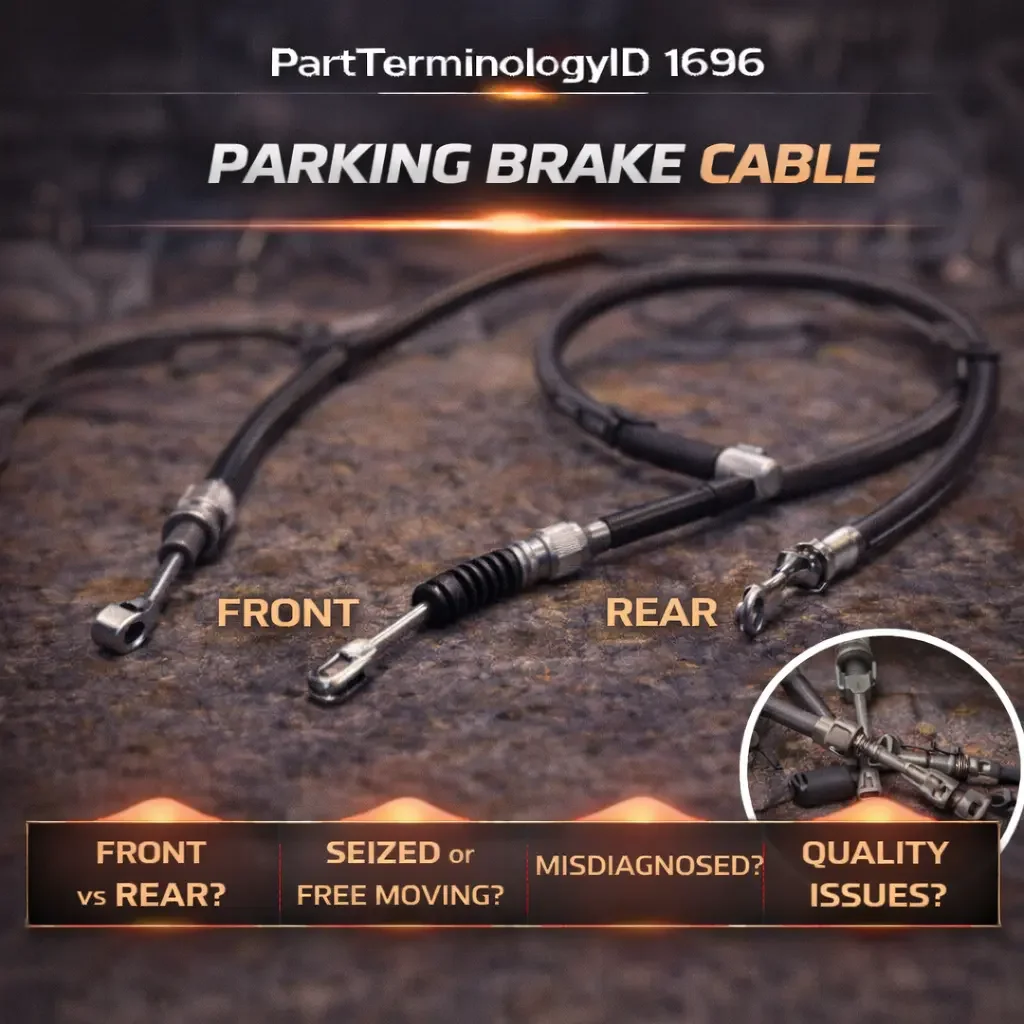
The parking brake cable is a steel inner wire inside a protective conduit (outer housing) that transmits mechanical force from the parking brake lever or pedal inside the vehicle to the rear brake assembly, applying the parking brake to hold the vehicle stationary. A typical parking brake system uses two or three cables: a front cable from the lever/pedal to the equalizer, and one or two rear cables from the equalizer to the brake assemblies at each rear wheel. The equalizer is a junction mechanism that balances the applied force between the two rear wheels and provides a means of adjusting cable tension.
The parking brake cable is a paradox in the aftermarket. Its primary failure mode - seizing from internal corrosion between the inner wire and the outer conduit - is caused by the cable not being used. Vehicles whose parking brakes are applied and released regularly maintain free-moving cables because the cycling action prevents moisture from settling and corrosion from bonding the inner wire to the housing. Vehicles whose parking brakes sit dormant for months or years (common on automatic-transmission vehicles where drivers rely solely on the transmission park pawl) develop internal corrosion that progressively binds the cable until it either seizes in the applied position (dragging the brakes), seizes in the released position (no parking brake function), or snaps from the weakened, corroded wire strands.
This is a mid-volume product with a high return rate driven by three factors: the cable system uses multiple position-specific cables that are not interchangeable, aftermarket cable quality is inconsistent (documented problems with end fitting dimensions, conduit protection, and cable length), and the installation is often far more labor-intensive than the buyer anticipates because the routing path runs through the vehicle interior, under the floor pan, and through corroded guide brackets.
PIES/PCdb: PartTerminologyID 1696 - Parking Brake Cable
PIES 8.0 / PCdb 2.0: No change
What Parking Brake Cable Means in the Aftermarket
The cable system architecture
A complete parking brake cable system consists of multiple cables, and the buyer must understand the system architecture to order the correct one:
Front cable (primary cable, apply cable). Runs from the parking brake lever or pedal inside the vehicle cabin, through the firewall or floor pan, to the equalizer underneath the vehicle. This cable transmits the driver's input force. On foot-operated parking brakes (common on trucks and SUVs), this cable routes from the pedal assembly through the dash area, through a grommet in the floor pan, and under the vehicle to the equalizer. On hand-operated parking brakes (center console lever), it routes downward through the console area and through the floor pan.
Rear cable(s) (secondary cables, wheel cables). Run from the equalizer to the brake assemblies at each rear wheel. On some vehicles, a single rear cable splits at the equalizer to serve both wheels. On others, two separate rear cables (driver side and passenger side) connect to the equalizer independently. The rear cables route along the frame rail, axle, or underbody to the brake backing plate, where they pass through the backing plate and connect to the parking brake lever on the drum brake assembly or to the caliper-mounted parking brake mechanism on disc brake vehicles.
Intermediate cable. On some vehicles, an additional cable segment connects between the front cable and the equalizer, or between sections of the routing path where a single cable cannot span the full distance. Intermediate cables are vehicle-specific and less commonly available in the aftermarket.
Equalizer. The equalizer is not a cable but is integral to the cable system. It may be a threaded adjuster with a nut that sets overall cable tension, a pivot bar that balances force between the two rear cables, or a combination of both. The equalizer bracket (covered in PartTerminologyID 1692 - Parking Brake Cable Guide) holds this mechanism in position.
Cable construction
The inner wire is a multi-strand steel cable (typically 7x7 or 7x19 construction) with end fittings swaged or formed onto each end. End fittings vary by application: a barrel (cylindrical) end for the lever or pedal connection, a hook or clevis for the equalizer connection, and a formed end for the brake assembly connection. The specific shape, size, and orientation of each end fitting is vehicle-specific and is the primary fitment variable.
The outer conduit is a flexible steel housing (wound steel wire or braided steel) with a plastic or rubber outer jacket that protects the inner cable from road debris, moisture, and abrasion. The conduit transfers the reaction force from the inner cable to its mounting points (the guide brackets and backing plate fitting). OE cables typically have continuous plastic jackets with additional rubber boots at each end to seal out moisture. Aftermarket cables may have gaps in the jacket or less robust end seals, which accelerates moisture intrusion and corrosion.
Why cables seize
The inner wire slides inside the conduit with a thin film of factory-applied lubricant between them. Over time, moisture enters through the cable ends (especially where the jacket terminates or where end boots deteriorate), displaces the lubricant, and causes corrosion between the wire strands and the conduit interior. This corrosion binds the wire to the conduit.
Regular parking brake use cycles the wire back and forth, which breaks up early-stage corrosion, redistributes the lubricant, and expels moisture. Cables on vehicles that use the parking brake daily can last the life of the vehicle. Cables on vehicles that never use the parking brake can seize in as little as three to five years, especially in salt-belt climates.
Once a cable is seized, no amount of penetrating oil will reliably free it. The corrosion exists along the entire inner length of the conduit, and lubricant applied from the ends cannot reach the full contact area. The cable must be replaced.
Cable versus caliper mechanism
A common diagnostic confusion: the parking brake does not release, and the buyer assumes the cable is seized. But on vehicles with caliper-integrated parking brakes (disc brake rear axles where the caliper piston incorporates a mechanical screw mechanism for the parking brake), the internal caliper mechanism itself may be frozen rather than the cable. Disconnecting the cable from the caliper and testing the cable independently is the correct diagnostic step. If the cable moves freely when disconnected, the caliper mechanism is the problem, not the cable. Ordering a new cable will not fix a frozen caliper.
This diagnostic confusion generates returns: the buyer replaces the cable, the parking brake still does not work, and the buyer returns the cable as "defective."
What Is Included
A parking brake cable is sold as a single cable assembly for one specific position on the vehicle:
Front cable (lever/pedal to equalizer) - one per vehicle
Rear cable, driver side - one per vehicle
Rear cable, passenger side - one per vehicle
Intermediate cable (if applicable) - one per vehicle
Each cable includes the inner wire with end fittings, the outer conduit with jacket, and any factory-attached grommets, seals, or end boots. The cable does not typically include the equalizer, the cable guide brackets (PartTerminologyID 1692), or the backing plate conduit fitting (though some cables include the backing plate fitting as an integral part of the conduit end).
The listing must specify which cable position is being sold. "Parking brake cable" without a position designation is meaningless because the front, rear driver, and rear passenger cables are all different lengths with different end fittings and different routing configurations.
The Aftermarket Quality Problem
Parking brake cables have a documented aftermarket quality inconsistency. Common problems reported by technicians and buyers include:
End fitting dimensions. The barrel end, hook end, or clevis end does not precisely match the OE dimensions. The cable attaches but sits at an angle, does not fully seat on the actuator hook, or can disengage under tension. This is particularly common with lever-end fittings where a dimensional difference of 1-2mm determines whether the cable locks into the lever mechanism.
Conduit length. The cable is slightly too long or too short for the routing path. Too long, and the cable cannot be pulled tight enough to apply the parking brake fully. Too short, and the cable is under tension even when released, causing brake drag.
Conduit protection. The outer jacket does not extend as far as the OE cable, leaving sections of the steel conduit exposed to road spray and corrosion. These exposed sections are the entry points for moisture that causes premature seizure.
End seal quality. The rubber boots at the cable ends are thinner, looser, or absent compared to OE. Moisture enters and the cable corrodes internally within a fraction of the OE cable's life span.
These quality issues have led to a common technician sentiment that parking brake cables are one of the few components where OE is worth the premium price, because an aftermarket cable that seizes in two years costs more in total (parts plus labor for a second replacement) than an OE cable that lasts ten years.
For catalog teams, this means quality tier designation is important: clearly distinguish OE-equivalent cables from budget alternatives, and if possible, note conduit jacket coverage and end seal quality in the listing.
Top Return Causes
1) Wrong cable position (front versus rear, driver versus passenger)
The buyer orders "a parking brake cable" and receives the front cable when they need the rear driver side, or vice versa. The cable lengths and end fittings are completely different.
Prevention: Cable position in the title: "Parking Brake Cable - Rear, Driver Side (Left)" or "Parking Brake Cable - Front, Lever to Equalizer." Never list a parking brake cable without position designation.
2) Cable does not fix the problem - caliper mechanism is frozen, not the cable
The buyer replaces the rear cable on a disc brake vehicle, but the parking brake still does not work because the caliper's internal parking brake mechanism is seized. The buyer returns the cable as non-functional.
Prevention: "If your parking brake is not engaging or releasing, disconnect the cable from the rear brake assembly and test the cable independently. If the cable moves freely when disconnected, the brake mechanism (not the cable) may be seized. On disc brake vehicles with caliper-integrated parking brakes, the caliper mechanism may need service or replacement."
3) End fitting does not match the actuator
The cable's end fitting does not properly seat on the parking brake lever, pedal mechanism, or caliper attachment point. The cable "almost fits" but sits at an angle or does not lock.
Prevention: This is a quality/manufacturing issue that is difficult to address through listing content alone. Including the OE part number cross-reference helps buyers verify compatibility. "Verify the end fitting shape and dimensions match your original cable before installation."
4) Cable too long or too short
The cable length does not match the vehicle's routing path. The cable cannot be adjusted to the correct tension.
Prevention: Cable length (overall and inner wire travel) in the specifications. OE part number cross-reference. "Compare the overall length and end fitting configuration of this cable to your original cable before installation."
5) Buyer orders one cable when multiple cables are needed
The buyer's parking brake system has multiple seized cables, but they order only one. They replace one cable, the system still does not function correctly because a second cable is also seized, and they attribute the problem to the new cable.
Prevention: "Parking brake systems use 2-3 cables (front, rear driver side, rear passenger side). If one cable has seized from corrosion, the remaining cables are likely in similar condition. Inspect all cables and replace any that do not move freely."
6) Installation complexity exceeds expectations
The buyer orders the cable expecting a simple swap but discovers the routing path requires removing interior trim, dropping exhaust components, removing heat shields, or accessing the floor pan from inside the vehicle. The job takes several hours or days instead of the expected 30 minutes. The buyer abandons the repair and returns the cable.
Prevention: While installation difficulty is not a product defect, a note can set expectations: "Parking brake cable replacement requires access to the vehicle interior (for the front cable) and the vehicle underside. Routing paths may require removal of interior trim panels, exhaust heat shields, or underbody covers. Allow adequate time for routing and securing the cable through all guide points."
Catalog Checklist for Attributes
Core taxonomy: Cable position: front (lever/pedal to equalizer), rear driver side, rear passenger side, intermediate. Brake type at rear: drum brake, disc brake with caliper-integrated parking brake, disc brake with drum-in-hat parking brake. Separate from parking brake cable guide (PartTerminologyID 1692), parking brake shoes (drum-in-hat), brake caliper parking brake mechanism.
Fitment: Year, make, model, submodel, trim, engine. Cable position. Rear brake type. Drive type (2WD/4WD may affect cable length due to different axle positions). Wheelbase (different wheelbases may use different cable lengths on the same model). Production date splits (mid-year cable routing changes).
Specifications: Overall cable length. Inner wire travel (stroke). Conduit length. End fitting type and dimensions (both ends). Conduit outer diameter. Jacket material and coverage.
Included components: Cable assembly (inner wire, conduit, end fittings). Grommets or seals (if included). Backing plate conduit fitting (if included). Mounting hardware (if any).
Installation notes: Cable position on vehicle. Routing path description. Guide bracket positions. Equalizer connection method. Brake assembly connection method. Parking brake adjustment procedure after installation. Cable travel test after installation.
Images: Complete cable assembly showing both end fittings. End fitting detail (both ends). Routing diagram or position reference on vehicle.
FAQ
Why did my parking brake cable seize?
Internal corrosion between the inner wire and the outer conduit, caused by moisture entering through the cable ends. Cables that are used regularly (parking brake applied and released daily) stay free because the cycling action prevents corrosion from bonding. Cables on vehicles where the parking brake is rarely or never used are most susceptible to seizure, especially in salt-belt climates.
Can I lubricate a seized parking brake cable to free it?
Generally no. Once the inner wire is corroded to the conduit along its full length, penetrating oil applied from the ends cannot reach the full contact area. Replacement is the only reliable fix. However, cables that are stiff but still move may benefit from lubrication as a temporary measure. The best prevention is regular use of the parking brake to keep the cable cycling.
Do I need to replace all the parking brake cables at once?
Not necessarily, but it is recommended. If one cable has seized from corrosion, the others are in the same environment and likely in similar condition. Replacing all cables at once avoids a second repair when the next cable seizes months later. At minimum, inspect all cables by disconnecting them and checking for free movement.
Why does my parking brake still not work after replacing the cable?
Possible causes: the caliper-integrated parking brake mechanism is seized (disc brake vehicles), the parking brake shoes are worn or contaminated (drum brake and drum-in-hat vehicles), the equalizer adjustment has not been set (the new cable requires tension adjustment at the equalizer nut), or a second cable in the system is also seized. Disconnect and test each component independently to isolate the failure.
Final Take for Aftermarket Teams
Parking Brake Cable (PartTerminologyID 1696) is a position-specific cable assembly where the return rate is driven by three factors: wrong cable position ordered (front versus rear, driver versus passenger), misdiagnosis (cable replaced when the caliper mechanism is the actual failure), and aftermarket quality inconsistency (end fitting dimensions, conduit length, jacket coverage).
The catalog teams that reduce these returns specify the cable position in the title (front, rear driver, rear passenger), include the cable length and end fitting descriptions in the specifications, cross-reference with the cable guide brackets (PartTerminologyID 1692) and related cables for the same vehicle, and include the diagnostic note about testing the cable independently from the brake mechanism before ordering. That diagnostic note alone prevents the most frustrating return in the category: the buyer who replaces a perfectly good cable because the real problem is a frozen caliper.