
Parking Brake Cable Guide (PartTerminologyID 1692): The Bracket Nobody Orders Until the Cable Won't Route
Written by Arthur Simitian | PartsAdvisory
The parking brake cable guide is a stamped steel or formed metal bracket, clip, or channel that routes, secures, and directs the parking brake cable along its path from the parking brake lever (or pedal) to the rear brake assembly. Cable guides are mounted at various points along the vehicle's underside - on the frame rail, the floor pan, the crossmember, the rear axle, or the brake backing plate - and they hold the cable in a specific position to prevent the cable from contacting exhaust components, suspension parts, drivetrain components, or the road surface.
This is a low-glamour, low-search-volume component that generates returns primarily through misidentification. The parking brake system on a single vehicle may use three to six individual cable guides of different shapes, sizes, and mounting configurations, and the buyer who orders "a parking brake cable guide" without specifying which position on the vehicle they need will almost certainly receive the wrong one. The product is also frequently overlooked during cable replacement - the technician replaces the cable and reuses the corroded, bent, or broken guide, then discovers the new cable does not route correctly through the damaged guide.
PIES/PCdb: PartTerminologyID 1692 - Parking Brake Cable Guide
PIES 8.0 / PCdb 2.0: No change
What Parking Brake Cable Guide Means in the Aftermarket
The product
A parking brake cable guide is not a single universal part. It is a family of position-specific brackets, clips, channels, and routing fixtures that hold the parking brake cable in the correct path. The cable guide may be any of the following physical forms:
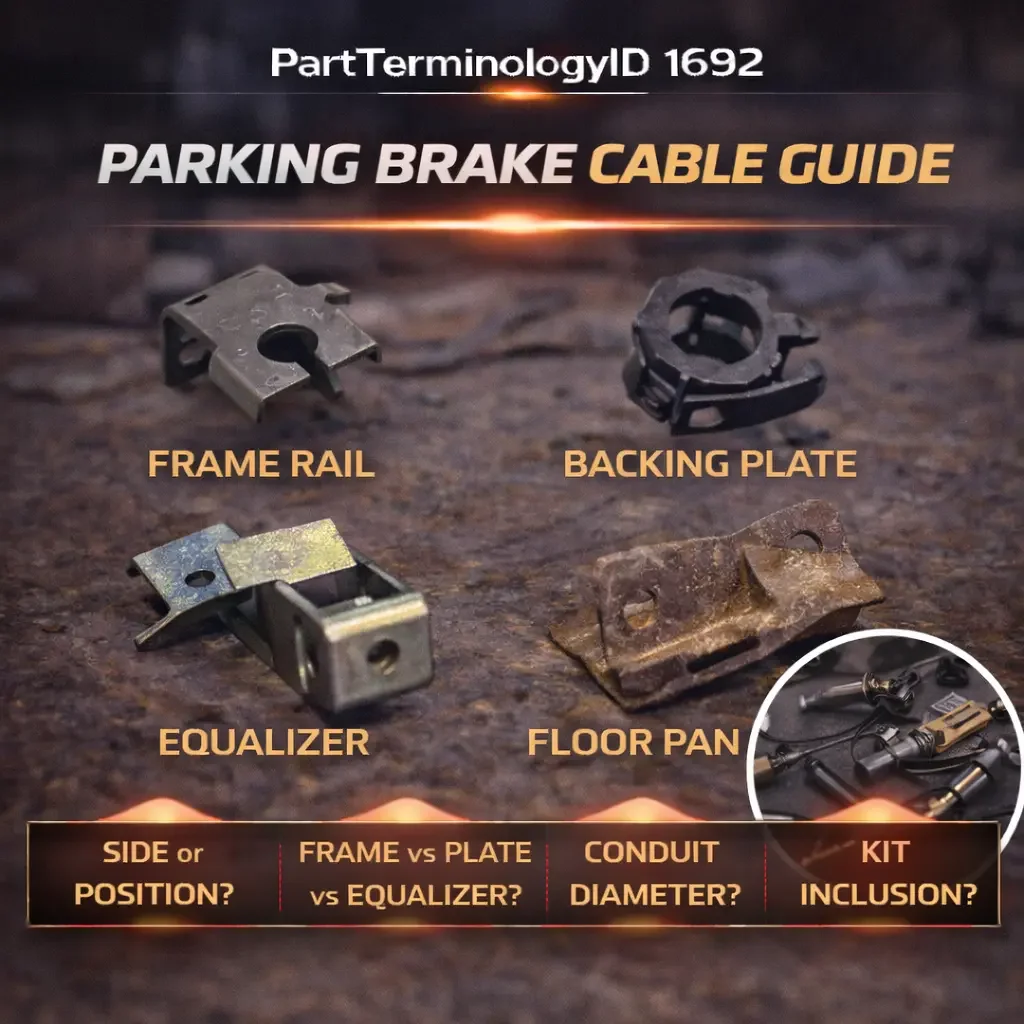
Frame-mounted channel or saddle. A U-shaped or C-shaped stamped bracket that bolts or clips to the frame rail and holds the cable conduit in a specific position. The cable slides freely through the guide while the conduit (the outer housing) is locked in place.
Backing plate pass-through fitting. A grommet, ferrule, or retainer that secures the cable conduit where it enters the brake backing plate. This fitting typically has spring-loaded retaining tangs that snap into a hole in the backing plate, locking the conduit in position. The cable inner wire passes through the fitting and attaches to the parking brake lever on the shoe assembly.
Crossmember clip. A simple spring-steel clip that snaps onto a crossmember or body panel and captures the cable conduit. These are often shared with other underbody cable or line routing (fuel lines, brake lines) and may not be sold as a "parking brake cable guide" specifically.
Equalizer bracket. The bracket that holds the equalizer (the Y-shaped junction where the single front cable splits into the two rear cables, or where the two rear cables are balanced by an adjuster mechanism). This bracket is structural and positions the equalizer at the correct height and angle for proper cable tension distribution.
Floor pan guide. A formed bracket or clip riveted or bolted to the underside of the floor pan that routes the front cable from the parking brake lever down to the equalizer.
Each of these guides is vehicle-specific in shape, mounting hole position, and cable conduit diameter. They are not interchangeable between positions or between vehicles.
Why cable guides fail
Cable guides are exposed to the full underside environment: road salt, water, mud, gravel impact, and temperature cycling. They corrode, crack, bend, break, and lose their retention force over time.
Corrosion. The most common failure mode. Salt-belt vehicles lose cable guides to rust. The bracket corrodes until it can no longer hold the cable conduit, and the cable drops and contacts the exhaust or gets pinched by suspension travel. Corroded backing plate pass-through fittings lose their retaining tangs and allow the cable conduit to push out of the backing plate.
Impact damage. Gravel, road debris, or contact with obstacles (curbs, rocks, speed bumps on lowered vehicles) can bend or break a cable guide bracket.
Fatigue and vibration. Cable guides that are welded or riveted to the frame or floor pan can crack at the attachment point from vibration fatigue over years of driving.
Broken during cable replacement. The retaining tangs on backing plate pass-through fittings are designed for one-time installation. Removing the cable conduit from the backing plate often breaks or deforms the tangs, making the fitting unable to retain the new cable conduit. The technician then needs a new guide fitting, which was not ordered because nobody anticipated the fitting would break.
Why cable guides are overlooked
Cable guides are overlooked because they are perceived as "just brackets" - they do not wear, they do not have friction surfaces, they are not springs, and they do not contain moving parts. Technicians and DIY installers focus on the cable itself (the wear item that is binding, frayed, or snapped) and assume the routing brackets will be reused. But a corroded guide that has lost its shape or its retention force will not hold the new cable in the correct path, and the result is a cable that contacts the exhaust (melting the conduit), gets pinched by suspension travel (binding or snapping the cable), or hangs loose and catches on road debris.
What Is Included
The parking brake cable guide is typically sold as a single bracket or clip for one specific position on the vehicle. The buyer must identify which position they need:
Front cable guide (lever to equalizer)
Intermediate cable guide (frame rail routing)
Rear cable guide (axle or backing plate area)
Backing plate cable conduit fitting
Equalizer bracket
Some cable replacement kits include the guide fittings for the backing plate pass-through. Most do not include frame or crossmember guides. The listing must clearly specify which guide is being sold by position description, not just by part number, because the buyer searching for a "parking brake cable guide" may need any one of several position-specific parts.
Top Return Causes
1) Wrong position on the vehicle
The buyer orders a cable guide without specifying which position they need. The vehicle may have four to six different guides, all sold under the same general product name. The buyer receives a frame rail guide when they needed a backing plate fitting, or vice versa.
Prevention: Position clearly stated in the title: "Parking Brake Cable Guide - Frame Rail, Driver Side" or "Parking Brake Cable Conduit Fitting - Backing Plate." Include the mounting location description and a reference image showing the guide's position on the vehicle.
2) Guide not needed - cable kit already includes it
Some aftermarket parking brake cable assemblies include the backing plate pass-through fitting as part of the cable assembly. The buyer orders a separate guide fitting that duplicates what came with the cable. This is a wasted purchase, not a defect, but it generates a return.
Prevention: Cross-reference with the parking brake cable part number. "Verify whether your replacement cable assembly includes the backing plate conduit fitting before ordering this guide separately."
3) Guide broken during installation
The retaining tangs on backing plate pass-through fittings are fragile. The buyer pushes the fitting into the backing plate hole and the tangs break or do not fully engage. The fitting does not lock and the cable conduit pushes out under parking brake application.
Prevention: "Press the conduit fitting squarely into the backing plate hole until the retaining tangs click into place. Do not force at an angle. If the tangs are damaged during installation, the fitting must be replaced."
4) Corrosion prevents removal of old guide
The old guide is rusted to the frame or backing plate and cannot be removed without destroying it (or the surrounding metal). The buyer orders the new guide but cannot install it because the mounting surface is corroded, the bolt holes are stripped, or the backing plate hole has enlarged from rust.
Prevention: This is not preventable through the listing, but a note is helpful: "On salt-belt vehicles, cable guide brackets may be corroded to the mounting surface. Apply penetrating oil before removal. Inspect the mounting surface and bolt holes after removal. If the backing plate hole has enlarged from corrosion, the backing plate may need replacement."
5) Wrong side (driver versus passenger)
On vehicles with side-specific cable guide brackets (different shapes for the driver and passenger sides due to exhaust or fuel tank routing), the buyer orders the wrong side.
Prevention: Side specified in the title: "Driver Side (Left)" or "Passenger Side (Right)." If the guide is universal (same for both sides), state "Fits both driver and passenger sides."
Catalog Checklist for Attributes
Core taxonomy: Position on vehicle: front (lever to equalizer), intermediate (frame rail), rear (axle/backing plate area), backing plate fitting, equalizer bracket. Side: driver, passenger, universal. Separate from parking brake cable (different PartTerminologyID), brake backing plate (PartTerminologyID 1628), drum brake shoe (PartTerminologyID 1688), parking brake hardware kit (may include some guides).
Fitment: Year, make, model, submodel, trim. Cable guide position (front, intermediate, rear, backing plate). Side (left, right, universal). Mounting type (bolt-on, clip-on, rivet, snap-in). Cable conduit OD compatibility.
Specifications: Material (stamped steel, stainless steel, nylon, composite). Mounting hole spacing. Conduit diameter. Overall dimensions.
Included components: Number of guides per package. Mounting hardware (bolts, clips, rivets) included or not.
Installation notes: Position on vehicle. Mounting orientation. Cable routing direction. Penetrating oil for corroded fasteners. Inspect mounting surface condition.
Images: Guide shown alone with mounting holes and conduit channel visible. Reference image showing position on vehicle or backing plate.
FAQ
Do I need to replace the cable guide when I replace the parking brake cable?
Inspect all cable guides during cable replacement. If any guide is corroded, bent, cracked, or has lost its retention (the cable conduit moves freely instead of being locked in position), replace that guide. Backing plate pass-through fittings should be replaced whenever the cable is replaced, because the retaining tangs are typically damaged during cable removal.
How do I know which cable guide I need?
Identify the position on the vehicle where the guide has failed or is missing. Parking brake systems use multiple guides in different locations. Measure the cable conduit outer diameter and the mounting bolt spacing if applicable. Compare to the listing specifications. When possible, order by OEM part number for the specific position.
Is the parking brake cable guide the same as the brake cable bracket?
Yes, these are the same product category under different names. Parking brake cable guide, brake cable bracket, cable clip, cable routing bracket, cable conduit retainer, and cable support bracket are all used to describe position-specific routing hardware for the parking brake cable. The exact name varies by manufacturer and catalog system.
Final Take for Aftermarket Teams
Parking Brake Cable Guide (PartTerminologyID 1692) is a low-volume, position-specific routing bracket that generates returns almost exclusively through misidentification. The buyer does not know which of the four to six guides on their vehicle they need, or they do not know that the guide is a separate component from the cable assembly.
The catalog teams that avoid these returns do two things. First, they specify the guide position on the vehicle in the title (frame rail, backing plate, equalizer, floor pan) and the side (driver, passenger, universal). Second, they cross-reference the parking brake cable part number and note whether the cable assembly includes a backing plate conduit fitting, because that single cross-reference prevents the most common duplicate purchase in this category.