
Written by Arthur Simitian | PartsAdvisory
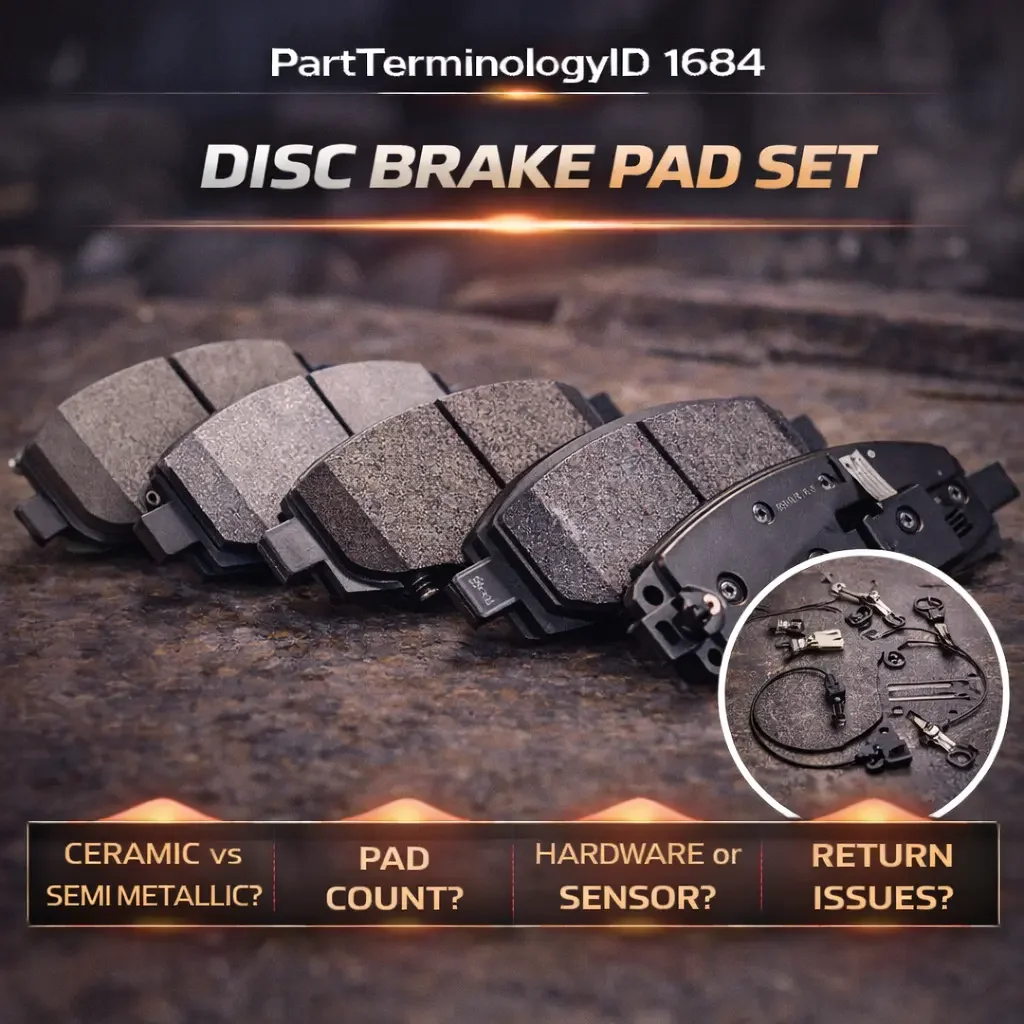
The disc brake pad set is the set of friction pads - typically four pads for one axle (two per caliper, two calipers per axle) - that squeeze against the brake rotor when the driver applies the brakes, converting the vehicle's kinetic energy into thermal energy through friction and slowing the wheel. This is the single highest-volume replacement part in the automotive aftermarket by unit count, generating more individual SKUs, more consumer purchases, more online searches, and more returns than almost any other product category in the chassis and brake space.
The volume is driven by the fact that brake pads are a universal wear item on every disc-brake-equipped vehicle (which is virtually every vehicle built after the mid-1970s for front brakes and after the early 2000s for rear brakes), they wear out predictably (every 30,000 to 70,000 miles depending on driving style, pad formulation, and vehicle weight), and they are the most common DIY brake repair. The returns are driven by the sheer number of fitment variables (vehicle-specific pad shape, caliper type, hardware inclusion, sensor inclusion, formulation preference), the quality stratification between budget and premium products, and the noise/dust complaints that arise when the buyer's expectations about pad behavior do not match the pad formulation they purchased.
This post covers the product in the depth that the category demands: what the pad set includes, how formulations differ and why it matters for listings, what fitment variables drive returns, and how catalog teams can reduce the return rate on the most-sold brake product in the aftermarket.
PIES/PCdb: PartTerminologyID 1684 - Disc Brake Pad Set
PIES 8.0 / PCdb 2.0: No change
What Disc Brake Pad Set Means in the Aftermarket
The product
A disc brake pad consists of two bonded components: a steel backing plate and a friction material compound molded and bonded (or, on some heavy-duty and racing applications, riveted) to one face of the backing plate. The friction material is the wear surface that contacts the brake rotor. The backing plate provides structural rigidity, distributes the clamping force from the caliper piston across the friction material, and serves as the mounting surface for any attached hardware (wear sensors, anti-squeal shims, anti-rattle clips).
A "disc brake pad set" (PartTerminologyID 1684) is typically sold as a set of four pads - enough for one axle (left and right wheels). Two pads are installed in each caliper: an inboard pad (closest to the vehicle center, pushed by the caliper piston) and an outboard pad (closest to the wheel, pushed by the caliper bracket or the caliper body). On some vehicles, the inboard and outboard pads are identical; on others, they are different (the inboard pad may have a wear sensor attachment point, a different backing plate shape, or a different shim configuration).
Some listings sell pads for one caliper only (two pads). The buyer must understand whether the listing covers one axle (four pads) or one caliper (two pads), because ordering a two-pad set when four are needed leaves one wheel undone, and installing new pads on only one side of an axle creates a dangerous braking imbalance.
The formulation landscape
This is where the aftermarket complexity explodes. The friction material formulation determines how the pad performs in every measurable dimension: stopping power, fade resistance, noise, dust, rotor wear, cold-weather performance, wet-weather performance, pedal feel, and service life. Three primary formulation families dominate the automotive aftermarket:
Non-Asbestos Organic (NAO / Organic). Made from organic fibers (glass, rubber, carbon, Kevlar), fillers, and resin binders. NAO pads are the OE standard on approximately 67% of new vehicles sold in the United States. They are quiet, produce moderate dust, provide a soft pedal feel, and are gentle on rotors. They are the least expensive formulation. Their weaknesses are shorter wear life (they are the softest material), reduced performance under high heat (they fade sooner than other formulations), and a narrower effective temperature range. NAO pads are appropriate for normal daily driving, commuting, and light-duty use.
Semi-Metallic. Made from 30% to 70% metallic content (steel, iron, copper, and other metals) mixed with friction modifiers, fillers, and resin binders. Semi-metallic pads are the OE standard on many trucks, SUVs, performance vehicles, and European vehicles. They provide the highest stopping power across the widest temperature range, the best fade resistance under heavy braking, and good cold-weather performance. Their weaknesses are higher noise (they are the noisiest formulation), more brake dust (dark, metallic dust that adheres to wheels), more aggressive rotor wear (the metallic content abrades the rotor surface faster), and a harder pedal feel. Semi-metallic pads are appropriate for towing, hauling, performance driving, mountain driving, cold climates, and any application where stopping power and fade resistance are priorities.
Ceramic. Made from ceramic fibers and compounds with copper fibers (note: copper content is being reduced by EPA regulation, with a mandate to reach 0.5% copper by weight by 2025, affecting current and future formulations), bound with resin. Ceramic pads are the premium aftermarket option. They are the quietest formulation, produce the least visible dust (a fine, light-colored dust that does not adhere to wheels), provide a firm pedal feel, and have the longest wear life. Their weaknesses are the highest cost, slightly lower initial bite in cold conditions compared to semi-metallic, and the fact that they transfer more heat through the pad into the caliper and brake fluid (because the ceramic material itself absorbs less heat than metallic content). Ceramic pads are appropriate for daily driving where noise and dust are priorities, luxury and premium vehicles, and buyers who want the longest service interval.
The OE-match question
One of the most consequential debates in brake pad marketing is whether to replace pads with the same formulation type that the vehicle manufacturer originally specified (OE-match or OE-equivalent) or to upgrade/change to a different formulation. The vehicle manufacturer selects the OE pad formulation as part of a tuned system: the pad, rotor, caliper, ABS calibration, and brake booster are all designed to work together. Changing the pad formulation changes the behavior of the entire braking system.
For catalog and listing purposes, this means:
OE-match listings should clearly state the OE formulation type and position the product as a direct replacement that preserves the original braking characteristics.
Upgrade/alternative formulation listings should clearly state how the pad differs from OE (quieter, more stopping power, less dust, longer wear) and note that the braking feel and behavior may change from what the driver is accustomed to.
The buyer who installs a ceramic pad on a vehicle that came with semi-metallic pads from the factory will notice a softer initial bite, less noise, less dust, but potentially reduced stopping power under aggressive braking or towing conditions. The buyer who installs semi-metallic pads on a vehicle that came with ceramic pads will notice more noise, more dust, a harder pedal feel, but improved cold-weather bite and fade resistance. Neither is "wrong," but the buyer who is not informed about the difference will attribute the changed behavior to a "defective" pad and return it.
What Is Included in a Disc Brake Pad Set
The contents of the box vary significantly by manufacturer and product tier, and this variation is a major source of buyer confusion and incomplete repairs. The listing must clearly specify what is included:
Pads only
The four (or two) brake pads with friction material bonded to backing plates. No hardware, no shims, no sensors, no grease. This is the most basic product offering. The buyer must reuse the existing hardware or purchase it separately. Reused hardware (clips, shims, springs) that has lost its spring tension or is corroded is the most common cause of brake noise and uneven pad wear on an otherwise correctly installed pad set.
Pads with hardware
The pads plus the abutment clips (slide clips), anti-rattle clips, pad retainer springs, and/or anti-squeal shims. This is the recommended product configuration because new hardware restores proper pad movement and contact, reducing noise and promoting even wear. Best practice is to replace all brake hardware with every pad change, because reused clips lose spring tension and corroded hardware causes pad binding and uneven wear.
Pads with hardware and wear sensor
On vehicles equipped with electronic pad wear sensors (common on European vehicles: BMW, Mercedes-Benz, Audi, Volkswagen, Porsche, and some domestic and Japanese vehicles), the pad set may include a replacement wear sensor wire. The wear sensor is a small wire loop embedded in the pad friction material or attached to the pad backing plate. When the pad wears down to a threshold thickness, the wire contacts the rotor and either breaks (completing or interrupting a circuit, depending on design) or generates a resistance change that triggers the dashboard brake wear indicator. The sensor is a one-time-use component that is destroyed when activated and must be replaced with the pads.
If the pad set does not include the wear sensor, the buyer must order it separately. Installing new pads without replacing an activated wear sensor will leave the dashboard warning light illuminated, which the buyer will perceive as a defective product or incomplete repair.
Pads with anti-squeal shims (backing plate shims)
Some pad sets include anti-squeal shims (thin metal or rubberized-metal layers) that attach to the back of the pad backing plate. These shims dampen the high-frequency vibration that produces brake squeal. On some vehicles (especially Japanese vehicles), the OE pads have shims permanently attached. Aftermarket pads may or may not include these shims. A pad set without shims installed on a vehicle that originally had shims may produce noise that the OE pads did not.
Pads with molded-on chamfers and slots
Higher-quality aftermarket pads often include chamfered edges (angled cuts on the leading and trailing edges of the friction material) and slots (grooves cut into the friction surface). Chamfers reduce the initial contact area between the pad and rotor, which reduces noise during the break-in period. Slots provide an escape path for brake dust, gas, and water, improving wet-weather performance and reducing noise. Budget pads may not include chamfers or slots, which can contribute to noise complaints.
The Quality Stratification Problem
The brake pad category has one of the widest quality ranges in the aftermarket. Budget pads can be purchased for as little as $10 to $20 per axle set. Premium pads from Akebono, Brembo, Bosch, Wagner, Raybestos, StopTech, EBC, Hawk, and other established brands range from $30 to $100+ per axle set. The price difference reflects differences in:
Friction material formulation. Budget pads may use lower-quality raw materials, less precise formulation control, and simpler manufacturing processes. The friction material may be inconsistent in density, composition, or cure, leading to uneven wear, noise, and inconsistent braking performance.
Backing plate quality. Budget pads may use thinner backing plates, lower-grade steel, or backing plates with less precise machining. A backing plate that is not flat or that flexes under clamping force will cause uneven pad contact, noise, and accelerated wear. Some budget pads have been documented with backing plates that are too thick for the caliper, preventing proper pad-to-rotor contact.
Shim and hardware quality. Budget pads typically ship without hardware or with minimal hardware. Premium pads typically include high-quality stainless steel abutment clips, multi-layer anti-squeal shims, and application-specific hardware.
Chamfer and slot quality. Budget pads may have no chamfers or poorly cut chamfers. Premium pads have precision-cut chamfers and slots optimized for the specific application.
Scorching (pre-burnishing). Premium pads are often scorched (heat-treated) at the factory to burn off the initial layer of volatiles in the friction material. This reduces the break-in period and minimizes the risk of brake fade during the first few stops. Budget pads that are not scorched require a longer break-in period and may experience "green fade" (a temporary loss of braking effectiveness) during the first 100 to 200 miles.
Noise damping. Premium pads use multi-layer shims, rubberized coatings on the backing plate, and optimized friction formulations to minimize noise. Budget pads may rely on the buyer to apply aftermarket brake grease or shims to control noise.
For sellers, the quality issue creates the same strategic tension seen in wheel hub assemblies (PartTerminologyID 1636): list budget pads to compete on price and accept higher noise/dust/wear complaints, or list premium pads at higher prices with lower complaint rates but potentially lower sales volume. The catalog should at minimum clearly distinguish formulation type (organic, semi-metallic, ceramic) and quality tier so the buyer can make an informed decision.
Fitment Variables
Vehicle-specific pad shape
Every brake pad is shaped to fit a specific caliper. The pad's width, length, height, backing plate contour, tab positions, and slot locations are all vehicle-specific. A pad that is 1mm too wide will not fit in the caliper bracket. A pad with tabs in the wrong position will not engage the abutment clips. The pad shape is determined by the caliper manufacturer and model, which is determined by the vehicle year/make/model/trim/brake package.
This is the most fundamental fitment variable and the one that generates the fewest returns (because a wrong-shape pad is obviously wrong - it does not fit physically). However, some vehicles have multiple caliper options within the same year/make/model, and the buyer must identify which caliper their vehicle has. Common distinctions include:
Front vs. rear (always different pads)
Standard vs. heavy-duty brake package (different calipers and pads on the same vehicle)
Single-piston vs. multi-piston caliper (performance packages)
Production date splits (mid-year caliper changes)
Friction formulation
As detailed above, the buyer must choose between organic (NAO), semi-metallic, and ceramic formulations. The formulation is not a fitment variable in the physical sense (all three formulations for the same vehicle have the same pad shape), but it is a performance variable that dramatically affects the buyer's experience.
Wear sensor compatibility
On vehicles with electronic wear sensors, the pad set must be compatible with the sensor. Some pads have a slot or channel in the friction material or backing plate for the sensor wire. Some pads come with the sensor; others do not. Installing a pad without sensor compatibility on a sensor-equipped vehicle means the wear sensor cannot be installed, leaving the vehicle without a low-pad warning.
Hardware inclusion
As detailed above, the buyer must know whether the pad set includes hardware (abutment clips, anti-rattle clips, shims) or whether hardware must be ordered separately. This is a listing content issue, not a physical fitment issue, but it is a major source of buyer dissatisfaction when the pad set arrives without the hardware needed to complete the job.
Backing plate thickness
On some vehicles, the total pad thickness (backing plate + friction material) must fit within a specific envelope defined by the caliper bore depth and the rotor thickness. Budget pads with thicker-than-OE backing plates or thinner-than-OE friction material may not provide adequate braking or may not fit properly.
Top Return Causes
1) Noise complaints (squeal, grind, scrape)
The most common complaint in the brake pad category, and the most difficult to resolve through catalog listing alone. Brake noise can be caused by the pad formulation (semi-metallic pads are inherently noisier than ceramic), missing or worn hardware (abutment clips, anti-rattle clips, shims), improper break-in (the pads were not properly bedded in), rotor condition (glazed, scored, or rough rotors cause noise regardless of pad quality), caliper issues (sticking piston, corroded slides), or simply the buyer's expectation mismatch (they upgraded from OE ceramic to budget semi-metallic and the noise increased).
Prevention: Formulation type clearly stated in the listing with noise expectations: "Ceramic formulation - quiet operation, low dust" or "Semi-metallic formulation - increased stopping power, may produce more noise and dust than ceramic or organic pads." Hardware inclusion clearly stated: "Includes stainless steel abutment clips and anti-squeal shims" or "Pads only - hardware sold separately." Break-in instructions: "Bed-in procedure required. Make 30 moderate stops from 30 mph, allowing 30 seconds between stops for cooling. Avoid heavy braking for the first 200 miles."
2) Dust complaints
Brake dust is an inherent byproduct of friction material wear. Semi-metallic pads produce the most dust (dark, metallic, adhesive). Organic pads produce moderate dust. Ceramic pads produce the least visible dust (fine, light-colored). The buyer who switches from ceramic to semi-metallic pads and notices dark dust on their wheels may return the pads as "defective."
Prevention: Dust expectations stated in the listing by formulation: "Low dust (ceramic)" or "Moderate dust (organic)" or "Higher dust output typical of semi-metallic formulation." Positioning dust as a trade-off: "Semi-metallic pads provide superior stopping power and fade resistance but produce more visible brake dust than ceramic pads."
3) Wrong caliper / wrong vehicle brake package
The buyer orders pads for their vehicle year/make/model but has a different brake package than assumed. The pads do not physically fit the caliper.
Prevention: Caliper type or brake package in the fitment details where multiple options exist. "Fits vehicles with [standard / heavy-duty / Brembo / performance] brake package. Verify your caliper type before ordering." Pad dimensions (length, width, thickness) in the specifications for buyer verification.
4) Wear sensor not included, dashboard warning light stays on
The buyer replaces pads on a sensor-equipped vehicle and the dashboard brake wear light remains illuminated because the old sensor (which was destroyed when it activated) was not replaced. The pad set did not include a new sensor.
Prevention: "This pad set [includes / does not include] a brake pad wear sensor. Vehicles equipped with electronic pad wear sensors require a new sensor with each pad replacement. If your vehicle has a brake pad wear indicator light on the dashboard, order a replacement wear sensor [cross-reference part number]."
5) Hardware not included, buyer cannot complete the job properly
The pad set does not include abutment clips, anti-rattle clips, or shims. The buyer reuses the old hardware, which is corroded or has lost spring tension. The new pads bind, wear unevenly, or make noise.
Prevention: Hardware inclusion clearly stated. "Includes: [list of hardware]" or "Hardware not included. We recommend replacing brake hardware with every pad change. See [brake hardware kit cross-reference]." For listings without hardware, note: "Reusing worn hardware can cause noise, uneven wear, and pad binding."
6) Green fade during break-in
The buyer installs new pads (especially budget pads that are not pre-scorched) and experiences a spongy pedal and reduced stopping power during the first 100 to 200 miles. The buyer returns the pads as "defective" when the actual issue is that the pads have not been bedded in.
Prevention: Break-in instructions with the product. "New brake pads require a break-in (bedding) procedure to achieve full braking performance. During the first 200 miles, avoid heavy or panic braking. Perform 30 moderate stops from 30 mph to transfer friction material to the rotor surface. Stopping power will improve as the pads bed in."
7) Pad set for one caliper ordered when four pads (one axle) needed
The buyer orders a two-pad set (one caliper) thinking it covers the entire axle. They install the new pads on one side and leave the old pads on the other side, creating a braking imbalance, or they realize mid-job that they need another set and cannot complete the repair.
Prevention: Quantity clearly stated in the listing title: "Disc Brake Pad Set - 4 Pads (1 Axle Set)" or "Disc Brake Pad Set - 2 Pads (1 Caliper)." "Brake pads should always be replaced on both sides of the same axle simultaneously to maintain balanced braking."
8) Formulation mismatch with rotor condition
The buyer installs new pads on old, glazed, scored, or unevenly worn rotors. The new pads do not make full contact with the rotor surface, resulting in reduced braking effectiveness, noise, and uneven wear. The buyer returns the pads as defective.
Prevention: "For best results, install new pads on new or properly resurfaced rotors. Glazed, scored, or unevenly worn rotors will prevent new pads from making full contact and may cause noise, reduced braking, and uneven pad wear."
Installation Considerations That Affect Returns
Bed-in (break-in) procedure
New brake pads require a bed-in procedure to transfer a thin, even layer of friction material to the rotor surface. This transfer layer is essential for optimal braking performance and noise control. Without proper bed-in, the pad-to-rotor interface is inconsistent, which causes noise, vibration, uneven wear, and reduced stopping power. The bed-in procedure is typically: 30 moderate stops from 30 mph, allowing 30 seconds of cooling between stops, followed by 200 miles of normal driving without heavy braking.
Caliper piston retraction
Before installing new (thicker) pads, the caliper piston must be pushed back into the caliper bore to accommodate the increased pad thickness. On front calipers, the piston is pushed straight back. On rear calipers with integrated parking brake mechanisms, the piston must be rotated clockwise (or counterclockwise, depending on the vehicle) while being pushed back, using a specific tool. Forcing the piston without rotation will damage the parking brake mechanism and prevent the caliper from functioning correctly.
Brake fluid displacement
When the caliper piston is pushed back, it displaces brake fluid back into the master cylinder reservoir. If the reservoir is full (because fluid was added to compensate for pad wear), the displaced fluid may overflow. The buyer should check the reservoir level before retracting the piston and remove excess fluid if necessary.
Anti-seize and brake grease application
A thin layer of brake-specific grease or anti-seize compound should be applied to the pad backing plate (where it contacts the caliper piston and caliper bracket), the abutment clip contact surfaces, and the caliper slide pins. This reduces noise and ensures smooth pad movement. The grease must never contact the friction material or rotor surface - any contamination will cause braking problems and require pad and possibly rotor replacement.
Compatibility Checklist for Buyers
1) Confirm your vehicle's brake package. Year, make, model, submodel, trim, engine, and brake package (standard, heavy-duty, performance). Some vehicles have multiple caliper options.
2) Choose your formulation. Ceramic (quiet, low dust, longest wear, premium price). Semi-metallic (best stopping power, best fade resistance, more noise and dust, mid price). Organic/NAO (quietest, softest pedal, shortest wear, lowest price). Match to your driving needs: daily commuting (ceramic or organic), towing/hauling/performance (semi-metallic), budget (organic).
3) Check what is included. Pads only, or pads with hardware (abutment clips, anti-rattle clips, shims)? Wear sensor included or sold separately? If hardware is not included, order a hardware kit separately.
4) Front or rear. Front and rear pads are always different. Order the correct position.
5) Plan for both sides. Brake pads must always be replaced on both sides of the same axle. A four-pad (one axle) set is the standard purchase. If the listing is for two pads (one caliper), order two sets.
6) Consider the rotors. If the rotors are scored, glazed, or below minimum thickness, replace or resurface them at the same time. New pads on damaged rotors will not perform correctly.
7) Have supplies ready. Brake cleaner, brake-specific grease, caliper piston retraction tool (especially for rear calipers with parking brake), torque wrench, new cotter pins or caliper bolt threadlocker if applicable.
8) Full vehicle details. Year, make, model, submodel, trim, engine, brake package. OEM part number or FMSI number cross-reference recommended.
Catalog Checklist for Attributes
Core taxonomy: Product form: pad set for one axle (4 pads), pad set for one caliper (2 pads), front, rear. Friction formulation: ceramic, semi-metallic, organic/NAO. Quality tier: OE-equivalent, premium, performance, budget. Separate from drum brake shoe (different PartTerminologyID), brake rotor (different PartTerminologyID), caliper (different PartTerminologyID), brake hardware kit (different PartTerminologyID, though may be included with pads).
Fitment: Year, make, model, submodel, trim, engine, brake package. Position (front/rear). Caliper type (if multiple options). FMSI number. OEM part number cross-reference.
Specifications: Pad dimensions (length, width, thickness - friction material and overall). Friction formulation (ceramic, semi-metallic, organic). Backing plate material and thickness. Chamfered edges (yes/no). Slots (yes/no). Scorched/pre-burnished (yes/no).
Included components: Number of pads (2 or 4). Abutment clips (yes/no). Anti-rattle clips (yes/no). Anti-squeal shims (yes/no, molded-on or separate). Wear sensor (yes/no, which positions). Brake grease packet (yes/no). Installation hardware (yes/no).
Installation notes: Bed-in procedure. Caliper piston retraction method (push-back or screw-back). Brake grease application points. Rotor condition inspection recommendation. Always replace both sides of same axle.
Images: Pad set showing all included components. Pad friction surface showing chamfers and slots. Backing plate showing shims and sensor attachment (if applicable). Hardware shown separately if included.
FAQ
What is the difference between ceramic and semi-metallic brake pads?
Ceramic pads are quieter, produce less visible dust, last longer, and cost more. Semi-metallic pads provide more stopping power, better fade resistance under heavy braking, work better in extreme cold, but are noisier, produce more dark dust, and wear rotors faster. Ceramic is best for daily commuting and comfort. Semi-metallic is best for towing, hauling, performance driving, and cold climates.
Should I replace the rotors when I replace the pads?
Not necessarily, but inspect them. If the rotors are scored, glazed, below minimum thickness, or have excessive lateral runout (causing brake pulsation), they should be replaced or resurfaced. New pads on damaged rotors will not perform correctly. If the rotors are in good condition with even wear and adequate thickness, they can be reused with new pads.
Why do my new brake pads squeal?
Possible causes: pads not yet bedded in (perform the break-in procedure), missing or worn hardware (abutment clips, anti-squeal shims), contamination on the friction surface or rotor (brake cleaner spray on both surfaces), caliper slide pins binding (clean and lubricate), or formulation characteristic (semi-metallic pads are inherently noisier than ceramic). If squeal persists after bed-in and hardware verification, the pad formulation may not be compatible with the rotor surface finish.
How many miles do brake pads last?
Highly variable: 30,000 to 70,000 miles for most passenger vehicles under normal driving conditions. Ceramic pads tend to last the longest (50,000 to 70,000 miles). Semi-metallic pads last moderately (40,000 to 60,000 miles). Organic pads wear the fastest (30,000 to 50,000 miles). Aggressive driving, frequent stop-and-go traffic, towing, and hilly terrain all accelerate pad wear. Gentle driving and highway-dominant use extend pad life.
Do I need a brake pad wear sensor?
If your vehicle has an electronic brake pad wear indicator (a dashboard warning light that illuminates when pads are low), yes. The sensor is a one-time-use component that is destroyed when it activates. It must be replaced with the new pads or the warning light will remain on. Check whether the pad set includes the sensor or if it must be ordered separately.
Final Take for Aftermarket Teams
Disc Brake Pad Set (PartTerminologyID 1684) is the highest-volume brake replacement product in the aftermarket, and its return rate reflects the category's breadth more than any individual product's defect rate. The returns are driven by noise complaints (formulation mismatch or missing hardware), dust complaints (formulation expectations), incomplete kits (missing hardware, missing wear sensors), and break-in issues (green fade on non-scorched pads).
The catalog teams that reduce these returns do six things consistently. First, they state the friction formulation (ceramic, semi-metallic, organic) in the listing title, not buried in the description, because formulation is the primary driver of the buyer's experience. Second, they state the pad count (4 pads / one axle or 2 pads / one caliper) so the buyer knows how many they are getting. Third, they list every included component (hardware, shims, sensors, grease) so the buyer can assess whether the kit is complete for their application. Fourth, they cross-reference the wear sensor part number when the pad set does not include one, because the buyer with a lit dashboard warning light will return the pads if they cannot clear the light. Fifth, they include or reference the bed-in procedure, because green fade on the first drive generates panic returns. Sixth, they set formulation expectations: ceramic is quiet and clean but costs more and may have less cold-weather bite; semi-metallic stops harder and resists fade but is noisier and dustier; organic is cheapest and quietest but wears fastest and fades soonest. That single paragraph of formulation guidance, placed in the listing description, prevents more returns than any other content in the brake pad category.