
Written by Arthur Simitian | PartsAdvisory
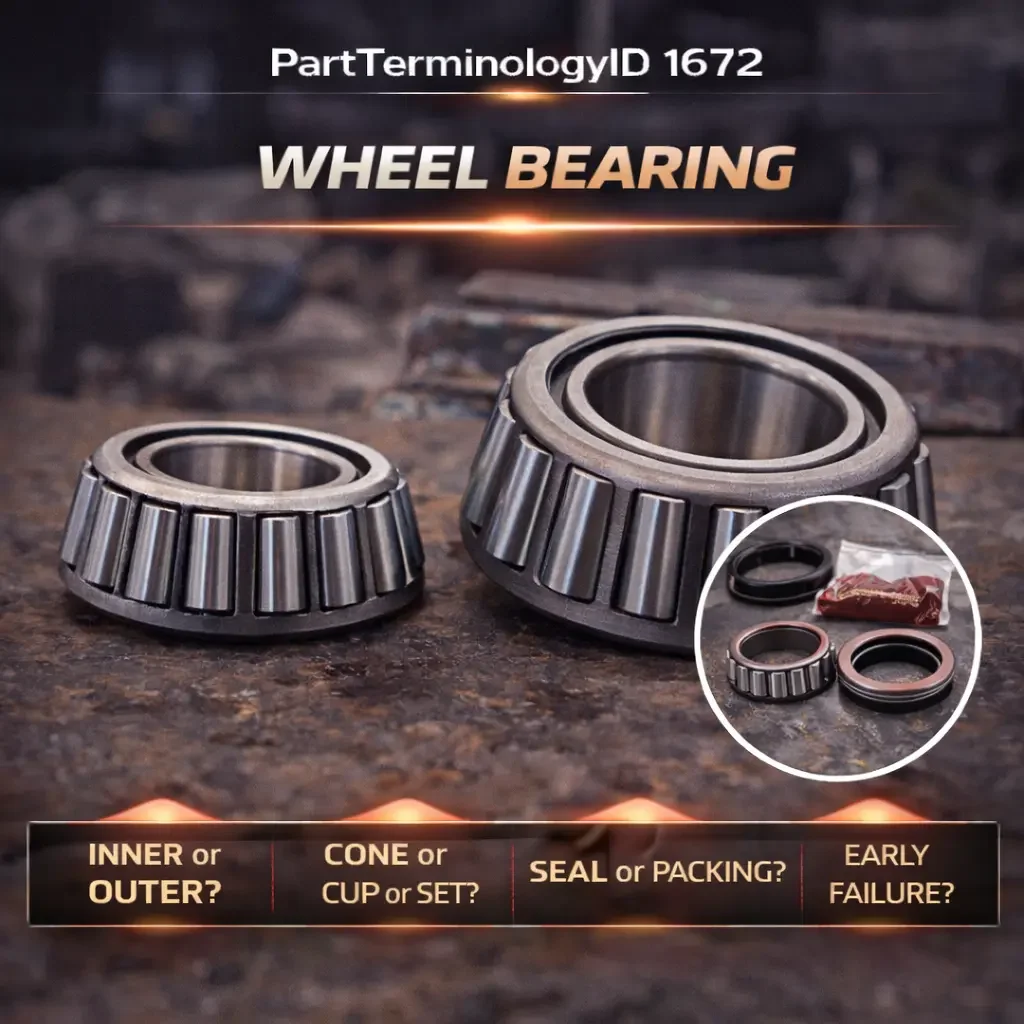
The wheel bearing (PartTerminologyID 1672) is the individual serviceable bearing - the cone, cup, or cone-and-cup set - that supports the wheel hub on a spindle and allows the wheel to rotate under the vehicle's weight. This is the classic tapered roller bearing (or, less commonly, ball bearing) that has been used on front and rear non-driven wheel ends since the earliest days of the automobile, and that remains in widespread use on trailers, older rear-wheel-drive vehicles, medium and heavy-duty trucks, and some current-production 4x4 front axles.
This PartTerminologyID is distinct from the sealed hub assembly (PartTerminologyID 1636), the serviceable hub assembly (PartTerminologyID 1640), and the drive axle shaft bearing (PartTerminologyID 1664). Those PartTerminologyIDs cover the bearing as part of a larger assembly or in the context of a driven axle shaft. PartTerminologyID 1672 covers the bearing itself as a standalone, individually serviceable component - the inner bearing cone, the outer bearing cone, the inner bearing cup (race), the outer bearing cup (race), or a matched set of cone and cup - that the buyer purchases to repack, replace, or upgrade in a serviceable hub.
This is one of the highest-volume, longest-running product categories in the automotive aftermarket. Timken, NTN/BCA, SKF, Koyo, National, and dozens of other manufacturers have produced billions of these bearings over the past century. The product is mature, the application knowledge is deep, and yet the return rate remains stubbornly persistent because of the gap between what the bearing requires (hand packing with grease, precision preload adjustment, matched cone-and-cup sets, and periodic maintenance) and what many buyers deliver (dry installation, impact-wrench tightening, mismatched components, and no maintenance until failure).
PIES/PCdb: PartTerminologyID 1672 - Wheel Bearing
PIES 8.0 / PCdb 2.0: No change
What Wheel Bearing (1672) Means in the Aftermarket
The product forms
PartTerminologyID 1672 covers several product configurations that must be clearly distinguished in catalog listings:
Bearing cone (inner ring assembly). The cone is the inner ring with the tapered rollers and cage assembled together. It rides on the spindle. The cone is the component that is hand-packed with grease before installation. Cones are sold individually because they are the wear component that is inspected and potentially replaced during every bearing service.
Bearing cup (outer ring / race). The cup is the outer ring that presses into the hub bore. The cup provides the outer running surface for the tapered rollers. Cups are pressed into the hub with an interference fit and are typically not removed unless they are damaged, pitted, or being replaced as part of a matched set with a new cone. A cup that is properly seated and undamaged can be reused through multiple cone replacements, though best practice is to replace the cup whenever the cone is replaced.
Cone and cup set (matched set). The cone and cup sold together as a matched pair. This is the recommended purchase configuration because the cone and cup wear together and should be replaced together. On most automotive applications, the cone and cup are not a factory-matched set (they are interchangeable within their part number), but they should be replaced in pairs to ensure consistent running surfaces.
Bearing set (inner and outer, both cones and cups). A kit containing the inner bearing cone, inner bearing cup, outer bearing cone, and outer bearing cup for one wheel end. This is the complete bearing replacement set for one hub. Some kits also include the wheel seal, spindle nut, washer, and cotter pin.
Complete wheel bearing kit. Everything needed for one or both wheel ends: inner and outer bearing cones and cups, wheel seal(s), grease, spindle nut(s), washer(s), cotter pin(s), and sometimes the dust cap. This is the most complete product offering and the most convenient for the buyer.
What this part is NOT
Not a sealed hub assembly (PartTerminologyID 1636). The sealed hub assembly is a non-serviceable unit where the bearing, hub, and often the ABS sensor are integrated and replaced as one piece. PartTerminologyID 1672 is the individual, serviceable bearing that the buyer removes, inspects, repacks, and reinstalls.
Not a serviceable hub assembly (PartTerminologyID 1640). PartTerminologyID 1640 covers the hub assembly for full-floating rear axles and similar applications where the hub, bearings, and seals are serviceable as a system. PartTerminologyID 1672 covers the individual bearing components within such a system (or within any serviceable hub).
Not a drive axle shaft bearing (PartTerminologyID 1664). The drive axle shaft bearing sits inside the axle housing on a semi-floating rear axle and supports the axle shaft. PartTerminologyID 1672 sits in the wheel hub on a spindle and supports the wheel.
Not a sealed press-in cartridge bearing (Gen 1). The Gen 1 sealed cartridge bearing that presses into a steering knuckle on a front-wheel-drive vehicle is covered under PartTerminologyID 1636, not 1672. Even though it is sometimes called a "wheel bearing," it is a sealed, non-serviceable unit that is replaced as a whole, not repacked or adjusted.
How Serviceable Wheel Bearings Work
The tapered roller bearing system
A serviceable wheel hub contains two tapered roller bearings - an inner (larger) bearing and an outer (smaller) bearing - that ride on a spindle. The spindle is a precision-machined shaft that protrudes from the steering knuckle (on front axles) or the axle housing (on non-driven rear axles and trailer axles). The bearing cups are pressed into the hub bore. The bearing cones ride on the spindle surface.
The tapered roller design is critical for this application. The rollers are conical - wider at one end than the other - and they roll along races (the cone inner surface and the cup inner surface) that are also conical. If the cone, rollers, and cup were extended as geometric cones, all three apex points would converge at the same point on the bearing centerline. This geometry allows the bearing to handle both radial loads (the vehicle's weight pushing down on the spindle) and axial loads (lateral forces from cornering, braking, and road irregularities) simultaneously. The taper angle determines the ratio of radial to axial load capacity.
The two bearings are oriented with their tapers facing in opposite directions (the small end of the inner bearing faces outward, the small end of the outer bearing faces inward). This opposed arrangement provides bidirectional axial load resistance - the bearings resist forces pushing the wheel inward and outward.
Bearing preload and end play
Unlike sealed hub assemblies where the preload is factory-set, serviceable wheel bearings require the installer to set the bearing adjustment during assembly. This adjustment controls the amount of end play (axial clearance) between the hub and the spindle.
The adjustment procedure varies by manufacturer but typically follows this general sequence:
Install the inner bearing cone (greased) into the hub.
Install the wheel seal.
Place the hub assembly onto the spindle.
Install the outer bearing cone (greased) onto the spindle.
Install the flat washer and spindle nut.
Tighten the spindle nut to a specified torque (typically 15 to 25 ft-lbs on passenger vehicles) while rotating the hub to seat the bearings.
Back the nut off a specified amount (typically 1/6 to 1/4 turn).
Verify end play with a dial indicator (typically 0.001 to 0.005 inches for passenger vehicles).
Install the nut lock, cotter pin, or jam nut to secure the adjustment.
Install the dust cap.
This procedure is the most critical skill in serviceable wheel bearing work, and incorrect preload is the single most common cause of premature failure. The adjustment must achieve a precise balance:
Too tight (excessive preload or zero end play). The rollers are overloaded. Friction increases, generating heat. The grease breaks down. The roller and race surfaces develop fatigue damage (spalling). In extreme cases, the bearing seizes and the hub locks up. A bearing that is over-preloaded can fail in as little as a few hundred miles.
Too loose (excessive end play). The hub rocks on the spindle. The wheel wobbles. The brake rotor moves laterally, causing pulsation. The rollers experience impact loading with every rotation, creating flat spots (Brinell marks). The bearing wears rapidly and develops noise.
The correct end play window is narrow - typically 0.001 to 0.005 inches - and must be set with a torque wrench and verified with a dial indicator. Setting the adjustment "by feel" (tightening until snug and backing off "a little") is common practice but produces inconsistent results and is a frequent cause of premature failure. Impact wrenches must never be used for the spindle nut on serviceable wheel bearings because they cannot achieve the required precision.
Grease packing
Serviceable wheel bearing cones must be fully packed with high-temperature wheel bearing grease before installation. The grease must be forced between every roller and into every space in the cage. This is done by hand (the "hand packing" method, pressing grease into the wide end of the cone and working it through until it emerges from the narrow end) or with a bearing packer tool.
The hub cavity between the inner and outer bearings must also contain grease - enough to lubricate the assembly for the service interval, but not so much that the cavity is completely filled. Overfilling causes grease churning, which generates heat, breaks down the grease, and can blow out the wheel seal. The general guideline is to fill the hub cavity approximately one-third to one-half full.
The grease type matters. High-temperature wheel bearing grease (NLGI Grade 2, lithium complex or synthetic base) is the standard. Marine-grade grease (formulated for water resistance) is recommended for boat trailer applications. Mixing grease types (lithium with polyurea, for example) can cause chemical incompatibility that degrades both greases and causes bearing failure. The buyer should use the same grease type that is already in the hub, or completely clean the hub and bearings before repacking with a different grease type.
Periodic maintenance
Serviceable wheel bearings require periodic inspection, cleaning, repacking with fresh grease, and preload readjustment. Maintenance intervals vary by application:
Passenger vehicles: Every 30,000 to 50,000 miles, or per the manufacturer's maintenance schedule.
Trailer applications: Annually, or every 12,000 miles, whichever comes first. Boat trailer hubs should be inspected before and after every season.
Heavy-duty and commercial vehicles: Per the fleet maintenance schedule, typically every 30,000 to 100,000 miles depending on load and operating conditions.
Off-road and severe-duty: After every water crossing or extreme event. Shortened intervals (every 15,000 to 25,000 miles) for regular off-road use.
This maintenance cycle is the reason PartTerminologyID 1672 has been one of the highest-volume recurring aftermarket products for over a century. Every maintenance event is a potential sale of cones, cups, seals, grease, and hardware.
Where Serviceable Wheel Bearings Are Still Used
Trailers (the largest current market)
Utility trailers, boat trailers, RV trailers, commercial trailers, horse trailers, equipment trailers, and every other type of towed vehicle use serviceable tapered roller wheel bearings. Trailer axles are almost universally designed with spindles and serviceable hubs because: sealed hub assemblies are unnecessary (no ABS, no driven axle, no electronic integration), serviceable bearings are less expensive for the trailer manufacturer, and trailer bearings require more frequent maintenance than vehicle bearings (due to lower-quality sealing, water exposure on boat trailers, heavy loads, and infrequent use patterns that allow grease to settle and seals to dry out).
The trailer market is the primary growth area for PartTerminologyID 1672 in the current aftermarket. As sealed hub assemblies have replaced serviceable bearings on most passenger vehicles, the trailer market has become the dominant source of demand for individual bearing cones, cups, seals, and bearing kits.
Older rear-wheel-drive vehicles (front wheel bearings)
Prior to the mid-1990s, nearly all rear-wheel-drive cars and trucks used serviceable tapered roller bearings on the non-driven front wheels. The hub contained an inner and outer bearing on the front spindle, with a spindle nut adjustment and a dust cap or grease cap on the outer end. These vehicles (classic cars, pre-1997 trucks, older RWD sedans) are still in the aftermarket in large numbers and represent a significant demand for PartTerminologyID 1672 products.
Current-production trucks and 4x4 front axles
Some current-production heavy-duty trucks and 4x4 front axles still use serviceable wheel bearings, particularly on solid front axles with manual locking hubs. The hub contains serviceable bearings on the spindle, with the locking hub mechanism mounted on the outer end. These applications are served by PartTerminologyID 1672 bearings.
Medium and heavy-duty commercial vehicles
Commercial trucks, buses, and equipment often use serviceable tapered roller wheel bearings that are designed for higher loads and longer service intervals than passenger vehicle bearings. These bearings are larger and more expensive but follow the same cone-and-cup design and require the same maintenance procedures.
Why Wheel Bearings Are Replaced
Normal wear and fatigue
Tapered roller bearings wear over time from the rolling contact between the rollers, cone, and cup. The contact surfaces develop microscopic fatigue cracks that eventually cause material to flake off (spalling). Spalling creates roughness, noise, and play. Under normal conditions with proper maintenance, serviceable wheel bearings can last 100,000+ miles. Without maintenance, they may fail at 30,000 to 50,000 miles or less.
Inadequate lubrication
The most common cause of premature failure. Grease dries out over time, especially in hubs that are not maintained. Water intrusion (from seal failure, water crossing, or boat ramp submersion) washes grease away and introduces corrosion. Contamination (dirt, metallic debris) entering through a failed seal accelerates wear. When the grease is depleted or degraded, the metal-to-metal contact between rollers and races generates extreme heat and rapid destruction.
Incorrect preload
Over-tightening the spindle nut crushes the grease out from between the rollers and races, creating immediate metal-to-metal contact and heat. Under-tightening allows impact loading that creates Brinell marks and flat spots. Either condition causes premature failure that the buyer may attribute to a "defective bearing" when the actual cause is installation error.
Water intrusion (especially boat trailers)
Boat trailer hubs are submerged during launching and retrieval. The temperature differential between the hot hub (from highway towing) and the cold water creates a vacuum inside the hub that draws water past the seals. This water contaminates the grease, corrodes the bearing surfaces, and causes rapid failure. This is such a widespread problem that an entire product category (bearing protector caps, such as Bearing Buddy) exists to address it.
Seal failure
The wheel seal (which sits between the inner bearing and the spindle) prevents grease from leaking out and contaminants from entering. When the seal fails, grease leaks onto the brake components (causing brake contamination and reduced braking effectiveness) and contaminants enter the bearing (causing accelerated wear). Seal failure is often caused by the same conditions that damage bearings: water intrusion, improper installation, and lack of maintenance.
Reusing worn cups with new cones (or vice versa)
When a bearing cone wears, it creates a wear pattern on the cup that matches the worn cone profile. Installing a new cone on a worn cup (or reusing a worn cone with a new cup) creates a mismatch between the roller contact surfaces. The new component wears rapidly because it is running on a surface that was shaped by the old component's wear pattern. Best practice is to replace the cone and cup as a matched set, even if one component appears to be in acceptable condition.
Impact damage
Hitting a pothole, curb, or road debris can create a Brinell mark (a dent in the race surface caused by a stationary roller being driven into the race by an impact load). The Brinell mark creates a bump that the roller must climb over with every revolution, generating noise and vibration. Impact damage may not be visible without disassembly and close inspection.
Fitment Variables
Application (vehicle position or trailer axle)
The bearing must match the specific spindle. Front inner and outer bearings are different sizes (the inner is always larger than the outer). Left and right sides on the same axle use the same bearings. Different vehicle models use different spindle sizes and therefore different bearings.
Bearing number (cone and cup)
Wheel bearings are identified by industry-standard part numbers. Timken, NTN, Koyo, and SKF all publish cross-reference charts. Common passenger vehicle bearing numbers include LM11749/LM11710 (a very common outer bearing), LM67048/LM67010 (a common inner bearing), and many others. Trailer bearings are typically identified by the trailer axle spindle size and the bearing number stamped on the cone or cup.
Cone and cup separately or as a set
The buyer may need a cone only (if the cup is in good condition), a cup only (rare, but possible if the cup was damaged during bearing service), or a cone-and-cup set (recommended). The listing must clearly specify what is included.
Seal inclusion
Some bearing kits include the wheel seal; others do not. The seal should always be replaced during bearing service because it is disturbed during hub removal and may not reseal properly. If the kit does not include the seal, the buyer must order it separately.
Grease inclusion
Some bearing kits include a small packet of wheel bearing grease; others do not. The buyer needs enough grease to hand-pack both cones and fill the hub cavity one-third to one-half full.
Top Return Causes
1) Buyer expected a sealed hub assembly, received individual bearings
The buyer searches for "wheel bearing" and expects a sealed, bolt-on hub assembly (PartTerminologyID 1636). They receive a cone-and-cup set (PartTerminologyID 1672) that requires hand packing, preload adjustment, and a serviceable hub. This is the mirror image of the 1636 return problem: there, the buyer expected individual bearings and got a sealed assembly. Here, the buyer expected a sealed assembly and got individual bearings.
Prevention: "This is a serviceable tapered roller bearing set (cone and cup) for vehicles with adjustable, repackable wheel bearings. This is NOT a sealed hub assembly. If your vehicle uses a bolt-on sealed hub assembly, see [PartTerminologyID 1636 cross-reference]."
2) Cone ordered without cup (or vice versa)
The buyer orders a cone only, not realizing they also need the cup (or that the cup in their hub is worn and should be replaced). They cannot complete the job or they install the new cone on the old cup and the bearing fails prematurely.
Prevention: "Bearing cone and cup should be replaced as a matched set. This listing is for the [cone only / cup only / cone and cup set]. If ordering the cone only, inspect the existing cup for pitting, scoring, or wear before reusing."
3) Inner bearing ordered when outer is needed (or vice versa)
The buyer orders the inner bearing (larger) when they need the outer bearing (smaller), or vice versa. Inner and outer bearings are different part numbers with different dimensions.
Prevention: "Inner bearing" or "Outer bearing" clearly specified in the listing title. Bearing dimensions (bore, OD, width) in the specifications. "The inner bearing is the larger bearing closest to the vehicle centerline. The outer bearing is the smaller bearing closest to the dust cap."
4) Wrong bearing number for the spindle
The buyer orders a bearing that does not match their spindle diameter. This is most common on trailer applications where the trailer axle spindle size is not always obvious and different spindle sizes use different bearings.
Prevention: Spindle diameter or axle specification in the fitment. Bearing number (Timken, NTN, etc.) cross-reference. "Fits [X]-inch spindle. Verify your spindle size before ordering."
5) Premature failure from incorrect preload
The buyer installs new bearings, tightens the spindle nut "by feel" or with an impact wrench, and the bearings fail in a few thousand miles. The buyer returns the bearings as defective.
Prevention: Include the preload procedure in the listing or product documentation. "Bearing preload must be adjusted with a torque wrench per the vehicle manufacturer's specification. Do not use an impact wrench. Typical procedure: torque spindle nut to [X] ft-lbs while rotating hub, back off [Y] turn, verify end play [Z] inches with dial indicator, install cotter pin. Incorrect preload is the most common cause of premature wheel bearing failure."
6) Premature failure from dry installation
The buyer installs new bearing cones without hand-packing them with grease. Serviceable tapered roller bearings are shipped dry (unlike sealed hub assemblies, which are factory-greased). The bearings fail almost immediately from lack of lubrication.
Prevention: "IMPORTANT: These bearings must be hand-packed with high-temperature wheel bearing grease before installation. Bearings are shipped DRY and will fail immediately if installed without grease."
7) Premature failure from water intrusion (boat trailers)
The buyer replaces trailer wheel bearings and submerges the hub during boat launching without bearing protectors. Water enters, grease is contaminated, bearings fail within the season.
Prevention: "For boat trailer applications: install bearing protector caps (such as Bearing Buddy) to prevent water intrusion during launching. Use marine-grade wheel bearing grease for improved water resistance. Inspect and repack bearings before and after every boating season."
8) Mixed grease types causing chemical incompatibility
The buyer repacks bearings with a different grease type than what was previously in the hub. Lithium complex grease mixed with polyurea grease (or other incompatible types) can cause softening, hardening, or separation of the grease, leading to inadequate lubrication.
Prevention: "Use the same type of grease that is currently in the hub, or completely clean the hub and bearings with solvent before repacking with a different grease type. Do not mix incompatible grease types. Consult the grease manufacturer's compatibility chart if uncertain."
Compatibility Checklist for Buyers
1) Confirm your vehicle uses serviceable wheel bearings, not a sealed hub assembly. If your vehicle has a bolt-on hub assembly that cannot be disassembled, you need PartTerminologyID 1636, not 1672.
2) Identify whether you need inner, outer, or both bearings. Inner (larger, closer to vehicle center) and outer (smaller, closer to dust cap) are different part numbers.
3) Order cone and cup sets, not just cones. Replace the cone and cup together for best results.
4) Identify your spindle size. Use the bearing number from the old bearing (stamped on the cone or cup) or the vehicle/trailer specification to determine the correct bearing.
5) Order the wheel seal. Replace the seal every time the hub is removed. If the bearing kit does not include the seal, order it separately.
6) Have grease and tools ready. High-temperature wheel bearing grease (NLGI Grade 2), bearing packer or hand-packing capability, torque wrench, dial indicator for end play, new cotter pin.
7) For boat trailers: order bearing protector caps. Prevent water intrusion during submersion.
8) Full vehicle or trailer details. Year, make, model, position (front/rear), spindle size, bearing number. OEM or industry bearing number cross-reference recommended.
Catalog Checklist for Attributes
Core taxonomy: Product form: bearing cone only, bearing cup only, cone and cup set, inner bearing set, outer bearing set, complete bearing kit (inner + outer + seals + hardware). Position: front inner, front outer, rear inner, rear outer. Bearing type: tapered roller (most common), ball bearing (some applications). Separate from sealed hub assembly (1636), serviceable hub assembly (1640), drive axle shaft bearing (1664).
Fitment: Year, make, model, submodel, drivetrain. Trailer axle manufacturer and spindle size. Position (front/rear, inner/outer). Industry bearing number (Timken, NTN, Koyo, SKF cross-references).
Specifications: Cone bore (inner diameter). Cup outer diameter. Bearing width. Roller count. Taper angle (for reference). Industry bearing number.
Included components: Cone (yes/no). Cup (yes/no). Wheel seal (yes/no). Spindle nut (yes/no). Washer (yes/no). Cotter pin (yes/no). Dust cap (yes/no). Grease (yes/no). Quantity (for one wheel end or for one axle / pair).
Installation notes: Bearings must be hand-packed with grease before installation. Preload adjustment procedure and specification. Torque wrench required, impact wrench prohibited. End play specification. Seal installation direction (lip faces inward). Do not mix grease types.
Images: Cone and cup separately and together. Inner and outer bearing size comparison. Bearing number location on cone and cup. Complete kit contents laid out. Installed position in hub on spindle (cutaway or exploded view).
FAQ
What is the difference between a wheel bearing (1672) and a wheel hub assembly (1636)?
A wheel bearing (1672) is an individual, serviceable component - a tapered roller bearing cone, cup, or set - that rides on a spindle inside a hub and can be removed, inspected, repacked with grease, and reinstalled. A wheel hub assembly (1636) is a sealed, non-serviceable unit that integrates the bearing, hub, and often the ABS sensor into one piece that is replaced as a complete assembly when the bearing fails. Older vehicles and trailers use serviceable bearings (1672). Most modern passenger vehicles use sealed hub assemblies (1636).
How often should I repack wheel bearings?
For passenger vehicles: every 30,000 to 50,000 miles or per the manufacturer's schedule. For trailers: annually or every 12,000 miles. For boat trailers: before and after every boating season. For off-road or severe-duty use: after water crossings and at shortened intervals (15,000 to 25,000 miles).
Should I replace the cup when I replace the cone?
Yes. Best practice is to replace the cone and cup as a set. The cup develops a wear pattern that matches the old cone, and a new cone running on a worn cup will not achieve optimal contact and will wear faster. If the cup must be reused (cost constraint or hub damage concern from pressing a new cup), inspect it carefully for pitting, scoring, discoloration, and wear before reusing.
Can I pack bearings with a grease gun instead of by hand?
A grease gun does not reliably force grease between the rollers and into the cage. A bearing packer tool (a conical device that presses grease into the bearing from the wide end) is an acceptable alternative to hand packing. Hand packing is the most thorough method: press a large amount of grease into the wide end of the cone with the heel of your hand, rotating the cone as you work, until grease emerges from the narrow end between every roller.
Why did my wheel bearing fail so quickly after replacement?
The three most common causes of premature failure on newly installed serviceable wheel bearings are: (1) incorrect preload, typically from over-tightening the spindle nut, which causes immediate overheating and surface damage; (2) dry or inadequately greased bearings, which causes rapid metal-to-metal contact; and (3) water intrusion from a failed seal or submersion without bearing protectors. If the bearing was properly greased, properly preloaded, and protected from contamination, it should last 80,000 to 150,000+ miles.
Final Take for Aftermarket Teams
Wheel Bearing (PartTerminologyID 1672) is the original aftermarket wheel-end product - the serviceable tapered roller bearing that has been sold, repacked, adjusted, and replaced for over a century. While sealed hub assemblies (1636) have captured the modern passenger vehicle market, PartTerminologyID 1672 remains the dominant product for trailers, older vehicles, and heavy-duty applications. It also remains one of the most maintenance-intensive products in the aftermarket, which is both its challenge and its commercial strength: every maintenance event generates demand for cones, cups, seals, grease, and hardware.
The catalog teams that serve this buyer effectively do five things. First, they clearly distinguish individual bearings (1672) from sealed hub assemblies (1636) so the buyer gets the correct product type for their vehicle. Second, they specify whether the listing includes the cone only, the cup only, the cone-and-cup set, or a complete kit with seals and hardware, because incomplete orders are the most common source of buyer frustration. Third, they specify inner vs. outer bearing, because these are different sizes and different part numbers, and ordering the wrong one stops the job. Fourth, they include the bearing preload procedure or at least a reference to it, because incorrect preload is the most common cause of premature failure and warranty returns. Fifth, they cross-reference the matching wheel seal, because the seal should always be replaced with the bearing and is often not included in the bearing listing.
The sixth thing - unique to the trailer market - is the water intrusion warning and the bearing protector cap cross-reference. The boat trailer buyer who replaces bearings without being told about bearing protectors will be back next season with the same failure. The seller who includes that guidance in the listing converts a one-time repair sale into a recurring maintenance customer who buys bearings, seals, grease, and protector caps as a regular seasonal purchase.