
Written by Arthur Simitian | PartsAdvisory
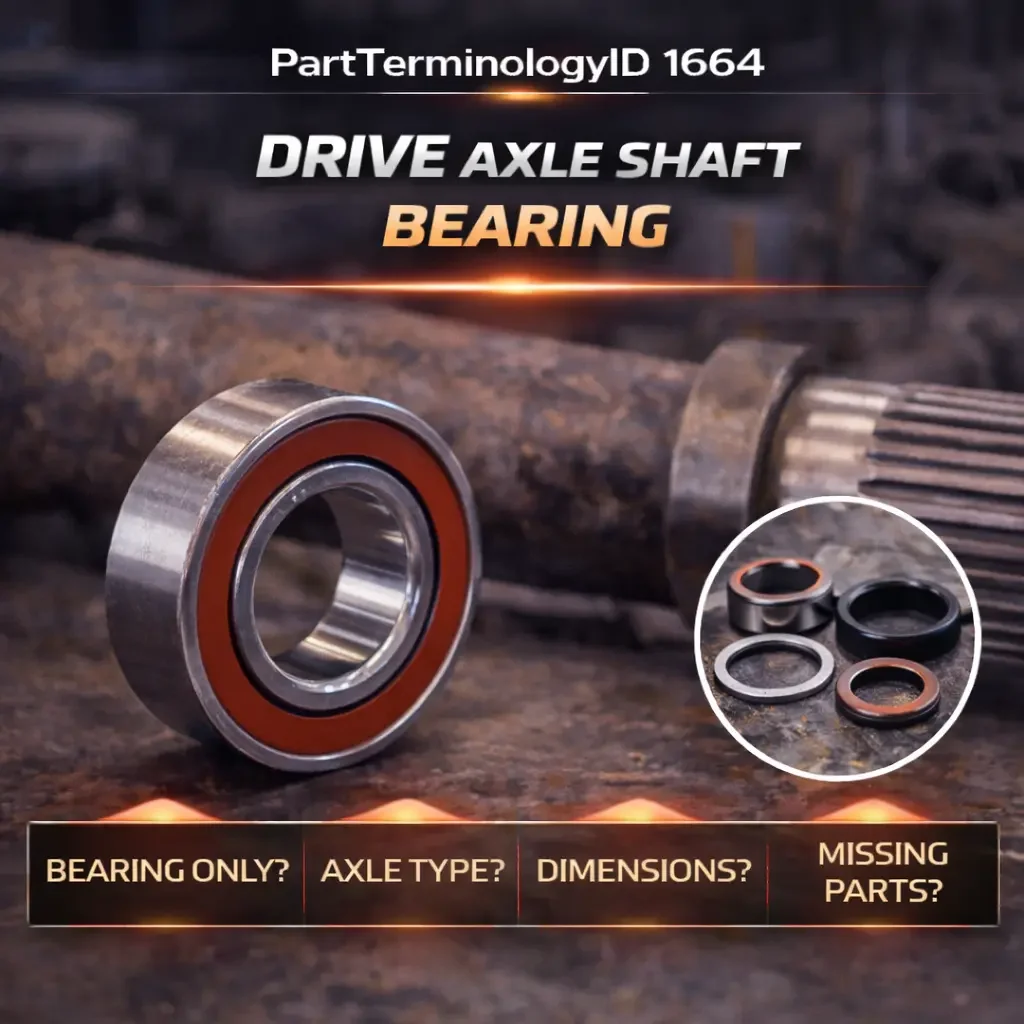
The drive axle shaft bearing is the individual bearing - and only the bearing - that supports the axle shaft inside the axle housing on a semi-floating rear axle. It is the same physical component described in the Drive Axle Shaft Bearing Assembly (PartTerminologyID 1632, covered earlier in this series), but PartTerminologyID 1664 exists as a separate catalog entry because it represents the bearing sold as a standalone component, without the seal, without the collar (PartTerminologyID 1648), without the lock ring (PartTerminologyID 1652), without the retainer plate (PartTerminologyID 1656), and without the spacer (PartTerminologyID 1660).
This distinction matters in the aftermarket because the buyer who needs only the bearing - because the seal is still good, the collar will be replaced from existing stock, or the retainer plate is being reused - should not have to purchase a complete kit. Conversely, the buyer who searches for "axle shaft bearing" expecting a complete kit and receives a bearing only will be unable to complete the job without additional components.
The coexistence of PartTerminologyID 1632 (bearing assembly, typically including bearing + seal and sometimes additional components) and PartTerminologyID 1664 (bearing only) creates a catalog overlap that is the single most common source of "missing parts" complaints in this product category.
PIES/PCdb: PartTerminologyID 1664 - Drive Axle Shaft Bearing
PIES 8.0 / PCdb 2.0: No change
How 1664 Relates to the Other Axle Bearing PartTerminologyIDs
This is the sixth PartTerminologyID in the axle bearing family covered in this series. Understanding how they relate to each other prevents cross-listing errors and buyer confusion:
PartTerminologyID 1632 - Drive Axle Shaft Bearing Assembly. The bearing sold as part of a kit, typically including the bearing and seal at minimum, and sometimes including the collar, retainer plate, lock ring, and/or spacer. This is the "buy this and you have everything you need" product.
PartTerminologyID 1664 - Drive Axle Shaft Bearing (this post). The bearing sold alone. Just the bearing. No seal, no collar, no hardware. This is the "I already have the other components and just need the bearing" product.
PartTerminologyID 1648 - Drive Axle Shaft Bearing Collar. The press-fit ring that locks the bearing on the shaft. Sold separately or included in the 1632 assembly.
PartTerminologyID 1652 - Drive Axle Shaft Bearing Lock Ring. The snap ring or C-clip that retains the bearing or shaft. Sold separately or included in overhaul kits.
PartTerminologyID 1656 - Drive Axle Shaft Bearing Retainer. The bolt-on plate that holds the assembly in the housing. Sold separately.
PartTerminologyID 1660 - Drive Axle Shaft Bearing Spacer. The shim that sets axle end play. Sold separately or included with the axle shaft.
The catalog problem is that a buyer searching for "axle shaft bearing" may be directed to either 1632 (assembly) or 1664 (bearing only), and the search results often do not make the distinction clear. The buyer who receives a bearing only when they expected a kit is missing the seal at minimum. The buyer who receives a kit when they only needed the bearing has overpaid.
What PartTerminologyID 1664 Covers
The bearing itself
On most semi-floating rear axles, the axle shaft bearing is a sealed ball bearing or sealed roller bearing that presses onto the axle shaft (on non-C-clip axles) or presses into the axle housing bore (on C-clip axles). Common bearing types include:
Sealed ball bearing. A double-row or single-row ball bearing with integrated seals on both sides. The seals retain the factory-packed grease and prevent contamination. This is the most common type on passenger car and light truck semi-floating rear axles. The bearing presses onto the shaft with an interference fit (typically 0.001 inches) on the inner race and sits in the housing bore with a slight interference or transition fit on the outer race.
Sealed tapered roller bearing. A tapered roller bearing with integrated seals. Less common on semi-floating axles but used on some applications where higher load capacity is needed. The taper angle provides both radial and axial load support.
Straight roller bearing. A cylindrical roller bearing without seals, used on some older axle designs where the axle tube serves as the outer race. These are becoming rare in the current aftermarket but still exist on classic vehicle applications.
Bearing identification
Axle shaft bearings are identified by industry-standard bearing numbers (Timken SET series, NTN, Koyo, SKF, and equivalent cross-references) that specify the bearing dimensions: inner diameter (bore), outer diameter, width, and bearing type. The most important dimensions for fitment are:
Inner diameter (bore). Must match the axle shaft journal diameter. On non-C-clip axles where the bearing presses onto the shaft, this is the shaft diameter at the bearing seat. On C-clip axles where the bearing presses into the housing, this is the shaft diameter at the bearing contact area.
Outer diameter. Must match the axle housing bore diameter. The bearing outer race sits in the housing bore with a specific fit (press fit, transition fit, or slip fit depending on the application).
Width. Must match the available space in the housing bore between the shaft shoulder (or snap ring) and the housing bore opening.
What this part is NOT
PartTerminologyID 1664 is NOT:
The axle shaft seal (the oil seal that prevents differential fluid from leaking past the bearing). The seal is a separate component that is almost always replaced with the bearing but is not included in a 1664 listing.
The bearing race/cup sold separately (on applications where the inner and outer races are separate components, such as tapered roller bearings with separate cups).
The wheel hub bearing (PartTerminologyID 1636/1640) at the wheel end on independent suspension vehicles.
The differential carrier bearing or pinion bearing inside the differential.
Why the Bearing-Only Product Exists
The seal is still good
On some occasions, the bearing fails (noise, roughness, play) but the axle shaft seal is still in good condition and not leaking. The buyer wants to replace only the bearing and reuse the seal. While best practice recommends replacing both together (because seal removal often damages the seal), experienced technicians on some applications can access and replace the bearing without disturbing the seal.
The buyer has the seal already
The buyer purchased the seal from a different source, has a seal in stock, or has a specific seal preference (OE vs. aftermarket) and wants to purchase the bearing and seal from different suppliers.
Fleet and shop stock
Shops and fleet operations that service a high volume of the same axle type may stock bearings and seals separately in bulk, mixing and matching as needed rather than purchasing pre-packaged kits.
The bearing is a different brand/quality than the kit
The buyer wants a specific bearing brand (Timken, NTN, Koyo) that is available as a standalone bearing but not as part of a pre-packaged kit for their application. Some budget bearing kits include lower-quality bearings, and the buyer prefers to assemble their own kit with a premium bearing and separately purchased seal.
Repair bearing (oversize/offset) applications
As discussed in the PartTerminologyID 1632 post, repair bearings (such as BCA NBRP series) are unitized bearing-and-seal assemblies designed for worn axle shafts. These are always sold as assemblies (1632), not as bearing-only (1664). However, the standard bearing that the repair bearing replaces would be a 1664 product. The buyer comparing options needs to understand that a standard 1664 bearing requires a good shaft surface, while a 1632 repair bearing assembly accommodates a worn shaft.
Fitment Variables
Axle type
The bearing must match the specific axle. GM 8.5-inch 10-bolt, GM 8.6-inch 10-bolt, GM 7.5/7.625-inch, Ford 7.5-inch, Ford 8.8-inch, Ford 9-inch (small bearing or large bearing), Chrysler 8.25-inch, Chrysler 9.25-inch, Dana 35, Dana 44, and others all use different bearings. The axle type determines the bearing dimensions.
C-clip vs. non-C-clip axle design
On C-clip axles, the bearing presses into the housing bore and the shaft slides through it. On non-C-clip axles, the bearing presses onto the shaft and the assembly slides into the housing. The bearing may be the same part for both designs on some axle models, but the installation method is different, and some axle models use different bearings for C-clip and non-C-clip configurations.
Bearing dimensions
Inner diameter (bore), outer diameter, and width must match the axle shaft and housing. Cross-reference by OEM part number or industry bearing number (Timken, NTN, Koyo, SKF) to ensure correct dimensions.
Sealed vs. unsealed
Most modern axle shaft bearings are sealed (grease-packed for life with integrated seals on both sides of the bearing). Some older or specialty applications use unsealed bearings that rely on the differential gear oil for lubrication. The buyer must match the correct seal configuration.
Top Return Causes
1) Buyer expected a bearing and seal kit, received bearing only
The most common return cause for this PartTerminologyID. The buyer searches for "axle shaft bearing," orders a 1664 product, and receives the bearing without the seal. They cannot complete the job because the old seal was destroyed during removal.
Prevention: "This listing is for the BEARING ONLY. Axle shaft seal is NOT included and must be ordered separately. For a complete bearing and seal kit, see [PartTerminologyID 1632 listing / cross-reference part number]." Use the word "ONLY" in the listing title: "Drive Axle Shaft Bearing - Bearing Only, Seal Sold Separately."
2) Wrong axle type
The buyer orders a bearing for the wrong axle. Same issue as all other axle components in this series - the axle type, not just the vehicle year/make/model, determines the bearing.
Prevention: Axle type in the listing title and fitment. Bearing dimensions (ID, OD, width) in the specifications. Industry bearing number cross-reference.
3) C-clip axle bearing ordered for non-C-clip axle (or vice versa)
On some axle models, the C-clip and non-C-clip versions use different bearings. The buyer orders the wrong one.
Prevention: Axle retention type (C-clip or non-C-clip / bolt-in) in the fitment details where the bearing differs between configurations.
4) Standard bearing ordered when repair bearing is needed
The buyer installs a standard 1664 bearing on a worn axle shaft. The shaft journal is grooved or polished at the original bearing contact surface, and the new bearing does not seal properly. The seal leaks because the shaft surface is worn.
Prevention: "Inspect the axle shaft bearing journal for grooves or wear before installing a standard replacement bearing. If the journal surface is worn, a repair bearing assembly (which shifts the bearing contact to an unworn section of the shaft) is required. See [PartTerminologyID 1632 repair bearing cross-reference]."
5) Buyer ordered bearing and seal separately from different sources, dimensions do not match
The buyer purchases a bearing from one source and a seal from another. The seal inner diameter does not match the bearing outer diameter, or the seal is for a different axle type. This is not a defect in either product but a fitment mismatch from sourcing components independently.
Prevention: Cross-reference the compatible seal part number in the bearing listing. "This bearing is compatible with axle shaft seal [part number]. Verify seal compatibility if purchasing from a different source."
Compatibility Checklist for Buyers
1) Determine whether you need the bearing only (1664) or a bearing and seal kit (1632). If you are replacing the bearing, you almost certainly need the seal too. A complete kit (1632) is usually the better purchase unless you have a specific reason to buy the bearing alone.
2) Identify your axle type. Not just year/make/model - the actual axle (GM 8.5 vs. 8.6, Ford 8.8 vs. 9-inch, etc.).
3) Confirm C-clip or non-C-clip design. This may affect which bearing you need.
4) Inspect the axle shaft journal before ordering. If the journal is worn, you need a repair bearing assembly (1632), not a standard bearing (1664).
5) Cross-reference the bearing number. Use Timken, NTN, Koyo, or SKF cross-references to verify the correct bearing dimensions.
6) Order the seal if not included. If purchasing a 1664 bearing only, order the matching axle shaft seal separately. The old seal is almost always damaged during bearing removal and cannot be reused.
Catalog Checklist for Attributes
Core taxonomy: Product form: bearing only (no seal, no collar, no hardware). Clearly distinguish from PartTerminologyID 1632 (bearing assembly / bearing and seal kit). Bearing type: sealed ball bearing, sealed tapered roller bearing, straight roller bearing.
Fitment: Year, make, model, submodel, trim, drivetrain. Axle type (manufacturer, ring gear size, model designation). C-clip or non-C-clip retention. Shaft diameter at bearing journal.
Specifications: Bearing inner diameter (bore). Bearing outer diameter. Bearing width. Bearing type (ball, tapered roller, straight roller). Seal configuration (sealed both sides, sealed one side, unsealed). Industry bearing number (Timken, NTN, Koyo, SKF cross-references).
Included components: Bearing ONLY. No seal, no collar, no lock ring, no retainer, no spacer, no hardware.
Cross-references: Compatible axle shaft seal part number. Compatible bearing and seal kit (PartTerminologyID 1632) part number. Repair bearing assembly part number (for worn shafts).
Installation notes: Bearing presses onto shaft (non-C-clip) or into housing bore (C-clip). Hydraulic press required. Inspect shaft journal for wear before installing standard bearing. Replace seal with bearing (even if purchasing components separately).
Images: Bearing alone from multiple angles. Bearing dimensions labeled (ID, OD, width). Seal side and shield side identified if applicable.
FAQ
What is the difference between PartTerminologyID 1664 (bearing) and 1632 (bearing assembly)?
PartTerminologyID 1664 is the bearing sold alone - just the bearing, no other components. PartTerminologyID 1632 is the bearing sold as part of a kit that typically includes the seal and may include the collar, lock ring, or other hardware. If you want everything you need in one package, order a 1632 product. If you only need the bearing and already have the seal and other components, order a 1664 product.
Should I replace the seal when I replace the bearing?
Yes. Best practice is to always replace the axle shaft seal when replacing the bearing, even if the seal appears to be in good condition. The seal is typically disturbed or damaged during bearing removal, and a new bearing paired with an old seal that leaks shortly afterward defeats the purpose of the bearing replacement. If you are ordering a 1664 bearing only, order the matching seal separately.
Can I use the bearing number to find the right part?
Yes. Axle shaft bearings have industry-standard bearing numbers (such as Timken SET10, NTN AE-608, Koyo 6207-2RS, etc.) that specify the exact dimensions and type. If you have the bearing number from the old bearing (stamped on the bearing outer race or inner race), you can cross-reference it to find the correct replacement from any manufacturer.
Is a more expensive bearing worth it?
For axle shaft bearings, quality matters significantly. The bearing must withstand the full weight of the vehicle (on semi-floating axles), road impacts, and rotational loads for 80,000 to 150,000+ miles. Premium bearings from Timken, NTN/BCA, SKF, and Koyo use higher-grade steel (AISI 52100), more precise heat treatment, better seals, and higher-quality grease than budget alternatives. A premium bearing typically costs $15 to $40 more than a budget bearing but lasts two to five times longer. On a part that requires a hydraulic press and significant labor to replace, the cost of the bearing is a small fraction of the total job cost, and a premature failure means doing the entire job again.
Final Take for Aftermarket Teams
Drive Axle Shaft Bearing (PartTerminologyID 1664) is the bearing and nothing but the bearing. Its catalog purpose is to serve the buyer who needs the bearing as a standalone component, separate from the seal and hardware that are included in a PartTerminologyID 1632 assembly kit. The catalog teams that handle this correctly do two things that prevent the majority of returns: they put "BEARING ONLY" (or equivalent) in the listing title so the buyer knows the seal is not included, and they cross-reference the compatible seal and the complete bearing-and-seal kit (1632) so the buyer can easily find the companion components or upgrade to the complete kit if they realize they need more than just the bearing. The third step that elevates the listing is the shaft journal inspection note, which directs the buyer with a worn shaft to the repair bearing assembly (1632) instead of the standard bearing (1664) that will not seal properly on a worn surface.