
Written by Arthur Simitian | PartsAdvisory
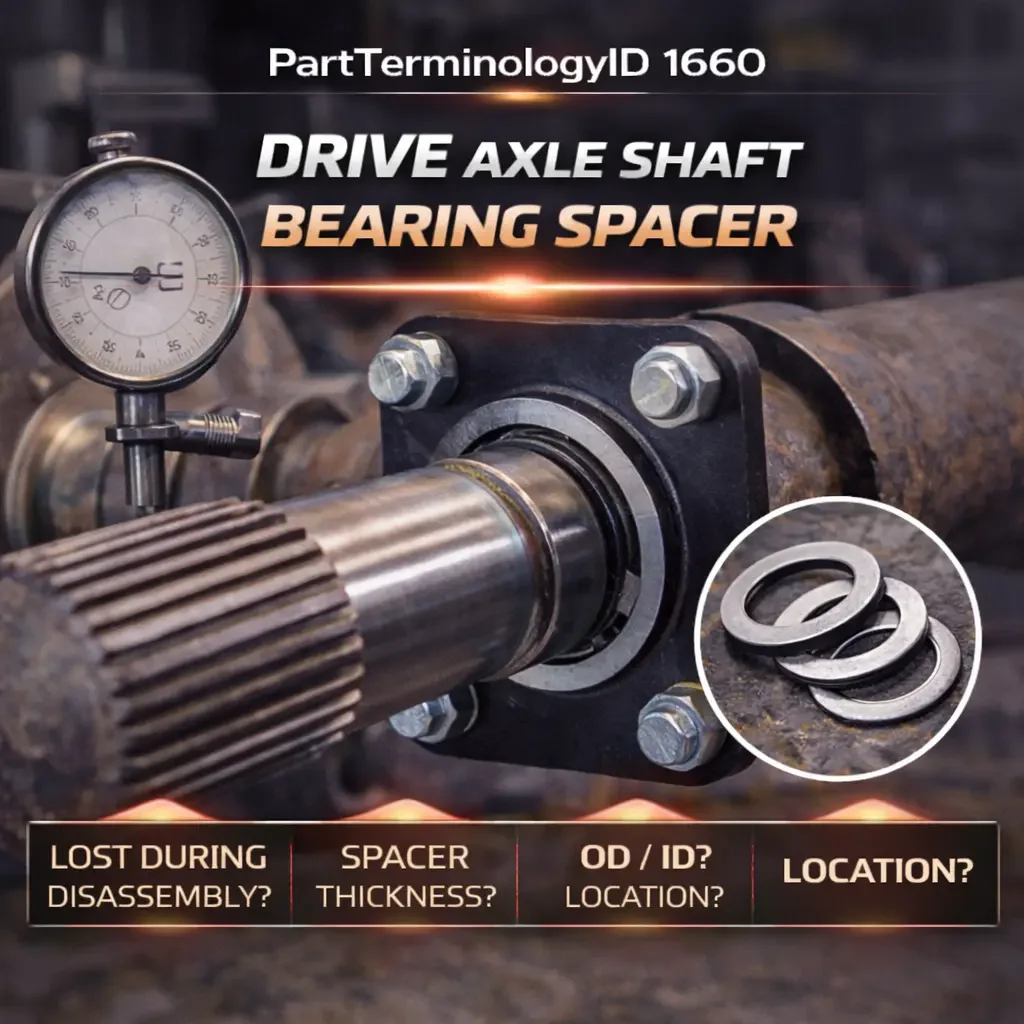
The drive axle shaft bearing spacer is a precision-thickness shim, washer, or spacer ring that sits in the axle assembly to control the axial position of the bearing and set the correct axle shaft end play. Depending on the application, it may sit between the bearing outer race and the axle housing bore shoulder, between the bearing inner race and the axle shaft shoulder, behind the bearing race in the housing, or between the bearing and the retainer plate. Its purpose is simple: it takes up the dimensional tolerance stack between the axle shaft, bearing, and housing so that the axle shaft has the correct amount of end play (typically 0.001 to 0.060 inches, depending on application) and the bearing is properly positioned axially.
This is a $5 to $50 part that is easy to lose, easy to forget, and easy to install in the wrong thickness. It is also the part that the buyer most often discards during disassembly without realizing it was there, then wonders why the reassembled axle has excessive play or the bearing sounds wrong.
PIES/PCdb: PartTerminologyID 1660 - Drive Axle Shaft Bearing Spacer
PIES 8.0 / PCdb 2.0: No change
What This Part Does
The bearing spacer controls axle shaft end play - the amount of in-and-out movement the axle shaft has within the housing. End play is necessary: some axial clearance allows for thermal expansion, prevents binding, and accommodates manufacturing tolerances. Too much end play causes the axle shaft to walk in and out during operation, producing a clunking noise on acceleration and deceleration, causing uneven brake wear (the rotor moves with the shaft), and accelerating bearing wear from impact loading. Too little end play (or negative end play, meaning preload) causes excessive bearing friction, heat generation, premature bearing failure, and in extreme cases bearing seizure.
The spacer achieves the correct end play by compensating for the accumulated tolerance variation across multiple components: the axle housing bore depth, the bearing width, the bearing race seat depth, the axle shaft shoulder position, and the retainer plate thickness. No two axle assemblies have exactly the same total tolerance stack, so the spacer is the adjustable element that makes the assembly come together with the correct clearance.
Where the spacer sits
The spacer's position varies by axle design:
Behind the bearing outer race in the housing bore. On some semi-floating axles (notably Nissan Titan, some Dana axles, some Toyota), a spacer or shim pack sits behind the bearing outer race (cup) in the axle housing bore. The spacer sets how deep the race sits in the bore, which controls the axle shaft's axial position. This is the most common aftermarket application for this PartTerminologyID.
Between the bearing and the axle shaft shoulder. On some applications, the spacer sits on the axle shaft between the bearing inner race and a shaft shoulder or snap ring. It controls the bearing's axial position relative to the shaft.
Between the bearing and the retainer plate. On some non-C-clip axles, the spacer sits between the bearing and the retainer plate (PartTerminologyID 1656), setting the bearing's axial position relative to the housing flange.
Inner axle shaft shim (IFS front axles). On independent front suspension (IFS) 4x4 applications (GM 9.25 AAM, GM 8.25 IFS, and others), a shim on the inner axle shaft sets the engagement depth between the inner shaft and the clutch gear or disconnect mechanism inside the differential. This shim must be measured and selected during assembly using specialized tools. If the wrong shim is used, the disconnect may not engage properly, the axle may have excessive end play, or the gears may bind.
What this part is NOT
The bearing spacer is NOT the same as the pinion bearing preload spacer (the collapsible spacer or solid spacer that sits between the pinion bearings inside the differential). That is a different component with a different PartTerminologyID. It is also NOT the same as the differential bearing shim (used to set ring gear backlash). Those are differential internal components. PartTerminologyID 1660 is specifically the spacer associated with the axle shaft bearing at the wheel end of the axle housing.
Why Bearing Spacers Are Replaced
Lost or discarded during disassembly
The number one reason. The spacer is a thin, flat washer or shim that sits behind the bearing race in the housing bore. When the old bearing is removed, the spacer may fall out unnoticed, get mixed in with other removed hardware, or be mistaken for a piece of debris and discarded. The buyer reassembles the axle without the spacer and discovers excessive end play.
Wrong thickness after component replacement
When any component in the end play tolerance stack is replaced (new bearing, new bearing race, new axle shaft, machined housing), the original spacer thickness may no longer produce the correct end play. A new spacer of the correct thickness must be selected. On some applications (GM IFS front axles), this requires measurement with specialized depth micrometers and calculation to determine the correct shim thickness.
Damaged or worn
Over time, the spacer can develop wear from the bearing race rotating against it (race spin), from corrosion, or from fatigue. A worn spacer is thinner than original, which increases end play. A corroded spacer may have rough surfaces that prevent the bearing race from seating properly.
Not reinstalled during previous service
Similar to the lost/discarded scenario, but the previous technician simply did not realize the spacer was part of the assembly. The axle has been running with incorrect end play since the last service, and the current buyer is correcting the problem.
Fitment Variables
Application-specific thickness
The spacer thickness must match the specific axle assembly's dimensional requirements. Spacers are available in specific thicknesses (selected by measurement) or in assortment kits that include multiple thicknesses for the buyer to select from during assembly. Common thickness ranges are 0.050 to 0.200 inches in increments of 0.005 or 0.010 inches.
Material and form
Spacers may be solid steel washers, laminated (peelable) shims, or individual shims from an assortment. Solid steel spacers are the most common OE configuration. Laminated shims allow the technician to peel layers to achieve a precise thickness. Assortment kits provide multiple individual shims for selection.
Axle type
The spacer outer diameter must match the housing bore or the bearing race outer diameter. The inner diameter must clear the spindle or shaft. These dimensions are axle-specific.
Position in the assembly
The buyer must know where the spacer sits in the assembly (behind the race, on the shaft, between bearing and retainer) because the dimensions and form differ by position.
Top Return Causes
1) Wrong thickness
The buyer orders a spacer in a specific thickness that does not produce the correct end play for their particular axle assembly. This is especially common when the buyer does not measure the end play and instead orders "the same thickness as the original" without accounting for the dimensional changes introduced by new components.
Prevention: "Axle shaft end play must be measured with a dial indicator after assembly to verify correct spacer thickness. The correct spacer produces end play within the specification range of [X] to [Y] inches. If end play is outside this range, a different spacer thickness is required." Offer spacer assortment kits that include multiple thicknesses.
2) Wrong OD/ID for the application
The buyer orders a spacer for the wrong axle type. The outer and inner diameters do not match the housing bore and spindle.
Prevention: Axle type in the listing. Spacer OD and ID in the specifications. Cross-reference with the bearing part number for the same application.
3) Buyer did not know the spacer existed
The buyer is performing their first axle bearing service and did not realize a spacer was part of the assembly. They assemble without it, discover excessive end play, and then order the spacer as a follow-up purchase. Not a return issue per se, but a source of incomplete orders and customer frustration.
Prevention: Cross-reference the spacer in the bearing kit listing. "This bearing set requires a bearing spacer (PartTerminologyID 1660) to set correct axle shaft end play. The spacer is not included in this bearing kit and must be ordered separately or reused from the original assembly if undamaged and the correct thickness."
4) Spacer included with another component, duplicate purchase
On some applications (Nissan Titan, for example), the spacer is included with the axle shaft assembly or the bearing kit. The buyer orders a separate spacer and discovers it was already included.
Prevention: Note in the listing whether the spacer is included with the axle shaft or bearing kit for the same application.
Compatibility Checklist for Buyers
1) Identify your axle type. The spacer must match the axle housing bore and bearing configuration.
2) Measure end play before disassembly. Record the existing end play with a dial indicator. This gives you a baseline to compare after reassembly.
3) Save the old spacer during disassembly. Even if you plan to replace it, the old spacer's thickness tells you the starting point for the new spacer selection.
4) Measure end play after reassembly. Install the spacer, assemble the axle, and measure end play with a dial indicator. If end play is not within specification, a different spacer thickness is required.
5) Consider ordering a spacer assortment kit. If you do not know the exact thickness needed, an assortment kit with multiple thicknesses allows you to select the correct one during assembly without waiting for a second shipment.
6) Full vehicle and axle details. Year, make, model, submodel, drivetrain, axle type. OEM part number cross-reference strongly recommended because the spacer thickness is often application-specific down to the production date.
Catalog Checklist for Attributes
Core taxonomy: Product form: individual spacer (specific thickness), spacer assortment kit (multiple thicknesses), shim pack (peelable or stackable). Position: behind bearing race in housing bore, on axle shaft, between bearing and retainer, inner shaft shim (IFS). Separate from pinion bearing preload spacer (different PartTerminologyID), differential bearing shim (different PartTerminologyID), bearing collar (PartTerminologyID 1648), bearing lock ring (PartTerminologyID 1652), bearing retainer (PartTerminologyID 1656).
Fitment: Year, make, model, submodel, drivetrain. Axle type (manufacturer, model, ring gear size). Position in assembly.
Specifications: Thickness (individual spacer, or range for assortment kit). Outer diameter. Inner diameter. Material (steel, laminated steel). Quantity per package.
Included components: Spacer only, or included with bearing kit / axle shaft assembly (cross-reference).
Installation notes: End play measurement required before and after assembly. Dial indicator and measurement procedure. End play specification range for the application. Shim selection method (measurement and calculation, or trial-and-check).
Images: Spacer alone with thickness and diameter visible. Spacer in context (installed position in housing or on shaft). Assortment kit showing available thicknesses.
FAQ
How do I know what thickness spacer I need?
Measure the axle shaft end play with a dial indicator after assembling the axle with a trial spacer. Compare the measured end play to the manufacturer's specification (typically 0.001 to 0.060 inches, depending on the application). If end play is too large, use a thicker spacer. If end play is too small (or the shaft is tight), use a thinner spacer. Some applications (GM IFS front axles) require measurement with specialized depth micrometers and a calculation to determine the correct shim thickness before assembly.
Can I reuse the old spacer?
Yes, if it is undamaged, not worn, not corroded, and you are not changing any other components in the end play tolerance stack (bearing, race, shaft, housing). If you are installing a new bearing or race, the old spacer thickness may no longer produce the correct end play, and you should measure and verify.
What happens if I assemble without the spacer?
The axle shaft will have excessive end play. Symptoms include clunking on acceleration and deceleration, brake pulsation (the rotor moves in and out with the shaft), bearing noise from impact loading, and accelerated bearing wear. On some applications, the shaft may walk far enough inward to disengage from the differential, causing loss of drive.
Is the bearing spacer the same as the pinion spacer?
No. The bearing spacer (PartTerminologyID 1660) is at the wheel end of the axle and sets axle shaft end play. The pinion spacer (collapsible or solid) is inside the differential and sets pinion bearing preload. They are completely different parts in different locations with different functions.
Final Take for Aftermarket Teams
Drive Axle Shaft Bearing Spacer (PartTerminologyID 1660) is the precision shim that turns a pile of axle components into an assembly with correct end play. It is the most commonly lost, forgotten, and misunderstood part in the axle bearing service sequence. The catalog teams that serve this buyer well do three things: they cross-reference the spacer with the bearing kit and axle shaft listings so the buyer knows the spacer exists and whether it is included or must be ordered separately, they specify the thickness (or offer an assortment kit) so the buyer can select the correct dimension during assembly, and they include the end play specification for the application so the buyer has a target to measure against. The fourth step that prevents the most frustrating return is a single line in the bearing kit listing: "Save your original bearing spacer during disassembly. It is located behind the bearing race in the housing bore and is required for reassembly." That line costs nothing to add and prevents the buyer from discarding a $15 shim that they will need to reorder before they can put the axle back together.