
Written by Arthur Simitian | PartsAdvisory
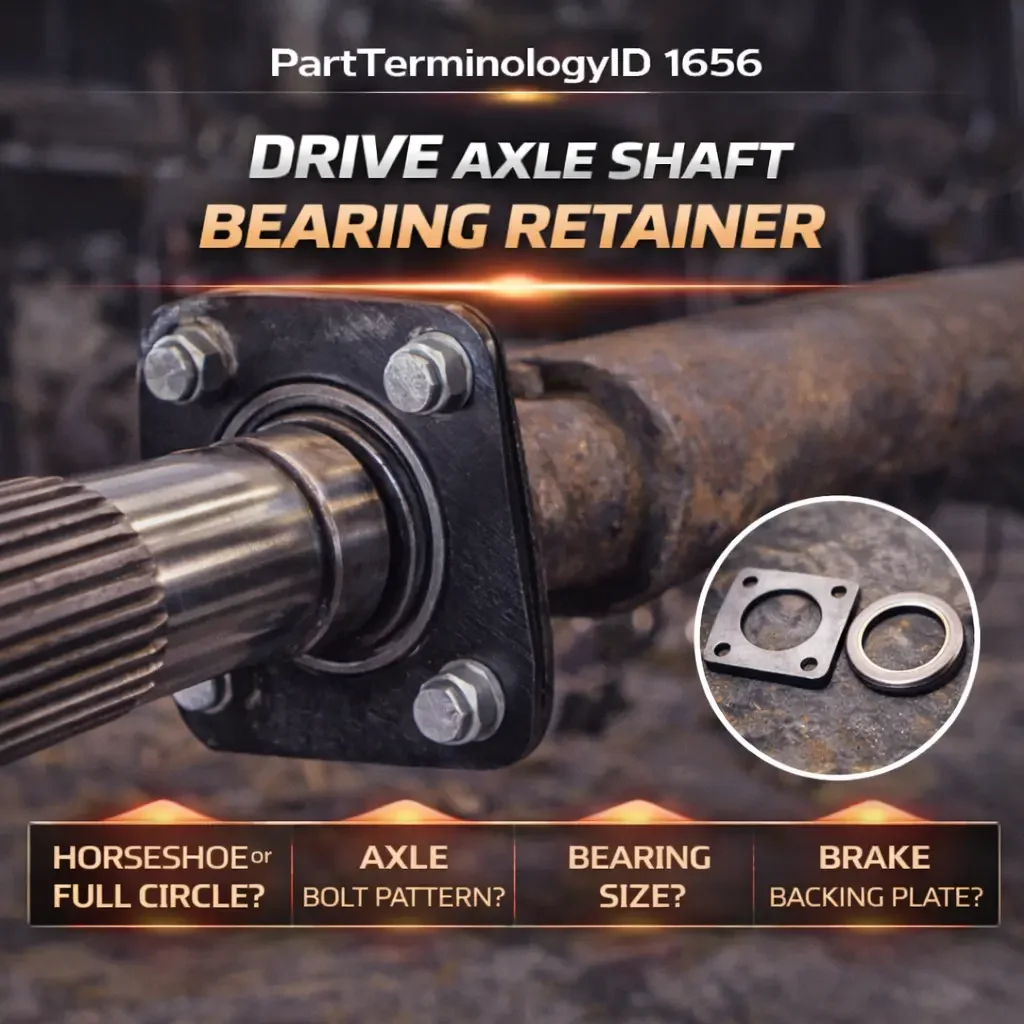
The drive axle shaft bearing retainer is the flat steel plate that bolts to the axle housing flange at the wheel end and holds the axle shaft, bearing, and seal assembly inside the housing. On non-C-clip (bolt-in) semi-floating rear axles, this plate is the final mechanical retention device between the axle shaft and the vehicle. Remove the retainer plate bolts and the entire axle shaft assembly - shaft, bearing, collar, and seal - slides out of the housing as a unit.
This is a $10 to $50 part (OE-style) or $20 to $60 (heavy-duty aftermarket) that is reusable in most cases but must be replaced when bent, cracked, corroded through, or when upgrading from drum brakes to disc brakes. It also serves double duty on many applications as the mounting surface for the brake backing plate, meaning the retainer plate and backing plate (PartTerminologyID 1628, covered earlier in this series) share the same bolt holes on the axle housing flange.
The retainer plate is specific to non-C-clip axle designs. On C-clip axles, the axle shaft is retained by a C-clip inside the differential (covered under PartTerminologyID 1652), and no external retainer plate is used at the wheel end.
PIES/PCdb: PartTerminologyID 1656 - Drive Axle Shaft Bearing Retainer
PIES 8.0 / PCdb 2.0: No change
What This Part Does
The retainer plate performs one function: it traps the bearing outer race inside the axle housing bore by covering the open end of the housing tube. The bearing is pressed onto the axle shaft and held axially by the press-fit collar (PartTerminologyID 1648). The bearing outer race sits in the axle housing bore. The retainer plate bolts to the housing flange and overlaps the bearing outer race, preventing it from sliding out of the bore. The axle shaft, bearing, collar, and retainer plate form a captive assembly that can only be removed by unbolting the retainer plate.
On most applications, the retainer plate also serves as the mounting point for the brake backing plate. The backing plate sits between the retainer plate and the axle housing flange, and the same four bolts (typically 3/8-inch or 7/16-inch) pass through the retainer plate, backing plate, and into the housing flange. This shared mounting means the retainer plate must be removed to replace the backing plate, and the backing plate must be removed to replace the retainer plate.
Two design types
Horseshoe (open) design. The plate has an open side (shaped like a horseshoe or U) that allows it to be slipped over the axle shaft without removing the bearing or collar. This design is the most common in the aftermarket because it can be installed after the bearing and collar are already pressed onto the shaft. If the retainer plate is forgotten during the initial assembly (before pressing the bearing and collar), a horseshoe-style plate can still be installed without cutting the collar off and starting over. This is the design that saves the job when the installation sequence error described in the PartTerminologyID 1648 collar post occurs.
Full-circle (closed) design. The plate has a complete circle center hole that must be installed on the axle shaft before the bearing and collar are pressed on. This design provides slightly more bearing retention surface (contact around the full circumference) but cannot be installed after the bearing is in place. Full-circle retainers are used on some Dana 44 applications (Jeep CJ, Wagoneer, TJ) and some other axles where the OE design specifies full-circle retention.
The design type is a critical fitment variable. A buyer who orders a full-circle retainer for a job where the bearing is already pressed on will not be able to install it without disassembling the axle.
Why Retainer Plates Are Replaced
Bent or warped from improper bearing removal
During axle shaft removal, it is common to pry against the retainer plate to extract the shaft assembly from the housing. If excessive force is applied or the prying is done at a single point rather than evenly, the plate bends. A bent retainer plate will not seat flat against the housing flange, creating a gap that allows the bearing to shift, the seal to leak, or the backing plate to misalign.
Cracked from fatigue or impact
On vehicles used for off-road, towing, or high-performance applications, the retainer plate absorbs repeated shock loads transferred through the axle shaft and bearing. Over time, cracks can develop around the bolt holes or at the bearing contact edge. A cracked plate can fail suddenly, releasing the axle shaft.
Corroded through
In salt-belt states, the retainer plate corrodes over time because it is directly exposed to road spray. Severe corrosion weakens the plate and compromises its ability to retain the bearing.
Drum-to-disc brake conversion
When converting a non-C-clip axle from drum brakes to disc brakes, the retainer plate often must be replaced with a machined version that provides a precision bearing seat and accommodates the different caliper mounting geometry. Aftermarket companies like Currie Enterprises and Dutchman Axles offer heavy-duty machined retainer plates specifically designed for disc brake conversions. These machined plates have a bearing recess that maintains proper bearing preload in the absence of the drum brake backing plate, which on many OE setups provides the bearing seat.
Upgrade to heavy-duty plate
OE retainer plates are typically stamped from thin steel (1/8 inch or less). Aftermarket heavy-duty retainer plates are laser-cut from 3/16-inch or 1/4-inch steel and are significantly stronger. Performance and off-road builders commonly upgrade to heavy-duty plates as part of an axle build.
C-clip eliminator kit installation
C-clip eliminator kits convert a C-clip axle to a bolt-in (non-C-clip) retention design. The kit includes new axle bearings, seals, and retainer plates that bolt to the axle housing flange. The retainer plate in a C-clip eliminator kit is essentially adding PartTerminologyID 1656 functionality to an axle that did not originally have it. This is a safety upgrade that provides secondary axle retention in case of C-clip failure.
Fitment Variables
Axle type and housing end configuration
The retainer plate must match the bolt pattern and bolt hole size on the axle housing flange. Common configurations include:
Ford 9-inch, small bearing, 3/8-inch bolt holes (bolt spacing approximately 3-5/16 x 2 inches)
Ford 9-inch, large bearing, 1/2-inch bolt holes, old style (bolt spacing approximately 3-1/2 x 2-3/8 inches)
Ford 9-inch, large bearing, 3/8-inch bolt holes, new style (bolt spacing approximately 3-9/16 x 2 inches)
GM 10-bolt and 12-bolt car
GM 10-bolt and 12-bolt truck/Impala
Dana 44 Jeep CJ (full circle)
Dana 44 Jeep TJ with drum brakes (full circle)
Dana 44 Jeep TJ with disc brakes (full circle, with lip)
Dana 44 Jeep JL Rubicon (with studs)
Various Buick, Oldsmobile, Pontiac configurations
The bolt hole spacing, bolt hole size, and plate outer dimensions are axle-specific. The Ford 9-inch alone has three common bearing/bolt configurations (small bearing small bolt, big bearing big bolt, big bearing small bolt), and ordering the wrong one means the bolt holes do not align.
Horseshoe vs. full-circle design
As detailed above, this determines whether the plate can be installed after the bearing is pressed on. The buyer must know which design their axle requires and whether the bearing is already installed.
Bearing size compatibility
The retainer plate center opening (or bearing recess on machined plates) must match the bearing outer race diameter. A plate designed for a small bearing will not retain a large bearing, and vice versa. On the Ford 9-inch, the small bearing (2.835-inch OD race) and large bearing (3.150-inch OD race) use different retainer plates.
Brake type (drum vs. disc)
The retainer plate for a drum brake application is typically a flat plate that sits against the brake backing plate. The retainer plate for a disc brake conversion may have a machined bearing recess that provides proper preload, and/or mounting provisions for disc brake caliper brackets.
Plate thickness
OE plates are typically 1/8-inch stamped steel. Aftermarket heavy-duty plates are 3/16-inch to 1/4-inch laser-cut steel. The thicker plate may require longer housing flange bolts. The buyer should verify bolt length compatibility when upgrading.
Top Return Causes
1) Wrong bolt pattern for the axle housing
The buyer orders a Ford 9-inch retainer plate with the wrong bearing/bolt configuration. The three Ford 9-inch variants (SB-SB, BB-BB, BB-SB) are the most common source of this error.
Prevention: Bolt hole spacing and bolt hole diameter in the listing title or first line of the description. "Ford 9-inch, large bearing, 3/8-inch bolt holes, new style." Include a diagram or photo showing the bolt pattern with measurements.
2) Full-circle plate ordered when bearing is already pressed on
The buyer cannot install the full-circle plate over the existing bearing and collar assembly. They need a horseshoe plate.
Prevention: Specify horseshoe or full-circle design in the listing. "Horseshoe design - can be installed after bearing is pressed on shaft" or "Full-circle design - must be installed on shaft before pressing bearing."
3) Wrong bearing size (small vs. large)
The plate center opening does not match the bearing. This is most common on the Ford 9-inch where small and large bearing options exist.
Prevention: Bearing size designation in the listing. Compatible bearing part numbers cross-referenced.
4) Plate too thick for existing bolts
The buyer upgrades to a heavy-duty 1/4-inch plate and the existing 3/8-inch bolts are too short to engage the housing flange threads with the thicker plate.
Prevention: "Heavy-duty plate is [X] inches thick. Verify that your housing flange bolts are long enough to engage at least [Y] threads with this plate and the brake backing plate installed. Longer bolts may be required when upgrading from OE-thickness plates."
5) Already included in a C-clip eliminator kit or axle build kit
The buyer orders a retainer plate separately, then discovers the axle build kit or C-clip eliminator kit they also purchased includes retainer plates.
Prevention: Cross-reference with common kits. "Retainer plates are included in C-clip eliminator kit [part number] and axle build kit [part number]. If you have purchased a complete kit, separate retainer plates are not needed."
Compatibility Checklist for Buyers
1) Identify your axle type and housing end configuration. Ford 9-inch (which bearing/bolt combo?), GM 10/12-bolt (car or truck?), Dana 44 (which model Jeep?), etc.
2) Determine horseshoe or full-circle requirement. If the bearing is already pressed on the shaft, you need horseshoe. If you are building from scratch, either design works.
3) Confirm bearing size. Small or large bearing? The retainer plate must match.
4) Confirm brake type. Drum or disc? Disc conversions may require a machined retainer plate with a bearing recess.
5) Check bolt length. If upgrading to a thicker aftermarket plate, verify your bolts are long enough.
6) Full vehicle and axle details. Year, make, model, axle type, bearing size, bolt pattern, brake type. OEM part number cross-reference recommended.
Catalog Checklist for Attributes
Core taxonomy: Product form: retainer plate only, retainer plate with gasket, retainer plate set (pair). Design type: horseshoe (open) or full-circle (closed). Separate from brake backing plate (PartTerminologyID 1628), bearing collar (PartTerminologyID 1648), bearing lock ring (PartTerminologyID 1652).
Fitment: Year, make, model, submodel, drivetrain. Axle type (manufacturer, model, ring gear size). Bearing size (small/large, OD dimension). Brake type (drum/disc). Bolt hole spacing (horizontal and vertical center-to-center). Bolt hole diameter.
Specifications: Plate material (stamped steel, laser-cut steel, aluminum). Plate thickness. Bolt hole spacing (H x V, center-to-center). Bolt hole diameter. Center opening type (horseshoe/full-circle). Center opening diameter. Bearing recess (yes/no, machined or flat). Overall dimensions.
Included components: Plate only, plate with gasket, plate with mounting bolts, plate with studs. Quantity (single or pair).
Installation notes: Horseshoe vs. full-circle installation sequence. Bolt torque specification. Verify bolt length with thicker aftermarket plates. Install behind brake backing plate (shared mounting).
Images: Plate from front and back, bolt pattern visible with measurements, horseshoe opening (if applicable), bearing recess detail (if machined plate).
FAQ
Is the retainer plate the same as the brake backing plate?
No. They are separate parts that share the same mounting bolts. The retainer plate holds the axle bearing in the housing. The brake backing plate (PartTerminologyID 1628) mounts the brake components and shields them from debris. The backing plate sits between the retainer plate and the axle housing flange. Both are removed and installed together during axle bearing service.
Can I reuse the old retainer plate?
Usually yes, if it is not bent, cracked, or severely corroded. Unlike the bearing collar (PartTerminologyID 1648) which is destroyed during every removal, the retainer plate is simply unbolted and can be reinstalled. Inspect the plate for distortion (lay it on a flat surface and check for rocking), cracks around bolt holes, and corrosion that has reduced the plate thickness.
I forgot to put the retainer plate on before pressing the bearing. Do I have to start over?
Only if your axle uses a full-circle retainer plate. If your application accepts a horseshoe (open) retainer plate, you can slip it over the shaft and around the bearing without disassembly. Many aftermarket horseshoe retainer plates are specifically designed for this situation. Check whether a horseshoe plate is available for your axle before cutting the collar and pressing the bearing off.
What is the difference between OE and heavy-duty aftermarket retainer plates?
OE retainer plates are stamped from thin steel (approximately 1/8 inch) and are adequate for stock applications. Heavy-duty aftermarket plates (from Currie, Dutchman, Yukon, Moser, and others) are laser-cut from 3/16-inch to 1/4-inch steel, are more resistant to bending and cracking, and are often zinc-plated or painted for corrosion resistance. They are recommended for off-road, towing, performance, and any application where the axle experiences higher-than-stock loads.
Final Take for Aftermarket Teams
Drive Axle Shaft Bearing Retainer (PartTerminologyID 1656) is the final link in the non-C-clip axle retention chain: the collar holds the bearing on the shaft, and the retainer plate holds the whole assembly in the housing. The catalog teams that serve this buyer well specify three things: the bolt pattern (because the Ford 9-inch alone has three variants that look similar but do not interchange), the design type (horseshoe vs. full-circle, because getting this wrong stops the job), and the bearing size (because small bearing and large bearing plates are not interchangeable). The fourth detail that prevents returns is a note about plate thickness and bolt length compatibility for buyers upgrading from OE to heavy-duty aftermarket plates. A 1/4-inch plate that ships with no mention of bolt length will come back from the buyer who discovers their stock bolts are 1/8 inch too short to reach the housing flange threads.