
Written by Arthur Simitian | PartsAdvisory
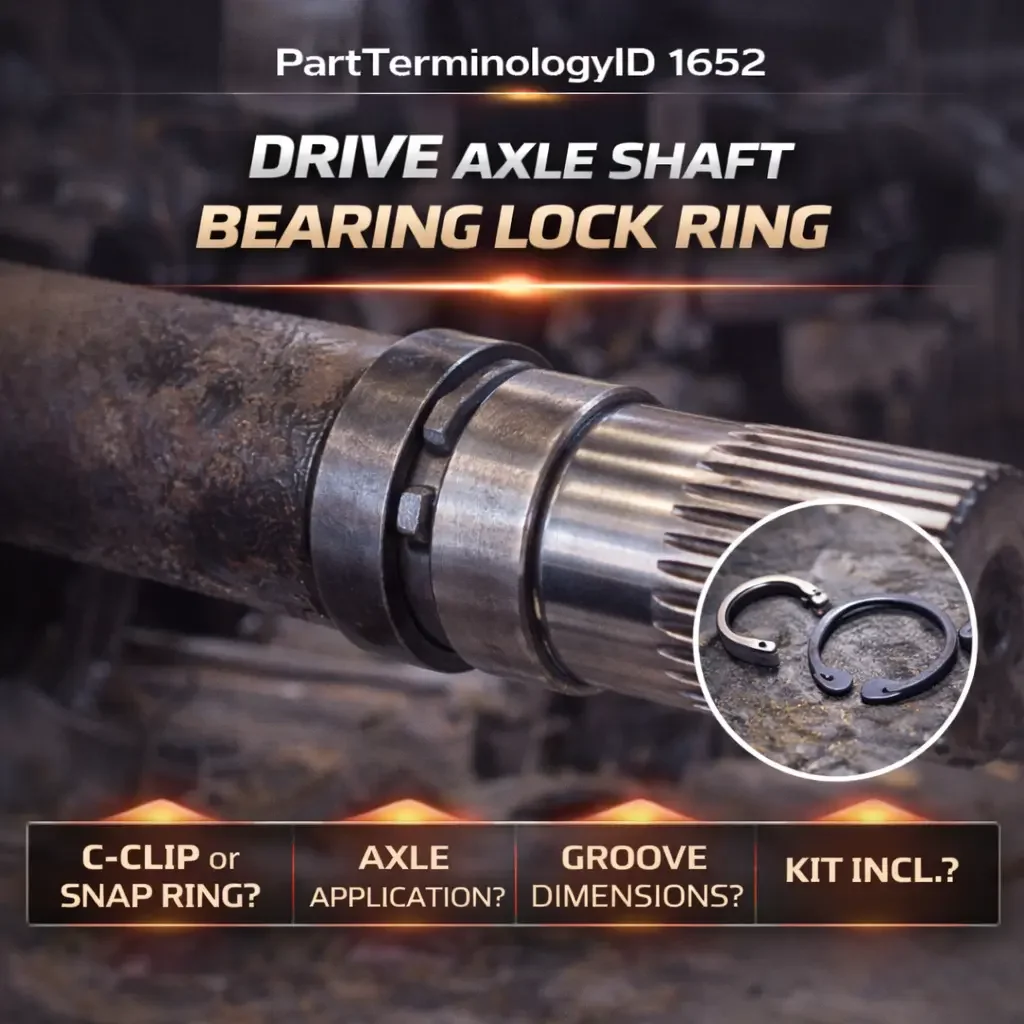
The drive axle shaft bearing lock ring is a snap ring, circlip, or retaining ring that fits into a machined groove on the axle shaft or in the axle housing bore to retain the axle bearing in position, prevent axle shaft walk, or both. Unlike the bearing collar (PartTerminologyID 1648, covered in the previous post), which is a heavy press-fit ring requiring 10 to 20 tons of force and destruction to remove, the lock ring is a removable spring-steel ring that snaps into a groove and can be removed with snap ring pliers or a pick tool. It is a lighter-duty retention device used on different axle configurations than the press-fit collar.
This is a $2 to $10 part that is routinely damaged or lost during axle disassembly and must be replaced during reassembly. It is one of the most frequently overlooked components in an axle bearing service, and its absence or failure allows the axle shaft to migrate inward or outward (axle walk), which can disengage the shaft from the differential, contaminate the brakes with gear oil, or allow the wheel to develop excessive play.
PIES/PCdb: PartTerminologyID 1652 - Drive Axle Shaft Bearing Lock Ring
PIES 8.0 / PCdb 2.0: No change
What Drive Axle Shaft Bearing Lock Ring Means in the Aftermarket
The lock ring serves as the retention mechanism that keeps the axle shaft and/or bearing in the correct axial position within the axle housing. It performs this function on several different axle configurations, and the specific type of lock ring varies by application:
C-clip (internal, inside the differential). On C-clip axle designs (GM 8.5/8.6-inch 10-bolt, GM 7.5/7.625-inch, some older Chrysler 8.25, some Ford 7.5), a small C-shaped clip sits in a groove at the inner end of the axle shaft inside the differential case. The C-clip prevents the axle shaft from pulling outward. To remove the axle shaft, the differential cover must be removed, the pinion shaft (cross shaft) must be partially withdrawn, and the C-clip must be slid off the axle shaft. C-clips are the most common axle retention method on passenger cars and half-ton trucks.
External snap ring (on axle stub shaft). On some front axle applications (Dana 28, Dana 30, Dana 44 front, Dana 50, GM 9.25 IFS) and some rear axle applications, an external snap ring sits in a groove on the outer end of the axle stub shaft. This ring retains the axle shaft in the hub or prevents the shaft from walking inward during operation. It may sit inside the locking hub on 4x4 front axles.
Internal snap ring (in housing bore). On some axle designs, a snap ring sits in a groove inside the axle housing bore, inboard of the bearing. This ring acts as a stop that prevents the bearing (and the shaft it rides in) from pushing inward.
Bearing retaining ring (on shaft, behind bearing). On some applications, a snap ring or circlip sits in a groove on the axle shaft immediately behind the bearing to prevent the bearing from walking along the shaft. This is functionally similar to the press-fit collar (PartTerminologyID 1648) but uses a groove-and-ring retention method instead of an interference press fit. It is removable and reusable if undamaged.
All of these are covered under PartTerminologyID 1652. The catalog challenge is that the same PartTerminologyID encompasses several physically different ring types (C-clips, external snap rings, internal snap rings, bearing retaining circlips) used in different locations (inside the differential, on the stub shaft, in the housing bore, behind the bearing) on different axle configurations. A listing that simply says "axle shaft lock ring" without specifying the type, position, and axle application will generate returns.
How the Lock Ring Works in Context
C-clip retention (most common application)
On a C-clip axle, the axle shaft slides into the axle housing tube from the wheel end, passes through the bearing at the outer end of the tube, and extends into the differential at the center. Inside the differential, the inner end of the axle shaft has a machined groove. A small C-shaped clip snaps into this groove. The clip sits between the axle shaft groove and the differential side gear, preventing the shaft from pulling outward.
The pinion shaft (cross shaft) passes through the differential case perpendicular to the axle shafts and runs between the two axle shaft inner ends. When the pinion shaft is in place, it blocks the C-clips from being removed. To remove an axle shaft, you must first remove the differential cover, drain the gear oil, partially withdraw the pinion shaft, slide the C-clip off the axle shaft groove, and then pull the shaft outward through the housing tube.
If the C-clip breaks, falls off, or is not reinstalled during reassembly, there is nothing preventing the axle shaft from walking outward under centrifugal force, differential thrust loads, or simple gravity on an incline. The shaft can pull far enough out to disengage from the side gear, resulting in loss of drive to that wheel. In the worst case, the shaft pulls out far enough that the bearing exits the housing bore and the wheel separates from the vehicle. C-clip axle failure is a well-documented safety concern that has led to the popularity of C-clip eliminator kits in the performance and off-road aftermarket.
External stub shaft snap ring
On 4x4 front axles with locking hubs, the external snap ring on the stub shaft serves a different purpose: it retains the axle shaft in the hub assembly and prevents inward migration during operation. When the locking hub is engaged, the snap ring ensures the axle shaft stays in position to transmit torque. When the hub is disengaged, the snap ring prevents the shaft from dropping inward under gravity.
These snap rings sit in a machined groove on the outer end of the stub shaft and are installed after the hub and locking hub components are assembled. They are commonly damaged during hub disassembly (bent, stretched, or lost) and must be replaced. Some vehicles have multiple groove positions on the stub shaft, and the correct groove must be used for proper retention.
Internal housing bore snap ring
On some axle designs, a snap ring inside the housing bore acts as a bearing stop. The bearing is pressed or slid into the housing bore until it contacts the snap ring, which sets the bearing's axial position. During service, this ring is removed with internal snap ring pliers before the bearing can be extracted. It is a precision-fit ring that must match the housing bore groove diameter exactly.
Why Drive Axle Shaft Bearing Lock Rings Are Replaced
Damaged during disassembly
This is the primary reason. C-clips are pried out with picks or small screwdrivers and can be bent, stretched, or cracked during removal. External snap rings are levered out with snap ring pliers and can be overstretched (losing their spring tension) or broken. Internal snap rings can be distorted during extraction. Any ring that has been deformed, cracked, or overstretched must be replaced because it will not provide reliable retention.
Lost during disassembly
Small snap rings and C-clips fall into the differential housing (C-clips), into the axle tube (external rings), or onto the shop floor. If the original ring cannot be found, a replacement must be obtained before reassembly.
Worn groove on axle shaft
The groove on the axle shaft that the ring sits in can wear, corrode, or become damaged over time, especially on high-mileage vehicles or vehicles that have experienced axle shaft walk. If the groove is worn, the ring may not seat properly and may pop out under load. In this case, the axle shaft itself may need replacement, but a new ring should also be installed.
Corrosion
Rings exposed to road salt, water, or differential fluid contamination can corrode, weaken, and lose their spring properties. Corroded rings should be replaced during any axle service.
Not reinstalled during previous service
A disturbingly common problem. A previous technician removed the C-clip or snap ring during axle service and forgot to reinstall it. The vehicle may operate normally for some time (the bearing friction and gear mesh hold the shaft in approximate position), but eventually the shaft walks and a failure occurs. This is especially common with C-clips because they are small, easy to lose inside the differential, and their absence is not visible from outside the axle.
Fitment Variables
Axle type
The lock ring must match the specific axle. C-clips for a GM 10-bolt are different from C-clips for a Ford 8.8 or a Chrysler 8.25. External snap rings for a Dana 30 are different from snap rings for a Dana 44 or GM 9.25 IFS. The axle type determines the ring dimensions and type.
Ring type (C-clip, external snap ring, internal snap ring)
The same axle may use different ring types at different positions. A 4x4 vehicle may use C-clips on the rear axle and external snap rings on the front axle stubs. The buyer must specify which ring they need by position and function, not just by vehicle.
Ring dimensions
C-clips: inner opening width and thickness. External snap rings: inner diameter (shaft groove diameter), outer diameter (free state), thickness. Internal snap rings: outer diameter (housing groove diameter), inner diameter (free state), thickness. These dimensions must match the shaft groove or housing groove exactly.
Spline count / shaft diameter
Different spline counts on the same axle model may produce different shaft groove diameters. A 28-spline GM 10-bolt axle shaft has a different groove diameter than a 30-spline shaft for the same axle.
Top Return Causes
1) Wrong ring type for the application
The buyer orders a C-clip when they need an external snap ring, or vice versa. The part name "lock ring" is generic enough to encompass all types.
Prevention: Specify the ring type in the listing title: "Axle Shaft C-Clip (Internal, Differential)" or "Axle Stub Shaft External Snap Ring" or "Axle Housing Bearing Retaining Ring." Position description: "Fits inside differential case on inner end of axle shaft" or "Fits in groove on outer stub shaft inside locking hub."
2) Wrong axle type
The buyer orders a C-clip for a GM 8.5-inch 10-bolt when they have a GM 8.6-inch 10-bolt, or a Dana 30 snap ring when they have a Dana 44. The rings are different sizes.
Prevention: Axle type in the listing title and fitment. Ring dimensions (ID, OD, thickness) in the specifications.
3) Already included in a differential rebuild or bearing kit
The buyer orders lock rings separately, then discovers that the bearing kit, differential overhaul kit, or C-clip eliminator kit they also purchased already includes the rings. They return the standalone rings.
Prevention: Cross-reference with common kits for the same application. "These C-clips are included in differential overhaul kit [part number]. If you have purchased the complete kit, separate C-clips are not needed."
4) Ring bent or stretched, buyer thinks it is wrong size
The buyer removes the old ring, bends or stretches it during removal, then compares it to the new ring and thinks the new ring is the wrong size because the old ring is deformed.
Prevention: "Compare the new ring to the shaft groove or housing groove, not to the old ring. Old rings are typically deformed during removal and should not be used as a dimensional reference."
5) C-clip eliminator kit ordered instead of (or in addition to) C-clips
The buyer who is concerned about C-clip axle safety may order a C-clip eliminator kit (which replaces the C-clip retention with a bolt-on bearing retainer plate, converting the axle to a non-C-clip design). If they also order C-clips, one of the two orders is returned.
Prevention: If listing both C-clips and C-clip eliminator kits for the same axle, note the relationship: "C-clip eliminator kits replace the C-clip retention method entirely. If installing a C-clip eliminator kit, C-clips are not needed."
Compatibility Checklist for Buyers
1) Identify your axle type. GM 8.5/8.6/7.5/7.625-inch, Ford 7.5/8.8/9/9.75-inch, Chrysler 8.25/9.25-inch, Dana 30/35/44/60, AAM 9.25/10.5/11.5-inch, etc.
2) Determine the ring type and position. C-clip (inside differential), external snap ring (on stub shaft), internal snap ring (in housing bore), or bearing retaining ring (on shaft behind bearing).
3) Verify dimensions against the shaft groove or housing groove. Do not compare to the old ring if the old ring was deformed during removal.
4) Check whether your bearing kit or overhaul kit includes the ring. Many kits include lock rings. Do not order separately if already included.
5) Order spares. Lock rings are inexpensive and easily damaged or lost during installation. Ordering an extra set costs almost nothing and can save a trip to the parts store mid-job.
Catalog Checklist for Attributes
Core taxonomy: Product form: C-clip, external snap ring, internal snap ring, bearing retaining ring, assortment/set. Position: internal (inside differential), external (on stub shaft), housing bore, behind bearing. Separate from bearing collar (PartTerminologyID 1648, which is a press-fit ring, not a snap ring). Separate from C-clip eliminator kit (different PartTerminologyID).
Fitment: Year, make, model, submodel, trim, drivetrain. Axle type (manufacturer, ring gear size, model designation). Shaft spline count. Position (front/rear, inner/outer).
Specifications: Ring type (C-clip, external snap ring, internal snap ring). Inner diameter. Outer diameter. Thickness. Material (spring steel, carbon steel).
Included components: Quantity per package (sold individually, in pairs, or in sets). Hardware included (some kits include the pinion shaft lock bolt or other small hardware).
Installation notes: Snap ring pliers required (internal or external type depending on ring). C-clip installation requires differential cover removal and pinion shaft withdrawal. Inspect shaft groove for wear before installing new ring. Do not reuse deformed rings.
Images: Ring alone with dimensions visible. Ring installed in application context (in differential groove, on stub shaft, in housing bore).
FAQ
What is the difference between a bearing lock ring (1652) and a bearing collar (1648)?
The lock ring is a removable snap ring or circlip that fits into a machined groove and is retained by spring tension. It can be removed with pliers or a pick tool and reused if undamaged. The collar is a heavy press-fit ring with 0.003 to 0.005 inches of interference that requires a hydraulic press to install and must be cut off to remove. They serve the same general purpose (retaining the bearing on the shaft) but use completely different retention methods on different axle configurations. Non-C-clip axles with press-on bearings use the collar. C-clip axles and axles with groove-retained bearings use the lock ring.
Can I reuse the old lock ring?
Only if it is completely undamaged. If the ring was bent, stretched, cracked, or corroded during removal, it must be replaced. Lock rings are inexpensive, and the consequences of a failed ring (axle shaft walk, wheel separation) are severe enough that replacement is always recommended during any axle service.
What is a C-clip eliminator kit and do I need one?
A C-clip eliminator kit converts a C-clip axle to a non-C-clip (bolt-in) design by adding a bearing retainer plate that bolts to the axle housing flange. This eliminates the C-clip as the sole axle retention device and adds a secondary retention method. C-clip eliminator kits are popular in the off-road and performance aftermarket because a broken C-clip on a standard C-clip axle can result in the axle shaft and wheel separating from the vehicle. If you are building an off-road or performance vehicle with a C-clip axle, a C-clip eliminator kit is a worthwhile safety upgrade. For stock street vehicles, the OE C-clip retention is adequate when properly maintained.
I lost the C-clip inside the differential during disassembly. What do I do?
The C-clip must be retrieved before reassembly. A small magnet on a flexible wand is the most effective tool. The C-clip may have fallen into the gear oil pool at the bottom of the differential case or lodged between the ring gear and the case. Do not reassemble the differential without the C-clip, and do not assume the clip will "find its way" into the correct position. A loose C-clip inside the differential can jam between gears and cause catastrophic differential failure.
Final Take for Aftermarket Teams
Drive Axle Shaft Bearing Lock Ring (PartTerminologyID 1652) is a $2 to $10 retention device that prevents the axle shaft from leaving the vehicle. Its low cost creates a false sense of insignificance. The reality is that this is a safety-critical component whose failure mode is wheel separation. The catalog teams that handle this part well do three things: they specify the ring type (C-clip, external snap ring, internal snap ring) and position (inside differential, on stub shaft, in housing bore) so the buyer gets the correct ring for their application, they cross-reference against bearing kits and overhaul kits to prevent duplicate purchases, and they distinguish clearly from the bearing collar (PartTerminologyID 1648) so the buyer does not confuse a $5 snap ring with a $15 press-fit collar that serves a similar function on a different axle type. The additional step that reduces returns is suggesting the buyer order spares. At $2 to $5 each, a spare lock ring in the toolbox costs less than a return shipment and far less than the damage caused by assembling an axle without one.