
Written by Arthur Simitian | PartsAdvisory
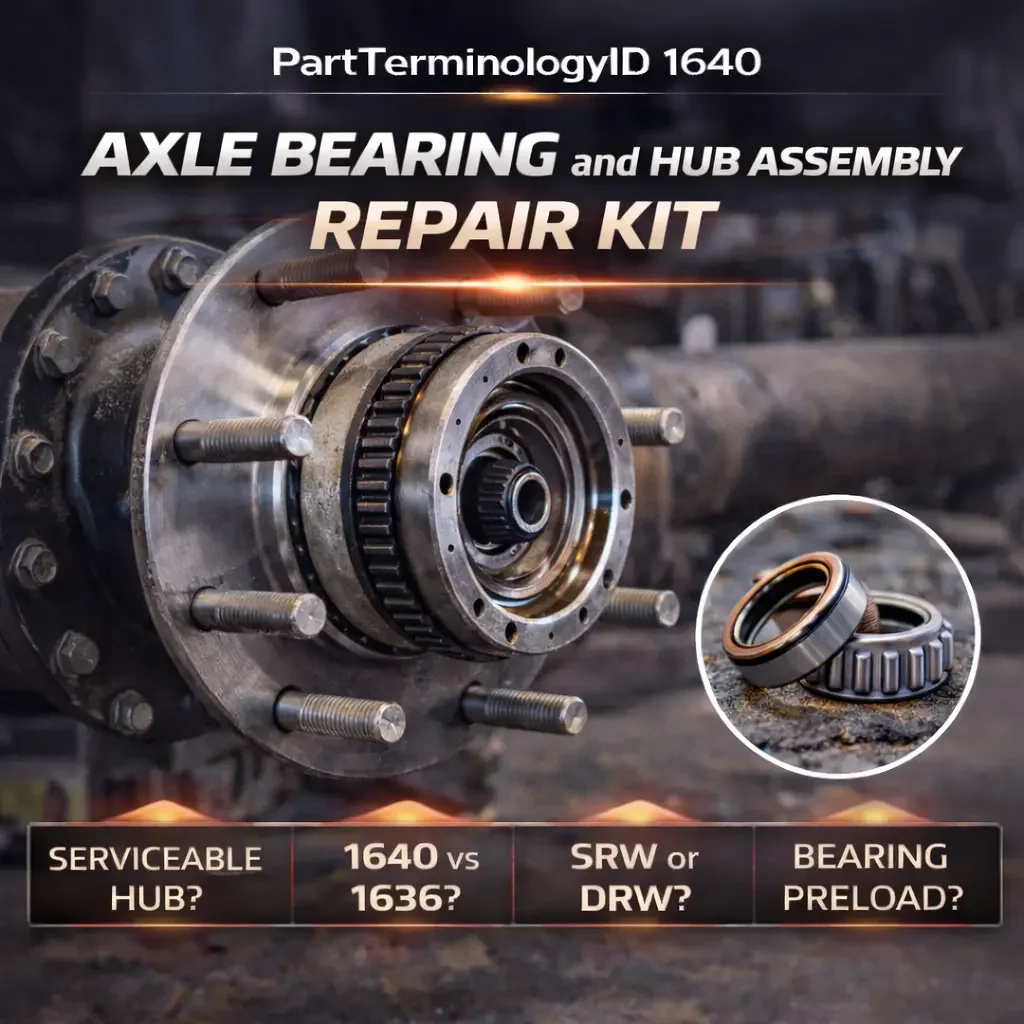
PartTerminologyID 1640 is the second "Axle Bearing and Hub Assembly" entry in the ACES/PIES catalog structure, and its existence creates one of the most persistent taxonomy headaches in the wheel-end category. It shares its name exactly with PartTerminologyID 1636 (covered in the previous post in this series), yet it exists as a separate entry. For catalog teams, this immediately raises the question: what is the difference, and why do two PartTerminologyIDs with identical names coexist in the same database?
The answer lies in application scope and assembly configuration. PartTerminologyID 1636 covers the integrated, sealed, non-serviceable hub assembly that dominates the modern passenger car and light truck market - the Gen 3 bolt-on unit where the bearing, hub, and ABS sensor are one sealed piece that gets replaced as a complete assembly. PartTerminologyID 1640 covers the serviceable hub assembly found on full-floating rear axles, heavy-duty truck applications, older front axle configurations with adjustable tapered roller bearings, and other applications where the hub, bearings, seals, and related components are individually serviceable rather than replaced as a single sealed unit.
This distinction matters enormously in the aftermarket because it determines how the product is sold (complete assembly vs. component kit), how it is serviced (bolt-on replacement vs. disassembly/reassembly/preload adjustment), and what the buyer needs to know before ordering (whether they need a single part number or a collection of component part numbers that must all be correct for the assembly to function).
This post is built for aftermarket catalog teams, marketplace sellers, parts counter staff, and heavy-duty/fleet buyers who need to understand the serviceable hub assembly ecosystem, how to catalog and list these products correctly, and how to prevent the cross-ordering confusion that occurs when buyers (and sometimes catalog systems) conflate PartTerminologyID 1640 with PartTerminologyID 1636.
Status in New Databases
Status in New Databases
Current: PIES 7.2 + PCdb Future: PIES 8.0 + PCdb 2.0 Status: No change
Why Two PartTerminologyIDs With the Same Name Exist
The ACES/PIES standard assigns different PartTerminologyIDs to products that serve the same general function but differ in their assembly configuration, application scope, or service approach. PartTerminologyID 1636 and 1640 both describe an "Axle Bearing and Hub Assembly," but they represent two fundamentally different product concepts:
PartTerminologyID 1636 is the sealed, integrated, non-serviceable unit. When the bearing fails, you replace the entire assembly. When the ABS sensor fails, you replace the entire assembly. There are no internal components to inspect, repack, adjust, or replace. The bearing preload is factory-set and cannot be changed. This is the dominant configuration on modern passenger cars, crossovers, and half-ton trucks.
PartTerminologyID 1640 is the serviceable hub assembly where the hub, bearings, seals, races, spacers, and other internal components can be individually removed, inspected, replaced, repacked with grease, and reassembled with proper bearing preload adjustment. This configuration is found on full-floating rear axles (3/4-ton and 1-ton trucks, commercial vehicles, heavy equipment), older front axle applications with tapered roller bearings (pre-1990s trucks, 4x4 front axles with manual locking hubs), and trailer axles.
The catalog consequence is direct: a buyer searching for "axle bearing and hub assembly" may be directed to either PartTerminologyID depending on their vehicle. If the catalog system does not clearly distinguish between the two, the buyer may receive a sealed Gen 3 assembly when they need a serviceable hub with separate bearings, or vice versa. The reverse is equally problematic: a fleet buyer ordering components for a full-floating one-ton truck rear axle may receive a sealed passenger car hub assembly that has no relevance to their application.
For the remainder of this post, all references to "hub assembly" refer to the PartTerminologyID 1640 serviceable configuration unless otherwise noted.
What PartTerminologyID 1640 Covers in the Aftermarket
Full-floating rear axle hub assemblies
This is the primary application for PartTerminologyID 1640 in the current aftermarket. Full-floating rear axles are found on 3/4-ton trucks (Chevrolet/GMC 2500, Ford F-250, Ram 2500), one-ton trucks (Chevrolet/GMC 3500, Ford F-350, Ram 3500), commercial vans and chassis cabs, medium-duty trucks, and heavy-duty vehicles.
In a full-floating design, the vehicle's weight is carried entirely by the axle housing and hub assembly. The hub bolts to a spindle (or rides on a spindle) that is part of the axle housing. Inside the hub, two tapered roller bearings (an inner bearing and an outer bearing) ride on the spindle and support the hub. The axle shaft passes through the center of the spindle and hub and connects to the hub via a bolted flange or drive plate. The axle shaft transmits torque only - it carries none of the vehicle's weight. This is the critical design distinction from a semi-floating axle, where the axle shaft carries both torque and vehicle weight.
Because the hub contains serviceable bearings, the hub assembly for a full-floating axle is sold in several configurations:
Complete hub assembly. The hub body, pre-installed with inner and outer bearings, races, seals, spindle nut, lock washer, and sometimes the wheel studs. This is the most complete product and the easiest to install because the bearing races are already pressed into the hub and the bearings are pre-packed or ready to pack with grease. The buyer still needs to adjust the bearing preload during installation.
Hub only. The hub body with wheel studs but without bearings, races, or seals installed. The buyer must separately purchase and install the inner bearing, outer bearing, inner race, outer race, inner seal, outer seal/dust cap, spindle nut, and lock washer. This configuration is common when the buyer is reusing serviceable bearings or upgrading to a different bearing specification.
Bearing and seal kit. The inner bearing, outer bearing, inner race, outer race, and seals, without the hub body. This is the maintenance kit for repacking or replacing the bearings while reusing the existing hub. This is the most common repair configuration because the bearings and seals wear out long before the hub body does.
Individual components. Inner bearing, outer bearing, inner race, outer race, inner seal, outer seal, dust cap, spindle nut, lock washer, and cotter pin sold individually. This allows the buyer to replace only the failed component, but requires accurate identification of each component.
The catalog challenge is that all of these configurations may be listed under the same PartTerminologyID 1640, and the buyer must understand which configuration they need. The listing must clearly specify what is included and what is not.
Older front axle hub assemblies with serviceable bearings
Prior to the widespread adoption of sealed Gen 3 hub assemblies (roughly pre-1997 for most passenger cars, pre-2000 for many trucks), front wheel hubs used serviceable tapered roller bearings. The hub contained an inner bearing and outer bearing that rode on a spindle, with the bearing preload set by the spindle nut. These bearings required periodic inspection, cleaning, repacking with grease, and preload adjustment as part of routine maintenance. When the bearings wore out, they were replaced individually.
This configuration was universal on rear-wheel-drive vehicles with front disc brakes from the 1970s through the 1990s, and was common on 4x4 front axles with manual locking hubs through the 2000s (and is still used on some current heavy-duty 4x4 applications). The hub, rotor, bearings, and seal were all separate, serviceable components.
In the aftermarket, these applications are served by bearing and seal kits, individual bearing and race sets, and sometimes complete hub assemblies with bearings pre-installed. The buyer for these applications is often a DIYer performing routine bearing maintenance rather than emergency bearing replacement, and they may need guidance on the bearing preload adjustment procedure.
Trailer axle hub assemblies
Trailer axles (utility trailers, boat trailers, RV trailers, commercial trailers) universally use serviceable hub assemblies with tapered roller bearings. Trailer hubs are simpler than vehicle hubs (no ABS sensor, no CV axle shaft, no drive components on non-driven trailers), but they are subject to harsh operating conditions: water submersion (boat trailers), heavy loads (commercial and RV trailers), long storage periods (seasonal trailers), and infrequent maintenance.
Trailer hub assemblies are available as complete hubs (with bearings pre-installed) or as hub-and-drum assemblies (with the brake drum integrated into the hub). They are sold by spindle size, bolt pattern, and bearing configuration. While trailer applications may fall under a different PartTerminologyID in some catalog systems, they share the serviceable bearing architecture with PartTerminologyID 1640 and are often cross-listed.
4x4 front axle hub assemblies with locking hubs
On 4x4 vehicles with solid front axles (Jeep, Ford, Dodge, Toyota) and some with independent front suspension (Ford, GM), the front hub assembly may include a manual or automatic locking hub mechanism that engages or disengages the front wheels from the front axle shafts. When the locking hub is engaged, the axle shaft is connected to the wheel hub and the front wheels are driven. When disengaged, the front wheels rotate freely, reducing drivetrain drag and improving fuel economy.
The locking hub mechanism mounts to the front of the hub assembly, and the hub assembly itself contains the serviceable bearings that support the hub on the spindle. The hub, bearings, seals, locking hub, and related hardware are all individually serviceable. The locking hub is typically a separate PartTerminologyID, but it interfaces with the hub assembly and must be compatible with it. This creates a fitment dependency between the hub assembly and the locking hub that must be reflected in the catalog.
How the Serviceable Hub Assembly Works
The tapered roller bearing system
The serviceable hub assembly uses two tapered roller bearings - an inner (larger) bearing and an outer (smaller) bearing - that ride on a spindle. The spindle is a precision-machined cylindrical shaft that protrudes from the axle housing (on a full-floating rear axle), the steering knuckle (on a front axle), or the axle beam (on a trailer axle). The bearing races (also called cups) are pressed into the hub bore. The bearing cones (also called inner rings, with the rollers and cage attached) ride on the spindle.
Tapered roller bearings are uniquely suited for this application because they can handle both radial loads (the vehicle's weight pushing down) and axial loads (lateral forces from cornering) simultaneously. The taper angle determines the ratio of radial to axial load capacity. The two bearings are oriented with their tapers facing in opposite directions, which allows them to resist axial forces in both directions.
Bearing preload adjustment
Unlike sealed Gen 3 hub assemblies where the bearing preload is factory-set, serviceable hub assemblies require the installer to set the bearing preload during installation. Preload is the slight compression applied to the bearings by the spindle nut that eliminates all play while maintaining minimal rolling friction. Correct preload is critical:
Too loose (insufficient preload or excessive end play). The hub rocks on the spindle. The wheel wobbles. The bearings experience impact loading with every rotation. The rollers skid instead of roll, creating flat spots and accelerating wear. The brake rotor wobbles, causing pulsation. In extreme cases, the hub can come off the spindle entirely.
Too tight (excessive preload). The bearings are overloaded. Rolling friction is excessive, generating heat. The grease breaks down from the heat. The bearing surfaces fatigue and spall (flake). The hub becomes hot to the touch after driving. In extreme cases, the bearing seizes, the hub locks up, and the wheel stops rotating.
The preload procedure varies by manufacturer but typically follows this general sequence: install the inner bearing and seal into the hub, place the hub on the spindle, install the outer bearing, thread the spindle nut on, tighten the spindle nut to a specified torque while rotating the hub to seat the bearings, back the nut off a specified amount (typically 1/4 to 1/2 turn or to a specific back-off torque), check end play with a dial indicator (typically 0.001 to 0.005 inches), and lock the nut in position with a lock washer, cotter pin, or jam nut.
This procedure requires a torque wrench, a dial indicator, and knowledge of the manufacturer's specific preload specification. Incorrect preload is the single most common cause of premature bearing failure on serviceable hub assemblies, and it is a significant source of returns and warranty claims when the bearing fails shortly after service.
Grease packing and sealing
Serviceable hub bearings are lubricated with high-temperature wheel bearing grease (typically NLGI Grade 2, lithium complex or synthetic). The grease must be packed into the bearing rollers and cage before installation, and the hub cavity between the bearings must contain enough grease to lubricate the assembly for the service interval. The grease also serves as a barrier against moisture and contamination.
The hub is sealed by an inner grease seal (pressed into the hub bore behind the inner bearing) and an outer dust cap or seal (pressed into or threaded onto the outer end of the hub). On full-floating rear axles, the outer seal prevents differential gear oil from entering the hub cavity and mixing with the bearing grease (which would degrade both lubricants). On front axles and trailer axles, the outer dust cap prevents water and debris from entering.
Seal failure is the most common cause of bearing failure on serviceable hubs. On boat trailer applications, the hub is submerged during launching and loading. The temperature differential between the hot hub (from highway driving) and the cold water causes the air inside the hub cavity to contract, creating a vacuum that draws water past the seals. This water contaminates the grease, corrodes the bearings, and causes rapid failure. Bearing protector caps (such as Bearing Buddy brand) are aftermarket devices that pressurize the hub cavity with grease to prevent water intrusion. They are a separate product category but are closely associated with the serviceable hub assembly market.
Why PartTerminologyID 1640 Hub Assemblies Are Replaced
Bearing wear from normal service
Tapered roller bearings in properly maintained hubs can last 100,000 to 200,000 miles or more on highway vehicles, and indefinitely on trailers with low annual mileage if properly repacked at regular intervals. However, "properly maintained" is the operative phrase. Many serviceable hubs go their entire life without a bearing repack because the owner does not know the maintenance is required (especially on trailers) or because the sealed appearance of the hub assembly creates the false impression that no maintenance is needed.
When bearings wear, the symptoms are similar to a sealed hub assembly failure: humming, growling, or grinding noise from the wheel area, detectable play when rocking the wheel, and eventually heat generation from excessive friction.
Seal failure and contamination
As detailed above, seal failure allows water, dirt, and debris to enter the hub cavity and contaminate the bearing grease. This is the most common cause of premature bearing failure, especially on trailer hubs (water submersion) and off-road vehicle hubs (water crossing, mud). On full-floating rear axles, a failed inner seal allows differential gear oil to leak into the hub cavity, washing the bearing grease out and contaminating the brakes.
Incorrect preload
Incorrect preload set during the last bearing service causes accelerated wear. Too loose: impact loading, skidding, wobble. Too tight: heat, spalling, seizure. The buyer may not realize that the preload was incorrect and may blame the bearing quality when the failure is actually an installation error.
Corrosion and pitting
Bearings and races that have been contaminated with water develop corrosion pitting on the rolling surfaces. These pits act as stress concentrators that accelerate fatigue failure. Even brief water exposure (such as a single boat ramp launch without bearing protectors) can initiate corrosion that leads to failure thousands of miles later. The insidious nature of this failure mode is that the damage occurs long before the symptoms appear.
Hub body damage
The hub body can be damaged by a seized bearing (which can spin the race in the hub bore, scoring the bore surface), by impact (curb strike, pothole), by corrosion (salt-belt vehicles), or by improper service (using a drift on the bearing race that damages the hub bore seat). A scored or damaged hub bore will not hold a bearing race at the proper press fit, allowing the race to spin or wobble, which destroys the new bearing.
Wheel stud failure
Wheel studs pressed into the hub flange can break, strip, or corrode. While individual studs can be replaced (pressed out and a new stud pressed in), repeated stud failure or multiple failed studs may indicate hub flange damage or distortion that warrants hub replacement.
Fitment Variables
Axle type and spindle diameter
The hub must match the spindle it rides on. Full-floating rear axles come in many configurations: GM 14-bolt (10.5-inch and 11.5-inch ring gear), Ford Sterling 10.25-inch and 10.5-inch, Ford Super Duty (Dana/AAM S110, S130, S132), Ram/AAM 11.5-inch and 11.8-inch, Dana 60, Dana 70, Dana 80, and many others. Each uses a different spindle diameter and bearing set. The bearing inner diameter must match the spindle; the bearing outer diameter must match the hub bore. Front axle spindle diameters vary by vehicle and axle manufacturer.
Bearing type and size
Inner and outer bearings are different sizes on the same hub (the inner bearing is always larger than the outer bearing because it carries more load). The bearing cone and race are a matched set and must be ordered together. Common bearing designations follow industry standards (Timken, NTN, Koyo part numbers) that specify the dimensions and taper angle.
Seal type and dimensions
Inner and outer seals must match the spindle diameter (seal inner diameter) and the hub bore (seal outer diameter). Seals come in single-lip and double-lip configurations, with or without a garter spring. Double-lip seals provide better contamination resistance but create slightly more friction.
Bolt pattern and stud configuration
The hub flange must match the vehicle's wheel bolt pattern. Full-floating rear axles on 3/4-ton and one-ton trucks typically use 8-lug patterns (8x6.5 inches on older GM and Dodge, 8x170mm on Ford Super Duty, 8x180mm on newer GM 2500/3500). The stud size, length, and thread pitch must match the wheels and lug nuts.
Drive flange bolt pattern
On full-floating rear axles, the axle shaft connects to the hub via a bolted drive flange. The bolt count (typically 6 or 8) and bolt circle on the hub must match the axle shaft flange. This is almost always axle-specific and determined by the axle type, but it is a fitment variable that must be correct.
ABS tone ring
Many modern full-floating rear axles include an ABS tone ring integrated into the hub assembly or pressed onto the hub. The tone ring tooth count must match the vehicle's ABS system. Older full-floating axles (pre-ABS) do not have a tone ring. Retrofitting ABS to an older axle requires a hub with the correct tone ring. Ordering a hub without a tone ring for an ABS-equipped vehicle (or vice versa) will cause ABS malfunction.
Single rear wheel (SRW) vs. dual rear wheel (DRW)
One-ton trucks are available in single rear wheel (SRW) and dual rear wheel (DRW, "dually") configurations. The hub assembly for a DRW truck is wider (to accommodate the inner and outer wheel) and has a different stud length and pattern than the SRW hub for the same axle. This is a critical fitment variable because many trucks were produced in both configurations.
Top Return Causes
1) Confusion with PartTerminologyID 1636 sealed hub assembly
The buyer searches for "axle bearing and hub assembly" and receives a sealed Gen 3 unit (PartTerminologyID 1636) when they need a serviceable full-floating hub assembly (PartTerminologyID 1640), or vice versa. The products are completely different in design, installation, and application.
Prevention: Clearly distinguish the product type in the listing title. "Full-Floating Rear Axle Hub Assembly with Bearings" vs. "Sealed Wheel Bearing and Hub Assembly, Bolt-On." Include the axle type (GM 14-bolt, Ford 10.5, Dana 60) in the title for full-floating applications. Cross-reference the PartTerminologyID in the catalog data.
2) Wrong bearing set for the spindle
The buyer orders a hub assembly or bearing kit with bearings that do not match their spindle diameter. This is most common when the same axle model was produced with different spindle sizes across years or applications (for example, the GM 14-bolt has both semi-floating and full-floating versions with different spindle and bearing configurations).
Prevention: Spindle diameter in the fitment details. Bearing part number (Timken, NTN, or equivalent) cross-reference. "Fits [axle type] with [spindle diameter] spindle. Verify your spindle diameter before ordering."
3) SRW hub ordered for DRW application (or vice versa)
The buyer orders a single rear wheel hub for a dually truck, or a dually hub for a single rear wheel truck. The hub width, stud length, and sometimes the bolt pattern are different.
Prevention: "Single Rear Wheel (SRW)" or "Dual Rear Wheel (DRW)" in the listing title. Hub width dimension in the specifications. Stud length specified.
4) Bearing preload not set correctly, premature failure
The buyer installs new bearings and does not properly adjust the preload. The bearings fail within a few thousand miles. The buyer returns the bearings as "defective."
Prevention: Include the bearing preload specification and procedure in the product documentation or description. "Bearing preload must be adjusted during installation per the vehicle manufacturer's specification. Incorrect preload will cause premature bearing failure. Typical procedure: torque spindle nut to [X] ft-lbs while rotating hub, back off nut [Y] turn, verify end play of [Z] inches with dial indicator, secure nut with lock washer and cotter pin."
5) Grease not packed into bearings before installation
New bearings shipped dry (without grease) must be fully packed with high-temperature wheel bearing grease before installation. Some buyers assume the bearings are pre-greased (as sealed Gen 3 assemblies are) and install them dry. The bearings fail almost immediately from lack of lubrication.
Prevention: "Bearings must be packed with high-temperature wheel bearing grease (NLGI Grade 2, lithium complex or equivalent) before installation. Do not install dry. Hub cavity must also contain grease between the bearings."
6) Inner seal not replaced with bearings
The buyer replaces the bearings but reuses the old inner seal. The old seal leaks (because it was deformed during removal, or because it was already worn), contaminating the new bearings. The buyer returns the bearings as defective when the seal was the failure point.
Prevention: "Always replace the inner seal when replacing bearings. The inner seal cannot be removed without deformation and should never be reused." Include the seal in the bearing kit if possible.
7) ABS tone ring missing or wrong tooth count
The buyer orders a hub without an ABS tone ring for an ABS-equipped vehicle, or with the wrong tooth count. The ABS system malfunctions.
Prevention: ABS tone ring status in the listing (with tone ring / without tone ring). Tooth count where applicable. "Verify whether your vehicle's ABS system requires a tone ring on the hub assembly."
8) Bearing race not fully seated in hub bore
The bearing race (cup) must be pressed squarely and fully into the hub bore until it seats against the shoulder. A race that is cocked, not fully seated, or seated against debris will not support the bearing correctly, causing uneven loading, noise, and rapid failure. This is an installation error, not a product defect.
Prevention: "Press bearing races squarely into the hub bore until fully seated against the shoulder. Verify that no debris is trapped between the race and the hub bore. A race that is not fully seated will cause bearing failure."
The Maintenance Dimension
Unlike sealed Gen 3 hub assemblies (PartTerminologyID 1636), which are replacement-only parts, PartTerminologyID 1640 hub assemblies have an ongoing maintenance requirement that creates a recurring revenue stream for aftermarket sellers. Serviceable hub bearings should be inspected, cleaned, repacked with grease, and have their preload readjusted at regular intervals:
Highway vehicles (full-floating rear axles on trucks). Inspection and repack every 30,000 to 50,000 miles, or per the vehicle manufacturer's maintenance schedule. Many manufacturers have extended these intervals or eliminated them in the owner's manual, but the bearings still benefit from periodic service, especially on vehicles used for towing or in harsh environments.
Trailer applications. Inspection and repack annually, or every 12,000 miles, whichever comes first. Boat trailer hubs should be inspected and repacked before and after every season, and bearing protector caps should be used to prevent water intrusion.
Off-road and severe-duty applications. Inspection after every water crossing or mud event. Repack at shortened intervals (every 15,000 to 25,000 miles or as dictated by use conditions).
This maintenance cycle means the aftermarket serves these customers not just when the bearings fail, but at every maintenance interval. Bearing and seal kits, wheel bearing grease, bearing protector caps, and preload adjustment tools are all recurring purchase opportunities.
Compatibility Checklist for Buyers
1) Identify your axle type. Full-floating rear axle (GM 14-bolt, Ford 10.5, Dana 60/70/80, AAM 11.5, etc.), front axle with serviceable bearings, or trailer axle. The axle type determines the spindle diameter, bearing set, and hub configuration.
2) Determine SRW vs. DRW. If full-floating rear axle on a one-ton truck, verify single rear wheel or dual rear wheel. The hubs are different.
3) Verify ABS tone ring requirement. Does your vehicle have ABS? If so, the hub must include the correct tone ring.
4) Decide on product configuration. Complete hub assembly (hub + bearings + seals + hardware), bearing and seal kit (bearings + seals + races for existing hub), or individual components.
5) Have grease and tools ready. High-temperature wheel bearing grease, bearing packer (optional but recommended), torque wrench, dial indicator for end play measurement, cotter pin.
6) Know the preload procedure. Obtain the vehicle or axle manufacturer's bearing preload specification before beginning the job.
7) Confirm full vehicle details. Year, make, model, submodel, trim, engine, drivetrain, axle type, SRW/DRW, ABS. OEM part number cross-reference strongly recommended.
Catalog Checklist for Attributes
Core taxonomy: Product form: complete hub assembly, hub only, bearing and seal kit, individual bearing, individual race, individual seal, individual component. Serviceable/non-serviceable: SERVICEABLE (this is the key distinction from PartTerminologyID 1636). Axle configuration: full-floating rear, serviceable front, trailer. Separate from PartTerminologyID 1636 (sealed hub assembly), PartTerminologyID 1632 (drive axle shaft bearing in axle housing), differential carrier bearing, pinion bearing.
Fitment: Year, make, model, submodel, trim, engine, drivetrain. Axle type (manufacturer, ring gear size, model designation). Spindle diameter. SRW/DRW. ABS (with/without tone ring, tooth count). Wheel bolt pattern (bolt count and circle diameter). Stud size and length. Drive flange bolt count and pattern.
Specifications: Inner bearing part number and dimensions (cone bore ID, cup OD, width). Outer bearing part number and dimensions. Inner seal dimensions (ID, OD). Outer seal/dust cap dimensions. Hub bore inner diameter (for inner and outer races). Hub flange bolt circle diameter and bolt count. Hub overall width (especially for SRW vs. DRW distinction).
Included components: Hub body (yes/no). Inner bearing cone and rollers (yes/no). Outer bearing cone and rollers (yes/no). Inner bearing race/cup (yes/no). Outer bearing race/cup (yes/no). Inner grease seal (yes/no). Outer dust cap or seal (yes/no). Spindle nut (yes/no). Lock washer (yes/no). Cotter pin (yes/no). Wheel studs (yes/no, count, size). ABS tone ring (yes/no, tooth count). Wheel bearing grease (yes/no).
Installation notes: Bearing preload specification and adjustment procedure. Grease type and packing requirements. Seal installation direction. Race seating verification. Recommended service interval for repack.
Images: Complete assembly from multiple angles. Exploded view showing all components (hub, inner bearing, outer bearing, inner race, outer race, inner seal, outer dust cap, spindle nut, lock washer). ABS tone ring location if equipped. Bolt pattern visible on hub flange.
FAQ
What is the difference between PartTerminologyID 1636 and 1640?
Both are called "Axle Bearing and Hub Assembly." PartTerminologyID 1636 covers sealed, non-serviceable hub assemblies (Gen 3 bolt-on units and Gen 1 press-in bearings) where the entire assembly is replaced when any component fails. PartTerminologyID 1640 covers serviceable hub assemblies where the hub, bearings, seals, and other internal components can be individually inspected, repacked, replaced, and adjusted. The 1636 is the modern passenger car and half-ton truck standard. The 1640 is the full-floating rear axle, serviceable front axle, and trailer hub standard. If you can take apart the hub and replace the bearings individually, it is a 1640 application. If you replace the entire sealed assembly as one unit, it is a 1636 application.
Do I need to repack the bearings on my full-floating rear axle?
Yes. Full-floating rear axle hub bearings are serviceable and should be inspected and repacked with high-temperature wheel bearing grease at the manufacturer's recommended interval (typically 30,000 to 50,000 miles for highway use, more frequently for towing, off-road, or severe-duty applications). Neglecting this maintenance accelerates bearing wear and can lead to premature failure. Some newer full-floating applications use sealed bearings that do not require repacking, but the majority of full-floating hubs in the aftermarket still use serviceable tapered roller bearings.
How do I tell if my truck has a full-floating or semi-floating rear axle?
Look at the rear wheel hub area. If you see a large hub protruding from the center of the wheel with a ring of bolts around it (typically 6 or 8 bolts in addition to the wheel lug nuts), you have a full-floating rear axle. The axle shaft can be unbolted and removed without affecting the wheel. If the wheel mounts directly to the axle shaft flange (no separate hub with its own bolt ring), you have a semi-floating rear axle. Most half-ton trucks (1500 series) have semi-floating rear axles. Most 3/4-ton (2500 series) and one-ton (3500 series) trucks have full-floating rear axles, though some 3/4-ton trucks had semi-floating axles depending on the year and option package.
Can I upgrade from a semi-floating to a full-floating rear axle?
Yes, but it is a major modification that typically involves replacing the entire rear axle assembly (housing, differential, axle shafts, hubs, and brakes) rather than converting the existing axle. Some aftermarket companies (Front Range Off-Road, Yukon, Dynatrac) offer full-floater conversion kits for specific axles, but these are specialty products with significant installation complexity. This is a performance and safety upgrade commonly done on off-road vehicles and heavy towing applications.
My boat trailer hub failed. What do I need?
A complete hub assembly or bearing and seal kit matched to your trailer's spindle size, bearing type, and bolt pattern. Boat trailer hubs fail primarily from water intrusion during launching. When replacing, also install bearing protector caps (such as Bearing Buddy) to pressurize the hub cavity with grease and prevent water from being drawn in during water submersion. Repack the bearings with marine-grade wheel bearing grease (formulated for water resistance) rather than standard automotive wheel bearing grease.
Why does my listing get confused with sealed hub assemblies?
Because both PartTerminologyIDs share the same name ("Axle Bearing and Hub Assembly") and many catalog systems, search engines, and marketplace platforms do not distinguish between them. The result is that a search for "hub assembly" on a given vehicle may return both sealed Gen 3 assemblies (1636) and serviceable bearing kits (1640) mixed together, with no clear indication to the buyer which type they need. The solution is aggressive differentiation in the listing title: "Full-Floating Rear Axle Hub Assembly - Serviceable Bearings" vs. "Sealed Wheel Bearing and Hub Assembly - Bolt-On." Use the axle type in the title for full-floating applications. Include "serviceable" or "adjustable bearing" in the description to distinguish from sealed units.
Final Take for Aftermarket Teams
PartTerminologyID 1640 exists in the shadow of its more famous twin, PartTerminologyID 1636. The sealed Gen 3 hub assembly gets the volume, the retail shelf space, and the consumer recognition. But PartTerminologyID 1640 serves the vehicles that work the hardest: the one-ton trucks towing fifth wheels, the commercial vans running daily routes, the 3/4-ton pickups hauling equipment, the trailer hubs carrying boats across the country. These are the applications where the bearing assembly is not a sealed, disposable, replace-and-forget module. It is a system of individually serviceable components that must be properly selected, properly greased, properly installed, and properly adjusted to survive the loads these vehicles demand.
The catalog teams that serve this buyer well do four things. First, they differentiate clearly from PartTerminologyID 1636 so the buyer does not receive a sealed passenger car hub when they need a serviceable truck hub (or vice versa). Second, they specify the axle type, spindle diameter, and SRW/DRW configuration so the buyer gets the correct components for their application. Third, they clearly list every component that is included in the kit (and every component that is not), because a missing inner seal or spindle nut will stop the job. Fourth, they include the bearing preload specification, because the single most common cause of premature failure on these assemblies is not a defective bearing - it is a bearing that was installed at the wrong preload by someone who did not have the specification.
The fifth thing, unique to this PartTerminologyID, is the maintenance message. These are not replace-and-forget parts. They are maintain-and-replace parts. Every bearing kit sold is a future repack customer. Every hub assembly sold is a future seal and bearing kit customer. The seller who includes "recommended service interval: inspect and repack every [X] miles" in their listing is not just providing good information. They are planting the seed for the next sale.