
Written by Arthur Simitian | PartsAdvisory
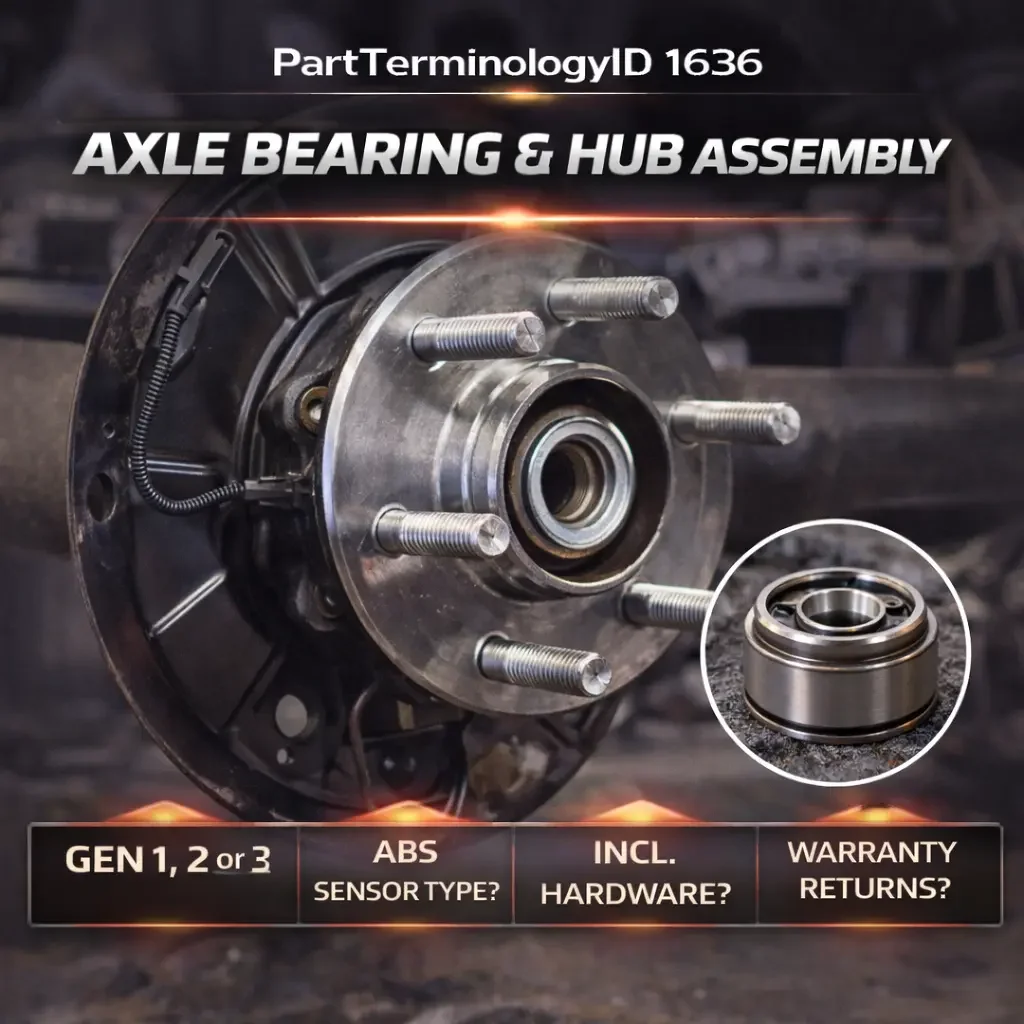
The axle bearing and hub assembly is the integrated unit that connects the wheel to the vehicle's suspension, supports the vehicle's weight at that corner, and allows the wheel to rotate freely while transmitting drive power (on driven axles) or simply rolling (on non-driven axles). On most vehicles built after the mid-1990s, this is a sealed, pre-greased, pre-loaded, bolt-on or press-in unit that contains the wheel bearing, the hub (the mounting surface for the brake rotor and wheel), and often the ABS wheel speed sensor or tone ring. It is the most commonly replaced wheel-end component in the aftermarket, and it is also one of the most frequently returned.
The return rate on this part is driven by a combination of factors that compound each other. The terminology is inconsistent: the same physical component is sold under at least six different names across different catalogs, retailers, and manufacturers. The product comes in three distinct generations of design (Gen 1, Gen 2, Gen 3), each with fundamentally different installation requirements. The ABS sensor integration creates electronic compatibility issues that have nothing to do with the physical bearing. And the quality spread between low-cost offshore bearings and OE-equivalent products is wider than on almost any other chassis part, producing a wave of premature failures that come back as warranty claims rather than fitment returns.
This post is built for aftermarket catalog teams, marketplace sellers, parts counter staff, and buyers who need to understand why this part generates so many problems, how to list it correctly, and what the buyer needs to know before ordering.
Status in New Databases
Status in New Databases
Current: PIES 7.2 + PCdb Future: PIES 8.0 + PCdb 2.0 Status: No change
What Axle Bearing and Hub Assembly Means in the Aftermarket
Axle Bearing and Hub Assembly (PartTerminologyID 1636) refers to the integrated bearing-and-hub unit at the wheel end that supports the axle shaft or spindle, carries the vehicle's weight, and provides the mounting surface for the brake rotor and wheel. This is the part at the wheel, not the bearing inside the axle housing (that is the Drive Axle Shaft Bearing Assembly, PartTerminologyID 1632, covered in the previous post in this series), not the differential carrier bearings, and not the pinion bearing.
The naming problem
This is where the catalog chaos begins. The same physical component is sold under all of the following names depending on the retailer, catalog system, manufacturer, and vehicle application:
Wheel Bearing and Hub Assembly. The most common retail name. Used by AutoZone, O'Reilly, Advance Auto Parts, Amazon sellers, and most consumer-facing catalogs. This is the name the buyer is most likely to search for.
Wheel Hub Assembly. Slightly shorter version of the above. Some catalogs use this to refer to the complete unit (bearing + hub + sensor), while others use it to refer to the hub only (without the bearing). This ambiguity causes fitment confusion.
Hub Bearing Assembly. Used interchangeably with "Wheel Bearing and Hub Assembly" by many manufacturers and distributors. NTN/BCA, SKF, Timken, and Moog all use variations of this name.
Axle Bearing and Hub Assembly. The ACES/PIES PartTerminology name (PartTerminologyID 1636). Used in catalog databases and B2B transactions but rarely seen by end consumers.
Wheel Bearing. Used loosely by consumers and some retailers to refer to the entire assembly, even though "wheel bearing" technically refers only to the bearing component inside the hub. On Gen 1 applications where the bearing is a separate press-in cartridge, "wheel bearing" correctly refers to the bearing alone. On Gen 3 applications where the bearing is not serviceable separately from the hub, "wheel bearing" and "hub assembly" are the same part. This creates a fundamental ordering confusion: the buyer searches for "wheel bearing," finds a Gen 1 bearing cartridge, but actually needs a Gen 3 complete hub assembly (or vice versa).
Unit Bearing. A term used primarily for Jeep Cherokee (XJ), Jeep Wrangler (TJ/JK), and some other applications where the bearing, hub, and mounting flange are a single bolt-on unit. Functionally identical to a Gen 3 hub assembly, but "unit bearing" is the common name in the Jeep community and some parts catalogs.
Front Hub. / Rear Hub. Shortened names used casually by technicians and consumers. These are imprecise because "hub" can mean the complete assembly (bearing + hub + sensor) or just the hub component (the wheel-mounting flange without the bearing).
The catalog consequence is significant. A buyer searching for "wheel bearing" may find a Gen 1 bearing cartridge, a Gen 3 complete hub assembly, or both, depending on the catalog. A buyer searching for "hub assembly" may find a complete unit with the bearing and ABS sensor, or a hub-only component without the bearing. Every listing must clearly specify what is included: bearing, hub, ABS sensor/tone ring, mounting hardware, and axle nut.
The three generations
The aftermarket uses a generation classification system for these assemblies. Understanding the generation is critical because it determines the installation method, the tools required, and the product configuration.
Generation 1 (Gen 1) - Press-in bearing cartridge. The bearing is a sealed double-row angular contact ball bearing (or, less commonly, a tapered roller bearing) that is pressed into the steering knuckle. The hub is a separate component that is pressed into the bearing's inner race. On driven axles, the CV axle shaft passes through the hub and is retained by an axle nut. On non-driven axles, a spindle or stub axle passes through the bearing. Gen 1 bearings require a hydraulic press for removal and installation. They are the most labor-intensive to replace and the most prone to installation errors (pressing on the wrong race, failing to support the inner and outer rings properly, damaging the knuckle bore). Gen 1 bearings were common on front-wheel-drive vehicles from the 1980s through the early 2000s and are still used on some current vehicles. Many are still in service and being replaced in the aftermarket.
The critical catalog distinction for Gen 1: the bearing and hub are separate components, often sold separately. The buyer who needs the bearing may not need the hub (and vice versa). Some aftermarket kits bundle them together; others sell them individually. The listing must specify "bearing only," "hub only," or "bearing and hub set."
Generation 2 (Gen 2) - Integrated flange bearing. The bearing has one integrated flange, either the wheel-hub flange (inner ring rotation) or the knuckle-mounting flange (outer ring rotation). The other side is a press-fit or slip-fit interface. Gen 2 bearings simplify installation compared to Gen 1 because one press operation is eliminated, but they still require some pressing or specialized tools. Gen 2 bearings were common on European vehicles, some Japanese vehicles, and non-driven rear axles of front-wheel-drive vehicles from the 1990s through the 2010s. Some Gen 2 designs slip onto a stub axle and are retained by a nut, making them easier to service than a full press-in Gen 1.
Generation 3 (Gen 3) - Bolt-on hub assembly. The bearing, hub, wheel-mounting flange, and knuckle-mounting flange are all integrated into a single sealed unit. The entire assembly bolts to the steering knuckle with three or four bolts. No pressing is required. The CV axle shaft passes through the center and is retained by an axle nut. The ABS wheel speed sensor or magnetic encoder tone ring is typically integrated into the assembly. Gen 3 is the most common type on vehicles built after the late 1990s and is the dominant type in the current aftermarket. It is theoretically the easiest to replace, but corrosion between the hub and knuckle (especially in salt-belt states) can make removal extremely difficult, sometimes requiring heat, penetrating oil, or even knuckle removal.
The critical catalog distinction for Gen 3: this is a complete, sealed, non-serviceable assembly. The bearing cannot be replaced separately. If the bearing fails, the entire hub assembly is replaced. If the ABS sensor fails, the entire hub assembly is replaced (unless the sensor is a separate, externally mounted component, which varies by application). The listing should make clear that this is a complete assembly and should specify whether the ABS sensor is integrated or external.
What this PartTerminologyID does NOT cover
It is important to note what falls outside this PartTerminologyID to prevent cross-listing errors:
Drive Axle Shaft Bearing Assembly (PartTerminologyID 1632). The bearing inside the axle housing on solid rear axle vehicles. Different component, different location, different installation. Covered in the previous post in this series.
Differential Carrier Bearings. Internal differential components. Different PartTerminologyID.
Pinion Bearing. The bearing supporting the pinion shaft at the driveshaft connection. Different PartTerminologyID.
CV Axle / Halfshaft. The articulated shaft that transmits power from the transaxle/differential to the wheel hub. Different PartTerminologyID, though the CV axle passes through the hub assembly on driven wheels.
Steering Knuckle. The suspension component that the hub assembly bolts to (Gen 3) or that the bearing presses into (Gen 1). Different PartTerminologyID, though knuckle condition directly affects bearing life and installation.
Brake Rotor. Mounts to the hub flange. Different PartTerminologyID, though hub flange runout directly affects rotor performance (discussed below).
How the Axle Bearing and Hub Assembly Works
The hub assembly sits at the intersection of the drivetrain, the suspension, and the braking system. Understanding its role in each system explains why its failure has such broad consequences.
Drivetrain function
On driven wheels (front wheels on FWD vehicles, rear wheels on RWD vehicles, all wheels on AWD/4WD vehicles), the CV axle shaft passes through the center of the hub assembly. The shaft is splined to the hub, and the axle nut compresses the assembly to create a rigid connection. Engine torque flows from the transmission/transaxle through the CV axle shaft, through the hub splines, to the hub flange, to the wheel studs, and into the wheel. The hub assembly is the final drivetrain connection before the wheel. On non-driven wheels, there is no CV axle shaft. The hub assembly sits on a spindle or stub axle and simply allows the wheel to rotate freely.
Suspension function
The hub assembly bolts to (Gen 3) or presses into (Gen 1/Gen 2) the steering knuckle, which is the pivot point of the suspension. The knuckle connects to the upper and lower control arms (or strut and lower control arm), the tie rod end (for steering), and the brake caliper bracket. The hub assembly must support the vehicle's weight at that corner, absorb radial loads (vertical forces from the vehicle's weight and road impacts), axial loads (lateral forces from cornering), and moment loads (forces from the offset between the tire contact patch and the bearing center). Modern hub assemblies use double-row angular contact ball bearings that are designed to handle all three load types simultaneously.
Braking function
The brake rotor mounts directly to the hub flange. The flat surface of the hub flange is the reference surface for the rotor. If the hub flange has excessive runout (wobble), that runout transfers directly to the rotor and causes lateral runout in the braking surface. This lateral runout causes uneven pad contact, which produces a pulsation in the brake pedal that is commonly misdiagnosed as "warped rotors." Hub flange runout should be less than 0.002 inches (0.05 mm) on most modern vehicles. A new hub assembly with excessive runout (from manufacturing inconsistency in low-quality units) will cause a brake pulsation problem that the buyer attributes to the brakes, not the hub. This is a significant source of misdiagnosed returns: the buyer returns the hub assembly thinking it is defective, when the actual problem is that the low-cost bearing has more runout than the braking system can tolerate.
ABS/ESC/Traction Control function
On most vehicles built after the mid-1990s, the hub assembly contains or interfaces with the wheel speed sensor for the ABS (anti-lock braking system), ESC (electronic stability control), and traction control systems. There are two common configurations:
Integrated tone ring (magnetic encoder). A magnetic encoder ring is built into the bearing seal. The ring has alternating north and south magnetic poles that generate a signal as the hub rotates. An externally mounted sensor reads this signal through the air gap between the sensor and the encoder ring. The sensor bolts to the knuckle; the encoder ring is part of the hub assembly. If the encoder ring is damaged, contaminated with metallic debris, or has a different pole count than the vehicle's ABS module expects, the ABS system will malfunction. The hub assembly must be replaced because the encoder ring is not serviceable separately.
Integrated sensor. The wheel speed sensor is built into the hub assembly itself. The sensor, wiring harness stub, and connector are all part of the hub unit. If the sensor fails, the entire hub assembly is replaced. This configuration eliminates air gap issues but makes the hub assembly more expensive and creates a connector-compatibility variable in fitment.
External sensor. The wheel speed sensor is a separate component that mounts to the knuckle and reads a tone ring on the CV axle or on the hub assembly. The sensor is serviceable separately from the hub. In this configuration, the hub assembly may or may not include the tone ring. If it does, the tone ring tooth count and dimensions must match the original.
The ABS integration creates a unique catalog and fitment problem. Two hub assemblies for the same vehicle year/make/model may look physically identical but have different ABS configurations: one with a magnetic encoder and one without, one with an integrated sensor and one with an external sensor, one with a 48-pole encoder ring and one with a 100-pole encoder ring. Installing the wrong configuration will cause the ABS light to illuminate, false ABS activation during normal braking, or complete ABS system failure. None of these symptoms look like a "hub bearing" problem to the buyer. They look like an ABS problem. The buyer may return the hub assembly as "defective" without realizing that the wrong ABS configuration was shipped.
Why Axle Bearing and Hub Assemblies Are Replaced
Bearing wear and noise
The most common reason for replacement. The sealed bearing wears over time from fatigue, contamination (water and debris entering through a compromised seal), or impact damage (hitting potholes, curbs, or road debris). The driver hears a humming, grinding, growling, or roaring noise from the wheel area that increases with vehicle speed. The noise often changes character when the vehicle turns: if the noise gets louder when turning left, the right-side bearing is typically the one failing (because the turn loads the right bearing more heavily). This directional noise test is one of the primary diagnostic methods.
Bearing lifespan varies widely. OE bearings on well-maintained vehicles in temperate climates routinely last 100,000 to 150,000 miles. Vehicles in salt-belt states, vehicles used for towing, vehicles with oversized tires or wheels, and vehicles with worn suspension components (which transfer abnormal loads to the bearing) may see bearing failure at 50,000 to 80,000 miles. Low-quality aftermarket bearings may fail in as little as 15,000 to 30,000 miles, which is a major source of warranty returns and customer dissatisfaction.
Wheel play and looseness
As the bearing wears, it develops play (end play or axial clearance) that allows the wheel to wobble on the spindle. This wobble is detectable by grasping the tire at the 12 o'clock and 6 o'clock positions and rocking it in and out. Any detectable play in this test (after ruling out ball joint and tie rod end play) indicates bearing failure. Advanced play can cause the wheel to visibly wobble at speed, accelerate tire wear, damage suspension components (ball joints, tie rod ends), and in extreme cases allow the wheel to separate from the vehicle. This is a safety-critical failure mode.
However, in the early stages of bearing failure, the play may be too small to detect by hand. A dial indicator measuring hub runout is the definitive test: if hub runout exceeds 0.004 inches, the bearing has failed, even if no play is detectable by hand and no noise is present.
ABS/ESC/Traction control malfunction
As the bearing wears and develops play, the air gap between the ABS sensor and the magnetic encoder ring (or tone ring) changes. This change in air gap alters the signal strength that the sensor sends to the ABS module. If the signal from one wheel deviates from the signals from the other wheels, the ABS module may interpret this as a wheel speed discrepancy and activate the ABS during normal braking (false activation), illuminate the ABS warning light, disable the ESC or traction control system, or set diagnostic trouble codes related to wheel speed sensor performance.
In many cases, the ABS malfunction is the first symptom the driver notices, before any bearing noise or wheel play is detectable. The driver sees the ABS light on the dashboard and takes the vehicle to a shop. The shop scans the codes, finds a wheel speed sensor code, and replaces the hub assembly. This diagnostic pathway means the buyer may not even know they are replacing a "bearing" - they think they are fixing an "ABS sensor problem."
Seal failure and contamination
The bearing seals protect the lubricated rolling elements from water, road salt, dirt, and debris. When the seals fail (from age, impact damage, or exposure to chemicals), contaminants enter the bearing, displace or degrade the grease, and cause accelerated wear and corrosion. Vehicles in salt-belt states are especially vulnerable because road salt is highly corrosive to bearing components. Vehicles that are driven through standing water (flooding, off-road water crossings, boat ramp launches) can force water past the seals. Once contaminated, a sealed bearing cannot be re-greased or repaired; the entire hub assembly must be replaced.
Hub flange runout causing brake pulsation
As discussed above, hub flange runout transfers to the brake rotor and causes brake pulsation. If a new rotor is installed on a hub with excessive runout, the brake pulsation will return quickly. Shops that diagnose "warped rotors" may go through multiple rotor replacements before identifying the hub as the root cause. This is an important diagnostic point for listings and buyer guidance.
Impact damage
Hitting a pothole, curb, or road debris at speed can damage the bearing internally (creating a Brinell mark or flat spot on the bearing race) even if no external damage is visible. The damage may not produce immediate noise but will cause accelerated wear and eventual failure. Vehicles that have been in collisions, even minor ones that damage a wheel or tire, should have the hub assemblies inspected.
Corrosion between hub and knuckle
On Gen 3 bolt-on assemblies, the hub-to-knuckle interface is a precision machined surface that must be clean and flat for proper installation. Over time, corrosion builds up between these surfaces, making hub removal extremely difficult and sometimes damaging the knuckle bore. This corrosion does not cause the hub to fail, but it complicates the replacement and can lead to installation errors if the corrosion is not cleaned from the knuckle before the new hub is installed. A new hub installed on a corroded knuckle surface may have excessive runout from day one, causing brake pulsation and accelerated bearing wear.
Fitment Variables
Driven vs. non-driven
The hub assembly for a driven wheel (one that receives power from the engine) has a center bore sized and splined for the CV axle shaft. The hub assembly for a non-driven wheel has a center bore sized for a spindle or stub axle, or may have a solid center (no through-bore). A front hub assembly for a front-wheel-drive vehicle (driven) is different from a front hub assembly for a rear-wheel-drive vehicle (non-driven), even if both vehicles have the same knuckle bolt pattern and wheel bolt pattern. Many fitment errors occur because the buyer orders based on position (front) without specifying drivetrain configuration (FWD vs. RWD vs. AWD).
ABS sensor configuration
As detailed above, the hub assembly must match the vehicle's ABS sensor configuration: integrated magnetic encoder (with correct pole count), integrated sensor (with correct connector), external sensor with tone ring (with correct tooth count), or no ABS. On some vehicles, different trim levels or option packages used different ABS configurations. A base model without ESC may use a different hub than a higher trim with ESC, even on the same year/make/model/engine. The ABS configuration is the single most common source of "it doesn't work right" returns on this part.
Wheel bolt pattern and stud configuration
The hub flange must match the vehicle's wheel bolt pattern (number of studs and bolt circle diameter). Common patterns include 4x100, 4x114.3, 5x100, 5x10⁸, 5x112, 5x114.3, 5x120, 5x127, 5x139.7, 6x135, 6x139.7, 8x165.1, 8x170, and 8x180. The stud size (thread pitch and diameter), stud length, and stud count must also match. Most hub assemblies come with the studs pre-installed, but some do not.
Mounting bolt pattern to knuckle (Gen 3)
The bolt pattern and bolt spacing on the knuckle-mounting flange must match the steering knuckle. This is almost always vehicle-specific and is rarely a source of error if the correct application is ordered, but it becomes an issue when the buyer is working from a universal catalog that does not distinguish between submodels or option packages.
Bearing generation (Gen 1, Gen 2, Gen 3)
The generation determines the installation method. The buyer who orders a Gen 1 press-in bearing for a vehicle that uses a Gen 3 bolt-on assembly (or vice versa) has the wrong part entirely. This error is most common when the buyer searches for "wheel bearing" without specifying the assembly type, and the catalog returns results for both Gen 1 bearings and Gen 3 assemblies for the same vehicle platform.
Axle nut specification
On driven wheels, the axle nut that retains the CV axle shaft in the hub is a critical component. Many axle nuts are torque-to-yield (TTY) and are designed for one-time use. Reusing a TTY axle nut can result in the nut loosening on the road, which allows the CV axle to disengage from the hub and causes a loss of drive power (and potentially a crash). Some hub assembly kits include a new axle nut; others do not. The listing should specify whether the axle nut is included. If it is not, the buyer must be informed that a new axle nut is required.
The Quality Problem
The axle bearing and hub assembly category has a well-documented quality stratification problem that directly affects returns, warranty claims, and customer satisfaction. This section is included because the quality issue is so central to the aftermarket experience with this part that no catalog team or seller can afford to ignore it.
The manufacturing landscape
The global hub assembly market is dominated by a small number of OE manufacturers (NTN, SKF, Timken, NSK, JTEKT, Schaeffler/FAG) and a very large number of aftermarket manufacturers, many of which are low-cost producers primarily in China. The OE manufacturers produce hub assemblies to OEM specifications with tight tolerances on bearing preload, seal integrity, runout, and material hardness. The low-cost producers often use lower-grade steel, smaller bearing elements, thinner seals, and less precise manufacturing processes.
How quality affects performance
The quality differences manifest in several measurable ways:
Bearing element size. Some low-cost hub assemblies use bearing balls or rollers that are smaller than the OE specification. Smaller elements carry less load, generate more contact stress, and fail earlier.
Steel quality and heat treatment. The bearing races and rolling elements must be made from high-carbon chromium bearing steel (typically AISI 52100) with precise heat treatment to achieve the correct hardness (typically 58-64 HRC). Low-quality bearings may use lower-grade steel or inconsistent heat treatment, resulting in softer surfaces that Brinell (develop dents) under impact loads and wear faster under normal loads.
Seal quality. The seals must keep water, road salt, and debris out of the bearing for the life of the assembly. Low-quality seals use thinner rubber compounds, less precise lip geometry, and lower spring tension. These seals fail earlier, especially in salt-belt environments, allowing contamination that destroys the bearing.
Grease quality and quantity. The bearing grease must withstand the temperature range, load, and speed of the application for the life of the assembly. Low-quality assemblies may use less grease, lower-quality grease, or grease that is not optimized for the application.
Hub flange runout. The hub flange must have very low runout (less than 0.002 inches) to prevent brake pulsation. Low-quality assemblies may have significantly higher runout from manufacturing, which causes brake pulsation from day one.
ABS encoder ring quality. The magnetic encoder ring must produce a clean, consistent signal at all rotational speeds. Low-quality encoder rings may have inconsistent pole spacing, weaker magnetic fields, or poor contamination resistance, which causes erratic ABS behavior.
The lifecycle cost problem
A low-cost hub assembly may cost $30 to $60 retail. An OE-equivalent assembly from NTN, SKF, Timken, or Moog may cost $80 to $200 retail for the same application. The cost difference is significant and drives many buyers to the low-cost option. However, the low-cost assembly may fail in 15,000 to 30,000 miles, requiring a second replacement (plus labor). The OE-equivalent assembly may last 80,000 to 150,000 miles. The total cost of ownership (parts + labor over the vehicle's life) is often lower with the higher-quality part.
For sellers, the quality issue creates a strategic decision: list low-cost assemblies to compete on price and accept the higher return/warranty rate, or list higher-quality assemblies at higher prices with lower return rates but potentially lower sales volume. The catalog should at minimum clearly distinguish between quality tiers so the buyer can make an informed decision.
Top Return Causes
1) Wrong ABS sensor configuration
The most technically complex return cause. The buyer receives a hub assembly that physically bolts on and appears correct, but the ABS system malfunctions after installation. The hub has the wrong magnetic encoder pole count, the wrong sensor connector, a magnetic encoder when the vehicle uses an external sensor, or no encoder when the vehicle requires one. The buyer returns the part as "defective" because the ABS light is on or the ABS activates falsely during normal braking.
Prevention: ABS sensor type in the listing (integrated magnetic encoder, integrated sensor, external sensor compatible, no ABS). Magnetic encoder pole count where applicable. Sensor connector type and pin count where applicable. "Verify your vehicle's ABS configuration before ordering. Vehicles with the same year/make/model may use different ABS configurations depending on trim level, option packages, and production date."
2) Wrong generation ordered (Gen 1 bearing vs. Gen 3 assembly)
The buyer searches for "wheel bearing," finds a Gen 1 press-in bearing cartridge, and orders it for a vehicle that uses a Gen 3 bolt-on hub assembly (or vice versa). The parts are not interchangeable. The Gen 1 bearing cannot be bolted on, and the Gen 3 assembly cannot be pressed in.
Prevention: Bearing generation (Gen 1/Gen 2/Gen 3) in the listing title or description. Installation type (press-in, slip-on with nut, bolt-on). "This is a [press-in bearing cartridge / complete bolt-on hub assembly]. Verify your vehicle's hub type before ordering."
3) Wrong driven/non-driven configuration
The buyer orders a hub assembly for the correct position (front left, for example) but the wrong drivetrain configuration. The front hub for a rear-wheel-drive pickup has a solid center or spindle bore, while the front hub for the same pickup in 4WD has a splined bore for the CV axle shaft. The part does not fit.
Prevention: Drive type (2WD/4WD/AWD/FWD/RWD) in the fitment details. "This hub assembly is for [driven / non-driven] wheels. Verify your vehicle's drivetrain configuration."
4) False ABS activation after replacing only one side
This is not a defective part, but it is the most common "it never did this before you worked on it" complaint. When one hub assembly is replaced with a new unit (fresh magnetic encoder, clean sensor interface, tight air gap) while the other side retains the old unit (worn encoder, corroded sensor interface, larger air gap), the difference in signal strength between the two sides can cause the ABS module to detect a wheel speed discrepancy and activate the ABS during low-speed stops. The ABS is working as designed; the signals are just mismatched.
Prevention: "When replacing a hub assembly with an integrated ABS encoder on one side, the opposite side's ABS sensor should be removed, cleaned, and reinstalled to equalize signal strength. If false ABS activation persists, replacing both hub assemblies may be necessary to restore matched signal output." This is not a defect in the new hub assembly. Consider recommending pair replacement in the listing.
5) Premature failure from low-quality bearing
The buyer installs a low-cost hub assembly that fails in 15,000 to 30,000 miles. The buyer returns the part under warranty (if within the warranty period) or posts a negative review (if outside the warranty period). Either way, the seller absorbs the cost of the return, the replacement, and the reputational damage.
Prevention: Quality tier disclosed in the listing. OE part number cross-reference to demonstrate compatibility. Warranty length as a proxy for quality confidence. "This hub assembly uses [bearing specification, e.g., double-row angular contact ball bearing with 52100 chrome steel races and polyamide cage]. Expected service life: [X] miles under normal driving conditions."
6) Hub flange runout causing brake pulsation misdiagnosed as defective hub
The buyer installs a new hub assembly (especially a low-cost one) and experiences brake pulsation within the first few hundred miles. The buyer blames the brakes and replaces the rotor. The pulsation returns because the root cause is hub flange runout. Eventually the buyer (or a technician) identifies the hub as the cause and returns it.
Prevention: "Check hub flange runout with a dial indicator before installing the brake rotor. Maximum acceptable runout is typically 0.002 inches (0.05 mm). If runout exceeds this specification, the hub assembly should be replaced before installing the rotor." Including a runout specification in the listing signals quality awareness.
7) Axle nut not included, buyer cannot complete the job
The buyer removes the old axle nut (which is often a torque-to-yield, one-time-use nut) and discovers that the new hub assembly kit does not include a replacement. The buyer cannot reuse the old nut (it is deformed from the original torquing) and cannot complete the installation until a new nut is obtained.
Prevention: "Axle nut [included / not included]. Note: The axle nut on most driven-wheel applications is a one-time-use, torque-to-yield fastener and should not be reused." If the kit does not include the nut, cross-reference the correct axle nut part number.
8) Corrosion prevents removal of old hub, knuckle damaged during removal
This is not a product fitment issue but a significant source of customer frustration and indirect returns. The old hub assembly is seized to the knuckle by corrosion (especially in salt-belt states). The buyer uses excessive force (sledgehammer, pry bar) to remove it and damages the knuckle bore. The new hub does not seat properly in the damaged bore, has excessive runout, or does not bolt up squarely. The buyer returns the new hub as "defective" when the actual problem is a damaged knuckle.
Prevention: "Before installation, inspect the steering knuckle bore and mounting surface for corrosion, nicks, or damage. Clean the mounting surface with a wire brush or emery cloth. If the knuckle bore is damaged, the knuckle must be replaced or resurfaced before installing the new hub assembly. Do not use lubricants on the hub-to-knuckle interface, as this can allow the hub to shift under load."
Installation Considerations That Affect Returns
Several installation errors contribute to premature failure and returns. While these are not fitment issues per se, listing teams that include installation guidance reduce return rates.
Axle nut torque
The axle nut on driven wheels must be torqued to the manufacturer's specification (typically 150 to 250 ft-lbs, but varies widely by application). Under-torquing allows the CV axle shaft to shift in the hub, which changes bearing preload and can cause accelerated wear. Over-torquing compresses the bearing excessively, increasing friction and heat, which causes premature failure. Impact wrenches should not be used for final torquing because they cannot achieve a precise torque value. A calibrated torque wrench is required. This is one of the most common installation errors and a significant cause of premature bearing failure on new hub assemblies.
Vehicle weight on bearing before axle nut is torqued
On driven wheels, the vehicle's weight must not be placed on the new bearing until the axle nut is torqued to specification. If the vehicle is lowered onto the tire before the axle nut is tightened, the weight of the vehicle compresses the bearing in an unloaded state, creating a flat spot (Brinell mark) on the bearing race. This flat spot causes immediate noise that the buyer attributes to a "defective" bearing. The correct procedure is to tighten the axle nut with the wheel off the ground (using a punch or screwdriver in the brake rotor cooling slot to prevent rotation), then lower the vehicle.
Knuckle surface preparation
The hub-to-knuckle mounting surface must be clean, flat, and free of corrosion. Any debris or corrosion on this surface will prevent the hub from seating squarely, introduce runout, and cause brake pulsation and accelerated bearing wear. Wire brushing, scraping, or using emery cloth to clean the surface is essential. However, lubricants (anti-seize, grease) should generally not be applied to this surface because they can allow the hub to shift under braking loads, though some manufacturers do recommend a thin application of anti-seize to prevent future corrosion. The buyer should follow the vehicle manufacturer's specific recommendation.
ABS sensor wire routing
When installing a hub assembly with an integrated ABS sensor, the sensor wire must be routed through all original retaining clips and away from any suspension components that could pinch, stretch, or chafe the wire during suspension travel. A damaged sensor wire will cause ABS malfunction that the buyer may attribute to a defective hub assembly.
Compatibility Checklist for Buyers
1) Confirm your vehicle's hub type. Gen 1 (press-in bearing cartridge), Gen 2 (integrated flange, semi-press or slip-on), or Gen 3 (complete bolt-on assembly). This determines which product you need.
2) Confirm driven vs. non-driven. Does the wheel receive power from the engine? FWD vehicles: front wheels are driven. RWD vehicles: rear wheels are driven. AWD/4WD vehicles: all wheels may be driven.
3) Confirm ABS configuration. Integrated magnetic encoder, integrated sensor, external sensor, or no ABS. If ABS-equipped, confirm pole count or sensor connector type.
4) Check what is included. Bearing, hub, ABS sensor/encoder, wheel studs, axle nut, mounting hardware. Order any components not included before beginning the job.
5) Plan for both sides. Hub assemblies on the same axle wear at similar rates. If one side has failed, the other side is likely near end of life. Replacing both sides simultaneously avoids a second repair and prevents ABS signal mismatch issues.
6) Have the correct tools. Gen 1: hydraulic press. Gen 2: varies by application. Gen 3: standard hand tools, torque wrench (calibrated), possibly a hub puller or slide hammer for removal of the old unit.
7) Have a new axle nut. If the wheel is driven, obtain a new axle nut before beginning the job. Do not reuse the old nut.
8) Full vehicle details. Year, make, model, submodel, trim, engine, drivetrain (FWD/RWD/AWD/4WD), ABS type. OEM part number cross-reference strongly recommended.
Catalog Checklist for Attributes
Core taxonomy: Product form: complete hub assembly (Gen 3 bolt-on), bearing cartridge (Gen 1 press-in), integrated flange bearing (Gen 2), bearing and hub set. Position: front left, front right, rear left, rear right (or front pair, rear pair). Driven or non-driven. ABS configuration: integrated encoder (pole count), integrated sensor (connector type), tone ring only, no ABS. Separate from Drive Axle Shaft Bearing (1632), Differential Carrier Bearing, Pinion Bearing, CV Axle, Steering Knuckle.
Fitment: Year, make, model, submodel, trim, engine, drivetrain. Hub generation (Gen 1/Gen 2/Gen 3). Wheel bolt pattern (bolt count and circle diameter). Stud size and length. Mounting bolt count and spacing (Gen 3). Center bore diameter. OEM part number cross-reference.
Specifications: Bearing type (double-row angular contact ball, tapered roller). Bearing dimensions (inner diameter, outer diameter, width). Hub flange runout specification. Maximum load rating (radial and axial). ABS encoder pole count. Sensor connector pin count.
Included components: Hub (yes/no - relevant for Gen 1 where sold separately). Bearing (yes/no - relevant for Gen 1 where sold separately). ABS sensor or encoder (yes/no). Wheel studs (yes/no, count, size). Axle nut (yes/no, size, torque spec). Snap ring (yes/no). Dust cap (yes/no). Mounting hardware (yes/no).
Installation notes: Required tools (press, torque wrench, hub puller). Axle nut torque specification. Knuckle surface preparation. ABS sensor wire routing. Hub flange runout check procedure. Alignment recommended after replacement.
Images: Assembly from multiple angles showing hub flange (stud pattern visible), knuckle mounting surface (bolt pattern visible), ABS sensor/encoder location, center bore, and any included hardware.
FAQ
What is the difference between a wheel bearing and a hub assembly?
On Gen 1 vehicles, the wheel bearing is a separate press-in cartridge and the hub is a separate component. They can be purchased and replaced independently. On Gen 3 vehicles, the wheel bearing is integrated into the hub assembly and cannot be replaced separately. The entire hub assembly is the replacement part. The terms "wheel bearing" and "hub assembly" refer to the same part on Gen 3 vehicles and different parts on Gen 1 vehicles. This is the single biggest source of ordering confusion in this category.
Can I replace just one side, or should I replace both?
You can replace just one side if only one has failed. However, there are two reasons to consider replacing both: (1) Both bearings have experienced the same mileage, road conditions, and loads, so if one has failed, the other is likely near end of life. (2) On vehicles with integrated ABS encoders, replacing only one side can create a signal mismatch between the new encoder and the old encoder, causing false ABS activation during low-speed stops. Replacing both eliminates this issue.
Why does my ABS light come on after replacing the hub assembly?
Several possible causes: the replacement hub has the wrong ABS encoder configuration (wrong pole count, wrong sensor type), the ABS sensor wire was damaged during installation, the sensor connector was not fully seated, or metallic debris on the encoder ring is disrupting the signal. If the hub has the correct ABS configuration and is properly installed, the most common cause is a dirty or corroded sensor on the opposite side creating a signal mismatch. Clean the opposite-side sensor and check for codes.
Why does my brake pedal pulsate after replacing the hub assembly?
The most likely cause is hub flange runout. If the new hub's flange has excessive runout (more than 0.002 inches), that runout transfers to the brake rotor and causes lateral rotor runout, which produces a pulsation in the brake pedal. Measure hub flange runout with a dial indicator before installing the rotor. If runout exceeds the specification, replace the hub assembly. This is more common with low-cost aftermarket hub assemblies than with OE-equivalent units.
How long should a hub assembly last?
An OE or OE-equivalent hub assembly on a well-maintained vehicle in a temperate climate should last 100,000 to 150,000 miles. Factors that reduce lifespan include: salt-belt driving (road salt accelerates seal and bearing corrosion), towing or hauling heavy loads, oversized tires or wheels (which increase bearing loads), worn suspension components (which transfer abnormal loads to the bearing), impact damage from potholes or curbs, and water exposure (flooding, off-road, boat ramp launches). Low-quality aftermarket assemblies may fail in as little as 15,000 to 30,000 miles regardless of driving conditions.
The new hub assembly feels stiff when I spin it by hand. Is it defective?
Probably not. New hub assemblies are often pre-filled with a viscous grease that makes them feel stiff when spun by hand. This is normal and the resistance will decrease as the grease distributes during the first few miles of driving. Do not return a new hub assembly for feeling stiff. However, if the hub has a rough, notchy, or grinding feel when spun by hand (as opposed to smooth but stiff), it may be defective and should be returned.
Final Take for Aftermarket Teams
Axle Bearing and Hub Assembly (PartTerminologyID 1636) is the highest-volume wheel-end replacement part in the aftermarket, and it carries a return rate that reflects the category's complexity rather than the product's actual defect rate. The returns are driven by naming confusion (six different names for the same part), generation confusion (Gen 1 bearing cartridge vs. Gen 3 complete assembly), ABS configuration mismatch (the most common "it works but it doesn't work" return), quality stratification (low-cost bearings that fail in a fraction of the OE lifespan), and installation errors that damage new bearings before the vehicle leaves the driveway.
The catalog teams that reduce these returns do five things consistently. First, they specify the generation and installation type in the listing title or first line of the description so the buyer knows immediately whether they are looking at a press-in bearing or a bolt-on assembly. Second, they specify the ABS sensor configuration with enough detail that the buyer can verify compatibility before ordering. Third, they state explicitly what is included in the kit: bearing, hub, sensor, studs, axle nut, hardware. Fourth, they include axle nut torque specification and a note about one-time-use axle nuts. Fifth, they recommend pair replacement and opposite-side sensor cleaning to prevent false ABS activation complaints that come back as warranty claims.
The sixth thing, which most listings do not do but which separates the best from the rest, is a brief note about hub flange runout. A single sentence telling the buyer to check runout before installing the rotor prevents one of the most frustrating misdiagnosis cycles in the brake and wheel-end category: the buyer who replaces rotors two or three times before someone finally puts a dial indicator on the hub and finds the runout that has been causing the pulsation all along. That one sentence saves the buyer a hundred dollars in unnecessary rotor replacements and saves the seller a return on a part that was never defective in the first place.