
Written by Arthur Simitian | PartsAdvisory
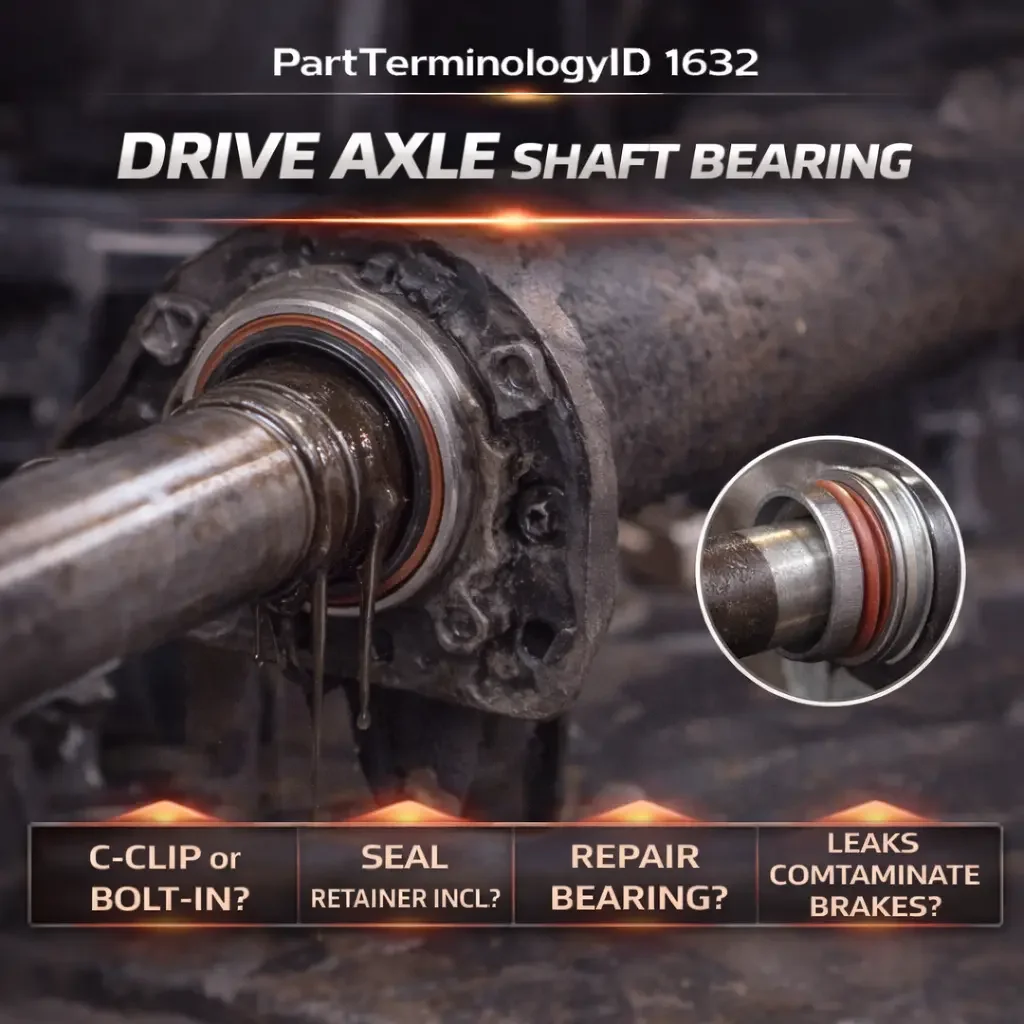
The drive axle shaft bearing assembly is the bearing (and typically the associated seal) that supports the axle shaft inside the axle housing on solid rear axle (live axle) vehicles. It sits at the outer end of the axle tube, near the wheel, and performs two functions: it supports the radial and axial loads on the axle shaft as it transmits engine power to the wheel, and it seals the differential lubricant inside the axle housing to prevent it from leaking past the axle shaft and contaminating the brake components on the other side of the brake backing plate (PartTerminologyID 1628, previously covered in this series).
This part is specific to solid axle configurations found on trucks, SUVs, vans, and rear-wheel-drive vehicles with a live rear axle. It does not apply to independent rear suspension (IRS) vehicles or front-wheel-drive vehicles with CV axle halfshafts (those use wheel hub bearings or CV joint bearings, which are different PartTerminologyIDs).
The failure mode of this bearing is what makes it consequential beyond its own replacement cost. When the axle shaft bearing wears, it allows the axle shaft to wobble. This wobble damages the seal. The damaged seal leaks differential oil. The oil runs along the axle shaft, past the bearing, through the brake backing plate, and onto the brake shoes or brake pads. The driver may not notice the bearing noise (a hum or growl from the rear) but will eventually notice brake performance degradation, a burning oil smell from the rear wheels, or visible oil contamination on the brake components. By this time, the brakes are compromised and the repair has expanded from a bearing replacement to a bearing, seal, brake shoe, and potentially drum or rotor replacement.
This post is built for aftermarket catalog teams, marketplace sellers, and buyers who need to identify, list, and order the correct bearing assembly and understand the full scope of the repair.
Status in New Databases
Status in New Databases
Current: PIES 7.2 + PCdb Future: PIES 8.0 + PCdb 2.0 Status: No change
What Drive Axle Shaft Bearing Assembly Means in the Aftermarket
Drive Axle Shaft Bearing Assembly (PartTerminologyID 1632) refers to the bearing and associated components that support the drive axle shaft within the axle housing. This is the bearing at the outer end of the axle tube, not the differential carrier bearings, not the pinion bearing, and not the wheel hub bearing on an independent suspension vehicle.
In catalog reality, this covers several product configurations:
Bearing and seal kit. The most common aftermarket product. Includes the axle shaft bearing (typically a ball bearing or roller bearing pressed into the axle housing or onto the axle shaft) and the axle shaft seal (the oil seal that prevents differential fluid from leaking past the bearing). These are almost always replaced together because a worn bearing damages the seal and a new bearing installed with an old seal will leak.
Bearing only. The bearing without the seal. Less common as a standalone product because the seal should always be replaced with the bearing.
Seal only. The axle shaft seal without the bearing. Appropriate when the seal is leaking but the bearing is still in good condition (no noise, no play). However, a leaking seal is often caused by bearing wear that allows shaft movement, so replacing the seal alone may result in a repeat leak if the bearing is also worn.
Repair bearing (oversize or offset). A specialized aftermarket bearing designed to address a common problem: axle shaft wear at the bearing contact surface. When the original bearing is replaced, the new bearing rides on the same worn section of the axle shaft. If the shaft is grooved or polished at the original bearing position, the new bearing will not seal properly and the new seal will leak. Repair bearings (such as those from BCA/National and Timken) are unitized bearing-and-seal assemblies with a slightly different bore dimension or axial position that shifts the bearing contact to an unworn section of the shaft. This allows the buyer to install a new bearing without replacing the axle shaft.
Bearing assembly with retainer ring. On some axle types (notably GM 10-bolt and 12-bolt, Ford 8.8, and Chrysler 8.25), the bearing is held in position by a pressed-on retainer ring on the axle shaft. The retainer ring must be pressed off the shaft to remove the bearing and pressed onto the new bearing during installation. Some kits include the retainer ring; others do not.
What this part does NOT cover
Wheel Hub Bearing Assembly. On independent rear suspension vehicles, the wheel bearing is part of the hub assembly at the wheel. Different component and different PartTerminologyID.
Differential Carrier Bearings. The bearings that support the differential carrier (the housing that holds the ring gear and spider gears) inside the axle housing. Different component, internal to the differential.
Pinion Bearing. The bearing(s) that support the pinion shaft where the driveshaft connects to the differential. Different component.
CV Axle / Halfshaft. The articulated shaft used on front-wheel-drive and independent suspension vehicles. Different component and different PartTerminologyID.
Axle Shaft. The shaft itself that transmits power from the differential to the wheel. Different PartTerminologyID, though the shaft condition directly affects bearing life.
How the Drive Axle Shaft Bearing Works
On a solid rear axle, the axle housing is a rigid tube that contains the differential at its center and extends outward to each wheel. The axle shafts run through the tubes from the differential to the wheels. At each outer end of the tube, an axle shaft bearing supports the shaft and allows it to rotate smoothly under load.
The bearing absorbs the radial load (the weight of the vehicle pushing down on the axle), the axial load (side forces from cornering), and the rotational friction of the spinning shaft. Immediately outboard of the bearing, an oil seal prevents the differential lubricant (gear oil) from migrating along the shaft and out of the housing.
On C-clip axle designs (common on GM 10-bolt, some Ford, and some Chrysler axles), the axle shaft is retained in the housing by a C-clip on the inner end of the shaft inside the differential. The bearing supports the shaft but does not retain it. On non-C-clip (bolt-in or press-in) axle designs (common on Ford 9-inch, Ford 8.8, some Chrysler, and many full-size truck axles), the bearing is pressed onto the axle shaft and a retainer plate bolts to the axle housing flange, retaining both the bearing and the shaft. The axle type determines how the bearing is removed and installed.
Why Drive Axle Shaft Bearing Assemblies Are Replaced
Bearing wear producing noise
The bearing develops roughness, pitting, or play from fatigue, contamination (water or debris entering past a degraded seal), or simple high-mileage wear. The driver hears a hum, growl, or rumble from the rear axle that changes with vehicle speed but not with braking or steering input. This distinguishes it from a wheel bearing noise (which often changes with steering) or a tire noise (which changes with road surface).
Seal failure causing differential fluid leak and brake contamination
The most consequential failure mode. The seal wears, hardens, or is damaged by axle shaft wobble from a worn bearing. Differential gear oil leaks past the seal, travels along the axle shaft, passes through the brake backing plate (PartTerminologyID 1628, previously covered), and contaminates the brake shoes, drum, pads, or rotor. Oil-contaminated brakes lose friction and can cause a dangerous imbalance in braking force between the left and right sides. The driver may notice a pulling sensation during braking, reduced brake effectiveness, or a burning oil smell from the rear wheels. The visible symptom is oil on the inside of the wheel or on the brake components.
Axle shaft wear at the bearing contact surface
The axle shaft develops a groove or polished area where the bearing inner race rides. This wear prevents a new standard bearing from sealing properly. If the shaft is not replaced, a repair bearing (with an offset contact surface) must be used.
Axle shaft play or wobble
The bearing has enough wear to allow the axle shaft to move laterally or radially. This wobble causes the seal to fail, the brake backing plate to be contacted by the shaft flange, and in extreme cases the wheel to wobble visibly. This is a safety issue that requires immediate repair.
Contaminated or degraded differential fluid
Water intrusion (from submerging the axle during off-road use or flooding), metal debris from differential gear wear, or severely degraded gear oil can attack the bearing and seal. Vehicles used for towing, off-road, or in extreme conditions are more susceptible.
Fitment Variables
Axle type and manufacturer
The bearing must match the specific axle. GM 8.5-inch 10-bolt, GM 8.6-inch 10-bolt, GM 9.5-inch 14-bolt, Ford 7.5-inch, Ford 8.8-inch, Ford 9-inch, Ford 9.75-inch, Ford 10.25-inch, Ford 10.5-inch, Chrysler 8.25-inch, Chrysler 9.25-inch, Dana 35, Dana 44, Dana 60, and many others all use different bearings. The axle type, not just the vehicle year/make/model, determines the bearing.
C-clip vs. non-C-clip (bolt-in) axle retention
On C-clip axles, the differential cover must be removed and the C-clip extracted before the axle shaft can be pulled and the bearing accessed. On non-C-clip axles, the bearing retainer plate is unbolted from the axle housing flange and the shaft with bearing is pulled as a unit. The bearing removal and installation procedure is different for each type.
Bearing type (ball bearing vs. roller bearing)
Some axles use a ball bearing; others use a tapered roller bearing or straight roller bearing. The bearing type must match the axle housing bore and the axle shaft journal.
Seal type and position
The seal may be a separate component that presses into the axle housing bore outboard of the bearing, or it may be integrated into the bearing assembly (unitized bearing-and-seal). The seal must match the axle shaft diameter and the housing bore.
Retainer ring inclusion
On non-C-clip axles, a retainer ring is pressed onto the axle shaft to hold the bearing in position. Some kits include the retainer ring; others do not. The buyer must know whether the retainer ring is included or must be purchased separately.
Repair bearing vs. standard bearing
If the axle shaft has wear at the original bearing contact surface, a standard replacement bearing will not seal properly. A repair bearing (oversize bore or offset position) must be used instead. The listing should specify whether the bearing is a standard replacement or a repair bearing designed for worn shafts.
Top Return Causes
1) Wrong axle type
The buyer orders a bearing for a GM 8.5-inch 10-bolt when the vehicle actually has a GM 8.6-inch 10-bolt, or orders a Ford 8.8-inch bearing when the vehicle has a Ford 7.5-inch. The axle type is not always obvious from the vehicle year/make/model because different axles were offered as options on the same vehicle.
Prevention: Axle type in the fitment details, not just vehicle year/make/model. "Fits GM 8.5-inch 10-bolt rear axle" or "Fits Ford 8.8-inch rear axle." Include axle identification guidance: "Verify your axle type by the differential cover shape, the number of cover bolts, or the axle tag/ID plate."
2) Seal not included when buyer expected it
The buyer orders a "bearing assembly" and receives the bearing only, without the seal. The buyer cannot complete the job without the seal.
Prevention: Explicitly state "Includes axle shaft seal" or "Seal not included, sold separately." The bearing and seal should ideally be sold together because they are almost always replaced together.
3) Retainer ring not included
On non-C-clip axles, the buyer needs the retainer ring to install the bearing on the shaft. The kit does not include one and the old retainer ring was damaged during removal.
Prevention: State whether the retainer ring is included. "Includes bearing, seal, and retainer ring" or "Retainer ring not included."
4) Standard bearing installed on a worn axle shaft, seal leaks immediately
The buyer installs a new standard bearing on a shaft with a worn bearing journal. The new seal leaks because the shaft is grooved where the seal rides.
Prevention: "Inspect the axle shaft bearing journal for grooves or wear before installing a standard replacement bearing. If the journal is worn, a repair bearing (offset design) is required to position the bearing and seal on an unworn section of the shaft." Cross-reference the repair bearing part number if available.
5) Buyer replaced only the seal when the bearing was also worn
The seal was leaking and the buyer replaced only the seal. The bearing was the root cause of the seal failure (shaft wobble from bearing wear). The new seal leaks again within weeks.
Prevention: "If the axle shaft seal is leaking, inspect the axle shaft bearing for play, roughness, or noise. A worn bearing allows the axle shaft to wobble, which causes seal failure. Replacing the seal without replacing the worn bearing typically results in a repeat leak."
Compatibility Checklist for Buyers
1) Identify your axle type. Do not rely solely on vehicle year/make/model. Verify by the differential cover shape, bolt count, or axle ID tag.
2) Determine C-clip vs. non-C-clip retention. This affects the removal procedure and whether a retainer ring is needed.
3) Order the bearing and seal together. They should always be replaced as a pair.
4) Inspect the axle shaft bearing journal before installing the new bearing. If the journal is grooved or worn, use a repair bearing instead of a standard bearing.
5) Inspect the brakes for oil contamination. If the seal was leaking, the brake shoes/pads, drum/rotor, and backing plate may be contaminated with differential fluid and must be cleaned or replaced.
6) Confirm full vehicle details and axle type. Year, make, model, submodel, trim, drive type, axle type (ring gear diameter, bolt count). OEM part number cross-reference strongly recommended.
Catalog Checklist for Attributes
Core taxonomy: Product form: bearing and seal kit, bearing only, seal only, repair bearing (unitized bearing-and-seal for worn shafts). Axle retention type: C-clip or non-C-clip (bolt-in). Separate from Wheel Hub Bearing, Differential Carrier Bearing, Pinion Bearing, CV Axle, and Axle Shaft.
Fitment: Year, make, model, submodel, trim, drive type. Axle type (manufacturer, ring gear diameter, bolt count). Axle shaft diameter. OEM part number cross-reference.
Specifications: Bearing type (ball, tapered roller, straight roller). Bearing inner diameter. Bearing outer diameter. Seal inner diameter. Seal outer diameter.
Included components: Bearing (yes/no), seal (yes/no), retainer ring (yes/no), installation hardware (yes/no).
Installation notes: Axle shaft journal inspection recommended. Repair bearing required if journal is worn. Brake inspection for oil contamination recommended. Differential fluid replacement recommended after service.
Images: Bearing and seal from multiple angles, retainer ring shown if included, installation orientation visible.
FAQ
How do I know if my axle shaft bearing is bad?
The most common symptom is a hum, growl, or rumble from the rear of the vehicle that increases with speed. This noise is consistent regardless of braking or steering input. If the seal has also failed, you may notice differential fluid on the inside of the rear wheel, oil-contaminated brakes, a burning oil smell from the rear, or a pulling sensation during braking.
Can I replace just the seal without replacing the bearing?
You can, but it is not recommended unless the bearing is confirmed to be in good condition (no play, no noise, no roughness when spun by hand). A worn bearing causes the axle shaft to wobble, which is the most common cause of seal failure. Replacing the seal alone when the bearing is worn will result in a repeat leak.
What is a repair bearing and when do I need one?
A repair bearing is a specially designed bearing-and-seal assembly that shifts the bearing and seal contact points to an unworn section of the axle shaft. It is needed when the original bearing journal on the axle shaft has developed a groove or polished wear surface that prevents a standard replacement bearing from sealing properly. Repair bearings avoid the need to replace the axle shaft, which is a more expensive and labor-intensive repair.
My rear brakes are contaminated with gear oil. What needs to be replaced?
At minimum: the axle shaft bearing and seal (the source of the leak), the brake shoes or pads (oil-contaminated friction material cannot be cleaned and must be replaced), and a thorough cleaning of the drum or rotor and backing plate. Inspect the axle shaft journal for wear. If the drum or rotor is heavily contaminated or scored, it should also be replaced. Refill the differential with the correct gear oil after the repair.
Final Take for Aftermarket Teams
Drive Axle Shaft Bearing Assembly (PartTerminologyID 1632) is a $15 to $100 drivetrain part whose failure creates a $300 to $600 brake repair. The bearing wears, the seal fails, and the differential oil contaminates the brakes before the driver notices anything is wrong. The catalog teams that serve this buyer effectively do three things: specify the axle type (not just the vehicle year/make/model), state whether the seal and retainer ring are included, and cross-reference the repair bearing alternative for worn axle shafts. The fourth step that separates a good listing from a great one is a note reminding the buyer to inspect the brakes for oil contamination, because the buyer who replaces the bearing and seal but does not inspect the brakes may leave oil-soaked brake shoes in place and return weeks later with a braking complaint that has nothing to do with the bearing.