
Brake Backing Plate (PartTerminologyID 1628): The Stamped Steel Plate Behind the Brake Assembly That Serves Two Completely Different Functions Depending on Whether the Vehicle Has Drums or Discs
Written by Arthur Simitian | PartsAdvisory
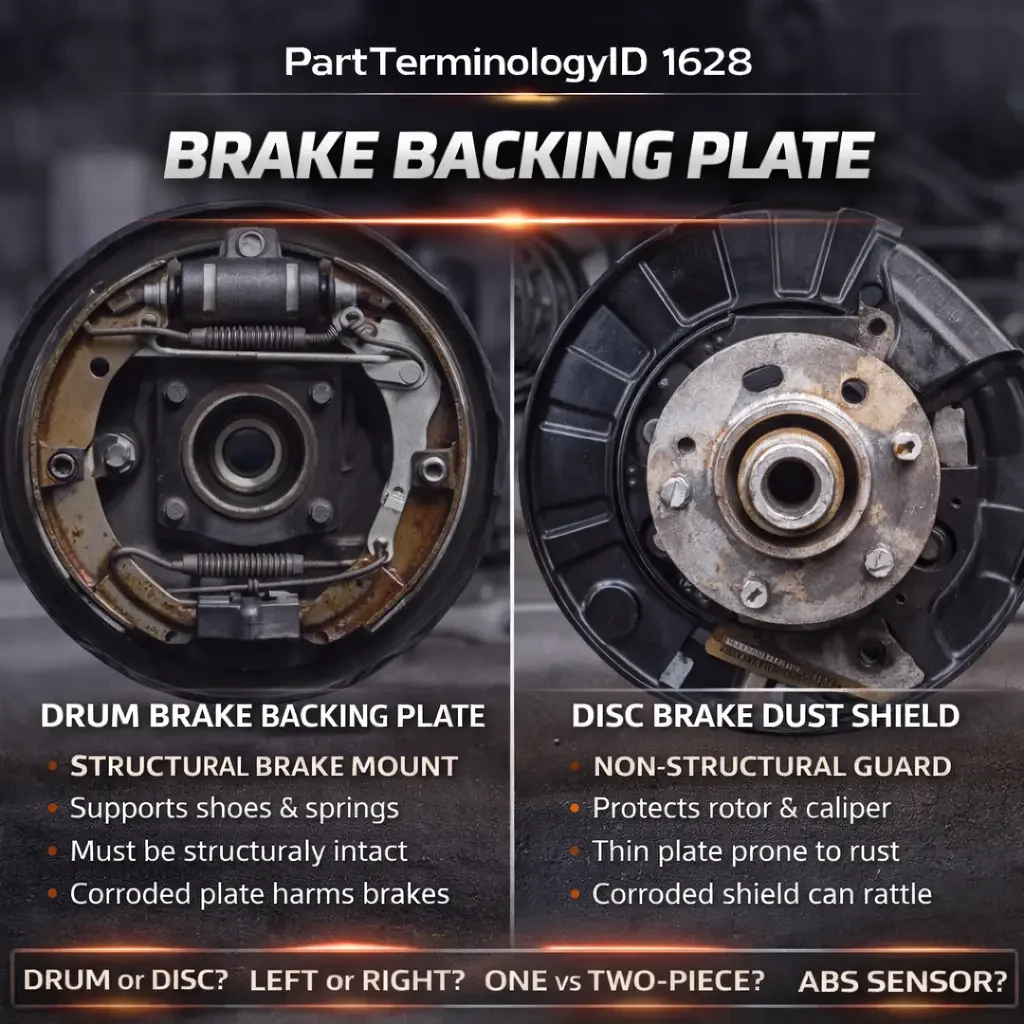
The brake backing plate is the stamped steel plate mounted behind the brake assembly at each wheel. On drum brake systems, the backing plate is a structural component: the wheel cylinder, brake shoes, springs, adjusters, and parking brake hardware all mount directly to it. It is the foundation of the entire drum brake assembly. On disc brake systems, the backing plate (more commonly called a dust shield or splash shield) is a protective component: a thin stamped steel plate mounted behind the rotor that deflects road debris, water, and contaminants away from the rotor and caliper.
Same name. Same PartTerminologyID. Two fundamentally different parts with different functions, different failure modes, different replacement urgency, and different price points.
The drum brake backing plate is a critical structural member. If it bends, cracks, or corrodes, the brake shoes cannot make proper contact with the drum, the wheel cylinder can leak, and the braking system on that wheel is compromised. Replacement requires a complete brake disassembly. It costs $30 to $150 and requires significant labor.
The disc brake dust shield is a protective non-structural component. If it rusts through, bends, or falls off, the disc brakes still function. The rotor is more exposed to debris and water, which can accelerate pad and rotor wear and cause temporary noise after water exposure, but the brake system itself is not compromised. Dust shields commonly rust and rattle in salt-belt states, and many owners simply remove them. Replacement costs $15 to $60 and ranges from straightforward to labor-intensive depending on whether the axle shaft or hub must be removed to access it.
This post is built for aftermarket catalog teams, marketplace sellers, and buyers who need to distinguish between these two very different products that share a single PartTerminologyID.
Status in New Databases
Status in New Databases
Current: PIES 7.2 + PCdb Future: PIES 8.0 + PCdb 2.0 Status: No change
What Brake Backing Plate Means in the Aftermarket
Brake Backing Plate (PartTerminologyID 1628) covers both drum brake backing plates and disc brake dust shields. The catalog must distinguish between them.
Drum Brake Backing Plate
A thick stamped steel plate (typically 2 to 4 mm) that bolts to the axle housing or steering knuckle and serves as the mounting surface for all drum brake components. The brake shoes ride on raised pads (shoe contact pads or support pads) stamped into the plate. The wheel cylinder bolts to the plate through machined holes. The shoe return springs, hold-down springs, adjuster mechanism, and parking brake strut all anchor to the plate. The backing plate also seals the inner side of the brake assembly, keeping road contamination out.
This is a structural, load-bearing component. It must maintain dimensional accuracy so the brake shoes contact the drum concentrically. If the plate is bent, the shoes will drag on one side and not contact on the other, causing uneven braking, noise, and premature wear.
Disc Brake Dust Shield
A thin stamped steel plate (typically 0.5 to 1.5 mm) that mounts behind the disc brake rotor, between the rotor and the steering knuckle or axle flange. Its function is debris and water deflection only. It does not bear any braking loads. No brake components mount to it (some vehicles mount the parking brake shoes to a separate parking brake support plate behind the rear disc brake rotor, but this is a different component from the dust shield).
Dust shields are the most corrosion-prone brake component on the vehicle. They are thin, unpainted or minimally coated, and exposed to the full force of road spray, salt, and debris from below. In northern climates, dust shields commonly rust through within 8 to 12 years. When corroded, they can rattle against the rotor, break apart and rub on the rotor (causing a grinding noise that mimics worn brake pads), or fall off entirely.
One-piece vs. split (two-piece) dust shield
A significant aftermarket innovation. On many vehicles, the dust shield mounts behind the hub or axle flange and cannot be replaced without removing the hub, wheel bearing, or axle shaft. This turns a $20 part into a multi-hour labor job. Dorman and other aftermarket suppliers offer split (two-piece) dust shields that clamp around the axle or hub without requiring removal of any drivetrain components. The old rusted shield is cut off and the two halves of the new shield are bolted or clipped together around the axle. This is one of the most popular aftermarket innovations in the brake hardware category.
What this part does NOT cover
Brake Drum. The rotating component the shoes press against. Different PartTerminologyID.
Brake Rotor. The rotating disc that the pads clamp. Different PartTerminologyID.
Caliper Bracket / Caliper Mounting Bracket. The bracket that the caliper bolts to. On disc brake systems, the caliper bracket is structural. The dust shield is not. Different component.
Parking Brake Support Plate. On some vehicles with rear disc brakes and a drum-in-hat parking brake, a support plate behind the rotor carries the parking brake shoes. This may look like a backing plate and may be called one, but it serves the parking brake specifically and is a separate part.
Disc Brake Anti-Rattle Clip (PartTerminologyID 1608). Previously covered in this series. The anti-rattle clip mounts on the caliper bracket. The dust shield mounts behind the rotor. Different components.
Why Brake Backing Plates Are Replaced
Drum brake backing plate: corroded shoe contact pads
The raised pads on the backing plate that the brake shoes slide on corrode and develop a rough surface. The shoes no longer slide freely, causing grabbing, uneven wear, and noise. In mild cases, the pads can be cleaned with a wire brush and lubricated with brake-specific lubricant. In severe cases, the pads are pitted or worn through and the plate must be replaced.
Drum brake backing plate: bent from impact or improper service
The plate can be bent by road debris impact, improper jack placement, or damage during axle service. A bent plate causes the brake shoes to sit at an angle to the drum, resulting in drag on one edge and a gap on the other. Braking performance, noise, and shoe life are all affected.
Drum brake backing plate: wheel cylinder mounting surface corrosion
The area where the wheel cylinder bolts to the plate corrodes, preventing a proper seal. Brake fluid leaks at the cylinder-to-plate interface.
Disc brake dust shield: rust-through
The most common replacement reason. The thin steel dust shield rusts completely through in salt-belt environments. Pieces of corroded metal break off and rub against the spinning rotor, producing a grinding or scraping noise that mimics worn brake pads. The driver brings the vehicle in for a "brake noise" complaint and the technician finds a disintegrating dust shield, not worn pads.
Disc brake dust shield: bent and contacting rotor
The dust shield is bent inward from road debris, a curb strike, or careless work during a brake job. The bent edge contacts the spinning rotor, producing a constant scraping or rubbing sound. This is the number one false-positive for a "bad brakes" diagnosis. The fix is to bend the shield back or replace it.
Disc brake dust shield: removed and now needed
Some owners or shops remove corroded dust shields entirely rather than replacing them. The brakes function normally without them. However, if the vehicle is later inspected (state inspection, pre-purchase inspection), the missing dust shield may be flagged. The owner then needs a replacement.
Fitment Variables
Drum vs. disc application
The primary fitment divide. Drum brake backing plates and disc brake dust shields are entirely different components despite sharing a PartTerminologyID. The listing must specify which type.
Position (front vs. rear, left vs. right)
Backing plates and dust shields are position-specific. The mounting holes, cutouts for brake lines, and clearances for the ABS sensor differ between left and right sides. Front and rear are almost always different. Ordering a front-left dust shield for a rear-right application will not work.
One-piece vs. split (two-piece) dust shield
If the buyer's vehicle requires hub or axle removal to install a one-piece dust shield, a split two-piece design is a significant labor saver. The listing should specify whether the shield is one-piece (requires hub/axle removal) or split (installs without hub/axle removal).
ABS sensor clearance
On vehicles with ABS, the backing plate or dust shield has a specific cutout or boss for the wheel speed sensor. The sensor must pass through or be accommodated by the plate. An incorrect plate may block the sensor or position it at the wrong distance from the tone ring.
Parking brake accommodation (rear disc)
On vehicles with rear disc brakes and a drum-in-hat parking brake, the dust shield (or a separate parking brake support plate) may need to accommodate the parking brake shoes, adjuster, and springs. Verify whether the listing is the dust shield only or includes the parking brake support structure.
Hub and bearing configuration
The center opening of the dust shield must match the hub, bearing, and axle flange diameter. Different bearing generations or hub designs on the same vehicle model can change the required dust shield.
Top Return Causes
1) Drum brake backing plate ordered when disc brake dust shield was needed (or vice versa)
The buyer searched "brake backing plate" and received the wrong type for their brake system.
Prevention: Brake system type in the title: "Drum Brake Backing Plate" or "Disc Brake Dust Shield." Never use the generic "Brake Backing Plate" alone when it could mean either type.
2) Wrong side (left ordered for right or vice versa)
Left and right backing plates/dust shields are mirror images with different mounting hole positions and line clearances.
Prevention: Side in the title: "Left (Driver Side)" or "Right (Passenger Side)" or "Pair (Left and Right)."
3) One-piece dust shield ordered, buyer cannot remove hub/axle to install it
The buyer receives a one-piece dust shield and discovers it cannot be installed without pulling the axle shaft or pressing out the wheel bearing. The job exceeds their capability or tool access.
Prevention: Specify one-piece or split (two-piece) in the title. For one-piece shields, note the installation requirement: "Installation requires removal of hub/axle assembly." Cross-reference the split two-piece alternative if available: "For easier installation without hub removal, see [split dust shield part number]."
4) Dust shield does not accommodate ABS sensor
The replacement dust shield does not have the correct cutout for the ABS wheel speed sensor. The buyer cannot route the sensor properly.
Prevention: "Includes ABS sensor provision" or "Designed for vehicles with ABS." Confirm fitment with full vehicle details including ABS configuration.
5) Parking brake support plate confused with disc brake dust shield (rear applications)
The buyer needs the parking brake support plate for the drum-in-hat parking brake but received the dust shield, or vice versa.
Prevention: Clearly distinguish between the disc brake dust shield and the parking brake support plate in the listing. "This is the disc brake dust shield only. Does not include parking brake support plate or parking brake hardware."
Compatibility Checklist for Buyers
1) Confirm brake system type at the position being serviced. Drum brakes require a backing plate. Disc brakes require a dust shield (or nothing, if the shield was previously removed).
2) Confirm side. Left or right. Front or rear.
3) For disc brake dust shields, determine whether your vehicle requires hub or axle removal for installation. If so, consider a split (two-piece) dust shield to avoid this labor.
4) Confirm ABS sensor accommodation. Verify the replacement has the correct sensor provision.
5) For rear disc brakes, distinguish between the dust shield and the parking brake support plate. They are different components.
6) Confirm full vehicle details. Year, make, model, submodel, trim, drive type (2WD/4WD). OEM part number cross-reference recommended.
Catalog Checklist for Attributes
Core taxonomy: Product type: drum brake backing plate or disc brake dust shield. Configuration: one-piece or split (two-piece). Position: front left, front right, rear left, rear right. Quantity: single or pair. Separate from Brake Drum, Brake Rotor, Caliper Bracket, Parking Brake Support Plate, and Disc Brake Anti-Rattle Clip (1608).
Fitment: Year, make, model, submodel, trim, drive type (2WD/4WD). ABS equipped (yes/no). Brake type at position (drum/disc). Side (left/right). OEM part number cross-reference.
Specifications: Material (steel, corrosion-resistant coated steel). Thickness. Mounting hole count and pattern. Center bore diameter. ABS sensor provision (yes/no).
Installation notes: Hub/axle removal required (one-piece shields, specify). Split design installs without hub/axle removal (if applicable). Shoe contact pad lubrication recommended (drum brake plates).
Images: Plate from front and back, mounting holes visible, ABS sensor cutout visible, center bore visible. For split shields, show the two halves and the joining hardware.
FAQ
Is a brake backing plate the same as a brake dust shield?
The term "brake backing plate" is used for both, but they are different components. On drum brake systems, the backing plate is a thick structural plate that all brake components mount to. On disc brake systems, the "backing plate" is actually a thin dust shield that deflects debris from the rotor and caliper. It is not structural and no brake components mount to it. Always confirm whether you need the drum brake backing plate or the disc brake dust shield for your application.
Can I just remove the rusted dust shield instead of replacing it?
Yes, many owners and shops do this. The disc brakes will function without the dust shield. However, the rotor will be more exposed to road debris and water, which may cause temporary brake noise after water exposure and slightly accelerated pad and rotor wear. Some state inspections may flag a missing dust shield. If you choose to remove it rather than replace it, be aware of these tradeoffs.
What is a split or two-piece dust shield?
A split dust shield is an aftermarket design that comes in two halves that clamp around the axle or hub flange without requiring removal of the hub, wheel bearing, or axle shaft. The old corroded shield is cut off, the two halves are positioned around the axle, and they are bolted or clipped together. This saves significant labor compared to a one-piece shield that requires hub or axle removal for installation.
My brakes are making a grinding noise but the pads are fine. Could it be the dust shield?
Yes. A corroded, bent, or broken dust shield can contact the spinning rotor and produce a grinding or scraping noise that closely mimics the sound of worn brake pads. This is one of the most common false-positive brake diagnoses. Visually inspect the dust shield for rust-through, broken sections, or edges bent inward toward the rotor.
Final Take for Aftermarket Teams
Brake Backing Plate (PartTerminologyID 1628) covers two fundamentally different parts under one name. The catalog teams that avoid confusion specify the brake system type (drum or disc) and the product type (structural backing plate or dust shield) in the title of every listing. For disc brake dust shields, specifying one-piece versus split (two-piece) and noting whether hub or axle removal is required prevents the most common installation-related return. The split two-piece dust shield is one of the most successful aftermarket innovations in brake hardware and should be cross-referenced in every one-piece dust shield listing where a split alternative exists. A $15 to $60 part with the brake type, side, and installation method clearly stated in the title eliminates virtually all returns in this category.