
Disc Brake Anti-Rattle Clip (PartTerminologyID 1608): The Small Spring Steel Clip That Prevents Brake Pad Noise and Gets Called Six Different Names Across the Industry
Written by Arthur Simitian | PartsAdvisory
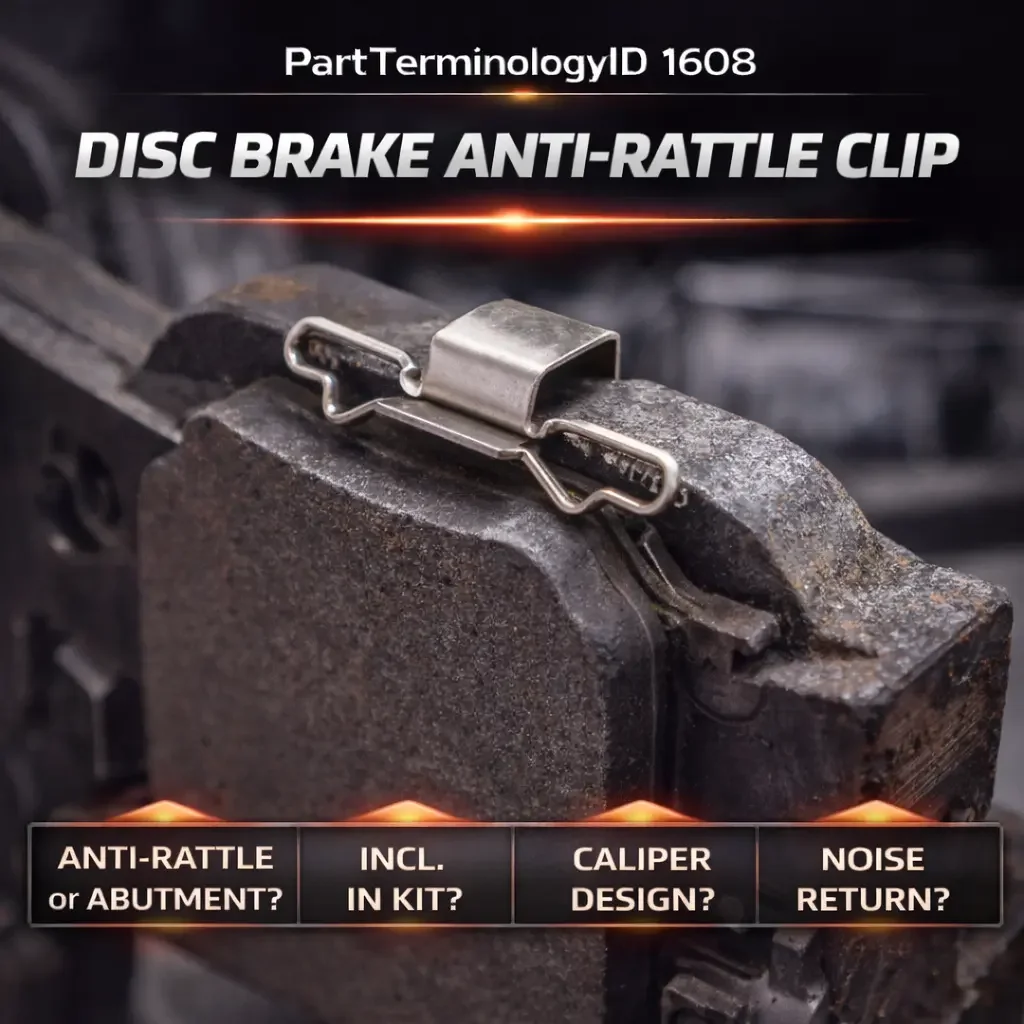
The disc brake anti-rattle clip is a small spring steel or stainless steel clip that secures the brake pad within the caliper or caliper bracket to prevent the pad from vibrating, rattling, or shifting during driving and braking. It is part of the disc brake hardware family and is one of the most overlooked, most frequently reused, and most inconsistently named components in the brake system.
When the vehicle hits a bump, goes over rough pavement, or transitions between braking and coasting, the brake pads can move slightly within the caliper bracket. Without proper retention hardware, this movement causes an audible rattle, click, or clunk. Over time, the movement also wears grooves into the caliper bracket's abutment surfaces, accelerates uneven pad wear, and can allow the pad to shift out of optimal contact with the rotor. The anti-rattle clip eliminates this movement by applying spring tension to the pad, holding it in position against the caliper bracket abutment surfaces.
The catalog challenge with this part is naming. The same physical component is called an anti-rattle clip, an abutment clip, a pad support plate, a pad retainer clip, a slider clip, a pad spring, or simply "brake hardware" depending on the manufacturer, the parts store, the service manual, and the person describing it. These names overlap with other brake hardware components that serve different functions. A buyer searching for "anti-rattle clip" may receive an abutment clip (which goes between the pad ear and the bracket) when they needed the spring clip that holds the pad body against the caliper. Or the buyer may receive the correct clip and not realize that the "brake hardware kit" they already ordered includes it.
This post is built for aftermarket catalog teams, marketplace sellers, and buyers who want to identify the correct clip, understand how it differs from other brake hardware, and avoid the most common ordering mistakes.
Status in New Databases
Status in New Databases
Current: PIES 7.2 + PCdb Future: PIES 8.0 + PCdb 2.0 Status: No change
What Disc Brake Anti-Rattle Clip Means in the Aftermarket
Disc Brake Anti-Rattle Clip (PartTerminologyID 1608) refers to the spring clip or retention device that prevents disc brake pads from vibrating or rattling within the caliper or caliper bracket. This is the clip that applies spring tension to hold the pad in a fixed position, not the shim on the back of the pad, not the abutment clip on the bracket rail, and not the caliper slide pin or bushing.
In catalog reality, the naming problem creates significant confusion because the term "anti-rattle clip" is used in different contexts across the industry:
Pad retainer spring clip. A spring steel clip that presses against the top or side of the brake pads to hold them in place within the caliper. This is the most literal "anti-rattle" clip: it applies spring pressure to prevent pad movement. Common on many Japanese and European caliper designs. Snaps onto the caliper or caliper bracket and bridges across the pads.
Abutment clip / pad support plate. A stainless steel clip that snaps onto the caliper bracket's abutment surface (the rail or ledge where the pad ears ride). The abutment clip provides a smooth, corrosion-resistant surface for the pad ears to slide on and prevents the pad from wearing grooves into the cast iron or aluminum bracket. Many factory parts catalogs and service manuals call these "disc brake anti-rattle clips" even though their primary function is pad guidance and bracket protection, not vibration damping. This is the source of most naming confusion.
Drag reduction clip / W-clip / pad retractor spring. A spring clip that sits behind the brake pad and applies outward pressure to retract the pad slightly away from the rotor when the brakes are released. This reduces residual drag, lowers brake temperatures, improves fuel economy, and reduces pad noise. Sometimes called an "anti-rattle clip" because it also prevents pad vibration, but its primary purpose is drag reduction.
Brake hardware kit. A complete set of clips, springs, and shims for a given caliper application. Most brake hardware kits include anti-rattle clips, abutment clips, and sometimes drag reduction clips, all in one package. When a buyer searches for an individual anti-rattle clip, they may find hardware kits that include it, individual clips that may or may not be the correct type, and listings that use the same name for different clip types.
What this part does NOT cover
Brake Pad Shim. The thin adhesive or clip-on plate on the back of the brake pad that dampens vibration transfer between the pad and the caliper piston. Different component and function, though also aimed at noise reduction.
Caliper Slide Pin / Bushing / Boot. The guide pin and bushing that allow the floating caliper to slide and self-center. Different component.
Brake Pad Wear Indicator Clip. The metal tab on some brake pads that contacts the rotor when the pad is worn, producing a squeal to alert the driver. Different component.
Caliper Mounting Bracket. The bracket that bolts to the steering knuckle or spindle and provides the abutment surfaces for the pads. Different component. The anti-rattle clip mounts to the bracket but is not the bracket.
Brake Pad Set. Some brake pad sets include anti-rattle clips and/or abutment clips in the box. If the buyer's pad set already included the clips, they do not need to order them separately.
The Naming Problem
This is the central catalog challenge for this PartTerminologyID.
The following terms are all used to describe components that may or may not be the same physical part depending on the vehicle and the source:
Anti-rattle clip
Abutment clip
Pad support plate
Pad retainer clip
Pad retaining spring
Slider clip
Brake pad spring
Disc brake pad support plate (Toyota factory term)
Brake hardware
A buyer who has a rattling noise from the front brakes and searches "disc brake anti-rattle clip" will find listings that could be any of three different clip types. If the buyer orders the wrong type, the clip either does not fit the caliper, does not solve the rattle, or solves the rattle but does not address the real problem (worn abutment surfaces, missing abutment clips).
Catalog solution: The listing should identify the specific clip type (pad retainer spring, abutment clip, or drag reduction clip), show a clear photo of the clip, and specify exactly where it mounts (on the caliper body, on the caliper bracket abutment rail, or behind the pad). Include the OEM part number to eliminate ambiguity.
Why Disc Brake Anti-Rattle Clips Are Replaced
Reuse during brake pad replacement
The most common scenario. The technician or DIY owner replaces the brake pads and reuses the old clips. The old clips have lost spring tension from years of heat cycling and corrosion. They no longer apply adequate pressure to the pads. The pads rattle. Best practice is to replace all brake hardware every time the pads are replaced. Many premium brake pad sets include new hardware; many economy pad sets do not.
Corrosion and loss of spring tension
Brake clips live in one of the harshest environments on the vehicle: exposed to road spray, salt, heat from braking, and brake dust. Stainless steel clips resist corrosion better than bare spring steel clips, but even stainless clips lose spring tension over time from repeated heat cycling. A clip that has been through 50,000 miles of brake heat no longer applies the same spring force as a new clip.
Clips missing or improperly installed
Clips are small, easy to lose during a brake job, and easy to install incorrectly. A clip installed upside down, backwards, or in the wrong position may not contact the pad properly. A missing clip allows the pad to move freely, producing rattle and accelerating bracket wear.
Worn caliper bracket abutment surfaces
When clips are not replaced or are missing, the pad ears ride directly on the caliper bracket's abutment surfaces. Over time, the pad ears wear grooves into the bracket. Once the bracket is grooved, even new clips cannot hold the pad steady because the pad sits lower in the groove and the clip cannot compensate for the lost material. At this point, the bracket must be cleaned and resurfaced (if possible) or replaced, and new clips installed.
Noise diagnosis leading to clip replacement
The driver hears a rattle, click, or clunk from the brakes, especially at low speed or over bumps. The technician inspects the brakes and finds worn or missing anti-rattle hardware. Replacing the clips solves the noise.
Fitment Variables
Caliper type and design
The clip must match the specific caliper and caliper bracket on the vehicle. Floating calipers, fixed calipers, single-piston, multi-piston, and different caliper manufacturers all use different clip designs. A clip for a single-piston floating caliper on a Toyota Camry is not interchangeable with a clip for a Brembo fixed caliper on a sports car.
Position (front vs. rear, upper vs. lower)
On many vehicles, the front and rear brakes use different calipers and therefore different clips. Even on the same caliper, the upper and lower clip positions may use different clip profiles. Toyota, for example, uses two different anti-rattle clip part numbers for the upper and lower positions on the same caliper bracket, and they are not interchangeable.
Clip type (retainer spring vs. abutment clip vs. drag reduction clip)
As detailed above, these serve different functions and are different physical components despite sometimes sharing a name. The listing must specify which type.
Material
OEM clips are typically stainless steel (abutment clips) or spring steel with a coating (retainer springs). Aftermarket clips vary. Some aftermarket brake hardware kits use lower-grade materials that corrode faster or lose spring tension sooner than OEM clips. Premium aftermarket kits from Raybestos, Carlson, Centric, and others generally match OEM quality.
Included with brake pad set or sold separately
Some brake pad manufacturers include all necessary hardware (anti-rattle clips, abutment clips, shims) in the pad box. Others include nothing. The buyer needs to know whether to order hardware separately.
Top Return Causes
1) Wrong clip type (abutment clip ordered, retainer spring needed, or vice versa)
The buyer searched "anti-rattle clip" and received the abutment clip when they needed the pad retainer spring, or the reverse.
Prevention: Specify the clip type in the title: "Disc Brake Pad Retainer Spring Clip" or "Disc Brake Abutment Clip" or "Disc Brake Pad Drag Reduction Clip." Photo showing exactly what the clip looks like and where it mounts.
2) Clips already included with buyer's brake pad set
The buyer orders anti-rattle clips separately and then discovers that the brake pad set they already purchased includes the same clips.
Prevention: Note in the description: "Check your brake pad set before ordering. Many premium brake pad sets include this hardware in the box."
3) Wrong position (front ordered for rear, or upper ordered for lower)
Front and rear clips are different, or upper and lower clips on the same bracket are different.
Prevention: Position in the title: "Front" or "Rear." If upper and lower clips differ, specify which positions the listing covers.
4) Clip does not fit aftermarket caliper or bracket
The buyer has an aftermarket big-brake kit (Baer, Wilwood, Alcon, Brembo aftermarket) and ordered OEM-application clips. Aftermarket calipers use their own hardware.
Prevention: "Fits OEM caliper and bracket for [year, make, model]. Not compatible with aftermarket big-brake kits."
5) Clip quality complaint (loses tension quickly)
Economy-grade clips lose spring tension or corrode within a few months. The buyer returns them as defective.
Prevention: Specify material (stainless steel, coated spring steel). If the clip is a premium or OEM-equivalent grade, call this out.
Compatibility Checklist for Buyers
1) Identify the specific clip type you need. Pad retainer spring, abutment clip, or drag reduction clip. If unsure, look up the OEM part number for your caliper's brake hardware.
2) Check your brake pad set. If you are replacing pads at the same time, check whether the pad box includes hardware. Many premium sets do.
3) Confirm position. Front or rear. Upper or lower if different.
4) Confirm caliper type. OEM caliper or aftermarket big-brake kit.
5) Confirm full vehicle details. Year, make, model, submodel, trim. OEM part number cross-reference recommended.
6) Replace all brake hardware whenever pads are replaced. This is industry best practice. Reusing old clips is the most common cause of post-brake-job noise complaints.
Catalog Checklist for Attributes
Core taxonomy: Clip type: pad retainer spring clip, abutment clip (pad support plate), drag reduction clip (W-clip/retractor spring), or hardware kit (includes multiple types). Position: front, rear. Sub-position: upper, lower, or both (if different). Separate from Brake Pad Shim, Caliper Slide Pin/Bushing, Brake Pad Wear Indicator, and Caliper Mounting Bracket.
Fitment: Year, make, model, submodel, trim. Caliper type (if multiple calipers were offered for the same vehicle). Position (front/rear). OEM part number cross-reference.
Specifications: Material (stainless steel, coated spring steel). Quantity per package (per caliper, per axle, per vehicle). Clip dimensions (if applicable).
Included in kit (if kit): List all clip types and quantities included. "Kit services X calipers" or "Kit services one axle (left and right)."
Images: Clip from multiple angles, close-up showing spring tension profile, installation position on caliper bracket (diagram or photo showing where it mounts).
FAQ
What is the difference between an anti-rattle clip and an abutment clip?
The terminology overlaps and causes confusion. An anti-rattle clip in its most specific meaning is a spring clip that applies pressure to the brake pad to prevent vibration and movement. An abutment clip is a flat stainless steel clip that snaps onto the caliper bracket's abutment surface to provide a smooth, corrosion-resistant rail for the pad ears to slide on. Both are frequently called "anti-rattle clips" in parts catalogs and service manuals. Check the OEM part number and the photo to confirm you are ordering the correct type.
Should I replace brake hardware every time I replace brake pads?
Yes. This is industry best practice recommended by brake pad manufacturers, caliper manufacturers, and automotive service organizations. Old clips lose spring tension from heat cycling and corrosion. Reusing old hardware is the most common cause of brake noise complaints after a pad replacement. New hardware costs $5 to $20 per axle and eliminates the most common callback in brake service.
My brake pads came with hardware in the box. Do I need to buy clips separately?
Check what is included. Many premium brake pad sets (Akebono, Bosch, Wagner ThermoQuiet, Raybestos Element3) include abutment clips, retainer springs, and sometimes shims. Economy pad sets often include nothing. If your pad set includes the hardware, you do not need to order it separately.
I installed new pads and hardware but the brakes still rattle. What else could it be?
If new hardware does not solve the rattle, inspect the caliper bracket's abutment surfaces for grooves worn by the previous pad ears. If the surfaces are grooved, the pad can move vertically in the groove and no clip can compensate. The bracket must be cleaned and the grooves filed smooth or the bracket replaced. Also check the caliper slide pins and bushings for binding or excess play, and verify that the caliper mounting bolts are torqued correctly.
Final Take for Aftermarket Teams
Disc Brake Anti-Rattle Clip (PartTerminologyID 1608) is a $3 to $20 part that prevents the most common post-brake-job noise complaint and generates returns primarily because the name "anti-rattle clip" is applied to three different clip types across the industry. The catalog teams that eliminate confusion in this category do two things: they specify the exact clip type (pad retainer spring, abutment clip, or drag reduction clip) in the title instead of using the generic "anti-rattle clip" term, and they include a photo or diagram showing exactly where the clip mounts on the caliper or bracket. A secondary note that many premium brake pad sets include this hardware in the box prevents duplicate orders. The part is cheap. The confusion is expensive. Clear naming and a good photo cost nothing and solve the problem.