
Written by Arthur Simitian | PartsAdvisory
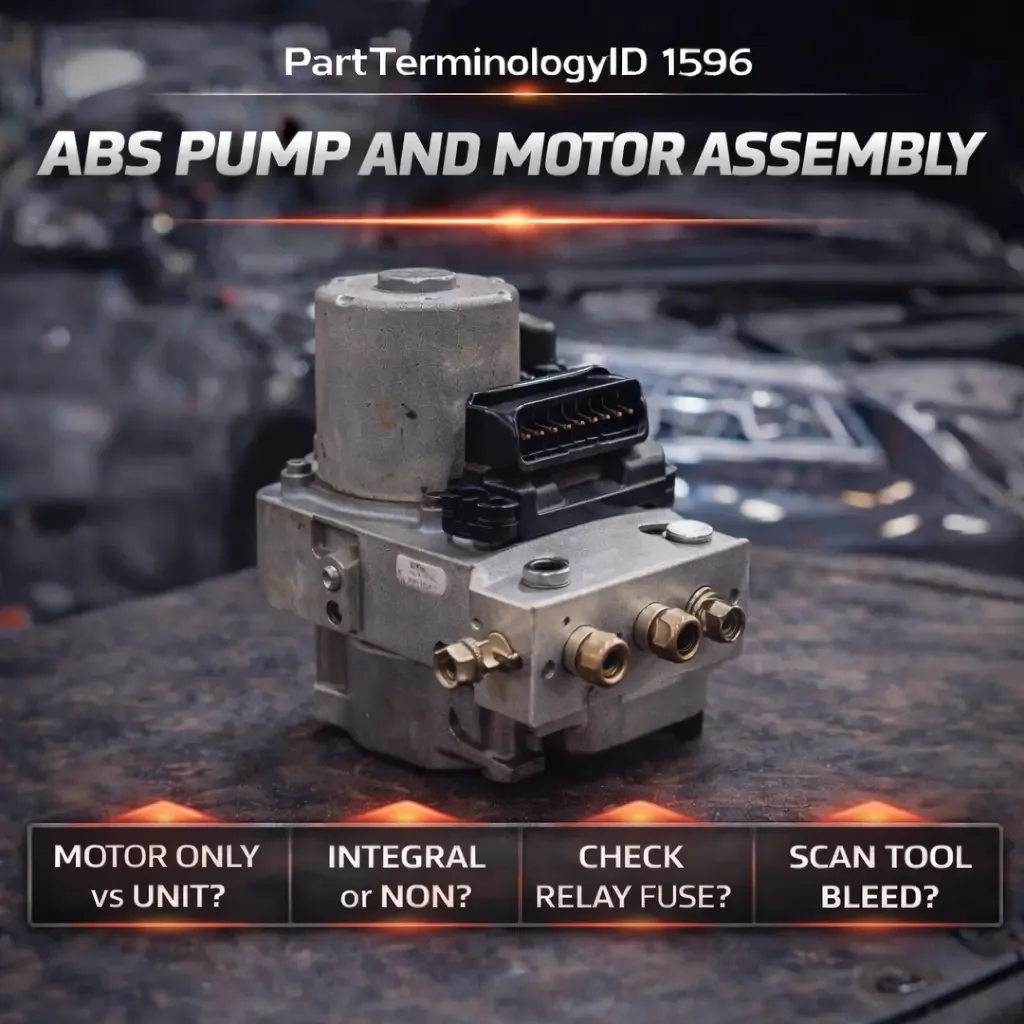
The ABS pump and motor assembly is the electric motor and hydraulic pump unit that generates brake fluid pressure for the anti-lock brake system. In integral ABS systems (Teves Mark II and related designs covered in the ABS Accumulator post, PartTerminologyID 1580), the pump provides all power-assisted braking pressure and charges the accumulator. In non-integral ABS systems (the vast majority of vehicles from the mid-1990s onward), the pump generates pressure only during ABS, traction control, or electronic stability control (ESC) events to reapply brake pressure after the modulator (PartTerminologyID 1592, previously covered) releases it during the hold-release-reapply cycle.
This is now the third ABS component covered in this series, and all three are interconnected. The accumulator (1580) stores pressure. The modulator (1592) directs pressure. The pump and motor (1596) generates pressure. On integral systems, if the accumulator fails, the pump overworks and burns out. On any system, if the pump fails, the modulator has no pressure to work with during ABS events. A buyer who needs one of these three parts frequently needs a second one, and a listing that cross-references the other two ABS PartTerminologyIDs in this series reduces the chance that the buyer solves one problem and creates another.
The catalog challenge with this PartTerminologyID is assembly level, just as it was with the modulator (1592). The "ABS pump and motor assembly" can mean the pump motor only (the electric motor that drives the pump), the pump and motor as a serviceable subassembly, or the pump and motor still attached to the modulator valve body as part of a complete ABS unit. When the pump motor is the only failed component, the buyer wants the motor only or the pump-and-motor subassembly. When the entire ABS unit is being replaced, the pump and motor come with it. The listing must state which assembly level is being sold.
This post is built for aftermarket catalog teams, marketplace sellers, and buyers who need to identify, list, and order the correct pump and motor for their ABS system.
Status in New Databases
Status in New Databases
Current: PIES 7.2 + PCdb Future: PIES 8.0 + PCdb 2.0 Status: No change
What ABS Pump and Motor Assembly Means in the Aftermarket
ABS Pump and Motor Assembly (PartTerminologyID 1596) refers to the electric motor and hydraulic pump that generates brake fluid pressure within the ABS system. This is the pump and its drive motor, not the modulator valve body, not the electronic control module, and not the accumulator.
In catalog reality, this covers several product configurations:
Standalone pump and motor subassembly. The electric motor with the hydraulic pump mechanism, sold as a unit that bolts onto or into the modulator valve body. This is the most targeted replacement: the buyer's pump motor has failed but the modulator and control module are functioning. On integral ABS systems (Teves Mark II), the pump and motor assembly typically bolts to the side of the master cylinder/hydraulic unit with one or two bolts and can be replaced without disturbing the brake lines. On non-integral systems, the pump is usually integrated into the modulator valve body and may or may not be separately serviceable.
Pump motor only. On some applications, the electric motor alone can be replaced. The pump mechanism (pistons, check valves, seals) remains in the valve body. The motor drives the pump through a coupling or direct drive. If the motor's windings have burned out but the pump mechanism is intact, the motor-only replacement is the most economical option. Availability is limited.
Complete ABS assembly including pump. The pump and motor sold as part of the complete ABS unit (modulator valve body + electronic control module + pump motor). This is the most common replacement form on modern vehicles because the components are tightly integrated. When ordering a "complete ABS assembly" under PartTerminologyID 1592 (ABS Modulator), the pump is included. When ordering under PartTerminologyID 1596, the buyer expects the pump and motor as the primary component but may or may not receive the valve body and module depending on the listing.
Remanufactured pump and motor. A used unit disassembled, inspected, rebuilt with new seals, brushes, and bearings, and tested under pressure. Cardone is the dominant remanufacturer in this category. Remanufactured units are common because new OEM pump assemblies for older integral ABS systems are discontinued, and new OEM pumps for modern systems can cost $500 to $2,000+.
What this part does NOT cover
ABS Modulator / Hydraulic Control Unit (PartTerminologyID 1592). The valve body that directs brake pressure to individual wheels. Previously covered. The pump bolts to the modulator but is a different component. On combined assemblies, both are included, but they serve different functions.
ABS Accumulator (PartTerminologyID 1580). The pressurized reservoir in integral ABS systems. Previously covered. The pump charges the accumulator. They are separate components that fail for different reasons and are replaced independently.
ABS Control Module. The electronic computer that commands the modulator solenoids and monitors wheel speed sensors. Different component, though on combined assemblies it is included.
Brake Booster / Vacuum Booster. On non-integral systems, the vacuum booster provides power assist and is separate from the ABS pump. On integral systems, the pump replaces the vacuum booster's function entirely.
ABS Relay. The electrical relay that provides power to the pump motor. A failed relay prevents the pump from running and is a common misdiagnosis. The relay is a $10 to $30 part. The pump is $200 to $800. Check the relay before ordering the pump.
Pressure Switch. The switch that tells the pump when to run and when to stop based on system pressure (integral systems). Different component.
How the ABS Pump and Motor Functions
On integral ABS systems (Teves Mark II and similar)
The pump and motor is the heart of the power brake system. When the ignition is turned on, the pressure switch monitors system pressure. If pressure in the accumulator is below the low threshold (approximately 2,000 PSI on Teves Mark II systems), the relay closes and the pump motor runs. The pump draws brake fluid from the reservoir and forces it into the accumulator at high pressure. When the pressure switch detects that system pressure has reached the upper threshold (approximately 2,600 PSI), the relay opens and the pump stops. This cycle repeats continuously during driving to maintain the pressure reserve.
The pump motor draws approximately 20 amps during operation. It is designed to run in brief cycles (a few seconds at a time), not continuously. A healthy accumulator means the pump runs infrequently. A failed accumulator means the pump runs constantly, overheats, and eventually burns out. This is the most common cascade failure in the integral ABS category: accumulator bladder deteriorates, pump overworks, pump motor fails, buyer now needs both parts.
On non-integral ABS systems (most modern vehicles)
The pump and motor sits within or attached to the modulator valve body. During normal braking, the pump does not run. It only activates when the ABS control module commands an ABS, traction control, or ESC intervention. During the ABS hold-release-reapply cycle, brake fluid released from a wheel brake flows into a low-pressure accumulator chamber within the modulator. The pump activates briefly to push this fluid back into the brake circuit and reapply pressure. The pump runs for fractions of a second during each ABS cycle.
On ESC-equipped vehicles, the pump can also generate pressure independently (without the driver pressing the brake pedal) to apply individual wheel brakes for stability correction. This requires a more powerful and responsive pump than ABS-only systems.
Because the pump on non-integral systems runs far less frequently than on integral systems, pump motor failure is less common. When it does fail, the most common causes are contaminated brake fluid (moisture and debris damaging the pump seals and motor windings), age-related bearing wear, and electrical faults in the motor winding or connector.
Why ABS Pump and Motor Assemblies Are Replaced
Pump motor burnout from accumulator failure (integral systems)
The number one failure cause on integral ABS systems. The accumulator can no longer hold pressure, the pump must run on every brake pedal application (or continuously), and the motor overheats and burns out. By the time the buyer diagnoses the pump as failed, the accumulator has already failed. Both must be replaced. Replacing only the pump without replacing the accumulator will burn out the new pump in short order.
Motor winding failure
The electric motor's windings deteriorate from age, heat, moisture ingress, or electrical surges. The motor draws excessive current, blows the fuse or relay, or simply stops running. Symptoms: the pump does not run when commanded, the ABS warning light illuminates, and on integral systems the brake pedal becomes extremely hard.
Internal pump seal failure
The hydraulic pump's internal seals wear or degrade. The pump runs but cannot generate adequate pressure. Symptoms: the pump runs longer than normal, the pressure switch does not signal the pump to shut off (integral systems), or ABS function is degraded (non-integral systems).
Bearing failure
The motor bearings wear, causing noise, vibration, or eventual seizure. The pump motor may make a grinding or whining noise before failing completely.
Electrical connector or relay failure (misdiagnosed as pump failure)
The pump motor is commanded to run but does not receive power because the relay has failed, the fuse has blown, or the connector is corroded. The pump motor itself is fine. This is a common and expensive misdiagnosis. The buyer replaces the $200 to $800 pump assembly when the $15 relay was the problem.
Contaminated brake fluid
Moisture, debris, or incorrect brake fluid attacks the pump seals, corrodes the motor housing, and damages internal components. Regular brake fluid changes (every 2 to 3 years) prevent this.
Fitment Variables
Integral vs. non-integral ABS system
This is the fundamental divide. Integral system pumps are larger, higher-pressure, and designed for continuous cycling. Non-integral system pumps are smaller, lower-pressure, and designed for intermittent use during ABS events. They are not interchangeable.
ABS system manufacturer and generation
Bosch, Teves (Continental), Kelsey-Hayes, Nippondenso, Sumitomo, Wabco, and others all manufactured ABS pumps. The pump must match the specific system generation. A Bosch 5.3 pump is different from a Bosch 5.7 or 8.0 pump. A Teves Mark II pump is different from a Teves Mark IV or Mark 20 pump.
Standalone pump vs. pump integrated into modulator
On some vehicles, the pump and motor is a separately serviceable component that bolts onto the modulator. On others, the pump is internal to the modulator valve body and can only be replaced by replacing the entire modulator assembly. The buyer must know which configuration their vehicle has before ordering.
Terminal count and connector type
The pump motor's electrical connector varies by application. Common configurations include 2-terminal, 4-terminal, and 8-terminal connectors. The connector must match the vehicle's wiring harness. A pump with the correct hydraulic interface but the wrong electrical connector will not plug in.
Mounting orientation and port configuration
The pump mounts to the modulator or hydraulic unit in a specific orientation. The hydraulic ports (intake from reservoir, output to accumulator or brake circuit) must align. A pump designed for the correct ABS system type but a different vehicle platform may have ports in different positions.
ESC / traction control capability
On ESC-equipped vehicles, the pump must be capable of generating pressure on demand for stability control interventions, not just during ABS events. ESC pumps may have higher flow rates, different motor windings, or additional control circuits.
Top Return Causes
1) Pump replaced without replacing the failed accumulator (integral systems)
The buyer's pump burned out because the accumulator had already failed. The buyer replaces the pump. The new pump runs constantly because the accumulator is still dead. The new pump overheats and burns out within weeks. The buyer returns the "defective" pump.
Prevention: "On integral ABS systems (Teves Mark II and similar), the pump and motor assembly works in conjunction with the ABS accumulator (PartTerminologyID 1580). A failed accumulator forces the pump to run excessively, which is the most common cause of pump failure. Always inspect and replace the accumulator when replacing the pump on integral systems."
2) Relay or fuse was the actual problem, not the pump
The pump does not run. The buyer assumes the pump motor is dead and orders a replacement. The actual problem was a failed relay or blown fuse. The new pump does not run either because the relay is still dead.
Prevention: "Before replacing the pump and motor assembly, verify that the ABS pump relay and fuse are functioning. The relay and fuse provide power to the pump motor. A failed relay (typically $10 to $30) is the most common cause of pump inoperation on integral ABS systems and should be checked first."
3) Wrong assembly level (pump only vs. complete ABS unit)
The buyer needed the pump motor subassembly only but received a complete ABS unit (modulator + module + pump) at a much higher cost. Or the buyer needed the complete unit and received the pump motor only, which cannot be used without the modulator.
Prevention: Assembly level in the title: "ABS Pump and Motor Assembly Only - does not include modulator valve body or control module" or "Complete ABS Unit including modulator, control module, and pump motor."
4) Wrong connector type
The pump motor has the correct hydraulic interface but a different electrical connector than the buyer's vehicle.
Prevention: Terminal count and connector type in the specifications. Photo of the connector. "2-terminal connector" or "8-terminal connector" in the fitment details.
5) Remanufactured pump requires ABS bleed procedure
Same issue as the modulator (1592): after pump replacement, air trapped in the hydraulic circuits requires a scan-tool-assisted bleed to purge.
Prevention: "Brake bleeding after pump replacement requires a scan tool with ABS bleed functionality to cycle the pump and solenoid valves. Conventional bleeding alone will not fully purge air from the ABS hydraulic circuits."
Compatibility Checklist for Buyers
1) Diagnose the actual failure before ordering. Check the ABS relay and fuse first. Verify the pump motor receives power when commanded. If the motor has power but does not run, the pump motor is the problem. If the motor has no power, trace the electrical circuit.
2) On integral ABS systems, inspect the accumulator. If the accumulator is failed, plan to replace both the accumulator (1580) and the pump motor (1596). Replacing only the pump guarantees a repeat failure.
3) Determine the assembly level you need. Pump motor only, pump and motor subassembly, or complete ABS assembly.
4) Confirm the ABS system type and generation. Teves Mark II, Bosch 5.3, Bosch 5.7, etc.
5) Verify connector type. Match the terminal count and connector to the vehicle's wiring harness.
6) Plan for ABS bleed procedure after installation. Confirm scan tool availability.
7) Confirm full vehicle details. Year, make, model, submodel, trim, engine, transmission. OEM part number cross-reference strongly recommended.
Catalog Checklist for Attributes
Core taxonomy: Product form: pump motor only, pump and motor subassembly, complete ABS assembly (pump + modulator + module). System type: integral ABS, non-integral ABS, ABS with traction control, ABS with ESC. Condition: new, remanufactured. Separate from ABS Modulator (1592), ABS Accumulator (1580), ABS Control Module, ABS Relay, Pressure Switch.
Fitment: Year, make, model, submodel, trim, engine, transmission. ABS system manufacturer and generation. ESC equipped (yes/no). Traction control equipped (yes/no). Terminal count and connector type. OEM part number cross-reference.
Specifications: Motor voltage (typically 12V). Terminal count. Connector type and gender. Port count and configuration. Motor amperage draw (if known).
Included components: Pump motor, mounting hardware (yes/no), O-rings or seals (yes/no), wiring harness or connector (yes/no), modulator valve body (yes/no), control module (yes/no).
Installation notes: ABS bleed procedure required (scan tool with ABS bleed function). Accumulator inspection recommended (integral systems). Relay and fuse check recommended before replacement. Brake fluid specification.
Images: Pump and motor from multiple angles, electrical connector visible with terminal count, hydraulic port locations visible, mounting interface visible.
FAQ
My ABS pump runs constantly. Is the pump bad?
On integral ABS systems, a pump that runs constantly usually indicates a failed accumulator, not a failed pump. The pump is doing its job but the accumulator cannot hold pressure, so the pump never shuts off. Check the accumulator first. On non-integral systems, a constantly running pump indicates an internal fault in the modulator (pressure not building) or a control module error. Read diagnostic trouble codes before replacing parts.
How do I know if the ABS relay is bad before I replace the pump?
Locate the ABS pump relay (check the vehicle's fuse/relay box diagram). Swap it with another relay of the same type in the box (many vehicles use identical relays for multiple circuits). If the pump runs with the swapped relay, the original relay was the problem. You can also test the relay with a multimeter for continuity across the contacts when power is applied to the coil pins.
Can I replace just the pump motor without replacing the entire ABS modulator?
On some vehicles, the pump motor is a separately serviceable subassembly that bolts to or detaches from the modulator. On others, the pump is internal to the modulator and cannot be replaced independently. Check the parts catalog for your vehicle. If the pump is available separately, it is typically much less expensive than the complete assembly.
I replaced the pump and now the brake pedal is spongy. Is the pump defective?
Most likely not. Air entered the ABS hydraulic circuits during installation. The system requires a scan-tool-assisted bleed procedure that commands the pump and solenoid valves to cycle, pushing trapped air out of the internal passages. Conventional gravity, vacuum, or pressure bleeding alone will not purge all air from the ABS circuits.
Final Take for Aftermarket Teams
ABS Pump and Motor Assembly (PartTerminologyID 1596) is the third ABS component in this series, following the Accumulator (1580) and the Modulator (1592). These three parts form a system, and a failure in one often causes or reveals a failure in another. The catalog teams that reduce returns in this category do two things that most listings skip: they cross-reference the accumulator in every integral-system pump listing with a note that both should be replaced together, and they include the relay/fuse check recommendation that prevents the most expensive misdiagnosis in the ABS category (replacing a $400 pump when a $15 relay was the actual failure). Assembly level in the title and the ABS bleed scan tool requirement complete the listing. A pump and motor assembly costs $150 to $800. The relay that should have been checked first costs $15. The accumulator that should have been replaced at the same time costs $75 to $300. The listing that communicates all three of these points before the buyer clicks "add to cart" is the listing that generates the fewest returns and the highest buyer satisfaction in the ABS category.