
Written by Arthur Simitian | PartsAdvisory
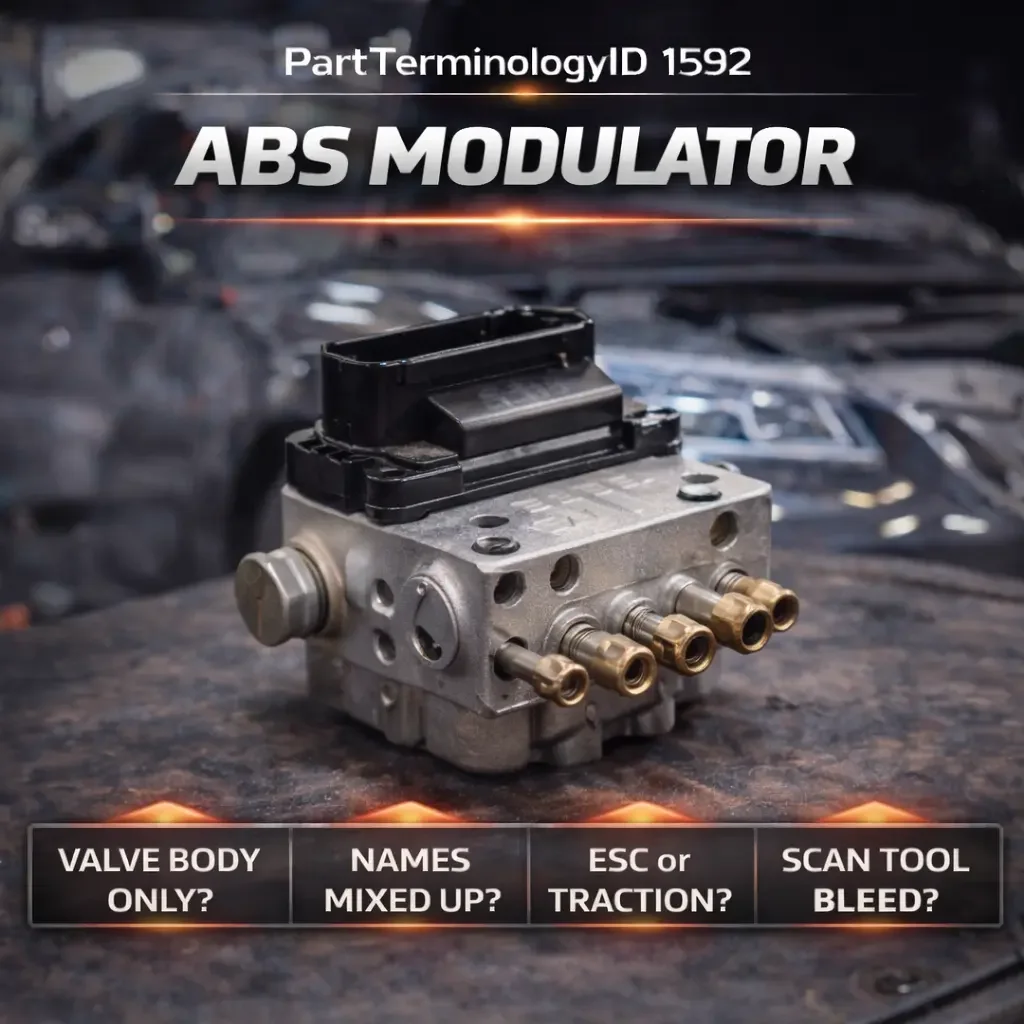
The ABS modulator is the hydraulic valve body that sits between the master cylinder and the individual wheel brake lines in an anti-lock brake system. It contains a set of solenoid valves (typically one inlet/isolation valve and one outlet/dump valve per controlled channel) that the ABS control module commands to open and close during an anti-lock braking event. During normal braking, fluid passes through the modulator unaltered from the master cylinder to the wheel brakes. When the ABS control module detects that a wheel is about to lock, it commands the modulator's solenoid valves to reduce, hold, or restore pressure to that wheel independently, cycling many times per second to prevent lockup while maintaining maximum braking force.
On modern vehicles (roughly mid-1990s onward), the ABS modulator is almost always a combined assembly: the hydraulic valve block, the electric pump motor, and the electronic control module are bolted together into a single unit often called the ABS pump, ABS module, ABS hydraulic unit, ABS hydraulic control unit (HCU), or ABS modulator. These names are used interchangeably in the aftermarket, in forums, by parts stores, and even by OEMs, which is the central catalog problem for this PartTerminologyID.
When PartTerminologyID 1592 says "ABS Modulator," it means the hydraulic valve body that modulates brake pressure. On some vehicles and in some catalogs, this is the standalone hydraulic block without the electronic control module or the pump. On other vehicles, the modulator is only available as part of the combined assembly. The buyer searching for "ABS modulator" may need the valve body only, the valve body with module, or the complete assembly with pump. If the listing does not make this distinction, the wrong part ships and a safety-critical brake component gets returned.
This post is built for aftermarket catalog teams, marketplace sellers, and buyers who need to navigate the terminology and get the correct ABS component the first time.
Status in New Databases
Status in New Databases
Current: PIES 7.2 + PCdb Future: PIES 8.0 + PCdb 2.0 Status: No change
What ABS Modulator Means in the Aftermarket
ABS Modulator (PartTerminologyID 1592) refers to the hydraulic control component of the anti-lock brake system that modulates (increases, decreases, or holds) brake fluid pressure to individual wheel brakes under ABS control module command. This is the valve body, not the electronic brain and not the pump motor, though all three are often sold together.
In catalog reality, this covers several assembly levels:
Standalone hydraulic valve body (modulator only). The aluminum block containing the solenoid valves, fluid passages, and brake line ports. No electronic control module attached. No pump motor attached. This is most common on older ABS systems (late 1980s through mid-1990s) where the components were physically separated. Also found on heavy-duty truck ABS systems (Wabco, Bendix, Meritor/WABCO) where the modulator valve is an individual inline component at each axle.
Modulator with electronic control module (no pump). The hydraulic valve body with the ABS electronic control module (ECM/EBCM) bolted to it. On many vehicles, the control module mounts directly to the valve body and communicates with the solenoids through internal connections. If only the control module has failed (common failure: internal circuit board, cold solder joints, corroded connections), it may be replaceable without replacing the valve body. If only the valve body has failed (stuck solenoid, internal leak), it may be replaceable without replacing the control module. But on many applications, the two are calibrated as a pair and must be replaced together.
Complete ABS assembly (modulator + control module + pump motor). The full unit as it comes off the vehicle. This is the most common replacement form on modern vehicles because the three components are tightly integrated. The pump motor bolts to the bottom of the hydraulic block, the control module bolts to the top or side, and the entire assembly is plumbed into the brake lines as a single unit. On many vehicles, the aftermarket and the OEM only offer the complete assembly, not individual components.
Remanufactured modulator or assembly. A used modulator or complete assembly that has been disassembled, inspected, tested, and rebuilt with new solenoids, seals, or circuit board components as needed. Cardone is the largest supplier of remanufactured ABS assemblies in the aftermarket. Remanufactured units are common because new OEM assemblies can cost $800 to $3,000+, while remanufactured units are typically $200 to $800.
Heavy-duty truck modulator valve. On commercial trucks and trailers with air brake ABS systems, the modulator valve is an individual pneumatic valve (not hydraulic) that regulates air pressure to each ABS-controlled brake at the axle. These are inline components manufactured by Wabco, Bendix, Haldex, and Meritor. They are physically and functionally different from passenger vehicle hydraulic modulators but share the same PartTerminologyID.
What this part does NOT cover
ABS Control Module (electronic only). The electronic computer/processor that reads wheel speed sensors and commands the modulator's solenoid valves. When sold separately from the hydraulic block, this is a different PartTerminologyID. When sold attached to the modulator, it is part of the assembly.
ABS Accumulator (PartTerminologyID 1580). The pressurized reservoir used in integral ABS systems. Previously covered in this series. The accumulator stores pressure; the modulator controls where that pressure goes.
ABS Pump / Motor. The electric motor and pump that generate hydraulic pressure for the ABS hold-release-reapply cycle (and for power assist on integral systems). When sold separately, different component. When sold as part of the modulator assembly, included in the assembly.
ABS Wheel Speed Sensor. The sensor at each wheel that detects rotational speed and sends signals to the control module. Different PartTerminologyID.
Master Cylinder. The component the driver's foot operates through the brake pedal and booster. The master cylinder feeds the modulator. On integral systems (Teves Mark II), the master cylinder is integrated with the modulator/hydraulic unit. On non-integral systems, they are separate.
Brake Lines and Hoses. The steel and rubber lines that connect the modulator to the individual wheel brakes. Different components.
The Terminology Problem
This is the biggest catalog and search challenge in the ABS category, and it affects every listing under this PartTerminologyID.
The same physical component is called:
ABS Modulator
ABS Modulator Valve
ABS Hydraulic Unit
ABS Hydraulic Control Unit (HCU)
ABS Pump (when the pump is attached)
ABS Pump and Motor Assembly (when the pump is attached)
ABS Control Module (sometimes, incorrectly, when the module is attached)
ABS Pressure Modulator Valve
BPMV (Brake Pressure Modulator Valve, GM terminology)
EHCU (Electronic Hydraulic Control Unit)
ABS Unit
A buyer searching any of these terms may be looking for the same part. A buyer searching "ABS control module" may need the electronic module only or the complete assembly. A buyer searching "ABS pump" may need the pump motor only or the complete assembly.
The catalog consequence: Listings appear under multiple PartTerminologyIDs and multiple search terms for what is physically the same part. The buyer finds multiple listings at different prices and does not understand why an "ABS modulator" costs $250 while an "ABS hydraulic unit" for the same vehicle costs $600. The $250 listing is the valve body only. The $600 listing is the complete assembly. Neither listing makes this clear.
Catalog solution: The listing must explicitly state the assembly level in the title and the first line of the description:
"ABS Modulator Valve Body Only - does not include electronic control module or pump motor"
"ABS Modulator with Electronic Control Module - does not include pump motor"
"Complete ABS Assembly - includes hydraulic modulator, electronic control module, and pump motor"
Cross-reference all common names in the description so the listing appears in searches regardless of which term the buyer uses.
How the ABS Modulator Works
During normal braking, the driver presses the brake pedal, which actuates the master cylinder. Pressurized brake fluid flows from the master cylinder, through the modulator's open inlet valves, and out to the wheel brakes. The modulator is passive. The solenoid valves are open and fluid passes through unimpeded.
When the ABS control module detects (via wheel speed sensors) that one or more wheels are decelerating faster than the vehicle and are about to lock, it initiates ABS intervention by commanding the modulator's solenoid valves:
Pressure hold. The inlet valve for the affected wheel closes, trapping the current brake pressure at that wheel. No additional pressure from the master cylinder reaches that wheel.
Pressure release. The outlet valve for the affected wheel opens, allowing brake fluid to flow from the wheel brake back into a low-pressure accumulator (a small spring-loaded chamber within the modulator, not the same as the high-pressure accumulator in integral systems covered under PartTerminologyID 1580). This reduces pressure at the wheel, allowing it to resume turning.
Pressure reapply. The outlet valve closes, the inlet valve reopens, and the pump motor pushes fluid back from the low-pressure accumulator into the brake circuit, restoring pressure to the wheel.
This hold-release-reapply cycle occurs many times per second at each wheel independently. The driver feels this as a pulsation in the brake pedal. On vehicles with electronic stability control (ESC), the modulator also performs electronic brake distribution (EBD) and can apply brakes to individual wheels without driver input to correct oversteer or understeer.
A typical 4-channel passenger vehicle modulator has 8 solenoid valves (one inlet and one outlet per wheel). ESC-equipped vehicles may have 12 solenoids (the additional 4 allow the system to isolate the master cylinder and apply individual wheel brakes using pump pressure alone, which is how ESC applies braking without the driver touching the pedal).
Why ABS Modulators Are Replaced
Internal solenoid valve failure
The most common hydraulic failure. A solenoid valve sticks open, sticks closed, or responds too slowly. A stuck-open inlet valve allows uncontrolled pressure to a wheel during ABS activation, defeating the anti-lock function. A stuck-open outlet valve bleeds pressure from a wheel during normal braking, causing a pull to one side or a soft pedal. Contaminated brake fluid (moisture, debris, corrosion particles) is the leading cause of solenoid valve failure.
Internal fluid leaks
The valve body develops internal leaks between channels due to corrosion, seal degradation, or cracked passages. This causes cross-channel pressure loss: braking one wheel affects pressure at another. Symptoms include a spongy pedal, uneven braking, and persistent ABS or brake warning lights.
Corrosion in the valve body
Brake fluid is hygroscopic (it absorbs moisture from the atmosphere). Moisture in the brake fluid causes internal corrosion in the aluminum valve body over time. This corrosion can pit the valve seats, score the solenoid bores, and contaminate the fluid passages. Regular brake fluid changes (every 2 to 3 years) prevent this. Most owners never change their brake fluid, and by 100,000 miles the modulator has been exposed to years of moisture-laden fluid.
Electronic control module failure (on combined assemblies)
The control module's circuit board develops cold solder joints, corroded connections, or failed transistors. The ABS light illuminates and diagnostic trouble codes point to internal module faults. On vehicles where the module is bolted to the valve body, the module may be separately replaceable. On others, the entire assembly must be replaced.
Pump motor failure (on combined assemblies)
The electric pump motor burns out, loses power, or develops electrical faults. The pump cannot generate pressure for the ABS hold-release-reapply cycle. On combined assemblies, this often requires replacement of the entire unit.
External brake fluid leak at the modulator
Brake fluid seeps from the modulator at a line connection, a solenoid seal, or a body casting flaw. Any external brake fluid leak is a safety issue that requires immediate attention.
Damage from contaminated brake fluid
Non-approved brake fluid (wrong DOT specification), petroleum-based contamination, or severely degraded fluid can swell the solenoid seals, damage internal O-rings, and corrode the valve body. This type of damage is typically not repairable and requires replacement of the entire modulator.
Fitment Variables
Vehicle-specific calibration
The ABS modulator is vehicle-specific. The number of channels (2-channel vs. 4-channel), the solenoid configuration, the brake line port locations and thread sizes, the mounting bracket geometry, and the electrical connector all vary by vehicle. A modulator from a different model year of the same vehicle may not be compatible if the ABS system was updated.
Assembly level
As covered extensively above, the buyer must confirm whether they need the valve body only, the valve body with module, or the complete assembly. This is the single most important fitment variable.
Transmission type (manual vs. automatic)
On some vehicles, the ABS control module's programming differs between manual and automatic transmission models because the ABS and traction control systems account for drivetrain behavior. If the control module is included with the modulator, the correct transmission variant must be ordered.
ESC / traction control inclusion
Vehicles with electronic stability control or traction control have more solenoid valves in the modulator (typically 12 vs. 8) and different control module programming. A modulator from a non-ESC vehicle will not function correctly on an ESC-equipped vehicle.
Brake line port configuration
The brake line ports on the modulator must match the vehicle's brake line routing. Port location, thread size, and the number of ports vary. The modulator mounts in the engine compartment with the brake lines hard-plumbed to it. A modulator with ports in different positions will require line modifications or will not fit.
Heavy-duty truck vs. passenger vehicle
Heavy-duty truck ABS modulator valves are pneumatic (air brake) components, not hydraulic. They are inline valves at each axle, manufactured by Wabco, Bendix, or Haldex. These are entirely different products from passenger vehicle hydraulic modulators despite sharing a PartTerminologyID.
Top Return Causes
1) Buyer ordered the modulator valve body but needed the complete assembly (or vice versa)
The most common return. The buyer's listing said "ABS modulator" and the buyer expected the complete unit with module and pump. What arrived was the valve body only. Or the buyer only needed the electronic control module and ordered the complete assembly at three times the cost.
Prevention: Assembly level in the title. "Valve Body Only," "Valve Body with Control Module," or "Complete Assembly (Valve Body + Control Module + Pump Motor)." Include a photo showing exactly what is in the box.
2) Wrong transmission type or ESC configuration
The modulator/module assembly is calibrated for automatic transmission and the buyer has a manual, or the assembly is for a non-ESC vehicle and the buyer has ESC.
Prevention: Transmission type and ESC/traction control in the fitment details. "For vehicles with electronic stability control" or "For vehicles without electronic stability control."
3) Brake line ports do not match
The modulator mounts correctly but the brake line ports are in different positions than the buyer's original unit.
Prevention: OEM part number cross-reference. Port count and location in the specifications or photos.
4) Remanufactured unit requires bleeding procedure the buyer cannot perform
The buyer installs the remanufactured modulator, bleeds the brakes conventionally, but the ABS circuits still have air trapped in them. The pedal is spongy or goes to the floor. The ABS system requires a scan-tool-assisted bleed procedure that activates the pump and solenoids to purge air from the internal passages. The buyer does not have the scan tool and returns the modulator as "defective."
Prevention: "ABS brake bleeding after modulator replacement requires a scan tool with ABS bleed functionality to cycle the pump and solenoid valves. Conventional gravity or pressure bleeding alone will not fully purge air from the ABS hydraulic circuits. Verify scan tool availability before installation."
5) Buyer replaced the modulator when the problem was a wheel speed sensor
The ABS light was on and the buyer assumed the modulator was bad. The actual problem was a failed or dirty wheel speed sensor, a damaged sensor ring, or a wiring issue. The modulator was functioning correctly.
Prevention: "Diagnose the ABS system with a scan tool and read diagnostic trouble codes before replacing the modulator. Approximately 20% of ABS fault codes relate to the modulator's internal components. The majority of ABS faults are caused by wheel speed sensors, wiring, or communication issues that do not require modulator replacement."
Compatibility Checklist for Buyers
1) Read the ABS diagnostic trouble codes with a scan tool before ordering. Determine whether the fault is in the modulator/hydraulic unit, the electronic control module, the pump motor, a wheel speed sensor, or the wiring.
2) Determine the assembly level you need. Valve body only, valve body with control module, or complete assembly.
3) Confirm ESC and traction control. Match the modulator to the vehicle's stability control configuration.
4) Confirm transmission type if the control module is included in the assembly.
5) Verify that you have access to a scan tool with ABS bleed functionality. You will need it after installation.
6) Confirm full vehicle details. Year, make, model, submodel, trim, engine, transmission. OEM part number cross-reference strongly recommended.
Catalog Checklist for Attributes
Core taxonomy: Product form: valve body only, valve body with control module, complete assembly (valve body + control module + pump motor), heavy-duty truck modulator valve. System type: ABS only, ABS with traction control, ABS with ESC. Channel count: 2-channel, 4-channel. Solenoid count (if known). Separate from ABS Control Module (when sold standalone), ABS Pump/Motor (when sold standalone), ABS Accumulator (1580), Master Cylinder, Wheel Speed Sensor.
Fitment: Year, make, model, submodel, trim, engine, transmission type. ESC equipped (yes/no). Traction control equipped (yes/no). Brake line port count and configuration. OEM part number cross-reference (include all known cross-references and supersession numbers).
Condition: New OEM, new aftermarket, remanufactured. If remanufactured, specify what components were rebuilt (solenoids, seals, circuit board, pump motor).
Included components: Valve body, control module (yes/no), pump motor (yes/no), mounting bracket (yes/no), brake line seals/washers (yes/no), electrical connector (yes/no).
Installation notes: ABS bleed procedure required (scan tool with ABS bleed function). Brake fluid specification. Any programming or initialization required for the control module.
Images: Assembly from multiple angles, brake line ports visible, electrical connector visible, mounting bracket visible, label/sticker showing part number.
FAQ
What is the difference between an ABS modulator, an ABS hydraulic unit, and an ABS pump?
These terms are often used interchangeably in the aftermarket, but they can refer to different components or assembly levels. The ABS modulator (or modulator valve) is the hydraulic valve body containing the solenoid valves that control brake pressure to each wheel. The ABS hydraulic unit is often the same valve body, sometimes including the pump. The ABS pump is the electric motor and pump that generates pressure for the ABS cycle. On most modern vehicles, all three are bolted together into a single assembly. When ordering, confirm whether the listing includes the valve body only, the valve body with electronic control module, or the complete assembly with pump.
Do I need a scan tool to bleed the brakes after replacing the ABS modulator?
In most cases, yes. The modulator's internal passages and solenoid chambers trap air that cannot be purged by conventional gravity, vacuum, or pressure bleeding alone. A scan tool with ABS bleed functionality commands the pump and solenoid valves to cycle during the bleed procedure, pushing trapped air out of the internal circuits. Without this step, the brake pedal may remain spongy or low even after conventional bleeding.
My ABS light is on. Does that mean I need a new modulator?
Not necessarily. The ABS warning light can be triggered by many faults including wheel speed sensors, sensor wiring, sensor rings, control module communication errors, low brake fluid, and modulator internal faults. Read the diagnostic trouble codes with a scan tool before ordering parts. Only codes pointing to internal modulator valve or pump faults indicate a modulator replacement.
Can I replace just the electronic control module without replacing the entire ABS assembly?
On some vehicles, the electronic control module is bolted to the hydraulic valve body and can be replaced independently. On others, the module and valve body are calibrated as a pair and must be replaced together. Check the parts catalog for your specific vehicle. If only the module is available separately, confirm whether programming or initialization with a scan tool is required after installation.
Final Take for Aftermarket Teams
ABS Modulator (PartTerminologyID 1592) is the part with the worst naming problem in the brake category. The same physical component is called five to ten different things depending on the source, and it is sold at three different assembly levels that can vary in price from $200 to $2,000 for the same vehicle application. The catalog teams that eliminate returns in this category do two things consistently: they state the assembly level (valve body only, valve body with module, or complete assembly) in the title, and they include the scan-tool-assisted bleed requirement in the installation notes. Those two pieces of information prevent the two most common returns: wrong assembly level shipped, and "defective" unit returned because the buyer could not bleed the ABS circuits without a scan tool.