
Written by Arthur Simitian | PartsAdvisory
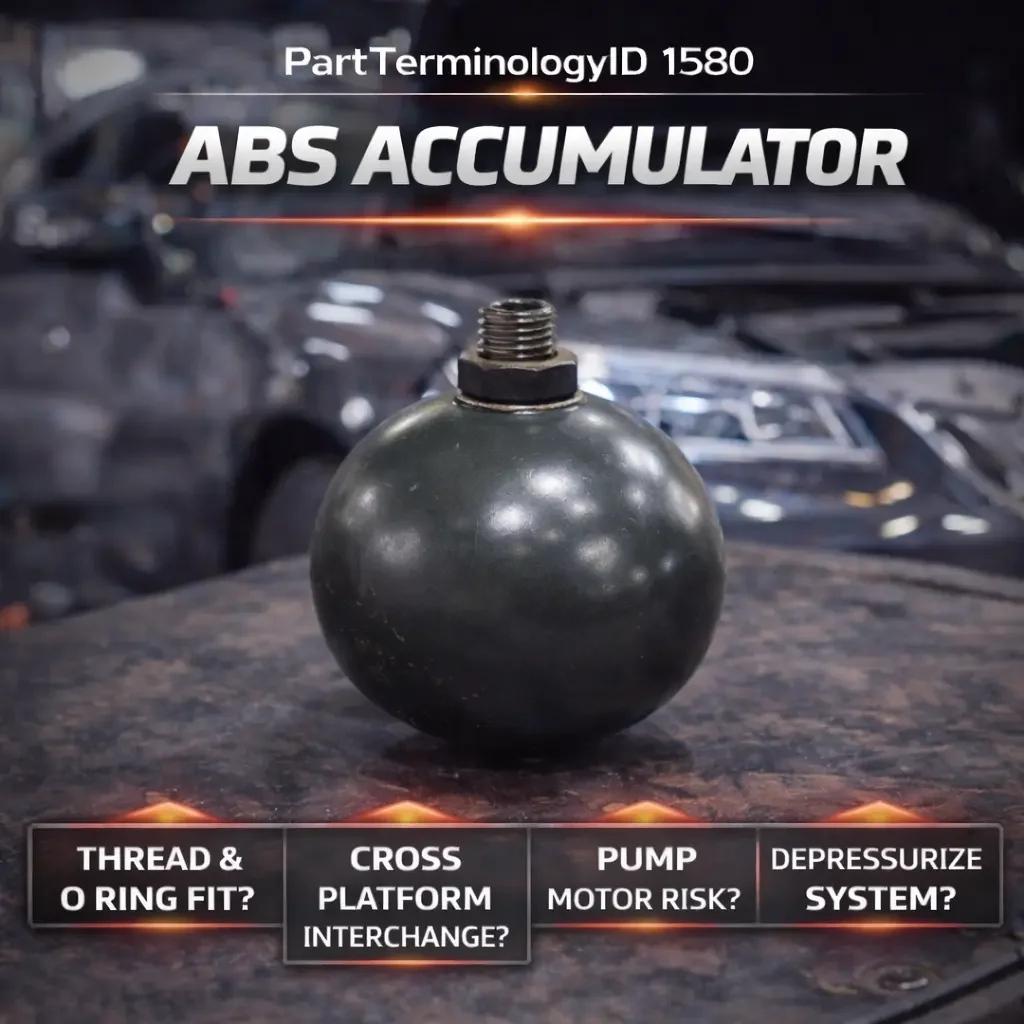
The ABS accumulator is a pressurized hydraulic reservoir used in integral anti-lock brake systems to store brake fluid at extremely high pressure, typically between 2,000 and 2,600 PSI. It is a sealed metal canister (often spherical, which is why it is commonly called the "bomb" or "ball") containing a rubber bladder or diaphragm pre-charged with nitrogen gas. The bladder separates the nitrogen from the brake fluid. When the electric brake pump runs, it forces brake fluid into the accumulator, compressing the nitrogen bladder and storing hydraulic energy. When the driver presses the brake pedal, the stored pressure provides instant power-assisted braking without a traditional vacuum booster. The accumulator also provides the reserve pressure needed for the ABS hold-release-reapply cycle during anti-lock braking events.
This part is specific to integral ABS systems, primarily the Teves Mark II and related designs used on GM vehicles (Buick Riviera, Buick Reatta, Cadillac Eldorado, Cadillac Seville, Oldsmobile Toronado), Ford vehicles (Thunderbird, Lincoln Continental, Lincoln Mark VII, Mercury Cougar), some European vehicles (Saab 900, Saab 9000, Volvo 480, Jaguar XJ6), and certain other applications from the mid-1980s through the mid-1990s. These systems replaced the conventional vacuum brake booster entirely with an electric pump and accumulator. Most modern ABS systems (Bosch 5.x, 8.x, Teves Mark IV, Mark 20, and later) are non-integral systems that use a conventional vacuum booster for power assist and do not have a high-pressure accumulator. This means the ABS accumulator is overwhelmingly a maintenance and replacement part for vehicles that are now 30 to 40 years old.
The catalog challenge is not complexity. It is safety, availability, and cross-reference. The accumulator operates at pressures that can cause serious injury if the system is not depressurized before service. The OEM parts are largely discontinued. Cross-compatible accumulators from other vehicle platforms are the most common sourcing method. And the buyer who needs this part is almost always dealing with a brake system that has already degraded to a dangerous condition.
This post is built for aftermarket catalog teams, marketplace sellers, and buyers who need to find, list, and install the correct accumulator safely.
Status in New Databases
Status in New Databases
Current: PIES 7.2 + PCdb Future: PIES 8.0 + PCdb 2.0 Status: No change
What ABS Accumulator Means in the Aftermarket
ABS Accumulator (PartTerminologyID 1580) refers to the high-pressure hydraulic accumulator used in integral ABS brake systems to store pressurized brake fluid for power-assisted braking and ABS modulation. This is the accumulator only, not the pump, not the master cylinder, not the ABS control module, and not the hydraulic control unit.
In catalog reality, this covers a narrow but critical range of products:
OEM accumulator. The original equipment accumulator specified for a given vehicle application. On most vehicles that used integral ABS, the OEM accumulator is discontinued by the vehicle manufacturer. New old stock (NOS) accumulators are occasionally available but increasingly rare and expensive.
Aftermarket replacement accumulator. A new accumulator manufactured to match the OEM specifications for thread size, pressure rating, bladder capacity, and physical dimensions. These are the primary aftermarket product in this category. Suppliers like Dorman, Cardone, and some specialty brake companies offer replacements for the most common applications.
Cross-compatible accumulator. Because the Teves Mark II system was used across multiple vehicle manufacturers, the accumulator from one vehicle platform may physically fit and function correctly on another. A GM accumulator may be interchangeable with a Ford or Jaguar accumulator if both use the same Teves unit. The thread size, O-ring seat, and pressure specification must match. Cross-referencing across platforms is the most common sourcing strategy for this part, especially for less common applications where a direct-fit aftermarket replacement does not exist.
Remanufactured or reconditioned accumulator. Some specialty suppliers offer accumulators that have been disassembled, fitted with a new bladder, recharged with nitrogen, and pressure-tested. Availability is limited and the buyer should verify the recharge pressure and bladder material.
Used / salvage accumulator. A used accumulator from a salvage vehicle. This is the highest-risk option. The bladder deteriorates with age regardless of mileage. A used accumulator from a 1990s vehicle may already have a failed bladder even if the vehicle it came from had low mileage. The nitrogen charge permeates through the rubber over time. A salvage accumulator may provide a few months of function before failing the same way the buyer's original accumulator failed.
What this part does NOT cover
ABS Pump / Motor. The electric motor and pump assembly that pressurizes the brake fluid and charges the accumulator. Different component, often sold separately or as a pump-and-motor assembly.
ABS Control Module. The electronic control unit that manages the ABS system. Different PartTerminologyID.
ABS Hydraulic Unit / Modulator. The valve body that directs pressurized fluid to individual wheel brakes during ABS operation. On integral systems, the hydraulic unit is integrated with the master cylinder. Different component.
Master Cylinder. On integral ABS systems, the master cylinder is part of the hydraulic unit assembly. On non-integral systems, the master cylinder is a conventional separate component with no accumulator.
Brake Booster / Vacuum Booster. Integral ABS systems do not use a vacuum booster. The accumulator replaces this function. On non-integral systems that do have an accumulator (rare), the vacuum booster still provides primary power assist.
Pressure Switch. The switch mounted on or near the accumulator that monitors system pressure and signals the pump to turn on when pressure drops below the low threshold (approximately 2,000 PSI) and off when it reaches the high threshold (approximately 2,600 PSI). Sold separately.
How the ABS Accumulator Works
The accumulator is a sealed steel sphere or canister. Inside, a thick rubber bladder divides the interior into two chambers. One chamber is pre-charged with nitrogen gas at a specific pressure (typically around 750 PSI on Teves Mark II systems, though this varies by application). The other chamber connects to the brake hydraulic circuit.
When the ignition is turned on, the ABS pump runs and forces brake fluid into the accumulator's hydraulic chamber. The incoming fluid compresses the nitrogen bladder, storing energy. The pump runs until the pressure switch detects that system pressure has reached the upper threshold (approximately 2,600 PSI), at which point the pump shuts off.
When the driver presses the brake pedal, the compressed nitrogen bladder pushes brake fluid out of the accumulator and into the brake circuit, providing power-assisted braking. Each pedal application uses some of the stored pressure. After several pedal applications (typically 10 or more with a healthy accumulator), the pressure drops to the lower threshold and the pump runs briefly to recharge.
During an ABS event, the ABS control module commands solenoid valves in the hydraulic unit to rapidly release and reapply pressure to individual wheel brakes. The accumulator provides the reserve pressure for this rapid cycling. Without adequate accumulator pressure, the ABS system cannot modulate braking effectively.
The critical safety implication: when the accumulator is fully charged, it contains brake fluid at up to 2,600 PSI. This pressure must be relieved before any service work on the brake system. The standard depressurization procedure is to turn the ignition off (or disconnect the battery to prevent the pump from running), then pump the brake pedal 25 to 40 times until a significant increase in pedal effort is felt.
Why ABS Accumulators Are Replaced
Nitrogen permeation through the bladder
The most common failure mode. Over time (typically 8 to 15 years), the nitrogen gas permeates through the rubber bladder material. The nitrogen charge decreases. The bladder loses its ability to maintain pressure on the brake fluid. The accumulator can no longer store adequate reserve pressure. This is a gradual failure. The system still works, but the pump runs more and more frequently as the accumulator holds less and less charge. Eventually the system cannot maintain minimum operating pressure.
Bladder rupture
The rubber bladder tears or ruptures. When this happens, the nitrogen charge is lost entirely and the nitrogen mixes with the brake fluid. The accumulator becomes a simple empty chamber with no pressure storage capability. The pump runs every time the brake pedal is pressed, and the system may not maintain adequate pressure under repeated or rapid braking. The BRAKE and ABS warning lights illuminate.
Seal failure at the accumulator-to-pump interface
The accumulator screws into the pump or hydraulic unit body with an O-ring seal. Over time, the O-ring degrades, and pressurized brake fluid leaks at the connection point. This can present as a visible fluid leak, a persistent low-fluid warning, or an inability to maintain system pressure.
Pump burnout caused by accumulator failure
This is a secondary failure. When the accumulator cannot hold pressure, the pump must run constantly or nearly constantly to maintain system pressure. The pump is designed to run in brief cycles, not continuously. Extended run times overheat the pump motor and eventually burn it out. The buyer then needs both the accumulator and the pump, which significantly increases the repair cost.
Age
Virtually all remaining accumulators in service are 25 to 40 years old. The rubber bladder has a finite service life regardless of use. Even a vehicle that has been stored or driven very little will have an accumulator with a deteriorated bladder simply due to age and nitrogen permeation.
Fitment Variables
ABS system type and manufacturer
The accumulator must match the specific integral ABS system on the vehicle. Teves Mark II is the most common, but there are variations. The thread size, O-ring size, and pressure specification differ between system variants. A Teves Mark II accumulator is not interchangeable with a Bosch system accumulator, even if the physical size appears similar.
Thread size and O-ring
The accumulator screws into the pump body or hydraulic unit. The thread pitch and diameter must match exactly. The O-ring that seals the connection must also match. A replacement accumulator should include the O-ring or specify the O-ring size so the buyer can source it separately.
Nitrogen pre-charge pressure
The nitrogen pre-charge in the bladder must match the system specification. An accumulator pre-charged to 750 PSI for a GM Teves application may not be correct for a Ford Teves application if the pressure specification differs. Using an accumulator with the wrong pre-charge can result in incorrect pump cycling, reduced braking performance, or premature pump failure.
Physical size and mounting clearance
The accumulator is a sphere or canister that protrudes from the pump or hydraulic unit in the engine compartment. The physical size must fit within the available clearance. Cross-compatible accumulators from other platforms may have a slightly different diameter or overall length. A slightly smaller accumulator (such as a Bosch unit used in place of a larger OEM unit) will physically fit but will hold less reserve pressure, causing the pump to cycle more frequently.
Cross-reference compatibility
Because OEM accumulators are largely discontinued, cross-referencing across vehicle platforms is essential. The listing should include all known compatible applications: "Fits GM Teves Mark II systems used on 1986-1993 Buick Riviera, 1988-1991 Buick Reatta, 1986-1993 Cadillac Eldorado, 1986-1993 Cadillac Seville, 1986-1993 Oldsmobile Toronado. Also compatible with Ford Teves Mark II systems (verify thread size)."
Top Return Causes
1) Accumulator does not solve the problem because the pump has already failed
The accumulator was the original failure, but by the time the buyer replaces it, the pump motor has burned out from overwork. The new accumulator is installed, the ignition is turned on, and the pump does not run. The system still has no pressure. The buyer returns the accumulator thinking it is defective.
Prevention: Include a diagnostic note: "Before replacing the accumulator, verify that the ABS pump motor runs when the ignition is turned on. If the pump does not run, the pump motor, relay, or pressure switch may also need replacement. A failed accumulator can cause pump motor burnout from extended run times."
2) O-ring not included or wrong size
The accumulator arrives without the O-ring seal. The buyer reuses the old O-ring, which leaks. Or the buyer cannot find the correct O-ring and cannot complete the installation.
Prevention: "Includes O-ring seal" or "O-ring not included. Required O-ring size: [specify]." Include the O-ring specification in the listing.
3) Wrong thread size for the application
Buyer orders a cross-compatible accumulator from a different platform, but the thread pitch does not match their pump body.
Prevention: Thread size in the specifications. Cross-reference chart listing which vehicle applications use which thread size. "This accumulator uses [X]mm thread with [Y] pitch. Verify compatibility with your pump body before ordering."
4) Used accumulator fails shortly after installation
Buyer purchases a salvage accumulator that appears functional but has a degraded bladder. The system works for a few weeks, then the same symptoms return.
Prevention: If selling used or salvage accumulators, disclose the age and the inherent risk: "Used accumulators may have reduced bladder life due to age-related nitrogen permeation. New or remanufactured accumulators are recommended for long-term reliability."
5) System not depressurized before installation, resulting in injury or fluid spray
Buyer attempts to unscrew the old accumulator without depressurizing the system. Brake fluid at 2,000+ PSI sprays from the connection.
Prevention: Safety warning in the listing, installation instructions, and any included documentation: "WARNING: The ABS system operates at pressures up to 2,600 PSI. Depressurize the system before removing the accumulator. Turn ignition off and disconnect the battery. Pump the brake pedal 25 to 40 times until a significant increase in pedal effort is felt. Failure to depressurize may result in serious personal injury."
Compatibility Checklist for Buyers
1) Confirm the vehicle has an integral ABS system with a high-pressure accumulator. Most vehicles with ABS built after the mid-1990s use non-integral systems that do not have an accumulator.
2) Identify the ABS system type. Teves Mark II is the most common for this part. Check the service manual or identify the system by the presence of a spherical accumulator ("bomb") on the hydraulic unit in the engine compartment.
3) Verify thread size and O-ring compatibility. Match to the pump body. If using a cross-compatible accumulator from another platform, confirm the thread interface.
4) Check the pump motor before ordering the accumulator. If the pump does not run, replacing the accumulator alone will not restore braking. Test the pump relay, fuse, pressure switch, and motor.
5) Plan for system depressurization and brake bleeding. Depressurize before removal. Bleed the system after installation per the manufacturer's procedure.
6) Confirm full vehicle details. Year, make, model, submodel. ABS system type. OEM part number cross-reference.
Catalog Checklist for Attributes
Core taxonomy: Product form: new aftermarket accumulator, remanufactured accumulator, NOS OEM accumulator, used/salvage accumulator. ABS system type: Teves Mark II, Teves Mark IV, Bosch, other (specify). Separate from ABS Pump/Motor, ABS Control Module, ABS Hydraulic Unit, Master Cylinder, Pressure Switch, and Brake Booster.
Fitment: Year, make, model, submodel. ABS system manufacturer and version. Thread size and pitch. Cross-compatible vehicle applications. OEM part number cross-reference (include all known OEM and cross-reference numbers across platforms).
Specifications: Nitrogen pre-charge pressure (PSI or bar). Operating pressure range (low and high thresholds). Physical dimensions (diameter, overall length). Thread size.
Included components: O-ring seal (yes/no, with size if not included). Installation instructions or safety warnings.
Safety warnings: High-pressure system depressurization required before service. Specific depressurization procedure (number of pedal pumps, battery disconnect).
Images: Accumulator from multiple angles, thread interface visible, O-ring seat visible, size reference (comparison to known object or dimensional callout).
FAQ
What is the "black bomb" on my brake system?
The black spherical object on the ABS hydraulic unit is the ABS accumulator. It stores pressurized brake fluid for power-assisted braking. It is specific to integral ABS systems (primarily Teves Mark II) used on certain GM, Ford, Saab, Jaguar, and Volvo vehicles from the mid-1980s through the mid-1990s.
My ABS pump runs every time I press the brake pedal. Is it the accumulator?
Most likely. A healthy accumulator stores enough pressure for 10 or more pedal applications before the pump needs to recharge. If the pump runs on every pedal press, the accumulator's nitrogen bladder has likely permeated or ruptured and is no longer holding reserve pressure. Replace the accumulator and verify the pump motor is in good condition.
Can I drive with a failed ABS accumulator?
The brakes will still function, but with significantly reduced power assist. The brake pedal will be very hard and require much more force to achieve adequate braking. The ABS function may also be degraded or nonfunctional. Additionally, a failed accumulator forces the pump to run excessively, which can burn out the pump motor and create a much more expensive repair. A failed accumulator should be replaced promptly.
Do I need to depressurize the system before replacing the accumulator?
Yes. This is a critical safety step. The system operates at pressures up to 2,600 PSI. Turn the ignition off and disconnect the battery negative terminal so the pump cannot activate. Then pump the brake pedal 25 to 40 times until you feel a significant increase in pedal resistance. Continue for 5 to 10 additional pumps after the pedal becomes hard. Only then should you remove the accumulator.
My vehicle's OEM accumulator is discontinued. What are my options?
Cross-reference the accumulator across other vehicle platforms that used the same ABS system. The Teves Mark II was used on multiple GM, Ford, and European vehicles, and accumulators are often interchangeable if the thread size and O-ring match. Some specialty suppliers also offer new aftermarket or remanufactured accumulators for common applications. Check both OEM and aftermarket part numbers across all known compatible platforms.
Final Take for Aftermarket Teams
ABS Accumulator (PartTerminologyID 1580) is a niche part for a shrinking population of vehicles, but it is a safety-critical component that generates high urgency when it fails. The buyer who needs this part is dealing with a brake pedal that is dangerously hard, warning lights that are on, and a pump that is working itself to death. The OEM parts are largely gone. The catalog teams that serve this buyer effectively do three things: publish comprehensive cross-reference tables across all vehicle platforms that share the same Teves or Bosch integral ABS system, include the O-ring and thread specification so the buyer can verify compatibility before ordering, and print the depressurization safety warning prominently in the listing and in any included documentation. The part costs $75 to $300. The pump motor it protects costs $200 to $600. The listing that gets the right accumulator to the buyer before the pump burns out saves the buyer the cost of the entire hydraulic assembly.