
Window Crank Handle (PartTerminologyID 1576): The Interior Handle That Opens Manual Windows and Ships With the Wrong Spline Depth More Often Than Any Other Interior Trim Part
Written by Arthur Simitian | PartsAdvisory
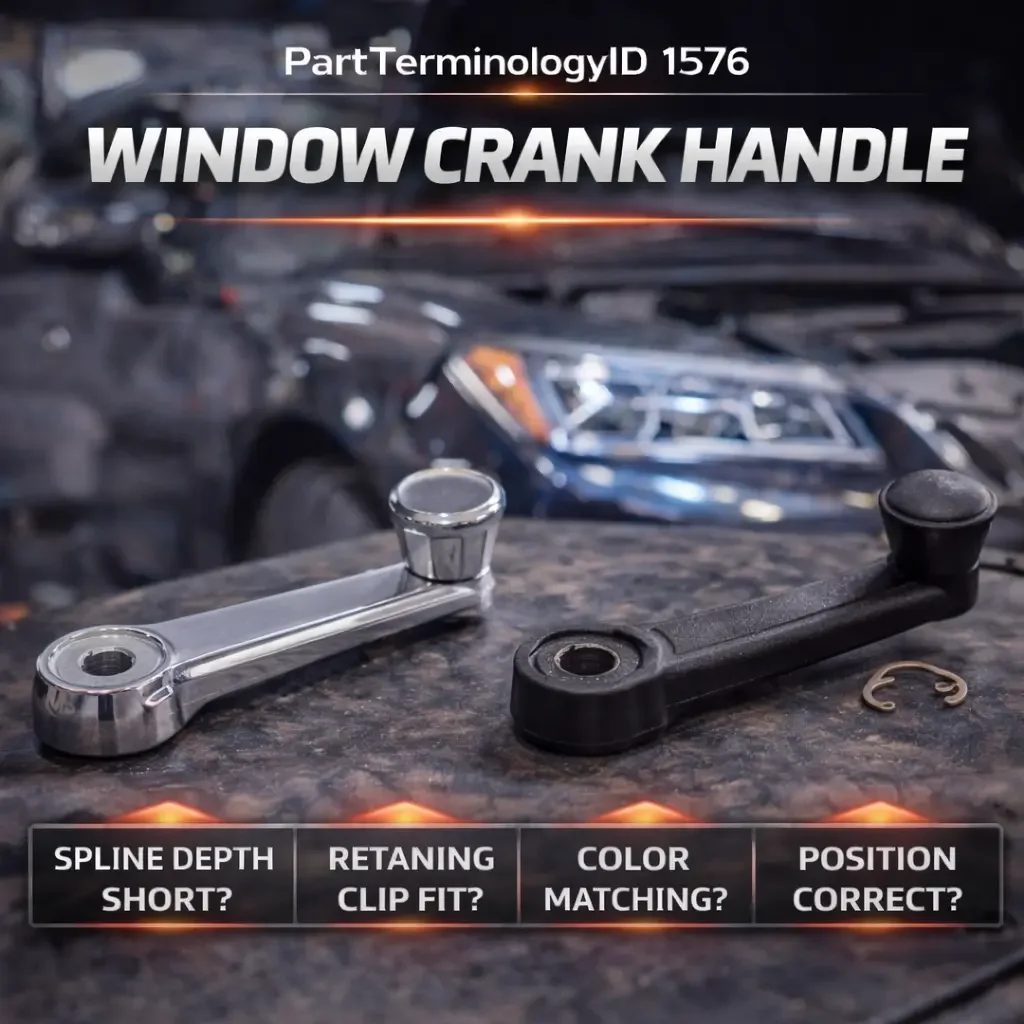
The window crank handle is the interior handle the driver or passenger turns to raise and lower a manual (non-power) window. It mounts to a splined shaft on the window regulator mechanism inside the door. The handle is retained on the shaft by a spring clip (sometimes called a C-clip, horseshoe clip, or Jesus clip because it disappears the moment it is removed), a retaining pin, or in some applications a screw.
This is one of the simplest parts in the vehicle. It is a handle with a splined bore and a grip knob. It costs $5 to $25 in most applications, with chrome or billet custom versions reaching $40 to $80. It requires no electrical connection, no programming, and no special tools beyond a clip removal tool or a shop rag to pop the retaining clip off.
And yet it generates a disproportionate number of returns for one specific reason: the spline interface between the handle and the regulator shaft does not engage properly on many aftermarket replacement handles. The splines are too shallow, the retaining clip groove is in the wrong position, or the bore depth is incorrect. The handle slides onto the shaft, appears to be installed, and then pops off the first time the buyer tries to crank the window. This is not a new problem. It has been documented in enthusiast forums for decades, particularly on GM vehicles from the 1950s through the 1990s where reproduction handles are widely available but inconsistently manufactured.
This post is built for aftermarket catalog teams, marketplace sellers, and buyers who want to get the right handle on the first order.
Status in New Databases
Status in New Databases
Current: PIES 7.2 + PCdb Future: PIES 8.0 + PCdb 2.0 Status: No change
What Window Crank Handle Means in the Aftermarket
Window Crank Handle (PartTerminologyID 1576) refers to the interior handle that the occupant turns to operate a manual window regulator. This is the handle only, not the regulator, not the door panel, and not the retaining clip (though the clip is often included).
In catalog reality, this covers several product forms:
Direct replacement OEM-style handle. Molded plastic or die-cast metal handle designed to match the original equipment handle in appearance, color, spline pattern, and clip groove location. This is the most common product in the category. Available for front left, front right, rear left, and rear right positions, though on many vehicles all four positions use the same handle.
Universal handle. A generic handle designed to fit multiple vehicle makes and models. Typically includes an adapter bushing or multiple spline inserts to accommodate different shaft sizes. Universal handles solve the availability problem for obscure applications but introduce a fitment risk because the adapter may not engage the shaft as securely as a direct-fit handle.
Chrome or custom handle. Aftermarket handles in chrome, billet aluminum, or other finishes designed as a visual upgrade. Common in the classic car, hot rod, and truck customization market. These must still match the shaft spline pattern and clip groove location to function correctly.
Reproduction (repro) handle. Handles manufactured to replicate a discontinued OEM design, typically for classic and vintage vehicles. This is where the spline depth and clip groove problems are most prevalent. The exterior appearance may be an excellent match for the original, but the internal bore geometry does not always engage the regulator shaft reliably.
Handle knob only. On some handles, the grip knob (the round piece the fingers wrap around) is a separate component that press-fits or screws onto the handle arm. When the knob breaks or falls off, it can be replaced independently without replacing the entire handle. Dorman and other suppliers list the knob as a separate part number.
What this part does NOT cover
Window Regulator. The mechanism inside the door (scissor-type or cable-type) that moves the window glass up and down. The handle operates the regulator but is not the regulator. Different PartTerminologyID.
Power Window Switch. On vehicles with power windows, there is no crank handle. The switch replaces this function entirely. Different PartTerminologyID.
Window Crank Handle Retaining Clip. The spring clip that holds the handle on the shaft. Often included with the handle, but also sold separately. Some suppliers list it under its own part number.
Door Panel / Door Trim Panel. The interior trim panel the handle protrudes through. The handle mounts through or against the panel but is not the panel.
Vent Window Crank Handle. On older vehicles with pivoting vent windows (wing windows), a separate smaller crank may be used for the vent window. Verify which handle the buyer needs.
The Spline Engagement Problem
This is the central quality and fitment issue in the category and the primary driver of returns.
The window crank handle has a splined bore that must mate precisely with the splined shaft on the window regulator. The engagement depends on three dimensions: the spline diameter (number and size of the spline teeth), the spline depth (how far the teeth extend into the bore), and the retaining clip groove position (how deep the handle seats on the shaft before the clip locks it in place).
On OEM handles, these dimensions are precise. The handle slides onto the shaft, the clip snaps into the groove, and the handle is locked firmly with zero play.
On many aftermarket and reproduction handles, the spline teeth inside the bore do not extend deep enough, or the bore is chamfered in a way that prevents full engagement. The handle appears to install correctly. The clip may even snap into place. But the spline engagement is insufficient. When the buyer applies torque to crank the window, the handle slips, wobbles, or pops off the shaft entirely.
This problem is especially well documented on GM vehicles from the 1950s through the 1990s. The spline pattern on GM window regulator shafts was consistent across many models and decades, making it a popular application for reproduction handles. But the reproduction tolerances have been inconsistent across multiple suppliers, leading to widespread complaints about handles that look correct but do not stay on the shaft.
The catalog consequence: The buyer orders a handle that matches the vehicle application, installs it, and it fails immediately. The buyer returns the handle. If the listing does not address spline engagement quality, the seller absorbs the return cost on a low-margin part.
Catalog solution: Listings should specify whether the handle is an OEM part, a direct replacement with OEM-matched spline geometry, or a reproduction with cosmetic-match priority. If the handle includes an upgraded or reinforced spline bore, this should be called out. Including a note about the retaining clip groove position relative to OEM can help set expectations.
Why Window Crank Handles Are Replaced
Broken handle arm
The most common reason. The driver applies force to raise or lower the window and the handle arm snaps, usually at the base where it meets the splined hub. Plastic handles on daily-driven vehicles are the most susceptible, especially in hot climates where the plastic becomes brittle over time.
Broken or missing knob
The grip knob at the end of the handle cracks, breaks off, or falls off. The handle arm is still functional but uncomfortable or difficult to grip. On some handles the knob can be replaced independently.
Lost retaining clip
The retaining clip is removed during door panel work (speaker replacement, lock repair, regulator replacement) and lost. Without the clip, the handle slides off the shaft. The buyer may need the clip only, not a new handle, but if the clip is not sold separately they must purchase a handle-and-clip set.
Cosmetic damage or fading
On restored or customized vehicles, the original handles may be faded, scratched, pitted (on chrome handles), or visually mismatched after a partial interior restoration. Replacement is cosmetic rather than functional.
Conversion from power to manual windows
On some project vehicles or custom builds, the owner converts from power windows to manual windows. This requires adding a manual regulator and a crank handle where none existed. The handle must match the regulator shaft spline pattern.
Stripped splines on handle or shaft
Repeated use with a loose or poorly fitting handle can strip the splines on the handle bore, the regulator shaft, or both. Once the splines are stripped, no amount of clip tension will keep the handle engaged. The handle must be replaced, and in severe cases the regulator shaft must also be replaced.
Fitment Variables
Spline pattern and diameter
The number of spline teeth and the shaft diameter vary by manufacturer and era. GM, Ford, Chrysler, and import vehicles use different spline configurations. A GM handle will not fit a Ford shaft. Within GM, the spline pattern was relatively consistent from the 1960s through the 1990s, but earlier vehicles and later vehicles may differ.
Retaining method
Handles are retained by one of three methods: spring clip (C-clip that snaps into a groove on the shaft), friction fit with a set screw, or a through-pin. The handle must be designed for the correct retaining method.
Handle length and offset
The distance from the center of the splined hub to the center of the grip knob varies by application. A handle that is too long or too short may interfere with the door panel, the armrest, or the door trim. On some vehicles, the front and rear handles are different lengths.
Color and finish
OEM handles match the interior color of the vehicle. Common colors include black, gray, tan, beige, brown, and white. Chrome handles are used on some trucks and classic vehicles. The listing should specify the color. A black handle on a tan interior is a visible mismatch that generates returns even though the handle functions correctly.
Left vs. right, front vs. rear
On many vehicles, all four window positions use the same handle. On others, the front handles differ from the rear handles (different length, different angle), or the left and right handles are mirror images. The listing must specify the position.
Knob style
The grip knob may be round, oval, or contoured. On some handles the knob is a separate press-fit piece. On others it is molded as part of the handle. If the buyer is matching an existing set (replacing one broken handle while the other three are original), the knob style must match.
Top Return Causes
1) Handle splines do not engage shaft properly
The handle slides on but wobbles, slips under torque, or pops off when cranking the window. The spline bore is too shallow or the clip groove is mispositioned.
Prevention: Specify spline engagement quality in the description. If the handle is a reproduction, note this. If the handle has been engineered with deeper splines or improved bore geometry relative to common reproductions, call this out. "Splines extend to full depth of bore for positive engagement with OEM regulator shaft."
2) Wrong color
Handle functions correctly but does not match the vehicle's interior color.
Prevention: Color in the title. Photo showing actual color (not a rendering). "Black" vs. "Gray" vs. "Tan" must be specified, not assumed.
3) Retaining clip not included or wrong size
Handle arrives without a retaining clip. Buyer cannot install it without a separate clip purchase.
Prevention: State "Retaining clip included" or "Retaining clip not included, sold separately." If included, specify the clip size.
4) Wrong position (front ordered, rear needed, or vice versa)
Front and rear handles are different lengths or angles on the buyer's vehicle.
Prevention: Position in the title: "Front" or "Rear" or "Front and Rear" or "All Positions." If all positions use the same handle, state that.
5) Handle length interferes with door panel or armrest
Handle is a universal fit and the arm is too long for the buyer's door panel cutout.
Prevention: Include handle length (center of hub to center of knob) in the specifications. OEM part number cross-reference.
Compatibility Checklist for Buyers
1) Confirm the spline pattern. Match the handle to the vehicle's window regulator shaft. OEM part number cross-reference is the most reliable method.
2) Confirm the retaining method. Spring clip, set screw, or through-pin.
3) Confirm position. Front, rear, or universal. Left, right, or both.
4) Confirm color and finish. Match to existing interior or desired upgrade.
5) Verify retaining clip is included or plan to order one separately.
6) If ordering a reproduction handle for a classic vehicle, check reviews and forums for spline engagement feedback specific to that supplier.
7) Confirm full vehicle details. Year, make, model, submodel, trim.
Catalog Checklist for Attributes
Core taxonomy: Product form: direct replacement handle, universal handle, chrome/custom handle, reproduction handle, knob only. Position: front left, front right, rear left, rear right, all positions. Separate from Window Regulator, Power Window Switch, Retaining Clip (if sold separately), and Door Panel.
Fitment: Year, make, model, submodel, trim. Position. OEM part number cross-reference.
Specifications: Handle material (plastic, die-cast metal, billet aluminum). Color/finish (black, gray, tan, chrome, etc.). Handle length (hub center to knob center). Spline count and diameter (if available). Retaining method (clip, screw, pin).
Included components: Retaining clip (yes/no). Friction washer or escutcheon (yes/no). Knob (integrated or separate).
Images: Handle from front and back, spline bore visible, retaining clip shown if included, color-accurate photo.
FAQ
Why does the replacement window crank handle keep popping off?
The most likely cause is insufficient spline engagement between the handle bore and the regulator shaft. Many aftermarket and reproduction handles have splines that are too shallow or a retaining clip groove that is positioned slightly too high, preventing the handle from seating deeply enough on the shaft. Compare the spline depth of the new handle to the original. If the original handle is still available and its splines are deeper, the replacement may not be a suitable match. Some owners have had success shimming the interface with aluminum foil around the splines as a temporary fix, but the correct solution is a handle with proper spline geometry.
Do I need a special tool to remove the window crank handle?
For clip-retained handles, a window crank handle removal tool (a flat, hooked tool that slides behind the handle to disengage the clip) makes the job much easier. In a pinch, a shop rag or thin cloth can be slid behind the handle and pulled back and forth to catch the clip edge and pop it free. For screw-retained handles, a screwdriver is all that is needed.
Are all the window crank handles on my vehicle the same part?
Not always. On many vehicles, all four positions use the same handle. On others, the front handles are longer than the rear handles, or the left and right handles are mirror images. Check the parts catalog for your specific vehicle before ordering.
The handle looks right but the retaining clip will not snap into place. What is wrong?
The clip groove on the regulator shaft and the clip groove inside the handle must align for the clip to seat. If the handle's bore depth is slightly off, the grooves will not align and the clip will not lock. This is the same spline depth issue described above. The handle may need to be seated more firmly (push it on harder) or the handle's bore geometry may simply not match the shaft.
Final Take for Aftermarket Teams
Window Crank Handle (PartTerminologyID 1576) is a low-cost, high-volume interior part where the primary return driver is not cosmetic mismatch or wrong application but manufacturing tolerance on the spline bore. The handle looks right, fits the application, and matches the color, but it does not stay on the shaft because the splines do not engage deeply enough. Catalog teams that reduce returns in this category do three things: specify the color in the title, state whether the retaining clip is included, and address spline engagement quality in the description, especially on reproduction handles for classic GM vehicles where this problem is most widespread. A $10 part with a $0 description improvement eliminates the most common return in the category.