
Written by Arthur Simitian | PartsAdvisory
The turn signal cam is the small, typically plastic component inside the steering column that automatically cancels the turn signal after the driver completes a turn. It is also commonly called the turn signal canceling cam, the turn signal cancel cam, or the self-canceling cam. It sits on or around the upper steering shaft, just below the steering wheel, and has one or two raised lobes (nubs, ridges, or protrusions) that physically interact with the turn signal switch mechanism as the steering wheel rotates back toward center after a turn. When the lobe contacts the switch's release lever, it pushes the turn signal stalk back to its neutral (off) position.
Every driver uses this part every time they make a turn. Almost no driver knows it exists until it breaks.
The turn signal cam is one of the least expensive parts in the steering column (typically $5 to $35 in the aftermarket, with some specialty or billet versions reaching $80). It is also one of the most frequently misdiagnosed. When turn signals stop canceling automatically, the buyer often assumes the turn signal switch (PartTerminologyID 1510, previously covered in this series) has failed. In many cases, the switch is fine. The cam is cracked, worn, or missing, and a $10 cam replacement solves the problem without replacing the $50 to $200 switch.
The other major issue with this part is aftermarket steering wheel fitment. When the factory steering wheel is replaced with an aftermarket wheel and adapter hub, the canceling cam's alignment with the turn signal switch can be thrown off entirely. The cam lobes no longer contact the switch at the correct point in the steering wheel's rotation. The signals either do not cancel at all, cancel only in one direction, or require more than a full turn of the wheel to cancel. This is not a defective cam. It is a clocking and alignment problem that the listing should address.
This post is built for aftermarket catalog teams, marketplace sellers, and buyers who want to correctly identify, list, and install this small but essential component.
Status in New Databases
Status in New Databases
Current: PIES 7.2 + PCdb Future: PIES 8.0 + PCdb 2.0 Status: No change
What Turn Signal Cam Means in the Aftermarket
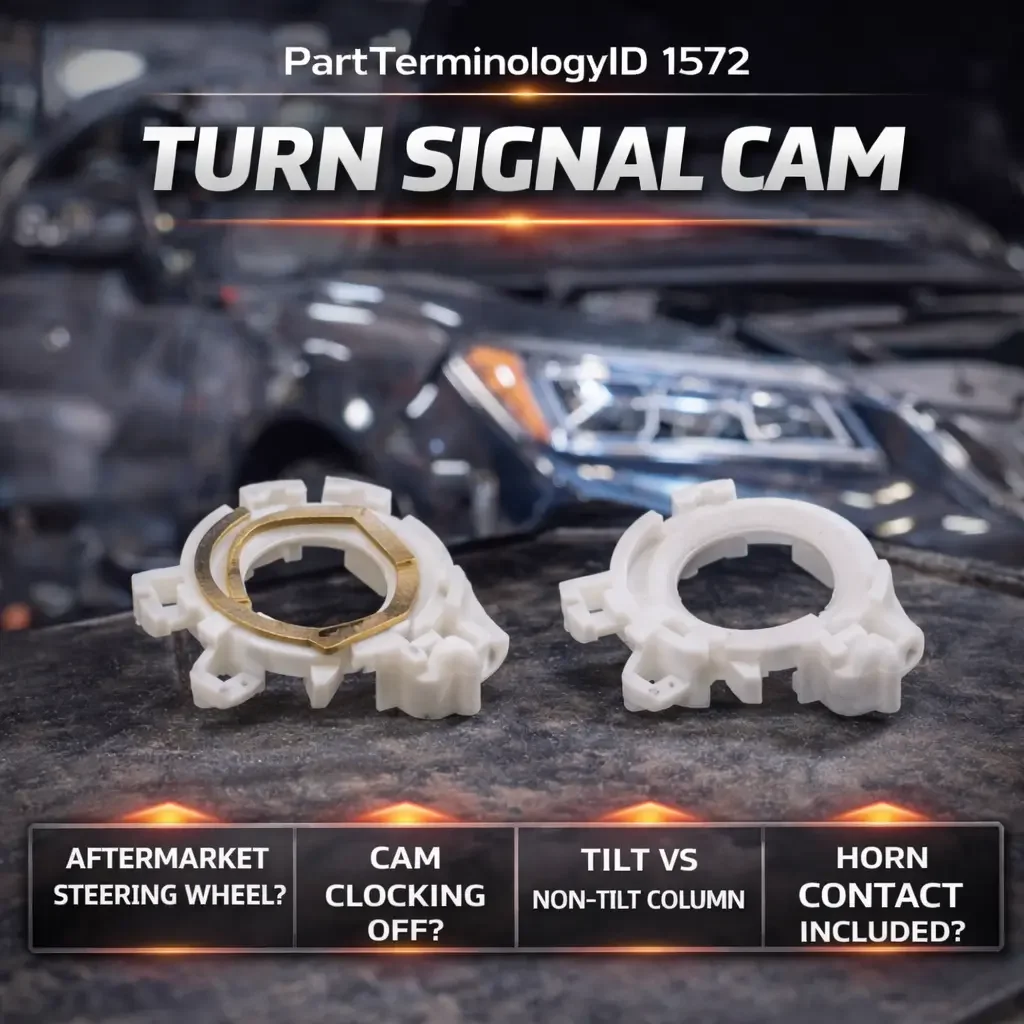
Turn Signal Cam (PartTerminologyID 1572) refers to the mechanical cam component that provides the automatic self-canceling function for the turn signal switch. This is the cam itself, not the turn signal switch, not the turn signal stalk, and not the clock spring.
In catalog reality, this covers a few different configurations:
Standalone canceling cam. The most common form in the aftermarket. A molded plastic piece (sometimes nylon, sometimes a harder engineering plastic) with one or two raised lobes and a center bore or keyed interface that fits over or around the upper steering shaft. On GM vehicles from the late 1960s through the 1990s, this is a well-known serviceable part. The cam rides on the shaft above the turn signal switch, held in place by a compression spring, a lock plate, and a retaining ring. On Ford trucks and Broncos from the 1960s through the 1980s, the canceling cam is a clip-style piece that mounts to the backside of the steering wheel itself rather than on the shaft.
Cam with horn contact. On many GM columns, the canceling cam also serves as the mounting point for the horn contact ring or horn wire contact. The cam has a molded pedestal or integrated brass contact that completes the horn circuit when the horn button is pressed. This means a worn or broken canceling cam can cause both a turn signal canceling failure and a horn failure simultaneously. Listings for these parts should state whether the horn contact is included.
Cam as part of a turn signal switch assembly. On some vehicles, the canceling cam is not sold separately. It is integrated into the turn signal switch assembly or the multi-function switch housing. In this case, the cam cannot be replaced independently and the entire switch must be replaced if the cam fails. The catalog should indicate whether the cam is a standalone part or only available as part of the switch assembly for a given application.
Billet or aftermarket performance cam. For hot rod, custom, and aftermarket steering column applications (IDIDIT, Flaming River, and similar), billet aluminum or reinforced canceling cams are available. These are designed to work with specific aftermarket column brands and may not be interchangeable with OEM columns.
What this part does NOT cover
Turn Signal Switch / Cruise Control / Tilt Lever (PartTerminologyID 1510). The multi-function switch assembly that the cam interacts with. Previously covered in this series. The cam cancels the switch; the cam is not the switch.
Clock Spring / Spiral Cable. The coiled ribbon cable inside the column that maintains electrical connections as the steering wheel rotates. Different component entirely, though it occupies a similar area of the column.
Steering Column (PartTerminologyID 1569). The full column assembly. The cam sits inside the column but is not the column. Previously covered.
Steering Wheel. The wheel the driver holds. On some Ford applications the canceling cam mounts to the back of the steering wheel, but the cam is not the wheel.
Steering Wheel Adapter / Hub Kit. The adapter that allows aftermarket steering wheels to mount to the column shaft. The adapter can affect cam alignment but is not the cam.
How the Turn Signal Canceling Cam Works
Understanding the mechanism is essential for catalog teams and sellers because most return and fitment issues stem from misunderstanding how this part functions.
When the driver moves the turn signal stalk up or down, a spring-loaded detent inside the switch holds the stalk in that position (left turn or right turn). The turn signal stays on.
The canceling cam is fixed in rotational alignment with the steering wheel. When the steering wheel turns, the cam turns with it. The cam has one or two raised lobes positioned so that as the wheel returns to center after a turn, a lobe contacts a release lever (sometimes called a canceling lever or canceling arm) on the turn signal switch.
The lobe pushes the release lever. The release lever disengages the spring-loaded detent that was holding the stalk in the turn position. The stalk snaps back to neutral. The turn signal turns off.
This is purely mechanical. There is no electrical component, no sensor, and no module involved in the canceling function on vehicles that use a traditional cam-based system. The cam is a shaped piece of plastic that physically bumps a lever at the right moment.
The critical requirement is alignment. The cam lobes must be clocked (rotationally positioned) so that they contact the release levers at the correct point in the steering wheel's rotation. If the cam is rotated even a small amount from its correct position, the signals may cancel too early, too late, only in one direction, or not at all.
On factory columns with factory steering wheels, the alignment is set at the factory and does not change unless the column is disassembled. On columns where the steering wheel has been removed and reinstalled (or replaced with an aftermarket wheel), the cam clocking must be verified.
Why Turn Signal Cams Are Replaced
Cracked or broken cam lobes
The most common failure. The cam is plastic and the lobes are the highest-stress point. Every time the turn signal cancels, the lobe impacts the release lever. Over tens of thousands of cycles, the lobe can crack, chip, or break off entirely. When one lobe breaks, the signal cancels in one direction but not the other. When both lobes break, the signal never cancels automatically.
Embrittlement from age and heat
The cam sits inside the steering column near the top of the dashboard, exposed to decades of heat cycling. Older nylon and plastic cams become brittle over time. A cam that has been in a column for 30 to 50 years may shatter during a routine steering wheel removal, leaving the owner with a canceling problem they did not have before the steering wheel was pulled.
Worn cam lobes
Even without cracking, the cam lobes wear down over high-mileage use. The lobe profile becomes rounded and shallow. The lobe still contacts the release lever but does not push it far enough to disengage the detent. The turn signal stalk moves slightly but does not fully return to neutral, or the signal cancels inconsistently.
Missing cam after steering wheel or column work
The cam is small and easy to lose during steering wheel removal, steering column disassembly, or column replacement. It can fall off the shaft, get stuck inside the column, or be left out during reassembly. The driver notices weeks later that the turn signals no longer cancel automatically.
Aftermarket steering wheel installation
When an aftermarket steering wheel and adapter hub are installed, the canceling cam may be left out (some adapter kits do not accommodate the OEM cam), or the cam may be present but misaligned relative to the new wheel. The aftermarket hub's bolt pattern or depth may position the cam lobes at a different rotational offset from where the turn signal switch expects them.
Horn contact failure (dual-function cams)
On GM columns where the canceling cam also carries the horn contact ring, corrosion or wear on the contact surface can cause horn failure. The driver replaces the cam to restore horn function and gets the turn signal canceling fix as a bonus, or vice versa.
Fitment Variables
Column manufacturer and design
The cam must match the steering column. GM, Ford, and Chrysler columns from different eras use different cam designs with different bore sizes, lobe profiles, lobe counts, and mounting methods. A GM canceling cam does not fit a Ford column. Within GM, tilt columns and non-tilt columns may use different cams.
Tilt vs. non-tilt column
On GM vehicles in particular, tilt and non-tilt steering columns use different canceling cam designs. The tilt mechanism changes the relationship between the steering shaft and the turn signal switch. The cam lobe geometry must account for this. A tilt-column cam installed on a non-tilt column (or vice versa) may not cancel correctly.
Shaft diameter and keying
The cam fits over or around the upper steering shaft. The shaft diameter and the keyway or spline interface must match. A cam with the wrong bore size will not seat properly on the shaft and may spin freely without rotating with the steering wheel, defeating its purpose entirely.
Horn contact inclusion
On GM columns where the cam carries the horn contact, the replacement cam must include the contact ring or contact button. A cam without the horn contact restores turn signal canceling but breaks the horn. A cam with the wrong contact type may not complete the horn circuit.
Aftermarket column brand compatibility
For IDIDIT, Flaming River, and other aftermarket column brands, the canceling cam must match the specific column model. These manufacturers sell their own canceling cams designed for their column geometry. An OEM cam will not fit an aftermarket column, and an IDIDIT cam will not fit a Flaming River column, even though they perform the same function.
Cam clocking position
The cam must be installed at the correct rotational position relative to the turn signal switch. On many GM columns, the standard position is approximately 10 to 11 o'clock when viewed from the top of the column. On Ford columns, the position is approximately 9 o'clock. If the cam is clocked incorrectly, the signals will not cancel symmetrically (one direction cancels, the other does not) or will require excessive steering wheel rotation to cancel.
Top Return Causes
1) Buyer replaced the turn signal switch when they only needed the cam
The turn signals stopped canceling. The buyer assumed the switch was bad and ordered a new turn signal switch (PartTerminologyID 1510) for $50 to $200. The switch was fine. The $10 cam was cracked. The buyer returns the switch after discovering the actual problem.
Prevention: Cross-reference PartTerminologyID 1572 in the Turn Signal Switch listing: "If your turn signals work when manually operated but do not cancel automatically after a turn, the issue may be the turn signal canceling cam (PartTerminologyID 1572), not the switch. Inspect the cam before replacing the switch."
2) Wrong cam for tilt vs. non-tilt column
Buyer has a tilt column but ordered the non-tilt cam, or vice versa.
Prevention: Column type (tilt or non-tilt) in the title or the first line of fitment details.
3) Cam does not include horn contact (GM applications)
Buyer installs the new cam and the turn signals cancel correctly, but the horn no longer works. The replacement cam did not include the horn contact ring that the old cam had.
Prevention: State whether the horn contact is included: "Includes horn contact ring" or "Horn contact not included - transfer from existing cam or order separately."
4) Cam does not fit aftermarket steering column
Buyer has an IDIDIT or Flaming River aftermarket column and ordered an OEM GM cam. The bore, lobe profile, and mounting interface do not match.
Prevention: Specify which column brands and models the cam fits. "Fits GM factory steering columns, 1969-1996. Does not fit IDIDIT, Flaming River, or other aftermarket columns."
5) Cam installed at wrong clocking position
Buyer installs the cam correctly on the shaft but at the wrong rotational position. Turn signals cancel in one direction but not the other, or require excessive wheel rotation.
Prevention: Include clocking instructions or a reference to the column manufacturer's installation guide. "Install with cam lobes at approximately the 10 o'clock position when viewed from above. Verify alignment with the turn signal switch before installing the steering wheel."
Compatibility Checklist for Buyers
1) Confirm the cam is the problem. If turn signals activate correctly when the stalk is moved but do not cancel automatically when the steering wheel returns to center, the cam is the likely cause. Inspect the cam for cracked, worn, or missing lobes before ordering a switch.
2) Confirm column type. Tilt or non-tilt. Factory or aftermarket. If aftermarket, confirm the column brand and model.
3) Confirm horn contact requirement. On GM columns, determine whether the canceling cam also serves as the horn contact. Order a cam with the correct contact configuration.
4) Confirm shaft diameter and keying. The cam must match the upper steering shaft bore and keyway.
5) Plan for cam clocking during installation. Know the correct rotational position for the cam before reinstalling the steering wheel. The factory service manual or column manufacturer's installation guide will specify this.
6) If installing an aftermarket steering wheel, verify that the adapter hub accommodates the canceling cam and does not change the cam-to-switch alignment. Some aftermarket hubs require the cam to be repositioned or replaced with a hub-specific cam.
7) Confirm full vehicle details. Year, make, model, submodel, trim. OEM part number cross-reference recommended.
Catalog Checklist for Attributes
Core taxonomy: Product form: standalone canceling cam, cam with horn contact, cam as part of turn signal switch assembly, billet/aftermarket performance cam. Column type: tilt or non-tilt. Column origin: factory or aftermarket (specify brand). Separate from Turn Signal Switch (1510), Clock Spring, Steering Column (1569), Steering Wheel, and Steering Wheel Adapter Hub.
Fitment: Year, make, model, submodel, trim. Column type (tilt/non-tilt). Column brand (factory GM, factory Ford, factory Chrysler, IDIDIT, Flaming River, etc.). Shaft diameter. OEM part number cross-reference.
Included components: Cam body, horn contact ring (yes/no), compression spring (yes/no), retaining hardware (yes/no).
Installation notes: Correct cam clocking position (clock position reference). Steering wheel removal required (yes/no). Special tools required (lock plate compressor, retaining ring tool).
Images: Cam from top and bottom showing lobe profile and bore, horn contact surface (if applicable), cam installed on shaft (if possible), and reference image showing the cam's location within the column relative to the turn signal switch.
FAQ
Why did my turn signals stop canceling after I installed an aftermarket steering wheel?
The canceling cam must be clocked (rotationally aligned) with the turn signal switch for the signals to cancel correctly in both directions. When the factory steering wheel is removed and an aftermarket wheel with an adapter hub is installed, the cam's position relative to the switch can change. Remove the steering wheel, verify the cam is present and undamaged, and reposition it to the correct clock position (typically 9 to 11 o'clock depending on the column) before reinstalling the wheel.
Do I need to replace the turn signal switch if the signals do not cancel?
Not necessarily. If the turn signals work correctly when manually operated (stalk up for right, stalk down for left, and the signals illuminate properly) but do not return to the off position automatically after a turn, the canceling cam is the more likely cause. Inspect the cam for cracked or worn lobes before replacing the switch.
My horn stopped working at the same time the turn signal canceling stopped. Are they related?
On many GM steering columns, yes. The canceling cam also carries the horn contact. If the cam cracks or the horn contact surface corrodes, both functions fail simultaneously. Replacing the cam with one that includes the horn contact should restore both functions.
Can I install the canceling cam without removing the steering column?
In most cases, you need to remove the steering wheel and the lock plate retainer to access the cam, but you do not need to remove the entire column from the vehicle. The cam is at the top of the column, under the steering wheel. The job typically requires a steering wheel puller, a lock plate compressor tool, and a snap ring tool.
Final Take for Aftermarket Teams
Turn Signal Cam (PartTerminologyID 1572) is one of the cheapest parts in the steering column and one of the most frequently misdiagnosed. When turn signals stop canceling, the buyer's first instinct is to replace the turn signal switch (PartTerminologyID 1510). Catalog teams that cross-reference the cam in their switch listings and include a one-line diagnostic note ("If signals work manually but do not cancel automatically, inspect the canceling cam first") save their buyers unnecessary switch purchases and reduce returns on the higher-cost part. The cam itself needs three things in the listing to prevent returns: tilt versus non-tilt, horn contact included or not, and a clocking position reference for installation. A $10 to $35 part with three attributes clearly stated in the description generates near-zero returns and high buyer satisfaction.