
Written by Arthur Simitian | PartsAdvisory
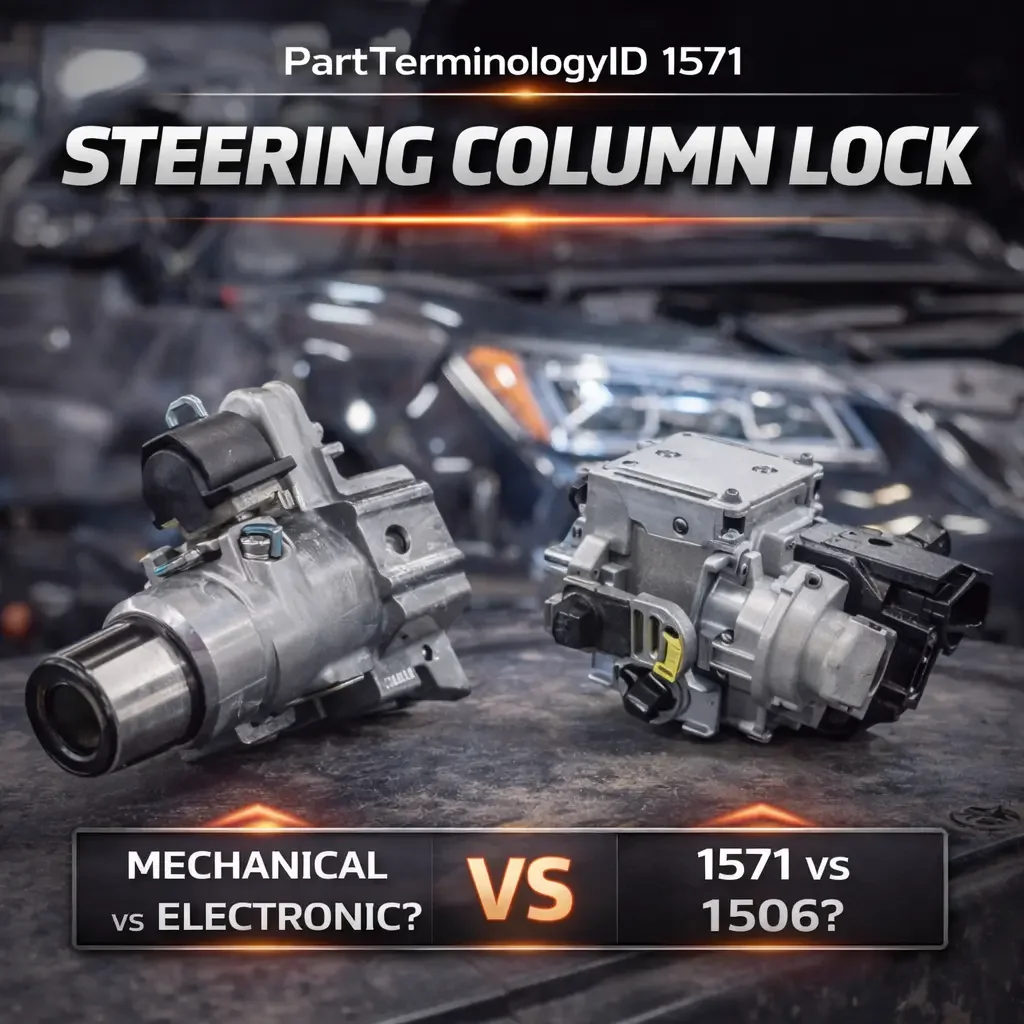
The steering column lock is the physical anti-theft mechanism that prevents the steering wheel from rotating when the vehicle is off. It is a locking bolt or pin that engages with a slot or set of teeth machined into the steering shaft or column tube. When the ignition key is removed (on mechanical systems) or when the vehicle is powered off (on electronic systems), this bolt extends into the shaft and physically immobilizes the steering wheel. When the correct key is inserted or the correct key fob is authenticated, the bolt retracts and the steering wheel turns freely.
This is a federally and internationally mandated anti-theft feature. European Commission Directive 95/56/EC requires all vehicles sold in Europe to have a steering lock capable of withstanding 100 Nm of force applied to the steering wheel. GM introduced steering column locks across its product line in 1969. Ford, Chrysler, and AMC followed in 1970. Nearly every passenger vehicle sold since then has one.
The catalog problem with this part is not complexity. It is identity. Steering Column Lock (PartTerminologyID 1571) is confused with Steering Column Lock Actuator (PartTerminologyID 1506) constantly - by buyers, by sellers, and sometimes by catalog teams. The lock is the mechanism (the bolt, the housing, the spring, the engagement interface). The actuator is the device that moves the lock (the electric motor, the solenoid, the gear train, the control module). They are related but they are not the same part, they often fail independently, and they are cataloged under different PartTerminologyIDs for exactly this reason.
This post is built for aftermarket catalog teams, marketplace sellers, and buyers who want to list, find, and order the correct part the first time.
Status in New Databases
Status in New Databases
Current: PIES 7.2 + PCdb Future: PIES 8.0 + PCdb 2.0 Status: No change
What Steering Column Lock Means in the Aftermarket
Steering Column Lock (PartTerminologyID 1571) refers to the physical locking mechanism that prevents steering wheel rotation when the vehicle is not in operation. This is the lock itself - not the actuator, not the ignition lock cylinder, not the column assembly.
In catalog reality, this covers two fundamentally different system types:
Mechanical steering column lock. Found on vehicles with traditional key ignition. The lock mechanism is integrated into or adjacent to the ignition lock cylinder housing. When the key is removed, a spring-loaded lock bolt (sometimes called a lock bar or lock pin) extends from the housing into a slot or groove in the steering shaft. The key's removal allows the bolt to travel into the engaged position. Inserting and turning the correct key retracts the bolt. This design has been standard since the early 1970s. On many vehicles, the mechanical lock mechanism is part of the ignition lock cylinder assembly and may not be sold as a separate part. On others (particularly GM trucks and full-size vehicles), the lock mechanism components - bolt, spring, housing, cam - can be purchased and replaced individually.
Electronic steering column lock (ESCL). Found on vehicles with push-button start and smart key systems. There is no mechanical key to engage or disengage the lock. Instead, an electronic control unit communicates with the vehicle's body control module (BCM) and immobilizer system. When the vehicle is powered off, the control unit commands an electric motor or solenoid to extend the lock bolt into the steering shaft. When the vehicle detects a valid key fob and the start button is pressed, the control unit retracts the bolt. The ESCL is a self-contained assembly that includes both the lock mechanism and the actuator in one unit. On some vehicles, however, the lock mechanism housing and the actuator motor are separate serviceable components - which is exactly where the PartTerminologyID 1571 versus 1506 distinction matters.
What this part does NOT cover
Steering Column Lock Actuator (PartTerminologyID 1506). The electric motor, solenoid, or gear-driven device that moves the lock bolt in electronic systems. Previously covered in this series. On some vehicles the actuator and lock are an integrated unit; on others they are separate. When separate, the actuator is 1506, the lock mechanism is 1571.
Ignition Lock Cylinder. The keyed cylinder where the driver inserts the key. On mechanical systems, the ignition lock cylinder and the steering column lock are closely related (the cylinder's cam operates the lock bolt), but they are different components. The lock cylinder is the keyed tumbler assembly. The lock is the bolt mechanism that engages the steering shaft.
Steering Column (PartTerminologyID 1569). The complete column assembly. The lock mounts to the column but is not the column. Previously covered in this series.
Aftermarket steering wheel locks (The Club, Disklok, etc.). These are add-on anti-theft devices that clamp onto the steering wheel. They are not OEM steering column lock mechanisms and are not cataloged under PartTerminologyID 1571.
Ignition switch. The electrical switch that controls accessory power, ignition power, and starter engagement. On older vehicles this is actuated by the same key that operates the lock, but it is a separate electrical component.
The 1571 vs. 1506 Problem
This is the central catalog challenge for this PartTerminologyID and it deserves its own section because it generates the most misfits in the category.
PartTerminologyID 1506 - Steering Column Lock Actuator is the motor or solenoid that physically moves the lock bolt. It was covered earlier in this series.
PartTerminologyID 1571 - Steering Column Lock is the lock mechanism itself: the bolt, the housing, the engagement interface with the steering shaft, and the spring or return mechanism.
On many modern vehicles with electronic steering column locks, the actuator and the lock are manufactured as a single integrated unit. The buyer orders one assembly and gets both. In this case, the listing may appear under either 1506 or 1571 depending on how the catalog team classified it, and both could be technically correct for the same physical part.
On other vehicles, the lock housing with the bolt mechanism is a separate component from the actuator motor. The lock housing bolts to the column. The actuator motor bolts to the lock housing. They fail for different reasons. A seized lock bolt is a 1571 problem. A burned-out motor is a 1506 problem. A stripped gear train in the actuator is a 1506 problem. A broken spring in the lock housing is a 1571 problem.
The catalog consequence: A buyer searching for "steering column lock" may find listings under 1571 (the lock) and listings under 1506 (the actuator) and not understand the difference. If the actuator motor has failed but the buyer orders the lock mechanism, the part does not solve the problem. If the lock bolt is seized but the buyer orders a new actuator, same result.
Catalog solution: The listing must state clearly whether the part is the lock mechanism only, the actuator only, or an integrated lock-and-actuator assembly. Cross-reference the other PartTerminologyID in the description: "This is the steering column lock mechanism (PartTerminologyID 1571). If you need the steering column lock actuator (the motor that operates this lock), see PartTerminologyID 1506."
Why Steering Column Locks Are Replaced
Lock bolt seizure
The most common failure. The lock bolt corrodes, gums up with old lubricant, or mechanically binds in its housing. The steering wheel either stays locked (bolt will not retract) or stays unlocked (bolt will not extend). On mechanical systems, the driver cannot turn the key or the key turns but the steering wheel remains immobile. On electronic systems, the dashboard displays a "Steering Lock Malfunction" or similar warning.
Worn engagement surfaces
The slot or teeth in the steering shaft that the bolt engages with wear over time, especially on vehicles where the driver habitually turns the wheel against the lock (parking on a hill with the wheel turned, then removing the key with pressure on the lock bolt). The lock engages but does not hold firmly, or makes grinding sounds during engagement.
Spring failure
On mechanical systems, the spring that pushes the lock bolt into the engaged position weakens or breaks. The bolt no longer extends reliably when the key is removed, which means the anti-theft function is compromised. The driver may not notice this failure until an inspection or until the vehicle is stolen.
Collision or theft attempt damage
A frontal collision can damage the lock housing or misalign the bolt with the steering shaft slot. A theft attempt that involves forcing the steering wheel against the lock (applying enough torque to break the lock bolt or shear the engagement teeth) will damage the lock mechanism and require replacement.
Electronic control failure (ESCL systems)
On vehicles with electronic steering column locks, the control circuitry within the lock assembly can fail. Communication errors between the lock module and the BCM, failed position sensors within the lock, or corrupted firmware can all prevent the lock from engaging or disengaging correctly. The vehicle may not start (lock will not disengage) or may display persistent warning lights.
Age and high mileage
The lock engages and disengages every time the vehicle is started and stopped. On a vehicle with 150,000+ miles, the lock mechanism has cycled tens of thousands of times. Wear on the bolt, the housing bore, and the return spring accumulates.
Fitment Variables
Mechanical vs. electronic system
This is the primary fitment divide. A mechanical lock designed for a key-ignition vehicle is not interchangeable with an electronic lock designed for a push-button start vehicle. The mounting geometry, the engagement interface, and the control method are completely different.
Column type and mounting location
The lock mounts to a specific location on the steering column. The column's diameter, the position of the steering shaft slot, and the lock housing mounting bracket must all match. Different model years of the same vehicle can use different column designs with different lock mounting provisions.
Steering shaft slot geometry
The lock bolt engages with a specific slot, groove, or set of teeth on the steering shaft. The shaft diameter, slot width, slot depth, and slot position must match. A lock with the correct housing but the wrong bolt geometry will not engage properly.
Integration level
On some vehicles, the steering column lock is sold only as part of the ignition lock cylinder assembly (mechanical systems) or as part of the ESCL assembly (electronic systems). On others, the lock mechanism is a standalone replaceable component. The buyer needs to know whether the lock can be purchased independently or must be purchased as part of a larger assembly.
Electronic communication protocol (ESCL systems)
Electronic steering column locks communicate with the BCM and immobilizer over CAN bus or LIN bus. The lock module must be compatible with the vehicle's network protocol, communication speed, and security authentication. A lock module from a different model year or a different platform may physically fit but fail to communicate, leaving the vehicle inoperable.
Programming and initialization requirements (ESCL systems)
Many electronic steering column locks require programming or initialization with a manufacturer-specific scan tool after installation. The lock module must be registered with the vehicle's immobilizer system. Without programming, the lock will not recognize valid key fobs and the vehicle will not start.
Top Return Causes
1) Buyer ordered the lock (1571) when they needed the actuator (1506), or vice versa
The most common return in this category. The buyer's diagnosis was "steering column lock problem" and they searched for that term. They received the lock mechanism when they needed the actuator motor, or they received the actuator when the lock bolt itself was seized.
Prevention: Title and description must clearly state whether this is the lock mechanism, the actuator, or an integrated lock-and-actuator assembly. Cross-reference the other PartTerminologyID. Include a one-sentence diagnostic guide: "If the lock motor runs but the bolt does not move, the lock mechanism (this part) may be seized. If the bolt housing is intact but no motor movement occurs, the actuator (PartTerminologyID 1506) may have failed."
2) Electronic lock requires programming that was not disclosed
Buyer installs the electronic steering column lock, reconnects the battery, and the vehicle will not start. The lock module has not been initialized with the vehicle's immobilizer system.
Prevention: "This electronic steering column lock module requires programming/initialization with a manufacturer-specific or compatible scan tool after installation. The vehicle will not start until the module is registered with the immobilizer system."
3) Mechanical vs. electronic system mismatch
Buyer has a push-button start vehicle but ordered a mechanical lock assembly, or vice versa.
Prevention: Ignition type (key or push-button) in the title and the first line of the description.
4) Lock housing physically fits but bolt geometry does not match steering shaft
The lock bolts to the column correctly but the lock bolt does not align with or engage the steering shaft slot. Different model year, different steering shaft, different slot position.
Prevention: Full vehicle details in fitment (year, make, model, submodel, trim). OEM part number cross-reference.
5) Integrated assembly expected, standalone component received (or vice versa)
On vehicles where the lock and actuator can be separate, the buyer expected the integrated assembly and received only the lock mechanism. Or the buyer only needed the lock mechanism and received (and paid for) the full integrated assembly.
Prevention: Explicitly state what is included: "Lock mechanism only - actuator not included" or "Integrated lock and actuator assembly."
Compatibility Checklist for Buyers
1) Determine whether you need the lock mechanism (1571), the actuator (1506), or an integrated assembly.Diagnose the failure before ordering. A seized bolt is a lock problem. A failed motor is an actuator problem.
2) Confirm ignition type. Key ignition (mechanical lock) or push-button start (electronic lock).
3) Confirm whether the lock is sold as a standalone component or as part of a larger assembly (ignition lock cylinder assembly, ESCL assembly).
4) For electronic locks, confirm programming requirements. Determine what scan tool is needed and whether your shop has access to it before ordering the part.
5) Confirm full vehicle details. Year, make, model, submodel, trim. OEM part number cross-reference strongly recommended.
6) Verify integration level. Does the listing include the lock mechanism only, the actuator only, or both? Match this to your diagnosis.
Catalog Checklist for Attributes
Core taxonomy: System type: mechanical or electronic (ESCL). Product form: standalone lock mechanism, integrated lock-and-actuator assembly, lock mechanism as part of ignition lock cylinder assembly. Separate from Steering Column Lock Actuator (1506), Ignition Lock Cylinder, Steering Column (1569), Ignition Switch, and aftermarket add-on steering wheel locks.
Fitment: Year, make, model, submodel, trim. Ignition type: key or push-button. Steering column type. Steering shaft slot geometry (if applicable). OEM part number cross-reference.
Electronic lock attributes: Communication protocol (CAN bus, LIN bus). Programming/initialization required (yes/no). Scan tool requirements. BCM compatibility.
Included components: Lock bolt/pin, housing, spring, mounting hardware, wiring connector (ESCL), actuator motor (if integrated). State explicitly what is included and what is not.
Images: Lock assembly from multiple angles, bolt in extended (locked) and retracted (unlocked) positions if visible, mounting interface, electrical connector (ESCL), and comparison view showing how the lock relates to the column and actuator.
FAQ
What is the difference between Steering Column Lock (1571) and Steering Column Lock Actuator (1506)?
The lock (1571) is the physical locking mechanism: the bolt, the housing, the spring, and the engagement interface with the steering shaft. The actuator (1506) is the device that moves the bolt: an electric motor, solenoid, or gear-driven unit. On some vehicles they are sold as a single integrated assembly. On others they are separate serviceable components. Diagnose the failure to determine which part you need.
My steering wheel is locked and will not release when I turn the key. Is it the lock?
It may be. On mechanical systems, a seized lock bolt is a common cause. Try gently rocking the steering wheel left and right while turning the key - this can relieve pressure on the bolt and allow it to retract. If this does not work, the lock bolt may be corroded or the spring mechanism may have failed. On electronic systems, the issue may be the lock module, the actuator, the BCM, or the key fob battery. A diagnostic scan is recommended before ordering parts.
Does the electronic steering column lock need to be programmed after replacement?
In most cases, yes. Electronic steering column locks are integrated with the vehicle's immobilizer and security system. After installation, the lock module typically must be registered and initialized using a manufacturer-specific or compatible scan tool. Without this step, the vehicle will not start. Confirm the programming requirements and scan tool availability before ordering the part.
Can I drive with a failed steering column lock?
If the lock is stuck in the unlocked position, the vehicle can be driven but the anti-theft function is disabled. This may also cause a persistent warning light or diagnostic trouble code. If the lock is stuck in the locked position, the vehicle cannot be steered and must not be driven. It requires repair before operation.
Final Take for Aftermarket Teams
Steering Column Lock (PartTerminologyID 1571) is a straightforward part with a complicated identity problem. The lock itself is a bolt, a housing, and a spring. But it shares a name, a location, and a failure symptom profile with the Steering Column Lock Actuator (PartTerminologyID 1506), and the two are confused in searches, in orders, and in returns more than almost any other adjacent PartTerminologyID pair in the steering category. The catalog teams that eliminate returns in this category do three things in every listing: state whether the part is the lock mechanism, the actuator, or an integrated assembly; specify mechanical or electronic and key or push-button; and for electronic locks, disclose the programming requirement before the buyer clicks "add to cart." The part costs $30 to $300 depending on system type and vehicle. The return costs more than the part when a buyer orders the wrong half of a two-part system because the listing did not make the distinction clear.