
Written by Arthur Simitian | PartsAdvisory
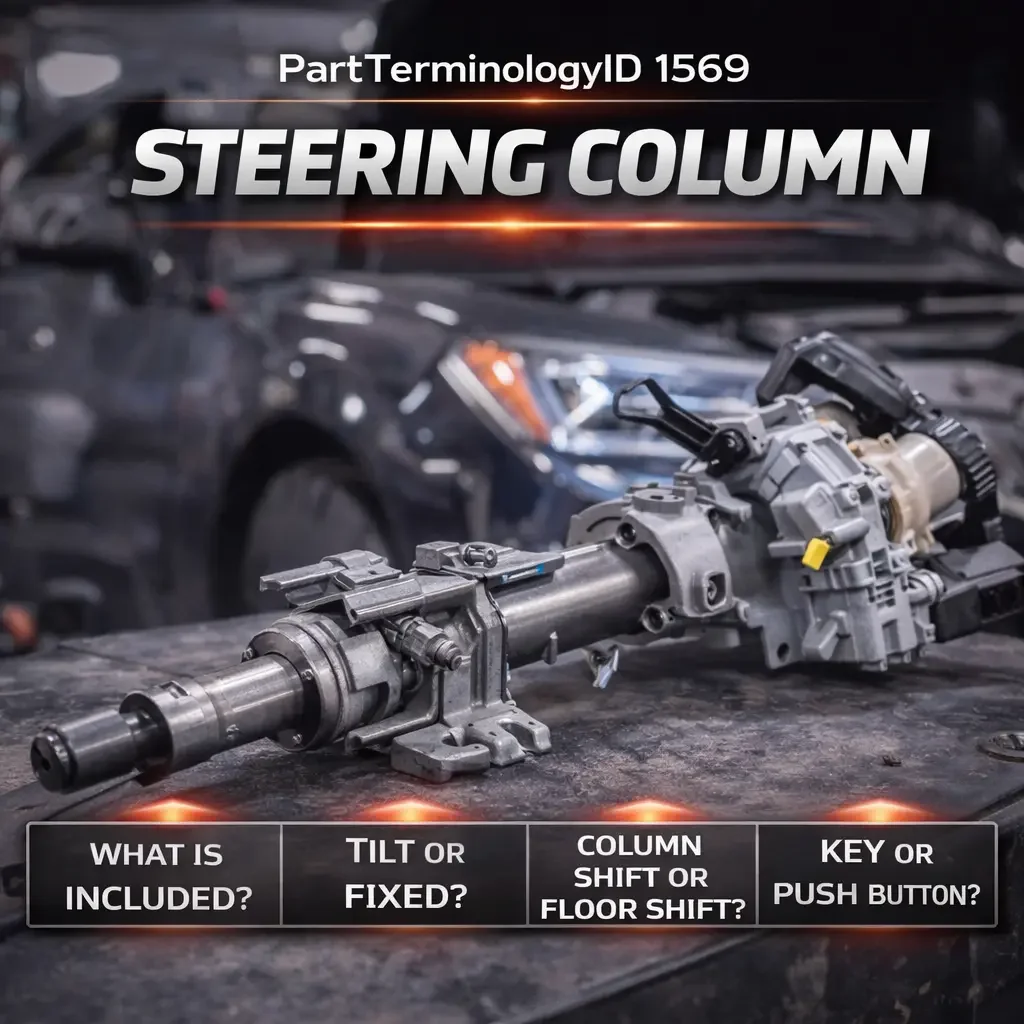
The steering column is the structural and functional assembly that connects the steering wheel to the steering gear (rack and pinion or steering box). It is the central housing through which the driver's steering input passes from hands to wheels. But it is far more than a tube with a shaft inside. The modern steering column integrates or mounts the ignition lock cylinder, the key switch or push-button start, the turn signal / cruise control / tilt lever (PartTerminologyID 1510), the clock spring (spiral cable), the steering column lock actuator (PartTerminologyID 1506), the tilt and telescoping adjustment mechanism, the collapsible energy-absorbing section (a federally mandated safety feature that compresses during a frontal collision to reduce steering wheel intrusion into the driver), and on many vehicles, the electronic power steering assist motor.
This post ties back to more previously covered parts than any other in the series. The turn signal stalk (1510) mounts to the column. The steering column lock actuator (1506) mounts to the column. The clock spring rides inside the column. The air bag module (1508) sits on the steering wheel that bolts to the column shaft. The column is the hub that connects them all.
When the steering column fails or must be replaced, the buyer faces the most complex "what is included and what is not" question in the aftermarket.
This post is built for aftermarket catalog teams, marketplace sellers, and buyers who want fewer mistakes and fewer returns.
Status in New Databases
Status in New Databases
Current: PIES 7.2 + PCdb Future: PIES 8.0 + PCdb 2.0 Status: No change
What Steering Column Means in the Aftermarket
Steering Column (PartTerminologyID 1569) refers to the complete steering column assembly that mounts to the vehicle's dashboard structure and connects the steering wheel to the steering gear.
In catalog reality, this covers a wide range of completeness levels:
Bare column assembly. The column tube, the steering shaft (intermediate shaft or upper shaft), the bearing(s), and the column mounting bracket. Does not include the ignition lock, the turn signal switch, the clock spring, the steering column lock actuator, or the column covers. The buyer must transfer all of these components from the old column to the new one. This is the most common source of buyer surprise: the column arrives and it is a bare metal assembly that looks nothing like what they removed from the vehicle.
Column assembly with switches. The column with the multi-function switch (turn signal / cruise control / tilt lever) and the ignition lock cylinder pre-installed. This is a more complete assembly but may still require transfer of the clock spring, the steering column lock actuator, and the column covers.
Column assembly with tilt/telescoping mechanism. Includes the tilt pivot, the tilt lock mechanism, and/or the telescoping adjustment. If the tilt mechanism is the reason for the column replacement (loose tilt, column drops under its own weight), this must be included. A bare column without the tilt mechanism does not solve a tilt problem.
Refurbished / remanufactured column. A used column that has been disassembled, inspected, and rebuilt with new bearings, new tilt mechanism components, and new bushings. Refurbished columns are common in this category because new OEM columns are extremely expensive ($500 to $2,000+) and aftermarket new columns have limited availability.
Recycled (salvage) column. A used column from a salvage vehicle. May arrive with some or all of the switches, lock, and covers still attached. The buyer must verify that all attached components are compatible with their vehicle (correct ignition key type, correct turn signal functions, correct clock spring). Recycled columns are the most affordable option but carry the most compatibility risk.
What this part does NOT cover
Steering wheel. The wheel the driver holds. Bolts to the column shaft but is a separate PartTerminologyID.
Steering gear / rack and pinion. The mechanism at the bottom that converts rotational input to lateral wheel movement. Different PartTerminologyID.
Intermediate steering shaft / coupling. The shaft that connects the column to the steering gear. May or may not be included with the column depending on the assembly level.
Power steering pump or motor. The hydraulic or electric assist components. Different PartTerminologyID (though the electric power steering motor may mount on the column itself).
Individual column-mounted components when sold separately: Turn signal switch (1510), steering column lock actuator (1506), clock spring, ignition lock cylinder, column covers/shrouds.
The "What Is Included" Problem
This is the central catalog challenge and the number one return driver:
A steering column is a major assembly that can be sold at many different levels of completeness. The buyer's expectation of what "steering column" means versus what arrives in the box creates a gap that generates returns, frustration, and negative reviews.
What the buyer expects: A ready-to-install assembly that looks like what they removed from their vehicle: column with tilt, switches, lock, covers, and all the wiring.
What often arrives: A bare column tube with shaft, bracket, and maybe bearings. No switches. No lock. No covers. No wiring.
The transfer labor: Moving all components from the old column to the new column can take 2 to 4 hours of labor. The buyer (or their mechanic) must remove the turn signal switch assembly, the ignition lock cylinder, the clock spring, the key switch, the column covers, and on some vehicles the electronic power steering motor from the old column and install them on the new one. If any of these components are damaged (which they may be, since the column is being replaced for a reason), the buyer needs those parts too.
Catalog solution: The listing must explicitly state what is included and what is not. Every major component should be listed as "Included" or "Not Included":
Tilt mechanism: Included / Not Included
Turn signal / multi-function switch: Included / Not Included
Ignition lock cylinder: Included / Not Included
Clock spring: Included / Not Included
Steering column lock actuator: Included / Not Included
Column covers / shrouds: Included / Not Included
Wiring harness: Included / Not Included
Intermediate shaft: Included / Not Included
This checklist in the description prevents the most common return in the category.
Why Steering Columns Are Replaced
Tilt mechanism failure
The most common reason for column replacement on high-mileage vehicles, especially GM trucks and SUVs. The tilt mechanism wears out, and the steering column drops under its own weight or cannot hold its adjusted position. This is the same tilt wear discussed in the Turn Signal / Cruise Control / Tilt Lever post (1510), but when the tilt mechanism in the column itself is worn (not just the lever), the column must be replaced or rebuilt.
Collision damage
A frontal collision can compress the collapsible section of the steering column (by design, to protect the driver). Once the collapsible section has compressed, the column must be replaced. It cannot be re-extended or repaired. The energy-absorbing design is a one-time-use safety feature.
Ignition lock failure
On older vehicles where the ignition lock cylinder is deeply integrated into the column, a failed lock may require column replacement. On most modern vehicles, the lock cylinder can be replaced independently.
Bearing failure
The steering shaft rotates in bearings at the top of the column. Worn bearings cause play (looseness) in the steering wheel, clunking sounds when turning, and a rough steering feel. Bearings can sometimes be replaced independently, but on some columns they are pressed in and the column must be replaced or rebuilt.
Vandalism or theft damage
Steering columns damaged during theft attempts (broken ignition lock, forced column covers, damaged wiring) may require full column replacement if the damage is extensive.
Electronic power steering (EPS) motor failure
On vehicles where the EPS motor is mounted on the column, a failed motor may require the column to be replaced if the motor and column are an integrated unit. On some vehicles, the motor can be replaced separately.
Fitment Variables
Tilt, telescoping, or fixed
The column must match the vehicle's adjustment type. A tilt column is not interchangeable with a fixed column. A tilt-and-telescoping column is not interchangeable with a tilt-only column. The mounting brackets, the column length, and the internal mechanisms are different.
Column shift versus floor shift
On trucks and some older sedans, the column may include the transmission gear selector (column shift). A column-shift column has a shift lever, a shift tube around the column, and a linkage or cable connection to the transmission. A floor-shift vehicle does not have any of this. The columns are not interchangeable.
Key ignition versus push-button start
Columns designed for key ignition have a lock cylinder housing with a keyway. Columns designed for push-button start have the steering column lock actuator (PartTerminologyID 1506) and no key cylinder. The electrical connections and the column housing geometry are different.
Steering wheel position sensors
On vehicles with electronic stability control (ESC) or lane keep assist, a steering angle sensor is mounted on or in the column. The sensor must be compatible with the vehicle's ESC system. Replacing the column may require steering angle sensor calibration with a scan tool after installation.
Column length and intermediate shaft compatibility
The column must be the correct length to connect to the vehicle's steering gear through the intermediate shaft. Different engine options, different firewalls (left-hand-drive versus right-hand-drive), and different dashboard configurations can affect column length.
Top Return Causes
1) Column arrives bare, buyer expected complete assembly
The column does not include the switches, lock, clock spring, or covers the buyer expected.
Prevention: Explicit included/not-included checklist in the description. Photos showing exactly what ships in the box.
2) Wrong adjustment type (tilt/telescoping/fixed)
Column does not match the vehicle's steering adjustment configuration.
Prevention: Adjustment type in the title: "Tilt Steering Column" or "Tilt and Telescoping Steering Column" or "Fixed Steering Column."
3) Column shift ordered for floor shift vehicle (or vice versa)
Prevention: Shift type in the title: "Column Shift" or "Floor Shift."
4) Components cannot transfer from old column
The turn signal switch, clock spring, or ignition lock from the old column is damaged or incompatible with the replacement column (different generation, different mounting).
Prevention: Note which components must be transferred and recommend inspecting them before installation. "The following components must be transferred from your existing column: [list]. Inspect each component during transfer. Damaged components should be replaced at this time."
5) Steering angle sensor requires calibration after installation
Vehicle has ESC or lane keep assist. After column replacement, the steering angle sensor is not calibrated. ESC light is on.
Prevention: "Vehicles with electronic stability control (ESC) or lane keep assist require steering angle sensor calibration with a scan tool after column installation."
Compatibility Checklist for Buyers
1) Confirm what is included in the column assembly. Check the included/not-included list for switches, lock, clock spring, covers, and wiring.
2) Confirm adjustment type. Tilt, tilt-and-telescoping, or fixed.
3) Confirm shift type. Column shift or floor shift.
4) Confirm ignition type. Key ignition or push-button start.
5) Inspect all components that must transfer from the old column. Turn signal switch, clock spring, ignition lock, column covers, steering column lock actuator. Replace any damaged components during the column swap.
6) Plan for steering angle sensor calibration if your vehicle has ESC or lane keep assist.
7) Confirm full vehicle details. Year, make, model, submodel, trim. OEM part number cross-reference strongly recommended.
Catalog Checklist for Attributes
Core taxonomy: Product form (bare column, column with switches, column with tilt mechanism, refurbished column, recycled column). Adjustment type: tilt, tilt-and-telescoping, fixed. Shift type: column shift, floor shift. Ignition type: key, push-button. Separate from Steering Wheel, Steering Gear, Intermediate Shaft, Turn Signal Switch, Clock Spring, Ignition Lock, Column Lock Actuator, and EPS Motor.
Fitment: Year, make, model, submodel, trim. Adjustment type. Shift type. Ignition type. EPS motor included (yes/no). OEM part number cross-reference.
Included components checklist: Tilt mechanism, turn signal/multi-function switch, ignition lock cylinder, clock spring, steering column lock actuator, column covers, wiring harness, intermediate shaft, steering angle sensor, EPS motor.
Condition (refurbished/recycled): Rebuilt components listed. Recycled donor vehicle details (if applicable).
Images: Column from multiple angles, included components visible, connector locations, mounting bracket, and close-up of the shaft end showing spline or coupling interface.
FAQ
Why does the steering column not come with switches and covers?
Many replacement columns are sold as bare assemblies (column tube, shaft, bracket, and bearings). The switches, lock, clock spring, and covers must be transferred from the old column to the new one. This is standard practice in the industry but surprises buyers who expect a ready-to-install assembly. Check the listing's included-components list before ordering.
My steering column drops when I let go of it. Is it the tilt mechanism?
Yes. A steering column that cannot hold its adjusted position has a worn tilt mechanism. The tilt pivot, tilt lock, or tilt spring inside the column has failed. The column must be replaced or the tilt mechanism rebuilt.
Do I need a scan tool after replacing the steering column?
If your vehicle has electronic stability control (ESC), lane keep assist, or an electronic power steering system, a scan tool is likely required after column installation to calibrate the steering angle sensor and/or initialize the EPS system. Without calibration, the ESC light may remain on and the system may not function correctly.
Final Take for Aftermarket Teams
Steering Column (PartTerminologyID 1569) is the assembly that connects more previously covered parts than any other in this series. It is also the part where the "what is included" question determines whether the buyer has a successful repair or a frustrating return. The catalog teams that reduce returns in this category publish an explicit included/not-included components checklist in every listing, specify tilt/telescoping/fixed and column-shift/floor-shift in the title, note the steering angle sensor calibration requirement, and include photos of exactly what arrives in the box. The steering column is a $200 to $2,000 assembly where a $0 communication effort (listing what is in the box) prevents the majority of returns.