
Seat Belt Warning Sensor (PartTerminologyID 1568): The Switch in the Buckle That Triggers the Chime
Written by Arthur Simitian | PartsAdvisory
The seat belt warning sensor is a simple switch inside the seat belt buckle that detects whether the belt is fastened. When the buckle is unlatched, the switch is open. The instrument cluster displays a seat belt warning light and (on most vehicles) sounds a chime to remind the driver or passenger to buckle up. When the belt is latched, the switch closes, and the warning light and chime turn off.
That is the entire function. It is one of the simplest electrical components on the vehicle: a switch that is either open or closed. But when it fails, the consequences range from an annoying chime that never stops (switch stuck in the unbuckled position) to a silent warning system that never activates (switch stuck in the buckled position), to an SRS fault code that illuminates the air bag warning light because the SRS module uses the seat belt status to determine air bag deployment strategy.
This post is built for aftermarket catalog teams, marketplace sellers, and buyers who want fewer mistakes and fewer returns.
Status in New Databases
Status in New Databases
Current: PIES 7.2 + PCdb Future: PIES 8.0 + PCdb 2.0 Status: No change
What Seat Belt Warning Sensor Means in the Aftermarket
Seat Belt Warning Sensor (PartTerminologyID 1568) refers to the switch or sensor in the seat belt buckle that detects whether the seat belt is latched.
In catalog reality, this covers:
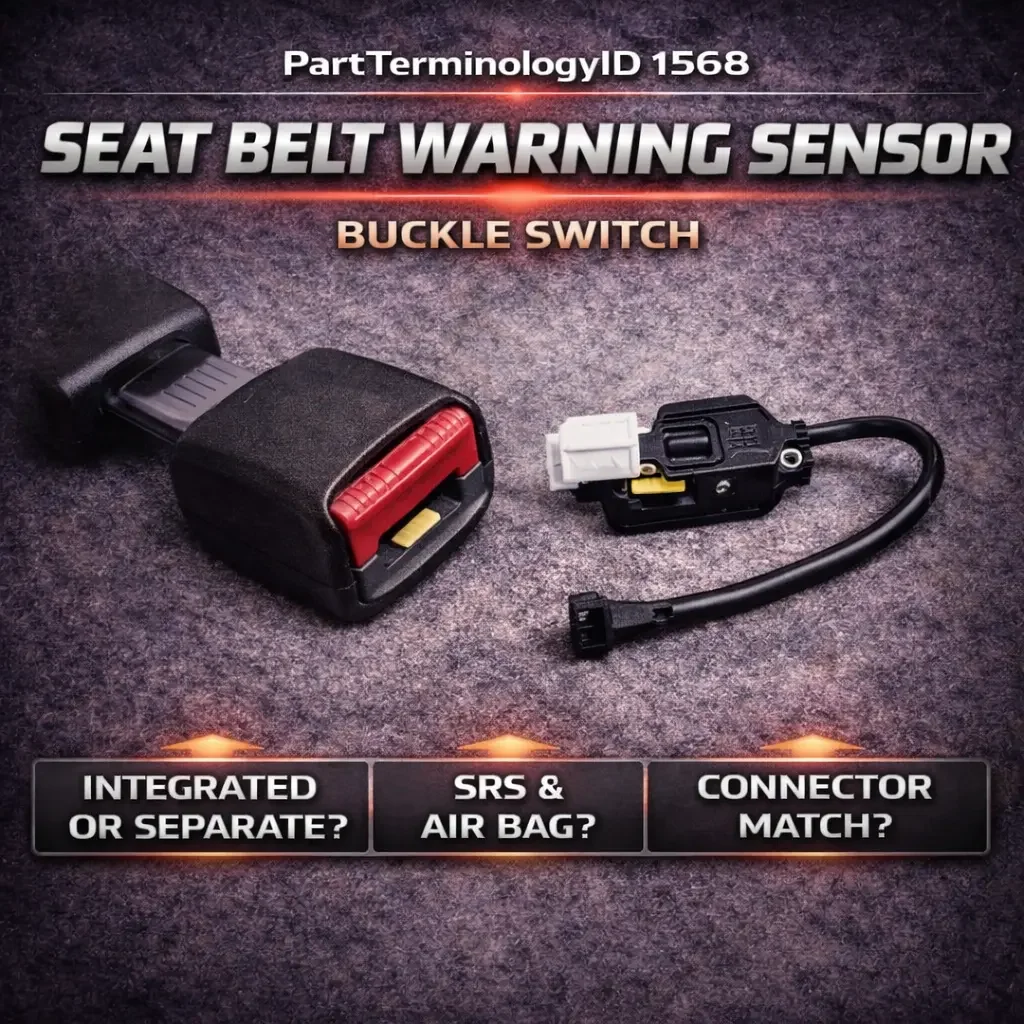
Buckle switch (integrated into the buckle assembly). On most modern vehicles, the warning sensor is built into the seat belt buckle. The switch is not separately replaceable. If the switch fails, the entire buckle assembly must be replaced. This is the most common product form.
Buckle switch (separate from buckle). On some older vehicles, the switch is a standalone component that plugs into or mounts adjacent to the buckle. It can be replaced independently.
Seat belt buckle assembly with switch. The complete buckle (the receptacle the tongue latches into) with the warning switch integrated. This is the primary replacement product for most modern vehicles because the switch and buckle are one unit.
Seat-mounted occupant detection sensor. On the passenger seat, some vehicles use a weight or pressure sensor in the seat cushion to determine whether the seat is occupied. This sensor works in conjunction with the buckle switch: if the seat is occupied (weight detected) and the belt is not buckled (switch open), the warning activates. The seat sensor and the buckle switch are different components but work together.
What this part does NOT cover
Seat belt webbing / belt assembly. The fabric belt and retractor. Different PartTerminologyID.
Seat belt retractor. The spring-loaded mechanism that retracts the belt. Different PartTerminologyID.
Seat belt pretensioner. The pyrotechnic device that tightens the belt in a collision. Different PartTerminologyID.
Seat belt tongue / latch plate. The metal plate on the belt that inserts into the buckle. Different component.
SRS control module. The computer that processes the belt status signal. Different PartTerminologyID.
Occupant classification sensor / weight sensor. The seat cushion sensor. Related but different component.
How the SRS System Uses Belt Status
This is the detail that elevates the seat belt warning sensor from a simple chime trigger to a safety-critical input:
Modern SRS systems use the seat belt buckle status as a factor in air bag deployment decisions. The SRS module adjusts deployment strategy based on whether the occupant is belted:
Belted occupant. The air bag may deploy at a lower force (dual-stage systems) because the seat belt is providing primary restraint. The belt holds the occupant in position, and the air bag supplements the belt.
Unbelted occupant. The air bag may deploy at full force because the belt is not helping. The air bag must do more work to restrain the occupant. Some systems may also deploy air bags at lower collision thresholds for unbelted occupants.
This means a failed seat belt warning sensor does not just affect the chime. It can affect how the SRS module deploys the air bags. If the sensor is stuck in the "buckled" position when the occupant is actually unbelted, the SRS module believes the occupant is restrained and may deploy the air bag at reduced force, providing less protection than needed.
This SRS integration is why a seat belt buckle switch fault often triggers the SRS warning light in addition to the seat belt warning light. The SRS module has lost a data input it needs for proper deployment decisions.
Why This Category Creates Fitment Problems
Buckle position (which seat)
Every seat position with a seat belt has its own buckle with its own switch. The driver buckle is different from the passenger buckle. The rear left buckle is different from the rear center buckle. Each buckle has a different connector, a different wire length, and sometimes a different mounting bracket. The listing must specify the exact seat position.
On vehicles with rear bench seats, the center buckle is often a different design from the outboard buckles because the center belt anchors differently.
Integrated versus separate switch
As noted above, on most modern vehicles the switch is integrated into the buckle and the entire buckle must be replaced. On some older vehicles, the switch is separate. The listing must specify whether the product is a standalone switch or a complete buckle assembly.
Connector type
The buckle switch connector varies by vehicle. Some are simple two-wire connectors (open/closed switch). Others have multi-wire connectors because the buckle includes additional functions (belt tension sensor, buckle illumination light for nighttime visibility, or a heated buckle feature on some luxury vehicles).
Color
Some buckles have a colored housing or button that matches the interior trim. A black buckle in a tan interior is a visible mismatch. Specify buckle color where applicable.
Seat belt warning regulations
Federal Motor Vehicle Safety Standard 208 (FMVSS 208) requires a seat belt warning system. Disabling or bypassing the seat belt warning sensor is a modification that can affect the vehicle's compliance with federal safety standards. Some buyers search for seat belt warning "eliminators" or "bypass" devices. These products defeat the warning chime but also defeat the SRS module's ability to read belt status, which can compromise air bag deployment strategy. Catalog teams should be aware that bypass products exist in the market but carry safety and regulatory implications.
Common Failure Modes
Switch contact corrosion. Liquid spills (coffee, soda, water) run down the belt webbing and into the buckle, corroding the switch contacts. The switch becomes intermittent or fails.
Switch contact wear. Thousands of buckle/unbuckle cycles wear the switch contacts. The switch becomes unreliable.
Wiring fatigue. The buckle moves when the seat is adjusted, the occupant shifts, or the belt is pulled. The wiring at the buckle connector flexes and can fatigue over time.
Physical damage. Objects dropped into the buckle (coins, food, small toys) can jam the mechanism or damage the switch.
Buckle latch failure combined with switch failure. The buckle itself may not latch securely, which is a more serious safety issue than the switch alone. If the buckle does not hold the tongue firmly, the occupant is unrestrained regardless of what the switch reports.
Top Return Causes
1) Wrong seat position
Buckle for front left ordered when rear right was needed, or vice versa.
Prevention: Seat position in the title: "Driver (Front Left) Seat Belt Buckle with Warning Switch" or "Rear Center Seat Belt Buckle with Warning Switch."
2) Standalone switch ordered for a vehicle where the switch is integrated into the buckle
The switch cannot be purchased separately for the buyer's vehicle.
Prevention: Specify product form: "Complete Buckle Assembly with Integrated Warning Switch (Switch Not Sold Separately)" or "Warning Switch Only (Separate from Buckle)."
3) Wrong connector
Buckle from the correct position but wrong model year or trim has a different connector.
Prevention: Full ACES fitment. OEM part number cross-reference. Connector photo in the listing.
4) Buyer attempts to bypass the warning rather than replace the sensor
Buyer purchases a bypass device or a buckle extender to silence the chime rather than replacing the faulty switch.
Prevention: This is a buyer choice, not a catalog error. However, noting the SRS implications may influence the decision: "The seat belt buckle switch provides input to the SRS air bag system. Bypassing the switch may affect air bag deployment strategy."
5) Wrong color
Black buckle ordered for a gray or tan interior.
Prevention: Color in the listing where applicable.
Compatibility Checklist for Buyers
1) Identify the seat position. Driver, passenger, rear left, rear center, rear right.
2) Determine product form. Does your vehicle use a separate switch or an integrated buckle assembly?
3) Confirm connector type. Compare to your existing buckle's connector.
4) Note the SRS connection. If your SRS light is on with a seat belt switch code, the buckle replacement should resolve both the chime issue and the SRS fault.
5) Confirm full vehicle details and buckle color.
Catalog Checklist for Attributes
Core taxonomy: Product form (buckle assembly with switch, standalone switch). Seat position: driver, passenger, rear left, rear center, rear right. Separate from Seat Belt Webbing, Retractor, Pretensioner, Tongue, SRS Module, and Occupant Classification Sensor.
Fitment: Year, make, model, submodel, trim. Seat position. OEM part number cross-reference.
Specs: Connector type and pin count. Buckle color. Switch type (normally open, normally closed).
Package contents: Buckle assembly (or switch), mounting hardware.
Images: Buckle from front showing button and color, buckle from rear showing connector, switch (if separate), connector close-up.
FAQ
Why is my SRS light on with a seat belt warning code?
The SRS module uses the seat belt buckle switch status to determine air bag deployment strategy. A failed buckle switch causes the SRS module to lose that input, triggering an SRS fault code. Replacing the buckle with a functioning switch should resolve both the chime issue and the SRS fault.
Can I just disconnect the chime instead of replacing the buckle?
You can, but the seat belt buckle switch also provides data to the SRS air bag system. Disconnecting or bypassing the switch may affect how the air bags deploy in a collision. Replacing the faulty buckle restores both the warning function and the SRS data input.
My seat belt chime goes off even when I am buckled. Is it the sensor?
Most likely. If the buckle switch is stuck in the open (unbuckled) position, the system thinks the belt is not fastened even when it is. The buckle assembly with the warning switch should be replaced.
Final Take for Aftermarket Teams
Seat Belt Warning Sensor (PartTerminologyID 1568) is a simple switch with a safety-critical role that most buyers do not realize. The chime is annoying. The SRS data input is essential. The catalog teams that serve this category specify seat position in the title, clarify whether the switch is sold separately or as an integrated buckle assembly, note the SRS implications of a failed switch, and include the connector photo so the buyer can verify compatibility before ordering. It is a $20 to $80 buckle replacement that restores both a warning system and an air bag deployment input.