
Written by Arthur Simitian | PartsAdvisory
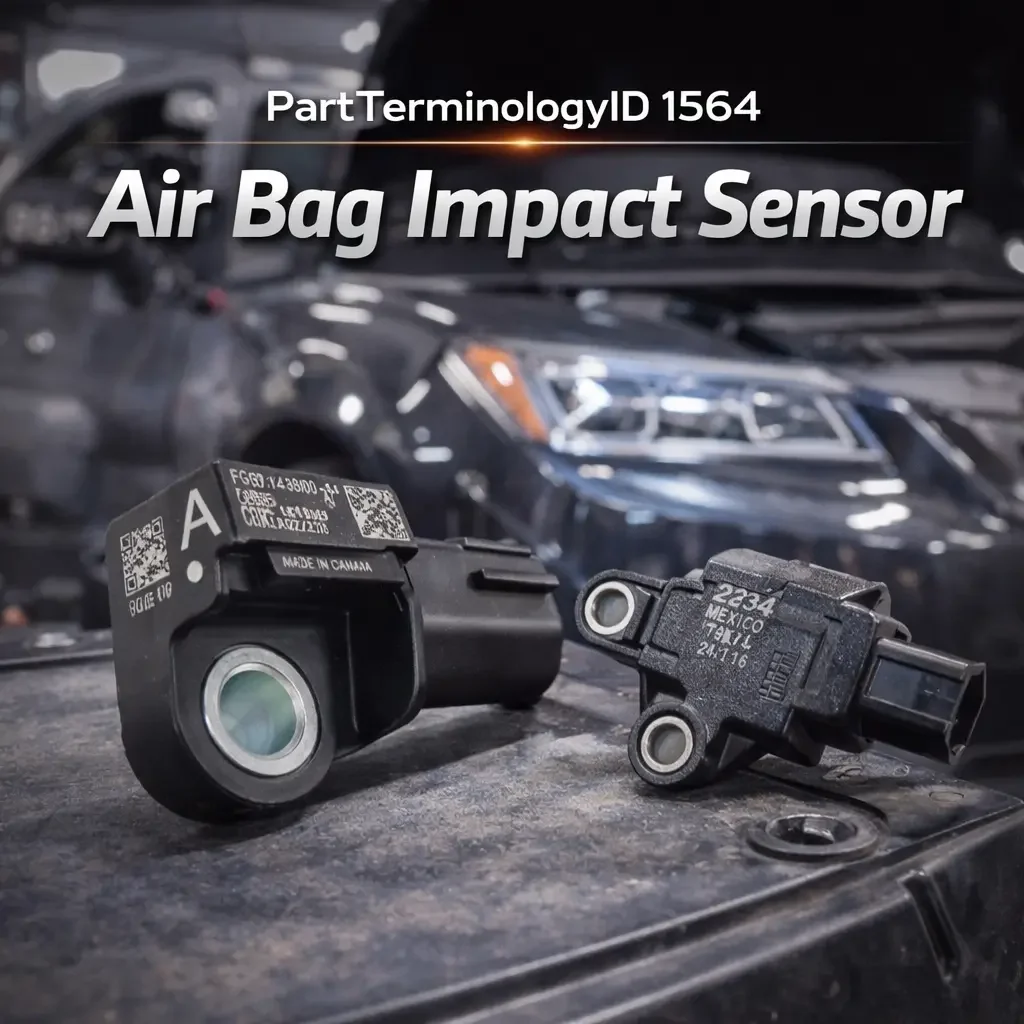
The Air Bag Module post (PartTerminologyID 1508) covered the explosive device that inflates to protect the occupant. This post covers the component that decides whether to fire that device: the Air Bag Impact Sensor, also called a crash sensor.
The impact sensor is an accelerometer or mechanical switch mounted in the vehicle's structure that detects the rapid deceleration of a collision. When the sensor detects an impact above a calibrated threshold, it sends a signal to the SRS (Supplemental Restraint System) control module. The SRS module evaluates signals from multiple sensors simultaneously and, if the collision meets the deployment criteria, fires the appropriate air bag modules within milliseconds.
The decision chain is: impact sensor detects crash, SRS module evaluates severity and direction, SRS module fires the correct air bags. The impact sensor is the first link in that chain. If the sensor fails to detect a collision, the air bags do not deploy. If the sensor sends a false signal, the air bags may deploy when there is no collision. Both outcomes are life-threatening.
This is a safety-critical, collision-repair-specific component. It is almost never replaced as a maintenance item. It is replaced after a collision, after an SRS diagnostic fault, or as part of a recall. The buyer population is almost entirely collision repair shops and mechanics, not DIY consumers.
This post is built for aftermarket catalog teams, marketplace sellers, and buyers who want fewer mistakes and fewer returns.
Status in New Databases
Status in New Databases
Current: PIES 7.2 + PCdb Future: PIES 8.0 + PCdb 2.0 Status: No change
What Air Bag Impact Sensor Means in the Aftermarket
Air Bag Impact Sensor (PartTerminologyID 1564) refers to a crash detection sensor that provides impact data to the SRS control module.
In catalog reality, this covers multiple sensor types and positions:
Front impact sensor. Mounted in the front crush zone of the vehicle, typically on the radiator core support, the front frame rails, or behind the front bumper beam. Detects frontal collisions. Most vehicles have two front sensors (left and right) to help the SRS module determine the angle of impact.
Side impact sensor. Mounted in the door, the B-pillar, or the C-pillar. Detects side (lateral) impacts. Triggers the side torso air bags and side curtain air bags. Most vehicles have sensors on both sides.
Rear impact sensor. Mounted in the rear of the vehicle structure. Detects rear-end collisions. Used on vehicles with rear seat side curtain air bags or fuel cutoff systems.
Rollover sensor. A gyroscopic or accelerometer-based sensor that detects vehicle rollover. Triggers the side curtain air bags to deploy and remain inflated during a rollover event. May be integrated into the SRS control module rather than mounted as a separate sensor.
Safing sensor / discrimination sensor. Some SRS systems use a two-sensor architecture: a "crush zone" sensor in the front of the vehicle and a "safing" sensor in the passenger compartment (often inside the SRS module itself). Both sensors must detect an impact simultaneously for the air bags to deploy. This dual-sensor design prevents deployment from a single sensor fault or a non-collision event (hitting a deep pothole, for example).
Seat-mounted occupant classification sensor. Not an impact sensor per se, but a pressure or weight sensor in the passenger seat that tells the SRS module whether the seat is occupied and by what size occupant. This determines whether to deploy the passenger air bag and at what force. May be cataloged adjacent to impact sensors.
What this part does NOT cover
Air bag module (PartTerminologyID 1508). The inflatable device that deploys. The sensor triggers deployment but is not the air bag itself.
SRS control module / air bag control module. The computer that processes sensor signals and commands deployment. Different PartTerminologyID.
Clock spring / spiral cable. The electrical connection through the steering column. Different PartTerminologyID.
Seat belt pretensioner. The belt-tightening device triggered by the SRS module. Different PartTerminologyID.
Parking sensor / ultrasonic sensor. Proximity sensors for parking assistance. Completely different system despite the word "sensor."
Why Impact Sensors Are Replaced
After a collision
This is the primary replacement scenario. When a vehicle is involved in a collision that triggers air bag deployment (or a collision severe enough to damage the sensor without triggering deployment), the impact sensors in the affected zone are typically replaced as part of the collision repair. Even if the sensors appear undamaged, many manufacturers and insurance protocols require replacement of any sensor in the crush zone that was affected by the collision because the sensor may have been stressed beyond its calibration limits without visible damage.
After an SRS diagnostic fault
The SRS warning light illuminates and a scan tool reads a fault code pointing to a specific impact sensor (open circuit, short circuit, resistance out of range, or communication fault). The sensor has failed electrically. This can occur without a collision due to connector corrosion, wiring damage, or internal sensor failure from age or vibration.
After a recall
Some impact sensors have been subject to manufacturer recalls for defects that could prevent proper crash detection.
After aftermarket modification or body repair
If the sensor mounting location was disturbed during body repair, aftermarket bumper installation, or frame modification, the sensor may need to be replaced or recalibrated.
Why This Category Creates Fitment Problems
Sensor position is the primary fitment variable
A front left sensor is not the same as a front right sensor on most vehicles. A front sensor is not the same as a side sensor. The sensor type, the calibration threshold, the connector, and the mounting orientation are all position-specific. Ordering "an impact sensor" without specifying the exact position is the most common fitment error.
Sensor generation changes within a model year
Impact sensor designs can change during a model year due to engineering updates, supplier changes, or safety recall remediation. Two vehicles of the same year, make, model, and trim may use different sensors if they were built on different sides of a production date split. VIN-based or production-date fitment is sometimes required.
OEM part number is essential
More than almost any other part in the aftermarket, the impact sensor requires an OEM part number match. The sensor's calibration (the g-force threshold at which it triggers, the signal output curve, and the communication protocol with the SRS module) is specific to the vehicle's SRS system. A sensor from a different vehicle that physically mounts in the same location but has a different calibration may not trigger at the correct threshold, either deploying too early (at lower impacts) or not deploying when it should (at higher impacts). Both scenarios are dangerous.
Aftermarket availability is limited
The aftermarket for impact sensors is significantly smaller than for parts like brake pads or filters. The safety-critical nature of the component, the vehicle-specific calibration requirements, and the liability exposure limit the number of aftermarket manufacturers. OEM and recycled (salvage) sensors are the primary product sources.
Recycled sensor risks
Recycled impact sensors from salvage vehicles carry the risk that the sensor was stressed in the donor vehicle's collision. A sensor that was in the crush zone of a collision (even if it did not deploy the air bags) may have been mechanically deformed or had its calibration altered. Recycled sensors should only be sourced from vehicle zones that were not involved in the collision (for example, a side sensor from a vehicle that was in a frontal collision, where the side sensors were unaffected).
The SRS Light and Scan Tool Requirement
After replacing any impact sensor, the SRS system must be cleared and verified with a scan tool:
Clear the SRS fault codes. The SRS module stores fault codes when a sensor fails or is disconnected. After installing the new sensor, the codes must be cleared with an SRS-capable scan tool.
Verify the SRS light turns off. If the SRS light remains on after code clearing, a fault still exists. The system must be diagnosed further. Driving with the SRS light on means the air bags may not deploy in a collision.
Verify sensor communication. The scan tool should confirm that the new sensor is communicating correctly with the SRS module and that the sensor's resistance and signal output are within specification.
This requires professional equipment. Generic OBD-II code readers typically cannot access the SRS system. A scan tool with SRS module access (manufacturer-specific or advanced aftermarket) is required.
The Collision Repair Context
Impact sensors are almost exclusively a collision repair part. The buyer is typically a body shop or a mechanic performing a collision repair. The ordering context is:
Insurance estimate drives the order. The insurance estimate specifies which sensors to replace based on the collision zone and the vehicle manufacturer's repair procedures. The sensor part numbers are listed on the estimate.
Multiple sensors may be needed. A frontal collision may require both front sensors. A side collision may require the door-mounted sensor, the B-pillar sensor, and the corresponding curtain air bag sensor. The repair order may include multiple sensor positions.
The sensor is one component in a larger SRS repair. The collision repair typically includes the impact sensor(s), the deployed air bag module(s), the seat belt pretensioner(s), the clock spring (if the steering wheel was replaced), and the SRS module (if it recorded a deployment event and is not resettable). All of these components must be correct and compatible for the SRS system to function after the repair.
Top Return Causes
1) Wrong sensor position
Front left ordered when front right was needed, or front ordered when side was needed.
Prevention: Sensor position in the title: "Front Left Impact Sensor" or "Right Side (B-Pillar) Impact Sensor" or "Rear Impact Sensor."
2) Wrong part number / wrong calibration
Sensor from a different vehicle or different production date that does not match the SRS module's expected calibration.
Prevention: OEM part number cross-reference is mandatory. "Verify OEM part number before ordering. Impact sensor calibration is vehicle-specific and must match the SRS control module."
3) Recycled sensor from the collision zone of the donor vehicle
Sensor was in the crush zone and may be compromised.
Prevention: For recycled sensors: "This sensor was sourced from a vehicle zone NOT involved in the donor vehicle's collision. Sensors from the collision zone should not be reused."
4) SRS light remains on after installation
Sensor installed but fault codes not cleared, or the sensor is not communicating correctly.
Prevention: "SRS fault codes must be cleared with an SRS-capable scan tool after installation. If the SRS light remains on, diagnose with the scan tool before driving the vehicle."
5) Sensor ordered when the wiring or connector is the actual failure
SRS fault code points to the sensor, but the failure is a corroded connector or a damaged wire between the sensor and the SRS module.
Prevention: "Before replacing the sensor, inspect the sensor connector and wiring harness for corrosion, damage, or disconnection. A corroded connector is a common cause of impact sensor fault codes."
Compatibility Checklist for Buyers
1) Identify the exact sensor position. Front left, front right, side left, side right (door or pillar), rear, rollover.
2) Match the OEM part number. This is not optional. Sensor calibration must match the vehicle's SRS system.
3) Confirm production date if applicable. Some vehicles have sensor changes within a model year.
4) If purchasing recycled, verify the sensor was not in the donor vehicle's collision zone.
5) Plan for SRS scan tool verification after installation. Fault codes must be cleared and the system verified.
6) Confirm full vehicle details. Year, make, model, submodel, trim. VIN-based lookup is recommended.
Catalog Checklist for Attributes
Core taxonomy: Sensor position (front left, front right, side left door, side left B-pillar, side right door, side right B-pillar, rear, rollover). Sensor type (accelerometer, mechanical, gyroscopic). Separate from Air Bag Module, SRS Control Module, Clock Spring, Seat Belt Pretensioner, and Parking Sensor.
Fitment: Year, make, model, submodel, trim. Sensor position. Production date (if applicable). OEM part number cross-reference (mandatory).
Condition (recycled): Not from the donor vehicle's collision zone (verified). Connector inspected for corrosion.
Specs: Connector type and pin count. Mounting bolt pattern. Sensor output type (analog, digital, CAN bus).
Package contents: Sensor, mounting bolt (if included).
Images: Sensor from multiple angles, connector close-up, mounting bracket, OEM part number label visible.
FAQ
Can I drive with the SRS light on after replacing the impact sensor?
You can physically drive the vehicle, but the SRS system may not function correctly. The SRS light indicates a fault in the air bag system. The air bags may not deploy in a collision. Have the SRS system scanned and verified before driving.
Do I need to replace impact sensors after every collision?
Not necessarily after every collision. Manufacturer repair procedures specify which sensors must be replaced based on the collision zone and severity. Sensors in the direct crush zone of the collision are typically replaced. Sensors in unaffected zones may not need replacement. Follow the manufacturer's collision repair manual.
Can I use a sensor from a different vehicle that looks the same?
No. Impact sensor calibration is vehicle-specific. A sensor that looks identical but has a different OEM part number may have a different trigger threshold. Using a sensor with the wrong calibration can result in air bags that deploy too early, too late, or not at all.
Final Take for Aftermarket Teams
Air Bag Impact Sensor (PartTerminologyID 1564) is a collision-repair-driven category where OEM part number matching is not a recommendation but a safety requirement. The sensor's calibration determines whether the air bags deploy at the right time, and a mismatched sensor can mean the difference between a functioning safety system and a system that fails when the occupant needs it most. The catalog teams that serve this category correctly specify sensor position in the title, require OEM part number cross-reference, note production date splits, verify recycled sensors were not from the donor's collision zone, and include the SRS scan tool requirement for post-installation verification. This is a part where getting it right saves lives. The catalog must treat it accordingly.