
Accelerator Pedal Pad (PartTerminologyID 1548): The $8 Rubber Piece That Wears Smooth, Lets Your Foot Slip, and Gets Confused With the $200 Pedal Assembly It Sits On
Written by Arthur Simitian | PartsAdvisory
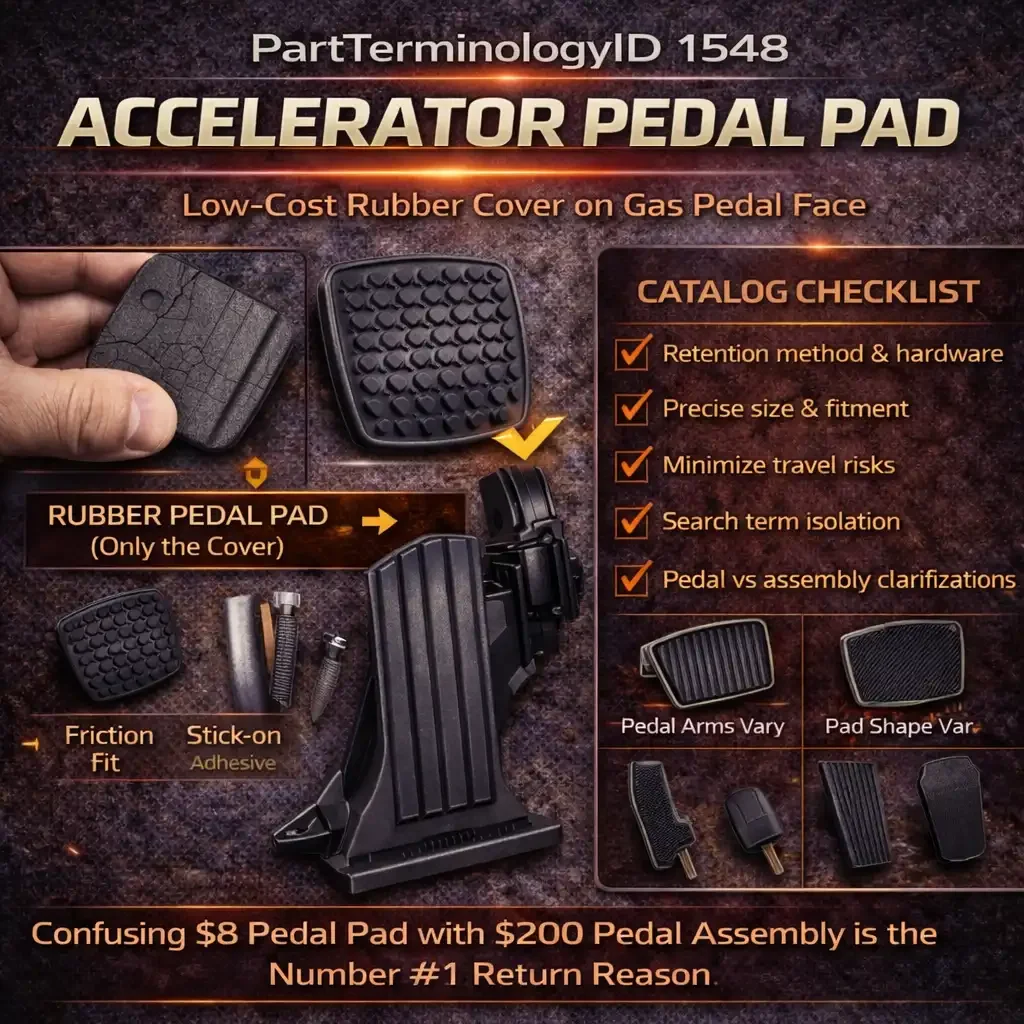
The accelerator pedal pad is the rubber or plastic cover on the face of the accelerator pedal. It is the surface the driver's foot presses against to accelerate the vehicle. The pad has a textured or ridged surface designed to grip the sole of the driver's shoe and prevent the foot from slipping off the pedal during normal driving.
Over years and tens of thousands of miles, the pad wears smooth. The ridges flatten. The rubber hardens, cracks, or tears. The pad may loosen from the pedal arm and shift position, or it may fall off entirely. A worn or missing accelerator pedal pad is a legitimate safety concern: a foot that slips off a smooth accelerator during a highway merge, an emergency maneuver, or wet-shoe conditions (rain, snow) creates a momentary loss of throttle control at exactly the wrong time.
The part is inexpensive ($5 to $20 for most applications) and simple to replace. But it generates a disproportionate number of returns because the buyer confuses the pad (the rubber cover) with the pedal assembly (the entire pedal arm, pivot, and in modern vehicles, the electronic throttle position sensor). This pad-versus-assembly confusion is the central catalog challenge.
This post is built for aftermarket catalog teams, marketplace sellers, and buyers who want fewer mistakes and fewer returns.
Status in New Databases
Status in New Databases
Current: PIES 7.2 + PCdb Future: PIES 8.0 + PCdb 2.0 Status: No change
What Accelerator Pedal Pad Means in the Aftermarket
Accelerator Pedal Pad (PartTerminologyID 1548) refers to the replaceable rubber or plastic cover on the face of the accelerator pedal.
In catalog reality, this covers:
Rubber pedal pad (slip-on). A rubber cover that slips over the pedal arm or clips onto the pedal face. The most common type. Held in place by friction, tabs, or a metal retention clip. When worn, the buyer slides the old pad off and slides the new pad on. No tools required for most applications.
Rubber pedal pad (adhesive-backed). A pad that adheres to the pedal face with a peel-and-stick adhesive backing. Used on pedals with a flat face where a slip-on pad is not applicable.
Pedal pad with retention hardware. Some pads are secured to the pedal arm with a screw, pin, or clip. The hardware must be matched to the pedal arm's mounting holes.
Aftermarket pedal cover (universal). An aluminum, stainless steel, or rubber aftermarket pedal cover designed to fit over the existing pedal face for aesthetic or grip improvement. Available in universal sizes that fit a range of pedal widths. These are accessories rather than direct replacements but may be cataloged under or searched for using PartTerminologyID 1548.
What this part does NOT cover
Accelerator pedal assembly. The complete pedal arm, pivot bracket, return spring, and (on modern vehicles) the electronic throttle position sensor (TPS) or accelerator pedal position sensor (APP). This is the $100 to $400 assembly. Different PartTerminologyID. The pad sits on this assembly.
Brake pedal pad. The rubber cover on the brake pedal. Same concept, different pedal, different PartTerminologyID.
Clutch pedal pad. The rubber cover on the clutch pedal (manual transmission vehicles). Different pedal, different PartTerminologyID.
Dead pedal / footrest pad. The stationary footrest to the left of the pedals. Different component.
The Pad vs. Assembly Confusion
This is the number one return driver and the number one catalog clarity issue:
The accelerator pedal pad is just the rubber cover. It costs $5 to $20. It slides on or clips on. It has no electronics, no sensors, no wiring.
The accelerator pedal assembly is the entire pedal mechanism including the arm, pivot, bracket, return spring, and on drive-by-wire vehicles (virtually all vehicles since the mid-2000s), the electronic accelerator pedal position sensor (APP sensor). The assembly costs $100 to $400. It bolts to the firewall and connects to the vehicle's wiring harness. The ECU reads the APP sensor to determine how much throttle the driver is requesting.
When a buyer searches "accelerator pedal" because their rubber pad is worn, they may find and order the complete assembly. They receive a $200 electronic pedal assembly when all they needed was an $8 rubber pad. The reverse also happens: a buyer with a failed APP sensor (causing a check engine light, limp mode, or erratic throttle response) orders a $10 pad thinking it will fix the electronic problem.
Catalog solution: Naming clarity. "Accelerator Pedal PAD (Rubber Cover Only, No Electronics)" in the title for the pad. "Accelerator Pedal ASSEMBLY (Complete with Position Sensor)" in the title for the assembly. The word "PAD" or "ASSEMBLY" must be prominent and unambiguous.
Pedal Pad Dimensions and Attachment
Why pads are not universal
Although accelerator pedal pads look similar across many vehicles, they are vehicle-specific because:
Pedal arm width varies. The pad must fit snugly over the pedal arm. A pad that is too wide wobbles. A pad that is too narrow does not seat properly and may pop off.
Pedal arm cross-section varies. Some pedal arms are flat, some are round, some are rectangular. The pad's internal channel must match the arm's cross-section.
Retention method varies. Some pads rely on friction fit alone. Some have internal tabs that engage holes in the pedal arm. Some use a metal clip that wraps around the arm. Some are secured with a screw. The retention method must match.
Pad shape varies. The pad face may be rectangular, trapezoidal, or curved to match the footwell geometry and pedal position.
The "fits many vehicles" universal pad problem
Universal pedal pads exist and sell well as accessories, but they are not exact replacements. A universal pad may be slightly too wide, slightly too narrow, or may not align correctly with the pedal arm's curvature. On drive-by-wire vehicles, an ill-fitting pad that shifts position or bunches up could theoretically interfere with the pedal's full range of motion, preventing the pedal from returning fully to the idle position. While this is unlikely with a simple rubber pad, it is a scenario that OEM-fit pads are designed to prevent.
Drive-by-Wire Pedal Considerations
On modern drive-by-wire vehicles (which have no mechanical cable between the accelerator pedal and the throttle body), the pedal assembly includes an electronic sensor. The pad sits on top of this assembly but does not interact with the electronics. However, two considerations apply:
The pad must not interfere with pedal travel. The APP sensor reads the pedal position from fully released to fully depressed. If the pad is too thick, too bulky, or shifts position, it could limit pedal travel or prevent full return to idle. OEM-spec pads are designed to allow full pedal travel.
A failed APP sensor is not a pad problem. If the vehicle has a check engine light with APP sensor codes (P2122, P2127, P2138, or similar), erratic throttle response, or limp mode (limited engine power), the problem is the electronic pedal assembly, not the rubber pad. Replacing the pad does not fix sensor issues.
Brake and Clutch Pedal Pads: The Cross-Shopping Opportunity
Buyers who need an accelerator pedal pad often also need brake and clutch pedal pads because all three wear at similar rates. They are exposed to the same shoe-sole abrasion, the same environmental conditions, and the same age-related rubber hardening and cracking.
Catalog teams should cross-reference accelerator pedal pads with brake pedal pads and clutch pedal pads for the same vehicle. A "pedal pad set" that includes all applicable pedal covers is a valuable bundle product. Many buyers do not realize the brake and clutch pads are also replaceable and will purchase them when they see them offered alongside the accelerator pad they searched for.
Top Return Causes
1) Buyer ordered the pedal assembly when they needed only the pad
$200 electronic pedal assembly returned because the buyer only needed an $8 rubber cover.
Prevention: Clear naming: "Accelerator Pedal PAD (Rubber Cover Only)." First line of description: "This is the rubber pad that covers the face of the accelerator pedal. This is NOT the complete pedal assembly with electronic sensor."
2) Buyer ordered the pad when they needed the pedal assembly
Buyer has an APP sensor failure (check engine light, limp mode) and ordered a pad thinking it would fix the electronic issue.
Prevention: "This pad does not include any electronics or sensors. If your vehicle has a check engine light related to the accelerator pedal position sensor, you need the Accelerator Pedal Assembly, not the pad."
3) Pad does not fit the pedal arm
Wrong size or wrong cross-section for the vehicle's pedal arm.
Prevention: Full ACES fitment. OEM part number cross-reference. Specify pedal arm width and cross-section in the listing.
4) Pad does not stay on the pedal
The retention method is wrong (friction fit pad ordered for a clip-mount application) or the pedal arm is worn/corroded and the pad cannot grip.
Prevention: Specify retention method: "Slip-On (Friction Fit)" or "Clip-On (Retention Clip Included)" or "Screw Mount." Note: "If the pedal arm is corroded or worn smooth, a friction-fit pad may not hold securely. Clean the pedal arm surface before installation."
5) Universal pad interferes with pedal travel
An aftermarket universal pad is too thick or too wide and limits the pedal's range of motion.
Prevention: For universal pads: "Verify that the pad does not interfere with full pedal travel after installation. Ensure the pedal returns fully to the idle position with the new pad installed."
Compatibility Checklist for Buyers
1) Determine what you actually need: the rubber pad or the complete pedal assembly. If your rubber cover is worn, cracked, or missing, you need the pad. If your vehicle has electronic throttle issues (check engine light, limp mode, erratic throttle), you need the pedal assembly.
2) Confirm your vehicle's pedal arm dimensions. Width, cross-section, and retention method.
3) Confirm full vehicle details. Year, make, model, submodel.
4) Consider ordering brake and clutch pedal pads at the same time. They wear at similar rates.
5) If ordering a universal pad, verify it does not interfere with full pedal travel after installation.
Catalog Checklist for Attributes
Core taxonomy: Product form (OEM replacement pad, universal pad, pedal cover accessory). Separate from Accelerator Pedal Assembly, Brake Pedal Pad, Clutch Pedal Pad, and Dead Pedal Cover.
Fitment: Year, make, model, submodel. OEM part number cross-reference. Pedal arm width and cross-section (where available).
Physical specs: Material (rubber, plastic, aluminum, stainless steel). Retention method (slip-on, clip, adhesive, screw). Dimensions (width, height, thickness).
Package contents: Pad, retention clip or hardware (if applicable).
Images: Pad from front (textured face), pad from rear (showing channel or attachment method), pad installed on pedal, and for universal pads, dimension callouts.
FAQ
Is the accelerator pedal pad the same as the accelerator pedal assembly?
No. The pad is the rubber cover on the face of the pedal ($5 to $20, no electronics). The assembly is the complete pedal mechanism including the arm, bracket, return spring, and electronic position sensor ($100 to $400). If your rubber cover is worn, you need the pad. If you have electronic throttle problems, you need the assembly.
Do I need tools to replace the pedal pad?
Usually no. Most accelerator pedal pads are slip-on or clip-on. Slide the old pad off, slide the new pad on. Some pads with screw retention require a screwdriver. The replacement takes less than 5 minutes.
Should I replace the brake pedal pad at the same time?
If your accelerator pedal pad is worn, the brake pedal pad is likely worn to a similar degree. Replacing both at the same time ensures consistent grip on both pedals and saves a future repair. Clutch pedal pad (if applicable) should also be inspected.
Final Take for Aftermarket Teams
Accelerator Pedal Pad (PartTerminologyID 1548) is a $5 to $20 part with a $200 confusion problem. The buyer who orders a $200 electronic pedal assembly when they need an $8 rubber pad, or the buyer who orders an $8 pad when they need a $200 electronic assembly, generates returns that cost more to process than the part is worth. The catalog teams that eliminate this confusion put "PAD" or "ASSEMBLY" in the title in a way that cannot be missed, include the first-line description that distinguishes the two products, cross-reference brake and clutch pedal pads as bundle opportunities, and specify the retention method so the pad stays on the pedal after installation. It is the simplest, least expensive part in this series. The catalog challenge is making sure the buyer knows that.