
Written by Arthur Simitian | PartsAdvisory
On most vehicles, closing the trunk requires the driver to push the lid down until the latch catches. On vehicles with a power trunk pull-down, the driver only needs to bring the trunk lid close to the closed position. A motor then takes over, pulling the lid the last few inches into a fully latched and sealed position. The trunk lid closes smoothly, evenly, and quietly without the driver slamming it.
The Trunk Lid Pull Down Motor is the electric motor that performs this final closing action. It is mounted inside or near the trunk latch and drives a mechanism (typically a cable, cam, or gear) that rotates the latch striker or pulls the lid down against the weatherstrip seal until the latch fully engages.
This is a luxury and premium vehicle feature. It is found primarily on Cadillac, Lincoln, Mercedes-Benz, BMW, Lexus, Audi, and other premium brands, as well as some higher-trim domestic sedans. It is not found on base-trim economy vehicles. The buyer population is narrower than most parts in this series, but the repair cost and the failure consequences are significant enough to warrant catalog attention.
This post is built for aftermarket catalog teams, marketplace sellers, and buyers who want fewer mistakes and fewer returns.
Status in New Databases
Status in New Databases
Current: PIES 7.2 + PCdb Future: PIES 8.0 + PCdb 2.0 Status: No change
What Trunk Lid Pull Down Motor Means in the Aftermarket
Trunk Lid Pull Down Motor (PartTerminologyID 1544) refers to the electric motor assembly that automatically pulls the trunk lid from a partially closed position to a fully latched and sealed position.
In catalog reality, this covers:
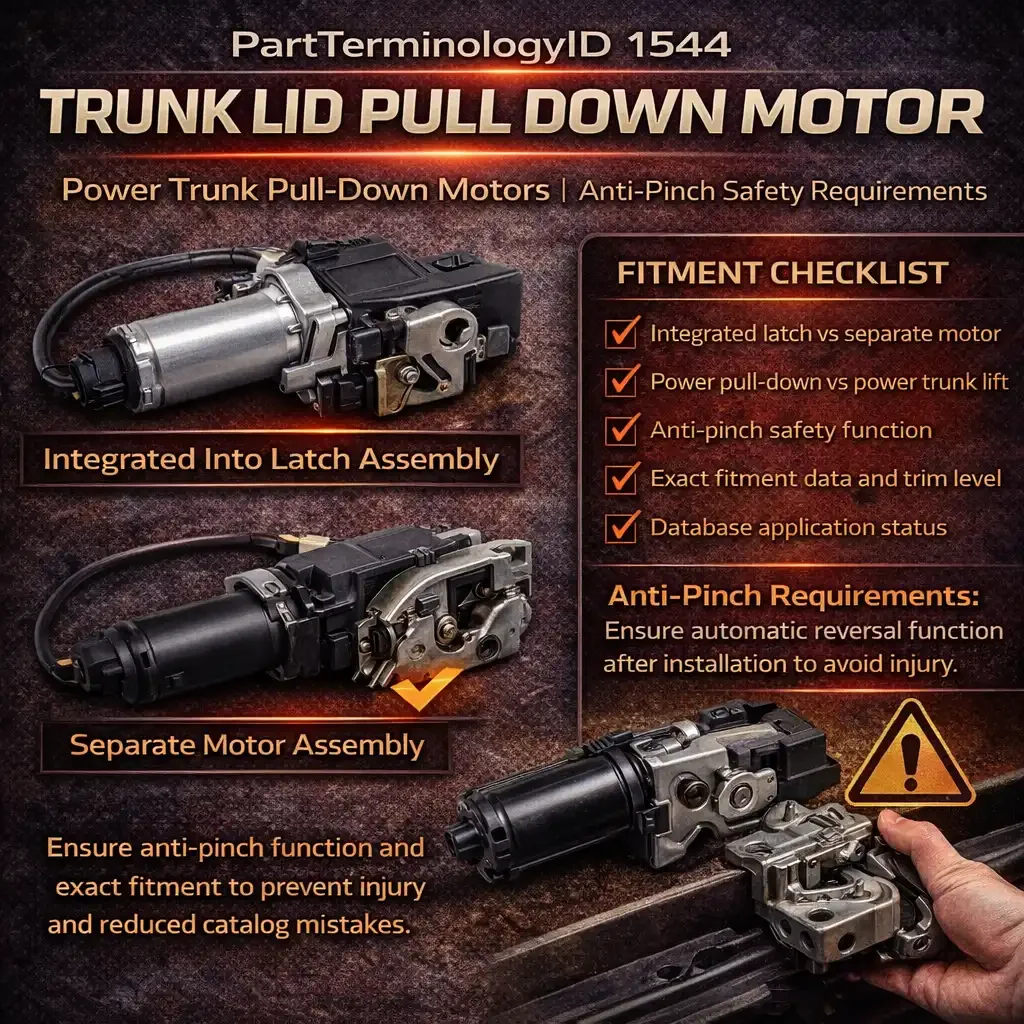
Pull-down motor assembly. The electric motor, the drive mechanism (cable, cam, or gear), and the mounting bracket. This assembly integrates into or mounts adjacent to the trunk latch. It is the standard replacement product.
Pull-down motor integrated into the latch assembly. On many vehicles, the pull-down motor is built into the trunk latch as a single unit. The motor cannot be purchased separately from the latch. If the motor fails, the entire latch assembly with pull-down motor must be replaced. This is the more common product form on modern vehicles.
Pull-down motor only (separate from latch). On some older luxury vehicles, the pull-down motor is a separate component that bolts to the trunk lid or body near the latch. It can be replaced independently of the latch.
What this part does NOT cover
Trunk latch. The mechanical latch that secures the trunk lid in the closed position. Different PartTerminologyID, though the pull-down motor may be integrated into the latch assembly.
Power trunk lift motor / trunk strut motor. The motor that raises the trunk lid automatically when the driver presses the key fob or trunk button. That is a power lift function (opening the trunk), not a pull-down function (closing the trunk). Different PartTerminologyID, different direction of operation.
Trunk lid hinge. The hinge that the trunk pivots on. Different PartTerminologyID.
Trunk lid strut / gas strut. The gas-charged strut that holds the trunk lid open. Different PartTerminologyID.
Trunk lid striker. The metal loop on the body that the latch hooks around. Different PartTerminologyID.
The Safety Concern: Anti-Pinch
The trunk pull-down motor applies significant force to close the trunk lid. If a hand, arm, grocery bag strap, or other object is in the path of the closing lid, the motor will attempt to pull the lid closed on the obstruction. Modern pull-down systems include an anti-pinch function that detects resistance beyond the normal force required to compress the weatherstrip seal. When excess resistance is detected, the motor reverses or stops, reopening the lid slightly to release the obstruction.
When the pull-down motor fails or is replaced with an incorrect unit, the anti-pinch function may not work. A pull-down motor without anti-pinch (or with a malfunctioning anti-pinch) will continue pulling the lid closed regardless of what is in the way. This can cause injury to fingers and hands, particularly for children who may have their hands near the trunk opening.
Every listing for a trunk lid pull-down motor should specify whether the anti-pinch function is included and should note: "Ensure the anti-pinch safety function is tested after installation."
How the System Works
The driver pushes the trunk lid partially closed. The lid does not need to be slammed. It only needs to reach a point where the latch's first stage (the secondary catch) engages the striker.
The pull-down motor activates. A sensor in the latch detects that the lid has reached the first-stage catch position. The body control module (BCM) or the latch's integrated controller commands the pull-down motor to run.
The motor pulls the lid down. The motor drives a cam, cable, or gear that rotates the latch mechanism, pulling the striker deeper into the latch. This compresses the trunk weatherstrip seal and seats the lid firmly.
The motor stops. The lid reaches the fully latched (second-stage) position. The motor stops, and the mechanism locks in the fully closed position.
To open, the normal trunk release is used. The pull-down motor does not impede normal trunk opening. The trunk release (key fob, interior button, or exterior handle) releases the latch, and the trunk struts push the lid open as usual.
Common Failure Modes
Motor burnout. The motor burns out from age, corrosion, or repeated stalling. The trunk lid reaches the first-stage catch but is not pulled into the fully closed position. The driver must manually push the lid down the final distance.
Motor runs but does not pull down. The internal gear or cam mechanism is stripped or broken. The motor spins but the latch is not actuated. Same pattern as the window motor stripped gear and the seat back motor stripped gear from previous posts.
Anti-pinch triggers falsely. The motor starts to pull the lid closed, detects false resistance (due to a worn or out-of-adjustment mechanism), and reverses. The trunk lid bounces back open repeatedly instead of latching. This can be caused by a failing motor, a worn latch mechanism, a misaligned striker, or a swollen weatherstrip seal.
Water intrusion. The pull-down motor is located in the trunk lid or in the latch area at the rear of the vehicle, exposed to water from rain, car washes, and road spray. Water intrusion into the motor or its connector causes corrosion, intermittent operation, and eventual failure. This is one of the most common failure causes, particularly in northern climates with road salt.
Wiring harness fatigue. The wiring harness to the trunk lid flexes every time the trunk is opened and closed. Over thousands of cycles, the wires fatigue and break, particularly at the point where the harness passes through the trunk lid hinge area. A broken wire in the harness can cause the same symptoms as a motor failure (pull-down does not operate) but replacing the motor does not fix a broken wire.
Vehicle-Specific Deep Dive: Where This Part Lives
Understanding which vehicles use trunk pull-down motors and how they implement the feature helps catalog teams scope the category and helps buyers confirm their vehicle is equipped:
GM / Cadillac
Cadillac has been the most prolific user of trunk pull-down motors in the domestic market. The feature has appeared on the DeVille, DTS, CTS, CT6, XTS, and other Cadillac sedans across multiple generations. GM also included pull-down on some Buick models (LaCrosse, Lucerne) and select Chevrolet models (Impala in higher trims). On GM vehicles, the pull-down motor is typically integrated into the trunk latch assembly. The most common failure on older GM pull-down systems is motor burnout caused by water intrusion through deteriorating latch seals.
Ford / Lincoln
Lincoln has used trunk pull-down on the Town Car, Continental, MKS, and MKZ. Ford included the feature on some Crown Victoria and Taurus models in higher trims. On Ford/Lincoln vehicles, the pull-down motor is often a separate component from the latch on older models (Town Car, Crown Victoria) and integrated on newer models (MKZ, Continental). The separate-motor design on older Lincolns makes the repair less expensive because only the motor is replaced, not the entire latch.
German luxury (Mercedes-Benz, BMW, Audi)
German luxury brands have used trunk pull-down extensively across their sedan lineups. Mercedes-Benz includes it on most S-Class, E-Class, and some C-Class models. BMW includes it on 5 Series, 7 Series, and some 3 Series. Audi includes it on A6, A8, and some A4 models. On German vehicles, the pull-down motor is almost always integrated into the latch assembly. The latch assemblies are more expensive than domestic counterparts (often $200 to $500 for the latch with motor). German vehicle pull-down systems tend to have more sophisticated anti-pinch calibration and may require a scan tool to reset or initialize the anti-pinch function after latch replacement.
Lexus / Toyota
Lexus includes trunk pull-down on the LS, GS, and ES in various generations. The feature is less common on Toyota-branded vehicles. Lexus pull-down systems are generally reliable, with the most common failure being motor burnout after 10 to 15 years.
What all of these have in common
The feature is found on vehicles that retail for $35,000 and above (when new), the owners expect premium function, and the repair costs are proportional to the vehicle class. A $300 latch assembly replacement on a $60,000 Cadillac is proportional. The same $300 part feels excessive to a second or third owner who purchased the vehicle for $8,000 with 150,000 miles.
OEM vs. Aftermarket vs. Recycled
OEM
The safest choice for this category. The pull-down motor integrates with the latch mechanism, the anti-pinch calibration, and the BCM communication. An OEM replacement ensures the anti-pinch function works correctly, the motor torque is appropriate for the trunk lid weight and weatherstrip resistance, and the connector and communication protocol match the vehicle. OEM latch assemblies with pull-down typically cost $150 to $500 depending on the vehicle.
Aftermarket
Aftermarket availability for trunk pull-down motors is limited compared to high-volume categories like brake pads or window regulators. The vehicle population is smaller (luxury/premium only), the product complexity is higher (integrated motor, anti-pinch, latch mechanism), and the liability exposure is real (anti-pinch failure can cause injury). Some aftermarket manufacturers offer pull-down latch assemblies for high-volume applications (GM Cadillac, Ford Lincoln), but coverage is not universal.
Quality considerations for aftermarket units:
Anti-pinch calibration. The anti-pinch threshold must be calibrated correctly. Too sensitive and the trunk bounces open on normal weatherstrip resistance. Too insensitive and the system does not reverse when it should, creating a pinch hazard. OEM units are calibrated to the specific vehicle's trunk lid weight, hinge friction, and weatherstrip resistance. Aftermarket units may use a generic calibration that does not match the vehicle precisely.
Motor torque and speed. The pull-down must complete its cycle smoothly and at the correct speed. A motor that is too slow makes the feature feel broken. A motor that is too fast can slam the trunk and stress the latch mechanism. OEM motors are tuned to the vehicle.
Weatherproofing. The motor and connector must be sealed against water intrusion. The trunk latch area is one of the wettest locations on the vehicle (directly exposed to rain when the trunk is open, and to road spray at all times). Aftermarket units with inadequate sealing will fail prematurely.
Recycled
OEM units from salvage vehicles. Correct fit, correct calibration, correct anti-pinch. The risk is water damage from the donor vehicle and unknown remaining motor life. Inspect the connector for corrosion and test the motor before purchasing if possible. Recycled latch assemblies with pull-down are a strong option for this category because the OEM engineering is preserved at a lower price.
The Full Diagnostic Path
Before ordering a pull-down motor or latch assembly, the buyer or mechanic should work through the complete diagnostic path:
Step 1: Confirm the vehicle is equipped with power pull-down. Not all trims have it. If the trunk has always required a firm push to close completely, the vehicle may not have a pull-down motor. Check the window sticker, the owner's manual, or look for the pull-down mechanism inside the trunk latch area.
Step 2: Check the fuse. The pull-down motor typically shares a fuse with other trunk/liftgate functions. A blown fuse means no pull-down operation. Replace the fuse and test.
Step 3: Inspect the trunk lid wiring harness. Open and close the trunk while watching the wiring harness where it passes through the hinge area. Look for kinked, pinched, or cracked wire insulation. Use a multimeter to test continuity on each wire from the body-side connector to the trunk-side connector. A broken wire is one of the most common causes of pull-down failure and is significantly less expensive to repair than replacing the motor.
Step 4: Listen for the motor. Close the trunk lid gently to the first-stage catch. Listen for the motor. If the motor hums or runs but the trunk does not pull down, the internal gear or cam mechanism is stripped. If there is no sound, the motor is not receiving power (wiring, fuse, switch, BCM command) or the motor itself has failed.
Step 5: Check striker alignment. If the pull-down activates but the trunk bounces back open, the striker may be misaligned. A misaligned striker creates excess resistance that triggers the anti-pinch reversal. Adjust the striker position (it is typically adjustable with two bolts) and retest.
Step 6: Check the weatherstrip. A swollen, hardened, or deteriorated weatherstrip changes the resistance the pull-down motor encounters. New weatherstrip that is too thick or old weatherstrip that has swollen from UV exposure or chemical contamination can trigger the anti-pinch reversal. Inspect the weatherstrip around the entire trunk opening.
Step 7: If all of the above check out, the motor (or latch assembly with motor) is the failure. Order the replacement.
This seven-step diagnostic path prevents unnecessary parts purchases and ensures the buyer orders the correct part after ruling out the simpler and less expensive causes.
Common Buyer Scenarios
Scenario 1: Wiring harness failure diagnosed as motor failure
A buyer with a 2012 Cadillac CTS notices the trunk pull-down has stopped working. They order a replacement latch assembly with pull-down motor ($280). After installation, the pull-down still does not work. A mechanic inspects the wiring harness and finds two broken wires inside the insulation at the hinge flex point. A $50 harness repair would have solved the problem. The $280 latch was unnecessary.
What helps: Step 3 of the diagnostic path. "Inspect the trunk lid wiring harness at the hinge flex point before ordering the motor."
Scenario 2: Striker misalignment after collision repair
A 2017 BMW 5 Series has the trunk pulled down and repainted after a minor rear-end collision. After reassembly, the trunk pull-down activates but the lid bounces back open every time. The body shop orders a new latch assembly. The actual problem is that the striker was reinstalled 3mm off its original position during reassembly. Adjusting the striker solves the problem.
What helps: Step 5 of the diagnostic path. "If the pull-down activates but the trunk bounces back open, check striker alignment before replacing the motor."
Scenario 3: Buyer orders lift motor instead of pull-down motor
A buyer with a 2015 Lincoln MKZ searches "trunk motor" and orders the power trunk lift motor (the motor that raises the trunk when the key fob button is pressed). Their actual problem is the pull-down (the trunk does not close automatically). The lift motor has nothing to do with closing. The buyer returns the lift motor and orders the correct pull-down latch assembly.
What helps: Clear function in every title. "Trunk Lid PULL-DOWN Motor (Closes Trunk)" is a different product from "Power Trunk LIFT Motor (Opens Trunk)."
Why This Category Creates Fitment Problems
Integrated latch versus separate motor
This is the primary product-form confusion. On many modern vehicles, the pull-down motor is not available separately. It is sold as part of the complete trunk latch assembly. The buyer searches for "trunk pull down motor" and cannot find a standalone motor because the product is cataloged as a trunk latch with pull-down. Conversely, on older vehicles where the motor is separate, the buyer may order a complete latch when they only need the motor.
Power lift versus pull-down confusion
The power trunk lift motor (opens the trunk) and the pull-down motor (closes the trunk) are different components. A buyer whose trunk does not close properly may search for the wrong motor. The lift motor pushes the trunk open. The pull-down motor pulls it closed.
Vehicle-specific
The motor mounting, the latch interface, the cam or cable mechanism, and the connector are all specific to the vehicle. There are no universal trunk pull-down motors.
Wiring harness as the actual failure
As noted above, a broken wire in the trunk lid harness produces the same symptom as a motor failure. Replacing the motor does not fix a broken wire. Diagnosis should include inspecting the harness at the hinge flex point and testing for continuity before ordering the motor.
Top Return Causes
1) Motor integrated into latch, standalone motor not available
Buyer orders a motor expecting a separate component. The product for their vehicle is the complete latch assembly with pull-down.
Prevention: Specify product form: "Trunk Latch Assembly with Pull-Down Motor (Motor Not Sold Separately for This Vehicle)" or "Pull-Down Motor Only (Separate from Latch)."
2) Power lift motor ordered instead of pull-down motor (or vice versa)
Buyer confuses the opening motor with the closing motor.
Prevention: Clear function in the title: "Trunk Lid PULL-DOWN Motor (Closes Trunk)" versus "Trunk Lid LIFT Motor (Opens Trunk)."
3) Wiring harness is the actual failure
Motor is fine but the harness is broken at the hinge flex point.
Prevention: "Before replacing the motor, inspect the trunk lid wiring harness where it passes through the hinge area. Flexing over thousands of open/close cycles can break wires internally. Test for continuity at the motor connector."
4) Striker misalignment or weatherstrip swelling causes false anti-pinch
The motor and latch are functional, but the system cannot fully close because the anti-pinch detects excess resistance from a misaligned striker or a swollen/hardened weatherstrip. The motor reverses instead of completing the pull-down.
Prevention: "If the trunk lid repeatedly bounces back open during pull-down, check the striker alignment and the condition of the trunk weatherstrip seal before replacing the motor. A misaligned striker or swollen seal can trigger the anti-pinch reversal."
5) Wrong vehicle application
Prevention: Exact ACES fitment. OEM part number cross-reference. Specify whether the vehicle is equipped with power pull-down (not all trims of a vehicle include this feature).
Compatibility Checklist for Buyers
1) Confirm your vehicle has a power trunk pull-down. Not all trims include this feature. If your trunk has always required a firm push to close and you have never noticed an automatic pull-down, your vehicle may not be equipped.
2) Determine the product form. Is the pull-down motor separate from the trunk latch on your vehicle, or is it integrated into the latch assembly?
3) Diagnose before ordering. Inspect the trunk lid wiring harness at the hinge flex point. Check striker alignment. Check weatherstrip condition.
4) Do not confuse pull-down (closes) with power lift (opens). They are different motors.
5) Confirm full vehicle details. Year, make, model, submodel, trim.
Catalog Checklist for Attributes
Core taxonomy: Product form (pull-down motor only, trunk latch with integrated pull-down motor, motor with bracket). Separate from Trunk Latch (without pull-down), Power Trunk Lift Motor, Trunk Hinge, Trunk Strut, and Trunk Striker.
Fitment: Year, make, model, submodel, trim. Power pull-down equipped (yes/no). OEM part number cross-reference.
Specs: Motor voltage (12V). Anti-pinch function included (yes/no). Connector type and pin count.
Package contents: Motor assembly (or latch with motor), mounting hardware, gasket or seal (if included).
Images: Motor or latch assembly from multiple angles, connector, mounting points, cam/cable interface, and installed reference.
FAQ
My trunk does not close all the way. Is it the pull-down motor?
Possibly. If the trunk reaches the first-stage catch but is not pulled into the fully closed position, the pull-down motor may have failed. However, also check the trunk striker alignment (a misaligned striker prevents full latching), the trunk weatherstrip (a swollen or hardened seal creates excess resistance), and the wiring harness (a broken wire at the hinge prevents power from reaching the motor).
Is the pull-down motor the same as the power trunk lift motor?
No. The pull-down motor closes the trunk (pulls the lid down from the first-stage catch to fully latched). The power trunk lift motor opens the trunk (pushes the lid up when you press the key fob or button). They are different motors in different locations performing opposite functions.
My trunk keeps bouncing open when I try to close it. What is wrong?
The anti-pinch system is detecting excessive resistance and reversing the pull-down. Check for a misaligned trunk striker, a swollen or hardened weatherstrip seal, or an obstruction in the latch area. If the striker and seal are fine, the pull-down motor or its anti-pinch sensor may be malfunctioning.
Final Take for Aftermarket Teams
Trunk Lid Pull Down Motor (PartTerminologyID 1544) is a luxury-market component where the product-form question (standalone motor versus integrated latch assembly) is the first catalog decision, and the lift-versus-pull-down distinction is the first buyer education task. The catalog teams that reduce returns specify the closing function prominently (PULL-DOWN, closes trunk), distinguish from the power lift motor (opens trunk), note whether the motor is available separately or only as part of the latch, include the wiring harness inspection note, and remind the buyer to check striker alignment and weatherstrip condition before ordering. It is a premium feature on premium vehicles, and the listing must deliver a premium level of clarity.