
Brake Pedal Pad (PartTerminologyID 1552): The Safety-Critical Rubber Cover That Nobody Replaces Until Their Foot Slides Off the Brake in the Rain
Written by Arthur Simitian | PartsAdvisory
If you read the Accelerator Pedal Pad post (PartTerminologyID 1548), you already know the story. The brake pedal pad is the same concept applied to the brake pedal: a rubber or plastic cover on the face of the pedal that provides grip for the driver's foot. It wears smooth over time, the ridges flatten, the rubber hardens and cracks, and eventually the driver's foot slips on a surface that was designed to prevent exactly that.
The difference is the consequence. A foot slipping off the accelerator means a momentary loss of throttle. A foot slipping off the brake means a momentary loss of stopping power. In an emergency braking situation, in rain where shoes are wet, or in stop-and-go traffic where the driver's foot is moving between pedals repeatedly, a worn brake pedal pad creates a real safety risk.
Despite this, brake pedal pads are one of the most neglected replacement items on any vehicle. Drivers replace brake pads (the friction material on the rotor) on schedule. They almost never replace the brake pedal pad (the rubber cover on the pedal they press to activate those brake pads). The rubber cover is not part of any scheduled maintenance interval. No mechanic includes it in a brake service inspection. It wears gradually enough that the driver adapts to the reduced grip without noticing until a wet shoe slides off the pedal at the worst possible moment.
This post is built for aftermarket catalog teams, marketplace sellers, and buyers who want fewer mistakes and fewer returns.
Status in New Databases
Status in New Databases
Current: PIES 7.2 + PCdb Future: PIES 8.0 + PCdb 2.0 Status: No change
What Brake Pedal Pad Means in the Aftermarket
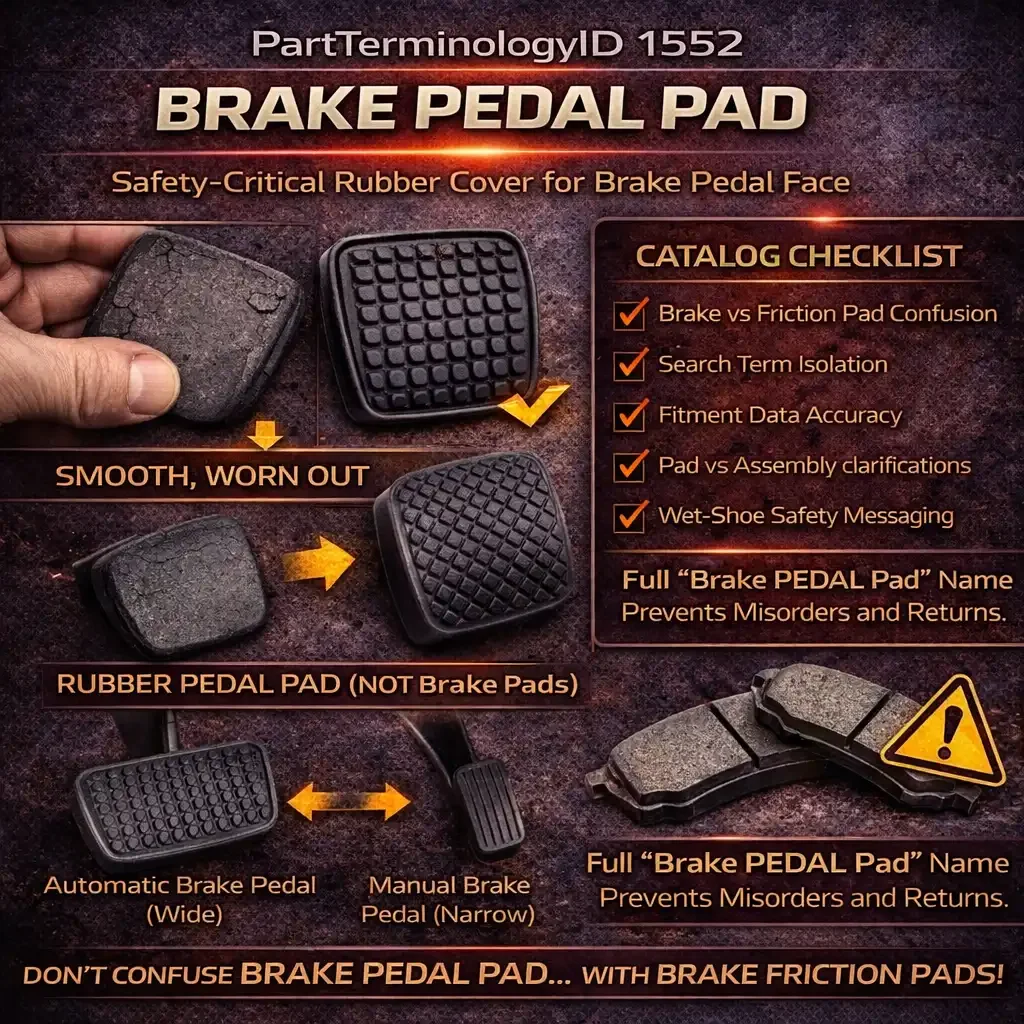
Brake Pedal Pad (PartTerminologyID 1552) refers to the replaceable rubber or plastic cover on the face of the brake pedal.
In catalog reality, this covers:
Rubber pedal pad (slip-on). A rubber cover that slides over the brake pedal arm or face. Held in place by friction, internal tabs, or a metal retention clip. The most common product form. Slide the old pad off, slide the new one on.
Rubber pedal pad (screw or pin mount). Some brake pedal pads are secured with a screw, roll pin, or rivet through the pedal arm. The retention is more positive than a friction fit, but replacement requires removing the fastener.
Pedal pad with integrated wear indicator. Some OEM brake pedal pads have raised ridges or patterns that serve as a visual wear indicator. When the ridges are worn flat, the pad is due for replacement. This is the same concept as tire tread wear indicators but for the pedal surface.
Aftermarket pedal cover (universal). Aluminum, stainless steel, or rubber covers designed to fit over the existing pedal face. Available in universal sizes. These are accessories that may be cataloged under or searched for using this PartTerminologyID.
What this part does NOT cover
Brake pads (friction material). The pads that press against the brake rotor to slow the vehicle. Completely different part, completely different function. The naming overlap between "brake pedal pad" and "brake pad" is a source of confusion.
Brake pedal assembly. The complete pedal arm, pivot, bracket, pushrod, and (on some vehicles) brake light switch mount. Different PartTerminologyID.
Accelerator pedal pad (PartTerminologyID 1548). Different pedal.
Clutch pedal pad. Different pedal (manual transmission vehicles).
Parking brake pedal pad. The rubber pad on the foot-operated parking brake pedal. Different PartTerminologyID (relates to Parking Brake Pedal Release Handle, 1450).
Dead pedal / footrest. The stationary footrest. Different component.
The "Brake Pad" Naming Collision
This deserves its own section because it is the single largest search and catalog confusion in this PartTerminologyID:
A buyer who searches "brake pad" is looking for brake friction pads (the pads that press against the rotor) approximately 99% of the time. The remaining 1% are looking for the brake pedal pad (the rubber cover on the pedal). The search term is identical. The products are completely unrelated.
This creates two problems:
The brake pedal pad buyer is overwhelmed by brake friction pad results. They search "brake pad" and get thousands of results for brake friction pads. They cannot find the rubber pedal cover because it is buried under pages of rotor-related brake pads.
The brake friction pad buyer accidentally finds a pedal pad. Less common, but a buyer who searches "brake pad" and clicks on a pedal pad listing may order it thinking it is a friction pad. They receive a small rubber cover instead of a box of brake pads.
Catalog solution: Always use the full term "brake PEDAL pad" in the title. Never abbreviate to "brake pad." Include "rubber cover for brake pedal" or "pedal face cover" in the description to reinforce what the product is. Use the "NOT brake friction pads" clarification in the first line of the description if the platform allows it.
Everything From the Accelerator Pedal Pad Post Applies
The fitment variables, dimensional considerations, and retention methods covered in the Accelerator Pedal Pad post (1548) apply here with the same logic:
Pedal arm width and cross-section must match. The brake pedal arm is typically wider than the accelerator pedal arm (because the brake pedal requires more foot surface area for effective braking force), so brake pedal pads are not interchangeable with accelerator pedal pads even on the same vehicle.
Retention method must match. Slip-on, clip, screw, or pin. The brake pedal experiences higher foot forces than the accelerator (the driver pushes harder on the brake), so the retention must be secure. A pad that slides off the brake pedal during hard braking is a serious safety issue.
Vehicle-specific dimensions. The pad must fit the specific vehicle's brake pedal arm. OEM-spec pads are the safest choice for exact fit.
Universal pads are an option but carry risk. A universal pad that shifts position under hard braking or does not cover the full pedal face reduces effective braking control.
Automatic vs. Manual Transmission Pedal Differences
On automatic transmission vehicles, the brake pedal is wider and more prominently positioned because the driver's left foot is not needed for a clutch pedal. The brake pedal pad on an automatic may be wider than the brake pedal pad on the manual transmission version of the same vehicle.
On manual transmission vehicles, the brake pedal is narrower to allow room for the clutch pedal to the left. The brake pedal pad is correspondingly narrower. Ordering a pad for the automatic version on a manual transmission vehicle (or vice versa) results in a pad that is too wide or too narrow.
This is a fitment variable that many buyers and even some catalog teams overlook. The listing must specify: "For Automatic Transmission" or "For Manual Transmission" on vehicles where the brake pedal width differs.
The Cross-Shopping Bundle
As noted in the Accelerator Pedal Pad post, buyers who need one pedal pad typically need all of them. The brake pedal pad, accelerator pedal pad, and clutch pedal pad (if applicable) wear at similar rates because they are exposed to the same conditions.
A "pedal pad set" or "pedal pad kit" that includes all applicable pedal covers for the vehicle is a high-value bundle product. The buyer came for one pad and leaves with three. The add-on sale is easy because the logic is obvious: if one pad is worn, they are all worn.
Top Return Causes
1) Buyer ordered brake friction pads, received a pedal pad
The naming collision. Buyer expected a box of brake pads for the calipers and received a small rubber cover.
Prevention: Full naming: "Brake PEDAL Pad (Rubber Cover for Brake Pedal Face)." Description first line: "This is the rubber cover that fits over the brake pedal. This is NOT brake friction pads for the calipers/rotors."
2) Buyer ordered the brake pedal assembly when they needed only the pad
Same pattern as the accelerator pedal pad. $150 pedal assembly returned when an $8 rubber pad was all that was needed.
Prevention: "Brake Pedal PAD (Rubber Cover Only). This is NOT the complete brake pedal assembly."
3) Wrong transmission type (automatic versus manual)
Pad is too wide or too narrow because it was designed for the other transmission type.
Prevention: Specify: "For Automatic Transmission (Wide Pedal)" or "For Manual Transmission (Narrow Pedal)."
4) Pad does not stay on during hard braking
Friction-fit pad slides off because the pedal arm is worn or because the retention method does not match.
Prevention: Specify retention method. "If the pedal arm surface is corroded or worn smooth, clean the surface with sandpaper before installing a friction-fit pad for better grip."
5) Wrong pedal (accelerator pad ordered instead of brake pad, or vice versa)
Buyer orders the wrong pedal's pad. The two are different sizes and shapes.
Prevention: "BRAKE Pedal Pad" in the title. Include a photo showing the pad on the brake pedal specifically.
Compatibility Checklist for Buyers
1) Confirm you need the pedal pad (rubber cover), not brake friction pads or the pedal assembly.
2) Confirm transmission type. Automatic or manual. Brake pedal width may differ.
3) Confirm the pedal and retention method. Slip-on, clip, screw, or pin.
4) Confirm full vehicle details. Year, make, model, submodel.
5) Consider ordering the accelerator and clutch pedal pads at the same time. They are likely worn to a similar degree.
Catalog Checklist for Attributes
Core taxonomy: Product form (OEM replacement pad, universal cover, pedal pad set). Separate from Brake Friction Pads, Brake Pedal Assembly, Accelerator Pedal Pad, Clutch Pedal Pad, Parking Brake Pedal Pad, and Dead Pedal Cover.
Fitment: Year, make, model, submodel. Transmission type (automatic or manual, where pedal width differs). OEM part number cross-reference.
Physical specs: Material (rubber, plastic, aluminum). Retention method (slip-on, clip, screw, pin). Dimensions (width, height, thickness).
Package contents: Pad, retention clip or hardware (if applicable).
Images: Pad from front (textured face), pad from rear (showing attachment channel or method), pad installed on brake pedal, and dimension callouts for universal pads.
FAQ
Is the brake pedal pad the same as brake pads?
No. The brake pedal pad is the rubber cover on the brake pedal inside the cabin (the pedal you press with your foot). Brake pads (friction pads) are the components in the brake calipers that press against the rotors to stop the vehicle. Completely different parts, completely different location, completely different function.
How do I know if my brake pedal pad needs replacing?
Look at the face of the brake pedal. If the textured ridges are worn smooth, if the rubber is cracked or hardened, if the pad is loose or has shifted on the pedal arm, or if your foot has ever slipped on the pedal (especially in wet conditions), the pad should be replaced.
Is the brake pedal pad the same width on automatic and manual transmission vehicles?
Not always. On many vehicles, the automatic transmission brake pedal is wider than the manual transmission brake pedal because the automatic does not have a clutch pedal competing for footwell space. Check whether your vehicle's listing specifies automatic or manual.
Final Take for Aftermarket Teams
Brake Pedal Pad (PartTerminologyID 1552) is the companion to the Accelerator Pedal Pad (1548) with one additional and critical catalog challenge: the naming collision with brake friction pads. "Brake pad" means friction pads to 99% of searchers. The 1% who need the pedal pad must be able to find it and must not be confused by or confused with the friction pad results. The catalog teams that serve this category put "PEDAL" in the title so it cannot be missed, specify automatic versus manual transmission where pedal width differs, cross-reference with accelerator and clutch pedal pads as a bundle, and include the safety note about worn rubber and wet-shoe slip risk. It is a $5 to $15 part that prevents a priceless accident.