
Sunroof Motor (PartTerminologyID 1536): The Motor Buried in the Headliner That Leaks, Jams, and Traps You With a Roof You Cannot Close
Written by Arthur Simitian | PartsAdvisory
The sunroof motor is the electric motor that opens, closes, tilts, and (on some vehicles) slides the sunroof glass panel. It is mounted in the headliner area, typically at the front or rear edge of the sunroof opening, and drives the sunroof glass through a cable, gear track, or linkage system.
When the sunroof motor fails, the driver is left with a sunroof panel that is stuck open, stuck closed, stuck tilted, or stuck partway through its travel. Stuck open is the emergency: rain, snow, debris, and theft exposure until the roof is manually closed or covered. Stuck closed is an inconvenience. Stuck partway is the worst of both scenarios because the glass may not seal properly against wind noise and water intrusion while also being cosmetically and functionally wrong.
Like every other motor in this series (window motor 1516, convertible top motor 1524, seat motor 1528), the sunroof motor shares symptoms with other failures in the system. The motor may be fine while the problem is a jammed track, a broken cable, a failed switch, or a blown fuse. Diagnosis before ordering prevents the most common return.
This post is built for aftermarket catalog teams, marketplace sellers, and buyers who want fewer mistakes and fewer returns.
Status in New Databases
Status in New Databases
Current: PIES 7.2 + PCdb Future: PIES 8.0 + PCdb 2.0 Status: No change
What Sunroof Motor Means in the Aftermarket
Sunroof Motor (PartTerminologyID 1536) refers to the electric motor that operates the power sunroof or moonroof panel.
In catalog reality, this covers:
Sunroof motor assembly. The electric motor with its integral gear reduction, mounting bracket, and electrical connector. The motor drives the sunroof glass via cables that run in tracks along both sides of the sunroof opening. This is the standard replacement product.
Sunroof motor with control module. On newer vehicles, the motor assembly includes an integrated electronic module that controls the sunroof's open/close sequencing, anti-pinch safety function, express open/close, and tilt operation. The module and motor are one unit. Replacing the motor replaces the module, and the new unit may require initialization (a learn procedure where the sunroof is cycled through its full range so the module learns the end-of-travel positions).
Sunroof motor only (without module). On vehicles where the motor and control module are separate components, the motor can be replaced independently. Less common on modern vehicles where integration is the norm.
What this part does NOT cover
Sunroof glass panel. The glass itself. Different PartTerminologyID.
Sunroof frame / track assembly. The metal frame and guide tracks that the glass rides in. Different PartTerminologyID.
Sunroof cable. The drive cables that connect the motor to the glass carrier. May be sold separately on some vehicles.
Sunroof switch. The button or control on the headliner or overhead console. Different PartTerminologyID.
Sunroof drain tubes. The rubber tubes that channel water from the sunroof tray to the vehicle's exterior. A clogged drain is the most common sunroof complaint (water leaking into the cabin) and has nothing to do with the motor.
Sunroof shade / sunshade. The interior sliding shade under the glass. Different PartTerminologyID.
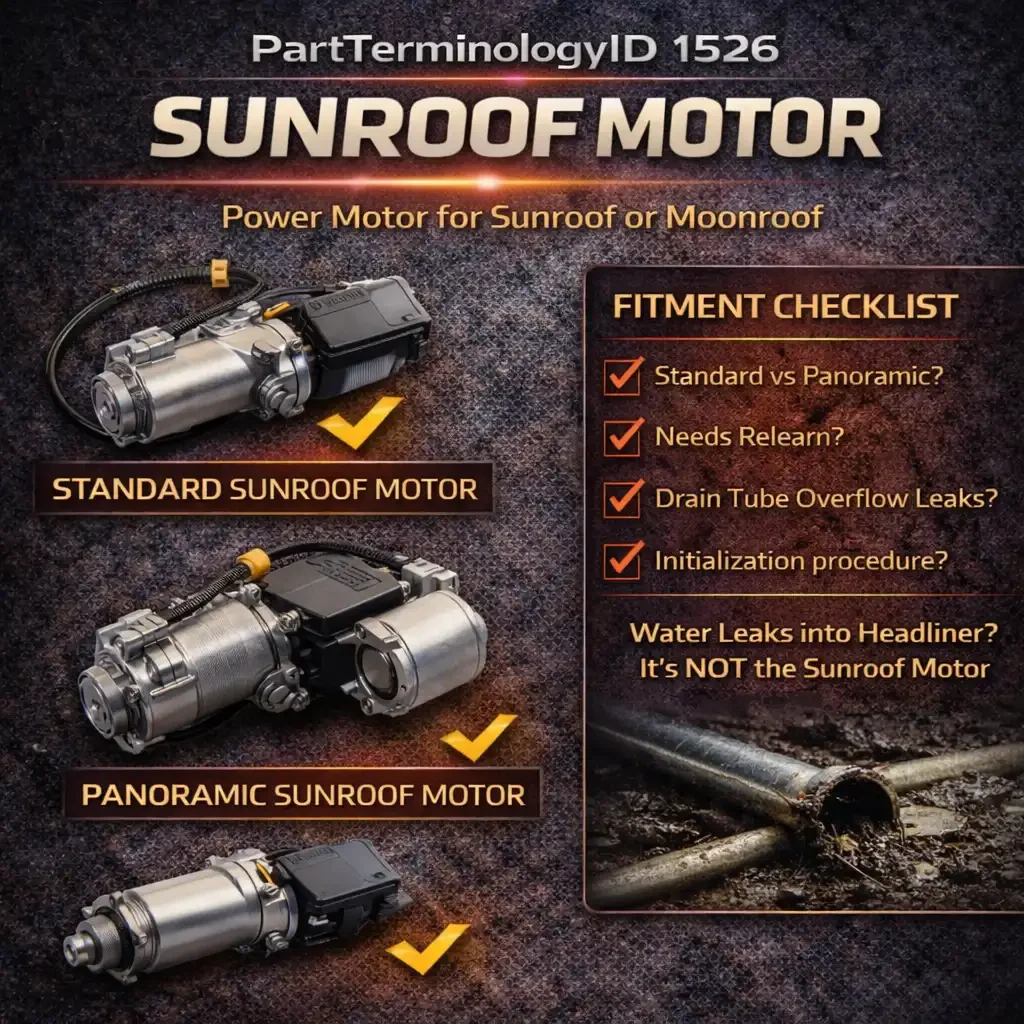
Panoramic sunroof motor. Some panoramic sunroofs use a different motor than a standard sunroof because the glass panel is larger and heavier. The motor must be matched to the sunroof type.
The Initialization / Relearn Requirement
This is the post-installation step that catches buyers off guard, similar to the programming requirement on the Steering Column Lock Actuator (PartTerminologyID 1506):
On most vehicles built since the early 2000s, the sunroof motor (or its integrated control module) must be initialized after replacement. The initialization procedure teaches the new motor where the fully open, fully closed, tilt, and vent positions are. Without initialization, the sunroof may:
Not respond to the switch at all
Move but not stop at the correct positions
Not perform express open/close (one-touch)
Not activate the anti-pinch safety function
The initialization procedure varies by manufacturer but typically involves holding the sunroof switch in the close direction for several seconds after the glass reaches the fully closed position, then holding it in the open direction for several seconds after it reaches full open. Some vehicles require a scan tool. The listing should reference the initialization procedure or note that one is required.
The Drain Problem That Is Not a Motor Problem
This deserves its own section because it is the single most common misdiagnosis in the sunroof category:
When water leaks into the cabin from the sunroof area, the buyer searches for sunroof parts and often lands on the sunroof motor. The motor has nothing to do with water leaks. Sunroofs are designed to allow a small amount of water past the glass seal into a drain tray molded into the roof panel. This water is channeled through drain tubes (typically four: two at the front corners, two at the rear corners) that route the water down through the A-pillars and C-pillars to exit under the vehicle.
When these drain tubes clog with leaves, dirt, pollen, or debris, the water backs up in the tray and overflows into the headliner, dripping onto the occupants, the seats, and the electronics. The fix is clearing the drain tubes, not replacing the motor. A catalog listing for a sunroof motor that includes a note about drain maintenance helps redirect the buyer who arrived at the wrong product.
Why This Category Creates Fitment Problems
Sunroof type
Standard sliding sunroof. A single glass panel that slides open along the roof. The motor drives the panel rearward to open and forward to close.
Tilt-and-slide sunroof. The glass tilts up at the rear edge for ventilation and also slides open. The motor must control both movements, typically via a switch that provides tilt in one direction and slide in another.
Panoramic sunroof. A large glass panel (or multiple panels) that may extend over both front and rear seats. The motor for a panoramic roof is typically larger and higher-torque than a standard sunroof motor because the glass is heavier. Panoramic sunroof motors are not interchangeable with standard sunroof motors.
Spoiler sunroof. The glass panel tilts up and slides on top of the fixed roof rather than retracting into a pocket. Different track and motor mechanism.
Vehicle-specific in every dimension
The motor mounting location, the cable type and routing, the connector, the gear interface, and the control module integration are all specific to the vehicle. A sunroof motor from a 2015 Accord does not fit a 2015 Civic even though both are Hondas.
Anti-pinch safety
Modern sunroof motors include an anti-pinch function that reverses the motor if the closing glass encounters an obstruction (such as a hand or object in the opening). This safety feature is required by regulation on most markets. The anti-pinch sensor may be integrated into the motor/module or may be a separate component. If the anti-pinch function is integrated into the motor, the replacement motor must include it.
Top Return Causes
1) Motor ordered when the track or cable is jammed
The motor is receiving power but cannot move because the sunroof track is obstructed, the cables are kinked, or the glass carrier is jammed. Replacing the motor does not fix a jammed track.
Prevention: "If the motor hums or clicks but the sunroof does not move, the track or cables may be jammed. Inspect and lubricate the sunroof tracks before replacing the motor. Debris in the tracks is a common cause of sunroof binding."
2) Initialization not performed
New motor installed, sunroof does not respond correctly.
Prevention: "INITIALIZATION REQUIRED after installation. The sunroof motor must learn the fully open, fully closed, and tilt positions. See your vehicle's service manual for the initialization procedure."
3) Water leak assumed to be motor-related
Buyer orders a motor thinking it will fix a sunroof water leak. The motor has no role in water sealing.
Prevention: "Sunroof water leaks are caused by clogged drain tubes, not motor failure. If water is leaking into the cabin from the sunroof area, inspect and clear the four sunroof drain tubes before ordering any sunroof components."
4) Wrong sunroof type
Motor for a standard sunroof ordered for a panoramic sunroof, or vice versa.
Prevention: Specify sunroof type: "For Standard Sliding Sunroof" or "For Panoramic Sunroof."
5) Motor ordered when the switch or fuse is the failure
No response from the sunroof. The fuse is blown or the switch has failed.
Prevention: "If the sunroof does not respond at all, check the sunroof fuse first. If the fuse is good, test the switch by checking for power at the motor connector."
Compatibility Checklist for Buyers
1) Diagnose before ordering. Check the fuse. Test the switch. Listen for the motor. If the motor runs but the roof does not move, the track or cables are the problem, not the motor.
2) If you have a water leak, check the drain tubes first. Clogged drains are the most common sunroof complaint and have nothing to do with the motor.
3) Confirm sunroof type. Standard sliding, tilt-and-slide, panoramic, or spoiler.
4) Confirm full vehicle details. Year, make, model, submodel.
5) Plan for initialization after installation. The motor must learn the open/close positions before it operates correctly.
6) Confirm whether the motor includes the control module. Integrated motor/module or motor-only.
Catalog Checklist for Attributes
Core taxonomy: Product form (motor assembly, motor with control module, motor only). Sunroof type: standard, panoramic, spoiler. Separate from Sunroof Glass, Sunroof Frame/Track, Sunroof Cable, Sunroof Switch, Drain Tube, and Sunshade.
Fitment: Year, make, model, submodel. Sunroof type (standard, panoramic). OEM part number cross-reference.
Specs: Motor voltage (12V). Anti-pinch function included (yes/no). Control module integrated (yes/no). Connector type and pin count.
Installation notes: Initialization procedure required (yes/no). Initialization method (switch-based or scan tool).
Package contents: Motor assembly, mounting hardware (if included).
Images: Motor from multiple angles, connector, mounting bracket, gear/cable output interface, and installed reference showing location in headliner area.
FAQ
My sunroof is leaking water. Do I need a new motor?
No. Sunroof water leaks are caused by clogged drain tubes, deteriorated glass seals, or a misaligned glass panel. The motor operates the glass movement and has no role in water sealing. Inspect and clear the four drain tubes (two front, two rear) before ordering any parts.
The sunroof does not work after I replaced the motor. What is wrong?
The motor likely needs initialization. After replacement, the motor must learn the fully open, fully closed, and tilt positions. Perform the initialization procedure per your vehicle's service manual. This typically involves holding the close switch past the fully closed position for 10 to 15 seconds, then holding the open switch past the fully open position for 10 to 15 seconds.
Can I manually close a sunroof with a dead motor?
Most vehicles with a power sunroof have a manual close provision. This is typically an Allen wrench socket or a screwdriver slot accessible through a small cover in the headliner near the sunroof motor. Inserting the tool and turning it manually drives the motor's gear and closes the glass. Check your owner's manual for the location and procedure.
Final Take for Aftermarket Teams
Sunroof Motor (PartTerminologyID 1536) is a category where two non-motor problems drive the majority of incorrect orders: jammed tracks (motor runs but glass does not move) and clogged drain tubes (water leak blamed on the sunroof system). The catalog teams that reduce returns include diagnostic guidance for both, specify the initialization requirement, distinguish standard from panoramic sunroof types, and note the manual close provision so the buyer can secure their vehicle while waiting for the replacement. The sunroof motor is a $100 to $400 part on a system where the $0 fix (clearing a drain tube or lubricating a track) solves the problem more often than the part does.