
Seat Back Motor (PartTerminologyID 1532): The Recline Motor That Gets Its Own PartTerminologyID Because It Is the Seat Adjustment That Fails the Most and Matters the Most
Written by Arthur Simitian | PartsAdvisory
The Seat Motor post (PartTerminologyID 1528) covered the full family of seat adjustment motors. This post focuses on one specific motor that the catalog standard separates out with its own PartTerminologyID: the Seat Back Motor, which controls the seatback recline angle.
Why does the recline motor get its own PartTerminologyID when the track motor, height motor, and lumbar motor are all grouped under the general Seat Motor (1528)? Because the seatback recline is the adjustment that experiences the most stress, the most use, and the most consequential failure:
It carries the most load. The seatback supports the full weight of the occupant's torso leaning against it. Every time the driver or passenger shifts position, leans back, reaches for something behind the seat, or a rear passenger pushes against the seatback, the recline mechanism and its motor absorb the force.
It is adjusted the most frequently. Drivers adjust recline more often than any other seat function. Different driving postures for highway cruising versus city driving, adjusting for comfort on long trips, and reclining to rest all exercise the recline motor more than the track or height motors.
A failure is immediately noticeable and cannot be ignored. If the height motor fails, the seat stays at its last height and the driver can still drive. If the track motor fails, the seat stays at its last position and the driver can usually still reach the pedals. If the recline motor fails with the seatback reclined too far, the driver cannot sit upright enough to safely drive. If it fails with the seatback too upright, the driver is uncomfortable but functional. Either way, a recline failure changes the driving position in a way that demands immediate repair.
This post is built for aftermarket catalog teams, marketplace sellers, and buyers who want fewer mistakes and fewer returns.
Status in New Databases
Status in New Databases
Current: PIES 7.2 + PCdb Future: PIES 8.0 + PCdb 2.0 Status: No change
What Seat Back Motor Means in the Aftermarket
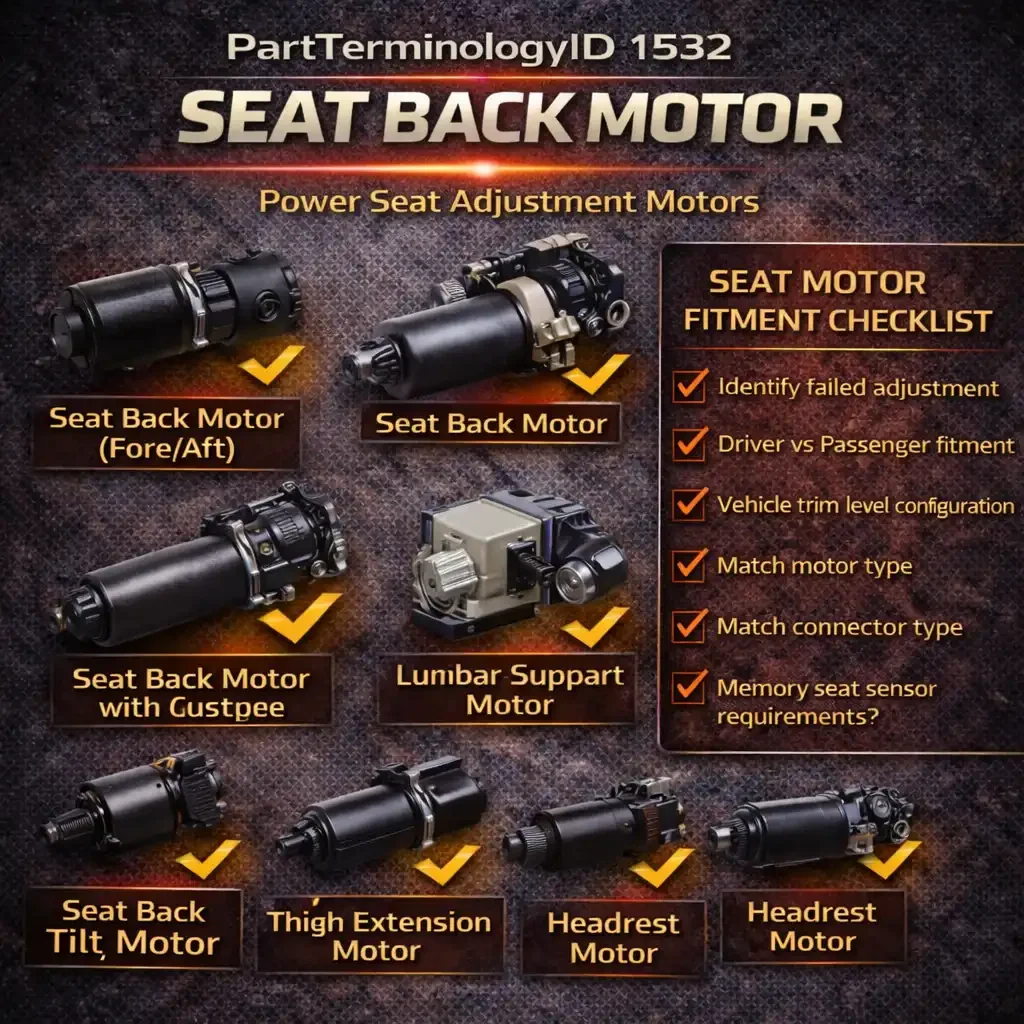
Seat Back Motor (PartTerminologyID 1532) refers to the electric motor that adjusts the seatback angle (recline) on a power seat.
In catalog reality, this covers:
Seat back recline motor. The electric motor mounted at or near the recline pivot point on the seat frame. It drives a gear mechanism (typically a sector gear or worm gear) that rotates the seatback forward or rearward relative to the seat cushion. This is the primary product.
Seat back motor with gearbox. On some designs, the motor and its reduction gearbox are an integrated unit. The gearbox provides the high torque needed to move the seatback against the occupant's weight. The motor and gearbox are replaced as a unit.
Seat back motor with position sensor. On vehicles with memory seats, the recline motor includes a position sensor (potentiometer or encoder) that reports the seatback angle to the seat control module. The module uses this feedback to return the seatback to a stored position. Without the sensor, the motor works but the memory function for recline does not.
Upper seatback motor (split-fold or power-fold). Some vehicles have a power-fold function on the rear seatback (for expanding cargo area) or a split-fold function driven by a motor. This is a different application from the front seat recline adjustment but may be cataloged under the same PartTerminologyID.
What this part does NOT cover
Seat motor (general) (PartTerminologyID 1528). The broader category covering track, height, lumbar, tilt, and other seat motors.
Manual recline mechanism / recline lever. The hand-operated lever on non-power recline seats. Different mechanism, no motor.
Seat back latch. The latch that holds a folding seatback in the upright position. Mechanical component, different PartTerminologyID.
Seat back panel / trim. The cosmetic panel on the back of the seat. Different PartTerminologyID.
Lumbar support motor. Adjusts the lumbar support within the seatback, not the seatback angle itself. Different motor, different function (covered under PartTerminologyID 1528).
How the Recline Mechanism Works
The seatback pivots on a hinge at the junction of the seat cushion frame and the seatback frame. The recline motor drives a gear at this pivot point. The gear mechanism must be strong enough to hold the seatback at any angle under the occupant's weight without drifting or creeping. This is why the recline motor and gearbox are typically heavier-duty than other seat motors.
The gear is the weak point. The recline gear mechanism (often a sector gear driven by a worm gear) must hold position under constant load. Over time, the gear teeth wear, and the seatback develops play (a slight rocking or looseness at the recline pivot). Eventually, the gears strip enough that the motor turns but the seatback does not move, or the seatback cannot hold position and drifts backward under load.
Motor burnout from forcing past the stop. The recline mechanism has a defined range of motion (typically from nearly flat to about 10 degrees forward of vertical). When the motor drives the seatback to the end of its range, a limit switch or the motor's stall-detection circuit should stop the motor. If the limit mechanism fails or the driver holds the switch after the seatback has reached its stop, the motor stalls against the mechanical limit and can burn out.
Why This Category Creates Fitment Problems
Everything from the Seat Motor (1528) post applies
Side (driver versus passenger), trim level (seat configuration), memory seat sensor, motor pack versus individual motor, and connector compatibility all apply exactly as described in the Seat Motor post. Read that post for the full fitment variable discussion.
Recline motor location varies by design
On some vehicles, the recline motor mounts on the outboard side of the seat (visible when looking at the seat from the door opening). On others, it mounts on the inboard side (between the seat and the center console). On some designs, it mounts at the rear of the recline pivot. The mounting location determines the motor's shape, bracket, and output shaft orientation. A motor designed for the outboard position will not fit the inboard position.
Recline motor versus power lumbar motor confusion
Both motors are inside the seatback area. When the buyer's seatback adjustment fails, they must determine whether the recline (seatback angle) is the failure or the lumbar (the support bulge within the seatback) is the failure. These are different motors with different part numbers. Pressing the recline switch should tilt the entire seatback. Pressing the lumbar switch should change only the firmness or shape of the lower seatback support area without moving the seatback angle.
Power-fold rear seat motor versus front recline motor
On vehicles with power-folding rear seats, the motor that folds the rear seatback flat is a different application from the motor that reclines the front seat. Both involve moving a seatback, but the mechanism, the motor size, the mounting, and the connector are different.
Top Return Causes
1) Recline motor ordered when lumbar motor was the failure
Buyer's seatback support feels wrong. They assume it is the recline motor. The actual failure is the lumbar motor or lumbar bladder.
Prevention: "This is the SEATBACK RECLINE motor (adjusts the angle of the entire seatback). If only the lumbar support (lower back firmness) has failed, you need the Lumbar Support Motor, not the Seat Back Motor."
2) Wrong side (driver versus passenger)
Prevention: Side in the title: "Driver (Left Side)" or "Passenger (Right Side)."
3) Motor without position sensor for memory seat
Motor works but the memory seat does not return the seatback to the stored angle.
Prevention: "With Position Sensor (Memory Seat)" or "Without Position Sensor (Non-Memory Seat)."
4) Front recline motor ordered for rear power-fold application (or vice versa)
Prevention: Specify seat position: "Front Seat Recline Motor" or "Rear Seatback Power-Fold Motor."
5) Gear mechanism is the failure, not the motor
The motor runs (buyer can hear it) but the seatback does not move or has excessive play. The gears at the recline pivot are stripped. Replacing the motor does not fix stripped gears.
Prevention: "If the motor runs but the seatback does not move or has excessive play/rocking, the recline gear mechanism may be worn or stripped. The motor drives the gear, but if the gear teeth are damaged, a new motor will not resolve the issue. Inspect the recline gear mechanism before ordering."
Compatibility Checklist for Buyers
1) Confirm the failure is the recline (seatback angle), not the lumbar (lower back support). Press the recline switch: does the entire seatback move? Press the lumbar switch: does the firmness of the lower back area change? Identify which function has failed.
2) Listen for the motor. If the motor runs but the seatback does not move, the gear mechanism may be stripped rather than the motor failed.
3) Confirm side. Driver (Left) or Passenger (Right).
4) Confirm front or rear seat.
5) Confirm memory seat. If equipped, the motor must include a position sensor.
6) Confirm trim level and seat configuration.
7) Confirm full vehicle details. Year, make, model, submodel, trim.
Catalog Checklist for Attributes
Core taxonomy: Product form (recline motor only, motor with gearbox, motor with position sensor, rear seatback power-fold motor). Separate from Seat Motor (general), Lumbar Motor, Manual Recline Mechanism, Seatback Latch, and Seatback Panel.
Fitment: Year, make, model, submodel, trim. Side: driver (left), passenger (right). Seat row: front, rear. Seat configuration. Memory seat (yes/no). OEM part number cross-reference.
Specs: Motor function (recline). Output type (gear, spline). Position sensor included (yes/no). Connector pin count. Motor voltage (12V). Mounting side (inboard, outboard).
Package contents: Motor (or motor with gearbox), mounting hardware (if included).
Images: Motor showing output shaft and gearbox, connector, mounting bracket, motor in context at recline pivot point on seat frame.
FAQ
My seatback rocks or has play but still reclines. Is it the motor?
Probably not. Seatback play (rocking at the pivot) is typically caused by worn recline gear teeth, not a motor failure. The motor drives the gear, but if the gear teeth are worn, replacing the motor will not eliminate the play. Inspect the recline mechanism at the pivot point.
Can I use a front seat recline motor for a rear power-fold seat?
No. The front recline motor and the rear power-fold motor are different parts with different mechanisms, mounting, and connectors, even though both move a seatback.
My seatback is stuck fully reclined. Can I manually return it to upright?
Some vehicles have a manual override or emergency release for the recline mechanism. Check your owner's manual. If no manual override exists, the seat may need to be partially disassembled to manually rotate the seatback to an upright position for safe driving until the motor is replaced.
Final Take for Aftermarket Teams
Seat Back Motor (PartTerminologyID 1532) exists as its own PartTerminologyID because the recline function is the most used, most stressed, and most failure-prone seat adjustment. The catalog challenges are the same as the general Seat Motor (1528) with two additional distinctions: separating recline from lumbar (different motors, frequently confused), and separating front recline from rear power-fold (different applications cataloged under similar descriptions). The teams that reduce returns specify "RECLINE" prominently, distinguish from lumbar, specify side and seat row, note memory sensor requirements, and include the gear-versus-motor diagnostic to prevent unnecessary motor replacements when the gear mechanism is the actual failure.