
Seat Motor (PartTerminologyID 1528): The Motor You Cannot See That Moves a 50-Pound Seat Six Different Directions and Fails One Direction at a Time
Written by Arthur Simitian | PartsAdvisory
A power seat on a modern vehicle can adjust in six, eight, ten, or more directions: forward/back, up/down, tilt (front edge up/down), recline, lumbar support (in/out and sometimes up/down), and on premium seats, thigh extension, side bolster adjustment, and headrest height/tilt. Each direction of movement is driven by its own dedicated electric motor. A fully loaded power seat can have 6 to 10 individual motors inside the seat frame, each responsible for one axis of adjustment.
When a buyer searches for a "seat motor," they are typically experiencing a partial failure: the seat moves in most directions but one direction has stopped working. The seat goes forward and back but will not go up. Or the seat reclines but will not return upright. Or the lumbar support button does nothing. One motor has failed while the others continue working.
This single-direction failure pattern is what makes the seat motor a catalog challenge. The buyer needs the specific motor for the specific function that failed, not a generic "seat motor." And the seat frame may contain 6 to 10 different motors, each with a different part number, different mounting location, and different output type. Ordering the wrong motor for the wrong function is the primary return driver.
This post is built for aftermarket catalog teams, marketplace sellers, and buyers who want fewer mistakes and fewer returns.
Status in New Databases
Status in New Databases
Current: PIES 7.2 + PCdb Future: PIES 8.0 + PCdb 2.0 Status: No change
What Seat Motor Means in the Aftermarket
Seat Motor (PartTerminologyID 1528) refers to an individual electric motor that drives one axis of adjustment on a power seat.
In catalog reality, this covers:
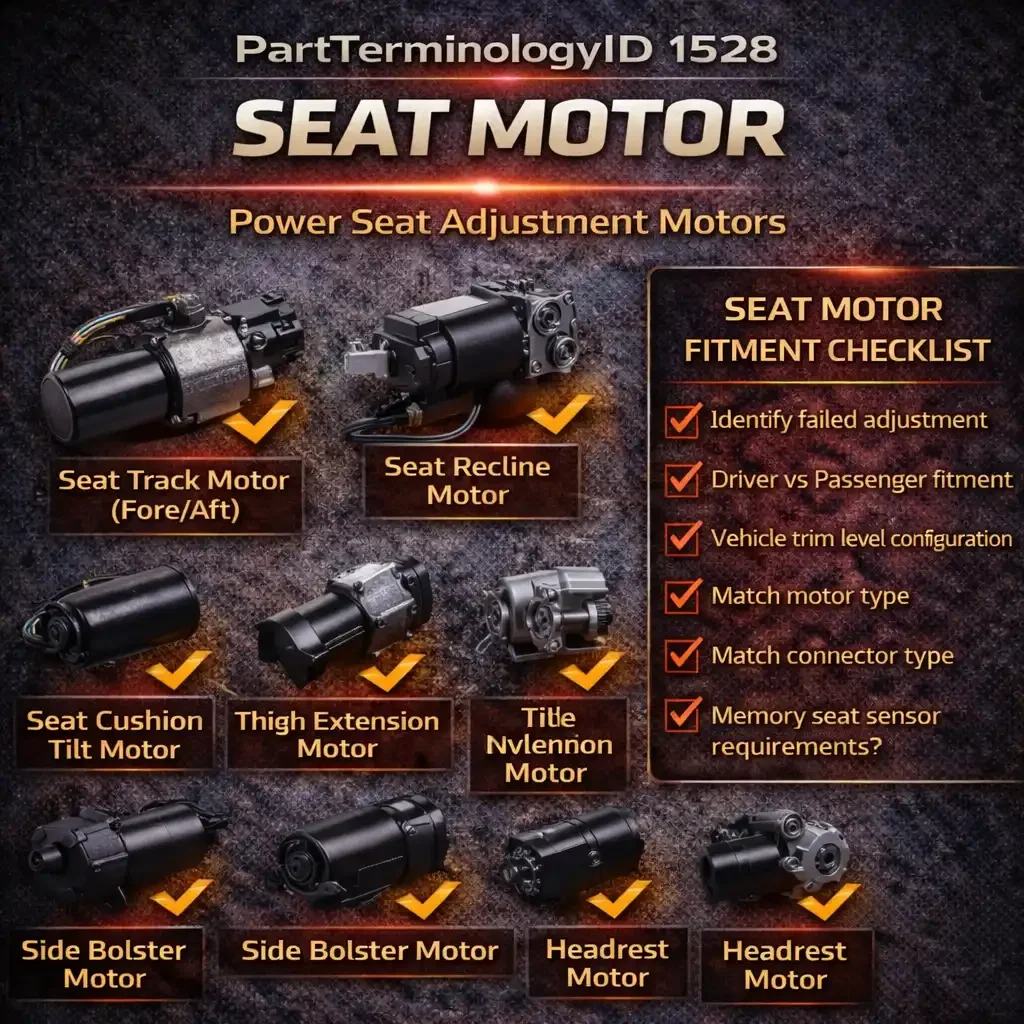
Seat track motor (fore/aft). Drives the seat forward and backward along the seat track. This motor typically has the highest torque requirement because it moves the entire seat, occupant, and frame assembly.
Seat height motor (vertical). Raises and lowers the seat. May drive one or both sides of the seat frame. Some vehicles use two height motors (front and rear) to provide tilt adjustment.
Seat recline motor. Adjusts the seatback angle. Drives a gear mechanism at the recline pivot point.
Lumbar support motor. Inflates or deflates an air bladder, or adjusts a mechanical support pad in the lower seatback. Lumbar motors are often smaller than track or height motors.
Seat cushion tilt motor. Adjusts the angle of the seat cushion (front edge up or down) independently of the overall seat height.
Thigh extension motor. Extends a section of the front seat cushion to provide additional thigh support. Found on premium seats.
Side bolster motor. Adjusts the side bolsters of the seat for tighter or looser lateral support. Found on sport seats and premium trims.
Headrest motor. Adjusts headrest height, tilt, or fore/aft position electrically. Found on premium seats and vehicles with active headrest systems.
Complete seat motor assembly / motor pack. On some vehicles, multiple motors are combined into a single motor pack or gearbox assembly that mounts to the seat frame. Individual motors within the pack may not be separately replaceable.
What this part does NOT cover
Seat track / seat rail. The mechanical track the seat rides on. Different PartTerminologyID.
Seat switch / seat adjustment switch. The controls on the door panel or seat side that the driver operates. Different PartTerminologyID.
Seat frame. The structural frame of the seat. Different PartTerminologyID.
Seat heater element. The electric heating pad in the seat cushion and back. Different system, different PartTerminologyID.
Seat ventilation motor / fan. The fan that blows air through perforated seat leather for cooling. Different function, different PartTerminologyID.
Seat belt pretensioner. The pyrotechnic device that tightens the belt in a collision. Different PartTerminologyID.
Why This Category Creates Fitment Problems
Multiple motors per seat, each is a different part
A single seat can have 6 to 10 motors. Each motor is a different size, shape, connector, and output shaft configuration because each drives a different mechanism. The recline motor is not interchangeable with the height motor. The lumbar motor is not interchangeable with the track motor. Ordering "a seat motor" without specifying which function is like ordering "an engine sensor" without specifying which one.
Motor function must be identified before ordering
The buyer must determine which specific adjustment has failed. This requires testing each seat function individually with the switch and identifying which direction does not respond. If the seat goes up but not down, or forward but not back, the issue may be the switch (one direction of the switch has a dead contact) rather than the motor. If the seat does not respond in either direction of a particular function, the motor for that function is the likely failure.
Side-specific (left versus right)
Driver seat motors are not interchangeable with passenger seat motors on many vehicles. The mounting orientation, the connector routing, and sometimes the motor specifications differ between the driver and passenger seats. The listing must specify: Driver (Left) or Passenger (Right).
Trim level determines seat configuration
Base trims may have a 4-way or 6-way power seat. Mid trims may have an 8-way seat. Premium trims may have a 10-way or 12-way seat with lumbar, thigh extension, and side bolsters. Different trim levels have different motors because they have different adjustment functions. A motor from a base 6-way seat does not match a premium 10-way seat.
Motor pack versus individual motor
On some vehicles, the motors are individually replaceable. On others, they are combined into a motor pack that must be replaced as a unit even if only one motor within the pack has failed. The listing must specify whether the product is an individual motor or a motor pack assembly.
Memory seat systems
Vehicles with memory seats (driver seat returns to a stored position when the driver enters the vehicle) use motors with position sensors or encoders. A motor without the position sensor may physically fit but the memory function will not work because the seat control module cannot track the motor's position. This is the same pattern as the express up/down sensor on window motors (PartTerminologyID 1516).
The Diagnostic Shortcut
Before replacing a seat motor, the buyer should rule out the simpler failures:
Check the fuse. Power seats have a dedicated fuse (often 20 to 30 amps). A blown fuse means no seat functions work.
Check the switch. If one direction works but the opposite direction does not (reclines but does not return upright), the switch may have a dead contact on one side. Swap the switch with a known good one or test continuity.
Listen for the motor. Press the switch for the non-functional direction and listen at the seat. If you hear the motor running but the seat does not move, the motor is fine and the mechanical linkage or gear has failed. If you hear nothing, the motor or the electrical supply is the failure.
Check the connector. The seat wiring harness runs under the seat and can be pinched, cut, or disconnected. Inspect the connector at the motor and at the seat junction.
Top Return Causes
1) Wrong motor function
Buyer orders a recline motor when they need a height motor, or a track motor when they need a lumbar motor.
Prevention: Motor function in the title: "Seat Height Motor (Vertical Adjustment)" or "Seat Recline Motor (Seatback Angle)" or "Lumbar Support Motor." Specify the function clearly.
2) Wrong side (driver versus passenger)
Prevention: Side in the title: "Driver (Left Side)" or "Passenger (Right Side)."
3) Motor ordered when switch was the failure
One direction works, the other does not. The switch contact is dead, not the motor.
Prevention: Diagnostic note: "If the seat moves in one direction but not the opposite, test the seat switch before replacing the motor. A dead switch contact on one side is a common cause."
4) Motor without position sensor for memory seat application
Motor fits and operates the adjustment but the memory seat function does not work.
Prevention: "With Position Sensor (For Memory Seat Vehicles)" or "Without Position Sensor (Non-Memory Seat Vehicles)" in the title.
5) Wrong trim level (motor does not match seat configuration)
Motor from a base 6-way seat ordered for a premium 10-way seat, or vice versa.
Prevention: Trim level and seat configuration in the fitment data: "For 8-Way Power Seat" or "For 10-Way Power Seat with Lumbar."
Compatibility Checklist for Buyers
1) Identify which seat function has failed. Test each adjustment direction individually. Note which specific function does not work.
2) Rule out the switch and wiring. If one direction works but the other does not, test the switch. If no functions work, check the fuse.
3) Confirm which motor you need. Track (fore/aft), height (vertical), recline, lumbar, tilt, thigh extension, side bolster, or headrest.
4) Confirm side. Driver (Left) or Passenger (Right).
5) Confirm seat configuration. 4-way, 6-way, 8-way, 10-way, or 12-way. Match to your trim level.
6) Confirm memory seat. Does your seat have a memory function? If so, the motor must include a position sensor.
7) Confirm full vehicle details. Year, make, model, submodel, trim level.
Catalog Checklist for Attributes
Core taxonomy: Motor function (track, height, recline, lumbar, tilt, thigh, bolster, headrest, motor pack). Side: driver (left), passenger (right). Separate from Seat Track, Seat Switch, Seat Frame, Seat Heater, Seat Ventilation Fan, and Seat Belt Pretensioner.
Fitment: Year, make, model, submodel, trim level. Seat configuration (4-way, 6-way, 8-way, 10-way, 12-way). Memory seat (yes/no). Side. OEM part number cross-reference.
Specs: Motor function. Output type (gear, spline, cable). Position sensor included (yes/no). Connector pin count. Motor voltage (12V).
Package contents: Motor, mounting hardware (if included), connector pigtail (if included).
Images: Motor from output shaft side, motor from connector side, motor in context showing mounting location on seat frame, connector close-up.
FAQ
My seat does not move at all. Is it the motor?
Check the power seat fuse first. If the fuse is good and no seat functions work, check the main seat connector under the seat for damage or disconnection. If only one specific function does not work (e.g., seat goes forward/back but not up/down), the motor for that function may have failed.
How many motors are in my power seat?
A basic 4-way seat has 1 to 2 motors. A 6-way seat has 2 to 3 motors. An 8-way seat has 3 to 4 motors. A 10-way or 12-way premium seat can have 6 to 10 motors. Each adjustment direction uses its own dedicated motor.
Can I replace just one motor or do I need the whole motor pack?
It depends on your vehicle. On some vehicles, each motor is individually replaceable. On others, multiple motors are combined into a motor pack assembly that must be replaced as a unit. Check whether your vehicle uses individual motors or a motor pack before ordering.
Final Take for Aftermarket Teams
Seat Motor (PartTerminologyID 1528) is a category where motor function is the fitment. A seat can contain 6 to 10 motors, each serving a different adjustment axis, each with a different part number. The catalog teams that reduce returns specify motor function in the title (height, recline, lumbar, track, tilt), specify side (driver/passenger), specify seat configuration by trim level, and note memory seat sensor requirements. The diagnostic content that saves the most returns is the single-direction failure test: if one direction works but the opposite does not, test the switch before ordering a motor.