
Convertible Top Motor (PartTerminologyID 1524): The Hydraulic Pump That Costs More Than Most Engine Repairs and Strands You With the Top Stuck Halfway
Written by Arthur Simitian | PartsAdvisory
The convertible top motor is the electric-hydraulic pump assembly that raises and lowers the power convertible top. On vehicles with a power-operated soft top or retractable hardtop, this motor drives a hydraulic system that actuates the folding mechanism through a series of rams, cylinders, and linkages. Press a button, the motor runs, the hydraulic fluid pressurizes, the cylinders extend or retract, and the top folds down into the boot or rises and latches into position.
When this motor fails, the top stops wherever it is in the cycle. If the top is halfway up, the vehicle cannot be driven on the highway (the wind will tear the partially raised top), cannot be parked in rain (the cabin is exposed), and cannot be easily moved to shelter because the top is blocking rear visibility and may be obstructing the trunk. The driver is stranded with a partially deployed top in whatever weather and location they happen to be in.
The repair is expensive. Convertible top motors are specialized, low-volume components that typically cost $300 to $1,200 for the motor/pump assembly alone. Labor to access, remove, and replace the motor can add $300 to $800 because the motor is buried under the top mechanism, inside the trunk, or behind interior trim. A complete convertible top motor replacement can easily reach $1,000 to $2,000 total.
This is a niche category that serves a specific vehicle population, but for that population, it is one of the most critical and most expensive mechanical repairs they will face.
This post is built for aftermarket catalog teams, marketplace sellers, and buyers who want fewer mistakes and fewer returns.
Status in New Databases
Status in New Databases
Current: PIES 7.2 + PCdb Future: PIES 8.0 + PCdb 2.0 Status: No change
What Convertible Top Motor Means in the Aftermarket
Convertible Top Motor (PartTerminologyID 1524) refers to the electric motor and hydraulic pump assembly that operates the power convertible top mechanism.
In catalog reality, this covers:
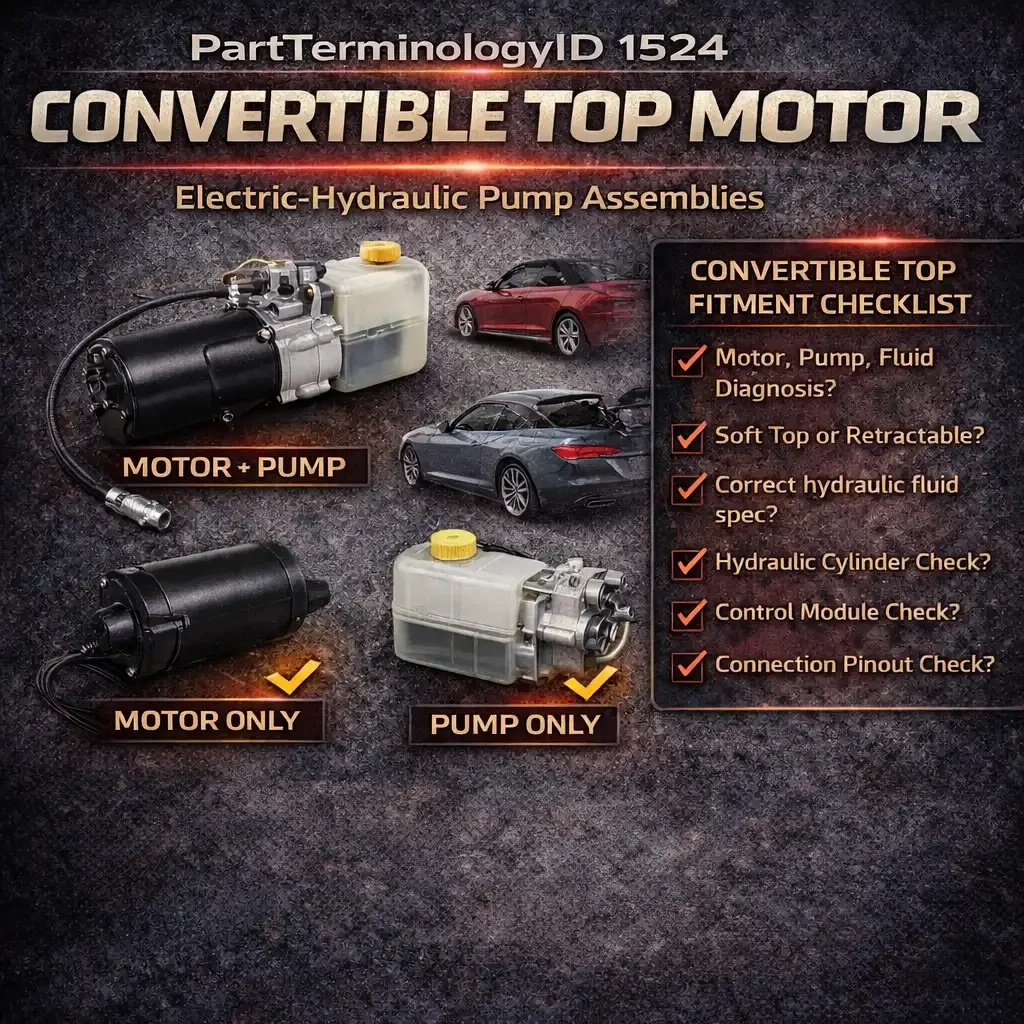
Complete motor/pump assembly. The electric motor, the hydraulic pump, the fluid reservoir, and sometimes the control solenoids in a single integrated unit. This is the standard replacement product. The complete assembly bolts into the vehicle and connects to the existing hydraulic lines and electrical harness.
Motor only (without pump). On some designs, the electric motor can be separated from the hydraulic pump. If the motor has burned out but the pump and hydraulic system are intact, the motor alone can be replaced. Less common as a product form because most failures involve the pump or both.
Hydraulic pump only (without motor). The pump section fails while the motor still runs. Internal pump seals wear, the pump loses pressure, and the top moves slowly or stalls. The pump can sometimes be replaced independently.
Motor/pump assembly with hydraulic cylinders. Some aftermarket kits include the motor/pump and the hydraulic ram cylinders as a complete conversion kit. This is common for older convertibles where the entire hydraulic system is being rebuilt.
Motor/pump assembly with control module. On newer convertibles, the top operation is controlled by an electronic module that sequences the top through its folding stages. Some motor assemblies include this module. Others sell it separately.
What this part does NOT cover
Convertible top fabric / soft top cover. The fabric or vinyl material of the top itself. Different PartTerminologyID.
Convertible top frame. The metal or composite folding frame structure. Different PartTerminologyID.
Convertible top hydraulic cylinder / ram. The individual hydraulic actuator that moves a specific section of the frame. May be sold separately from the motor/pump.
Convertible top latch. The latch that secures the top to the windshield header. Different PartTerminologyID.
Retractable hardtop mechanism. Some vehicles (Mercedes SLK, Mazda RF, BMW) have retractable hardtops with complex multi-piece folding roofs. The motor/pump may be similar but the mechanism is far more complex.
Manual convertible top. Convertibles with a manually operated top (Jeep Wrangler soft top, many older British roadsters) do not have a top motor. The top is raised and lowered by hand.
How the System Works
Understanding the system helps buyers and catalog teams understand where failures occur:
The motor is an electric motor that drives a hydraulic pump. The pump pressurizes hydraulic fluid (typically a dedicated convertible top hydraulic fluid, not standard brake fluid or ATF, though some older systems used generic hydraulic fluid).
The pressurized fluid is routed through hydraulic lines to cylinders (rams). Each cylinder is connected to a specific section of the convertible top frame. When pressurized, the cylinder extends or retracts, moving that section of the frame.
The direction of top movement (up or down) is controlled by solenoid valves that route the fluid to the extend or retract side of the cylinders. On older systems, a manual switch directly controls the motor direction. On newer systems, an electronic module sequences the operation through multiple stages.
A typical top cycle takes 15 to 30 seconds. During this time, the motor runs continuously, the pump maintains pressure, and the cylinders move through their full range. If any part of the system fails during the cycle (motor stalls, pump loses pressure, cylinder leaks, line bursts), the top stops mid-cycle.
Common Failure Modes
Motor burnout. The electric motor burns out from age, overuse, or stalling against a jammed mechanism. The motor draws no current (open circuit) or draws excessive current and blows a fuse without running.
Hydraulic pump seal failure. The internal seals in the pump wear out, allowing fluid to bypass rather than build pressure. The motor runs (you can hear it) but the top moves slowly, stalls partway through the cycle, or does not move at all. This is the most common failure mode and the one that gets worse over time as the seals deteriorate.
Hydraulic fluid leak. Fluid leaks from the pump, the lines, the fittings, or the cylinders. Low fluid means the pump cannot build adequate pressure. The motor runs, the pump turns, but there is not enough fluid to move the cylinders. Leaks at the motor/pump assembly are common at the line fittings and the reservoir seals.
Electrical failure. The motor relay, the fuse, the control switch, or the wiring fails. The motor does not receive power. As with the window motor (PartTerminologyID 1516), the buyer must diagnose whether the motor itself has failed or whether the electrical supply has failed.
Control module failure (newer vehicles). The electronic module that sequences the top operation faults. The motor and pump are functional but the module does not command the correct sequence. The top may start to move and stop, or not respond to the switch at all. Diagnosis requires a scan tool on CAN-bus-equipped vehicles.
The Diagnostic Challenge
Similar to the window motor, the convertible top motor shares symptoms with other failures in the system:
Motor runs but top does not move: Pump seal failure, low hydraulic fluid, or cylinder failure. The motor is fine.
No sound when switch is pressed: Motor failure, relay failure, fuse blown, switch failure, or wiring issue. Direct power test at the motor connector isolates whether the motor or the electrical supply is the problem.
Top moves slowly or stalls mid-cycle: Pump losing pressure (seal failure), low fluid, partially blocked line, or a cylinder that is leaking internally.
Top operates erratically or stops at random points: Control module issue (newer vehicles), intermittent electrical connection, or a hydraulic line with intermittent blockage.
Including diagnostic guidance in listing descriptions helps prevent the buyer from replacing a $600 motor/pump assembly when the problem is a $15 relay or a $5 fuse.
Why This Category Creates Fitment Problems
Completely vehicle-specific
Every convertible top mechanism is unique to the vehicle platform. The motor/pump assembly, the hydraulic line routing, the cylinder sizes, the mounting location, and the electrical connector are all specific to the vehicle. A motor from a Mustang convertible does not fit a Camaro convertible. A motor from a 2010 BMW 3 Series convertible does not fit a 2015 BMW 4 Series convertible. There are no universal convertible top motors.
Retractable hardtop versus soft top
Some vehicles were available with both a soft top and a retractable hardtop (Mazda Miata RF versus soft top, for example). The motor/pump assemblies are different because the hardtop mechanism is heavier and requires more hydraulic force. The listing must specify top type.
Model year and generation changes
Convertible top mechanisms change with vehicle generations and sometimes within a generation. The motor/pump may be revised for improved reliability, different hydraulic fittings, or a different electrical connector. Year-range fitment must be exact.
Hydraulic fluid type
Different systems use different hydraulic fluids. Some use a proprietary convertible top hydraulic fluid. Some older systems use standard hydraulic fluid (Dexron ATF was common on some GM convertibles). Using the wrong fluid can damage seals and cause premature pump failure. The listing should specify the correct fluid type.
Top Return Causes
1) Motor/pump ordered when the problem is a relay, fuse, or switch
The motor is not receiving power. The electrical supply is the failure.
Prevention: Diagnostic note: "Before replacing the motor/pump assembly, verify the motor is receiving power. Check the convertible top fuse and relay first. Apply 12V directly to the motor connector to test. If the motor runs with direct power, the problem is in the switch, relay, or wiring."
2) Wrong vehicle application
Motor from a different generation, different top type, or different vehicle entirely.
Prevention: Exact ACES fitment. OEM part number cross-reference. Specify soft top versus retractable hardtop.
3) Pump seal failure was the problem, buyer ordered motor-only
The motor spins but the pump does not build pressure because the internal seals are worn. A motor-only replacement does not fix the pump.
Prevention: "If the motor runs but the top moves slowly or not at all, the hydraulic pump seals may have failed. The motor/pump complete assembly replaces both the motor and pump. Motor-only replacement does not address pump seal failure."
4) Low hydraulic fluid was the actual problem
The system simply needed fluid refill, not a new motor/pump. A slow leak depleted the fluid over time.
Prevention: "Before replacing the motor/pump, check the hydraulic fluid level in the reservoir. Low fluid is a common cause of slow or non-functional top operation. Top up with the correct fluid type and test. If the top operates normally after refilling, locate and repair the fluid leak."
5) Control module failure (newer vehicles)
The motor and pump are functional but the control module is not commanding operation.
Prevention: "On vehicles with electronically controlled convertible tops, a scan tool may be required to diagnose control module faults. The motor/pump may be functional while the electronic module has faulted."
Compatibility Checklist for Buyers
1) Diagnose before ordering. Check fuse, relay, and switch first. Apply direct power to the motor. Check hydraulic fluid level. A $600 motor/pump may not be needed.
2) Confirm exact vehicle application. Year, make, model. Soft top or retractable hardtop.
3) Confirm product form. Complete motor/pump assembly, motor only, or pump only. The complete assembly is recommended for most repairs.
4) Confirm hydraulic fluid type. Check your owner's manual or service manual for the correct fluid specification. Do not use generic fluid unless specified.
5) Plan for professional installation. The motor/pump is buried in the trunk area under trim and mechanism components. Access requires significant disassembly. Budget for 2 to 4 hours of labor.
Catalog Checklist for Attributes
Core taxonomy: Product form (complete motor/pump assembly, motor only, pump only, motor/pump with cylinders kit). Separate from Convertible Top Fabric, Top Frame, Hydraulic Cylinder, Top Latch, Control Module, and Manual Top.
Fitment: Year, make, model, submodel. Top type: soft top or retractable hardtop. OEM part number cross-reference (critical).
Specs: Motor voltage (12V). Pump type. Hydraulic fluid type specified. Connector type and pin count. Reservoir capacity.
Package contents: Motor/pump assembly, mounting hardware, seals/gaskets (if included), hydraulic fluid (if included).
Images: Complete assembly from multiple angles, hydraulic line connections, electrical connector, mounting points, reservoir cap/fill location.
FAQ
My convertible top is stuck halfway. What do I do?
Most convertibles have a manual override or emergency release procedure that allows you to manually raise or lower the top without the hydraulic system. Check your owner's manual for the specific procedure. Typically it involves accessing a manual release lever or valve in the trunk area. Once the top is secured in the up or down position, diagnose the motor/pump system.
Can I use ATF instead of convertible top hydraulic fluid?
Only if your vehicle's service manual specifies ATF. Some older GM and Ford convertibles used Dexron ATF. Most modern convertibles require a specific convertible top hydraulic fluid that is not interchangeable with ATF. Using the wrong fluid can damage pump seals and cause premature failure.
How long does a convertible top motor last?
Typically 8 to 15 years or 50,000 to 100,000 cycles. Service life depends on usage frequency, climate, and maintenance. Vehicles in warm climates where the top is cycled frequently wear out faster. Maintaining correct fluid level and using the top regularly (rather than leaving it in one position for months) helps extend motor life.
Final Take for Aftermarket Teams
Convertible Top Motor (PartTerminologyID 1524) is a niche, high-cost category where misdiagnosis drives the most expensive returns in the aftermarket. A $600 motor/pump assembly returned because the problem was a $15 relay or a $5 worth of hydraulic fluid represents a significant loss. The catalog teams that reduce returns include diagnostic content (check fuse, relay, fluid level, direct power test), specify exact vehicle fitment with top type, recommend the complete motor/pump assembly over motor-only for most repairs, and note the correct hydraulic fluid type. The convertible top motor serves a small but passionate buyer population. Convertible owners love their cars. They deserve a listing that helps them get the right part the first time.