
Written by Arthur Simitian | PartsAdvisory
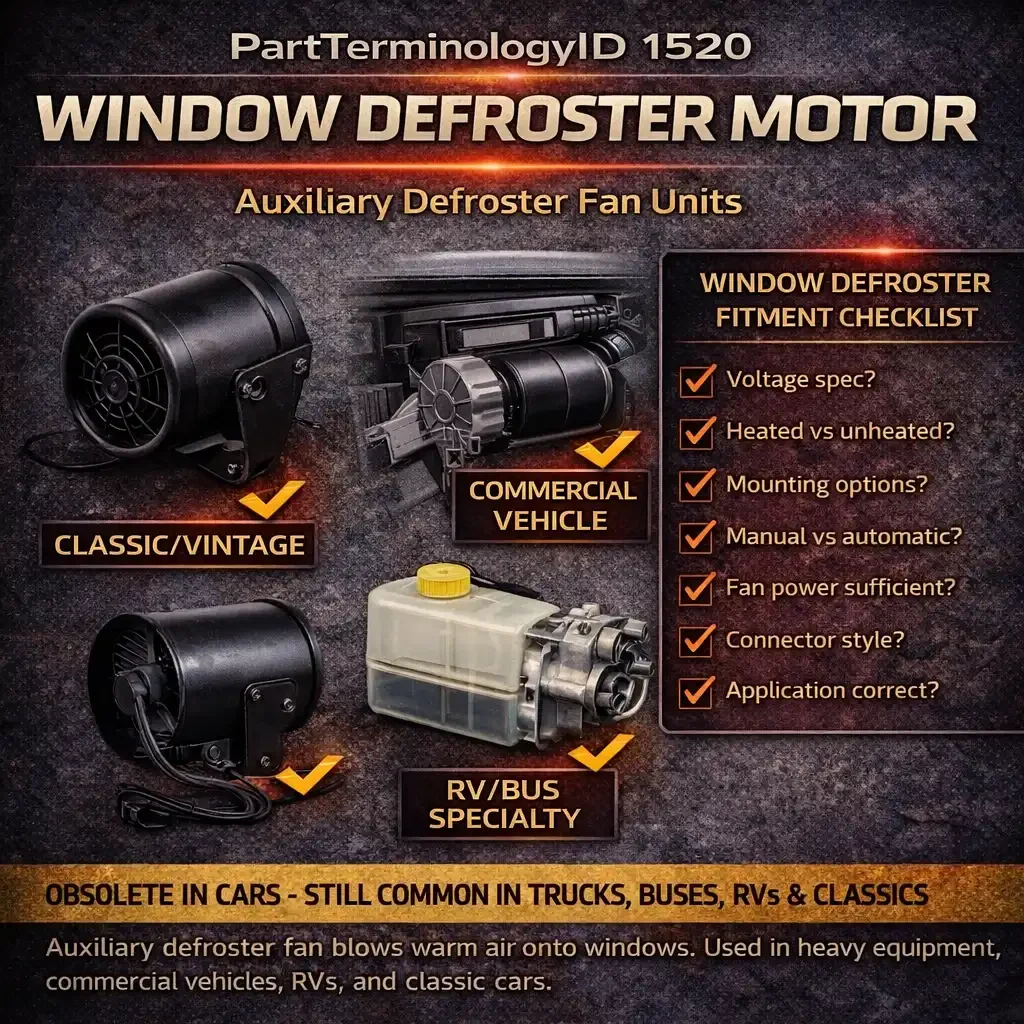
This is one of the most obscure PartTerminologyIDs in the catalog standard. The Window Defroster Motor refers to a motorized blower or fan assembly that directs warm air across the interior surface of the window glass to clear condensation, frost, or ice. It is not the heated grid on the rear window (that is a resistive defroster element embedded in the glass). It is not the HVAC system's defrost mode (that directs warm air from the main climate system through dashboard vents onto the windshield). It is a dedicated motor and fan assembly specifically designed to defrost or defog a window.
On mainstream passenger vehicles, this part has been functionally extinct for decades. The main HVAC system handles windshield defogging through the dashboard defrost vents. The rear window uses an electric grid heater embedded in the glass. Side windows rely on cabin air circulation. There is no separate defroster motor on the vast majority of vehicles built in the last 30 years.
Where this part does exist and does matter:
Commercial vehicles and heavy equipment. Large commercial trucks, buses, construction equipment, and agricultural equipment may have auxiliary defroster motors that blow heated air onto side windows, rear windows, or specialized glass panels that the main HVAC system cannot reach effectively. A bus with 20 feet of side windows cannot defrost all of them from a single dashboard vent system.
Specialty and conversion vehicles. Limousines, ambulances, RVs, and other conversion vehicles with extended or non-standard window configurations may use auxiliary defroster fan assemblies to keep secondary windows clear.
Classic and vintage vehicles. Some older vehicles (primarily 1950s through 1970s) had add-on defroster fan units that mounted on or near the dashboard to supplement the vehicle's weak factory defroster system. These were often aftermarket accessories rather than factory equipment. The classic car restoration market may search for reproduction units.
Aircraft, marine, and military applications. Non-automotive vehicles with window defogging requirements may use motorized defroster systems. These are outside the standard automotive aftermarket but may appear under this PartTerminologyID in broader catalog systems.
This post is built for aftermarket catalog teams, marketplace sellers, and buyers who want fewer mistakes and fewer returns.
Status in New Databases
Status in New Databases
Current: PIES 7.2 + PCdb Future: PIES 8.0 + PCdb 2.0 Status: No change
What Window Defroster Motor Means in the Aftermarket
Window Defroster Motor (PartTerminologyID 1520) refers to a dedicated electric motor and fan assembly designed to direct airflow across a window surface for defogging or defrosting.
In catalog reality, this covers:
Auxiliary defroster fan assembly. A small blower motor with a housing and ducting that mounts near a window and directs warm or ambient air across the glass surface. May include a heating element (warm air) or may simply circulate cabin air (ambient). Common on commercial vehicles and specialty conversions.
Dashboard-mount defroster fan (classic/vintage). A compact fan unit that sits on or clips to the dashboard and blows air onto the windshield. These were popular aftermarket accessories in the 1950s through 1970s when many factory defroster systems were inadequate. Reproduction units are available for the restoration market.
Rear window defroster fan. On vehicles without a heated rear window grid (primarily older vehicles), a fan assembly mounted near the rear window circulated air to reduce fogging. Rare on modern vehicles.
Side window defroster/defogger fan. Found on buses, commercial vehicles, and some vans. A small fan that blows air along the side window to maintain visibility.
What this part does NOT cover
HVAC blower motor. The main cabin blower motor that feeds the entire heating, ventilation, and air conditioning system, including the dashboard defrost vents. Different PartTerminologyID. This is what defrosts the windshield on virtually all modern passenger vehicles.
Rear window defroster grid / element. The resistive heating grid embedded in or bonded to the rear window glass. Electrical heating, not a motor or fan. Different PartTerminologyID.
Heated windshield. Some vehicles have electrically heated windshields with embedded heating elements. Different technology, different PartTerminologyID.
Mirror defogger / heated mirror element. The heating element in the side mirror glass. Different PartTerminologyID.
Why This PartTerminologyID Exists in the Standard
Catalog teams encountering PartTerminologyID 1520 for the first time often ask why it exists when the product barely appears in the modern automotive aftermarket. The answer is that the ACES/PIES standard is designed to be comprehensive across all vehicle types, all eras, and all applications. The standard must accommodate parts for:
Vehicles currently in production
Vehicles no longer in production but still on the road
Commercial and specialty vehicles with non-standard configurations
Historical vehicles maintained by restorers and enthusiasts
The Window Defroster Motor applies to a narrow but real set of vehicles and applications. It is not a high-volume category, but for the vehicles that need it, there is no substitute.
Fitment Variables for the Applications That Exist
Voltage
12V for most automotive and light commercial vehicles. 24V for heavy commercial trucks, buses, and military vehicles. The motor must match the electrical system voltage.
Airflow direction and mounting
The defroster motor must direct air at the correct window surface. Mounting location, duct orientation, and airflow volume vary by application. Commercial vehicle installations are often custom or semi-custom, with the motor and ducting adapted to the specific vehicle's interior layout.
Heated versus unheated airflow
Some auxiliary defroster fans include an integral heating element (electric resistance heater) that warms the air before it reaches the glass. Others simply circulate ambient cabin air. Heated units are more effective in cold conditions but draw significantly more electrical current. The vehicle's electrical system must support the additional load.
Motor speed
Some defroster fans are single-speed. Others have a two-speed or variable-speed motor controlled by a dashboard switch. The motor speed affects airflow volume and noise level.
Physical dimensions and mounting method
There is no standard size for auxiliary defroster motors. They range from small (4 to 6 inch diameter) dashboard-mount units to larger (8 to 12 inch) duct-mount commercial units. Mounting methods include dashboard clip, screw-mount, bracket-mount, and duct-integrated. The physical dimensions must fit the available space in the vehicle.
Top Return Causes
1) Buyer actually needs an HVAC blower motor
The buyer's windshield defroster is not working. They search for "defroster motor" and find a Window Defroster Motor listing. What they actually need is the main HVAC blower motor or a repair to the HVAC defrost mode door actuator (which controls the vent direction). The auxiliary defroster motor is not the part that defrosts windshields on modern vehicles.
Prevention: Clear naming that distinguishes the product from the HVAC system: "Auxiliary Window Defroster Fan (NOT the main HVAC blower motor). For vehicles with a dedicated auxiliary defroster fan assembly. Most modern passenger vehicles use the HVAC system defrost mode and do not have a separate defroster motor."
2) Wrong voltage
12V motor ordered for a 24V commercial vehicle, or vice versa.
Prevention: Voltage in the title: "12V Auxiliary Defroster Fan" or "24V Auxiliary Defroster Fan."
3) Part does not exist for the buyer's vehicle
Buyer searches for a window defroster motor for a modern passenger car. No such part exists for their vehicle because the windshield is defrosted by the HVAC system and the rear window uses a heated grid.
Prevention: Vehicle-specific fitment data that limits listings to vehicles actually equipped with an auxiliary defroster motor. Do not list this PartTerminologyID with broad fitment.
4) Heated unit ordered when unheated was needed (or vice versa)
Buyer receives an unheated fan when they expected a heated unit with an integral element, or receives a heated unit that draws more current than their system can support.
Prevention: Specify: "With Integral Heating Element" or "Fan Only (No Heating Element)." Note current draw for heated units.
Compatibility Checklist for Buyers
1) Confirm your vehicle actually has an auxiliary defroster motor. Most modern passenger vehicles do not. If your windshield defroster is not working, the problem is likely the HVAC blower motor, the defrost mode door actuator, or the HVAC controls, not a separate defroster motor.
2) If you have a commercial vehicle, bus, RV, or specialty conversion with an auxiliary defroster, identify the unit. Note the voltage, mounting location, duct size, and whether it is heated or unheated.
3) Confirm voltage. 12V or 24V.
4) Confirm heated versus unheated. If heated, verify your electrical system can support the additional current draw.
5) Confirm physical dimensions and mounting method. Measure the existing unit or the available mounting space.
Catalog Checklist for Attributes
Core taxonomy: Product form (auxiliary defroster fan assembly, dashboard-mount fan, duct-mount blower, fan with heater). Separate from HVAC Blower Motor, Rear Window Defroster Grid, Heated Windshield, and Heated Mirror Element.
Fitment: Vehicle-specific where applicable. Application type: commercial, bus, RV, conversion, classic car, military. Voltage: 12V or 24V.
Specs: Heated (yes/no). Motor speed (single, two-speed, variable). Airflow volume (CFM if specified). Current draw (amps). Physical dimensions. Duct connection size (if applicable).
Mounting: Dashboard clip, screw-mount, bracket-mount, duct-integrated. Mounting hardware included (yes/no).
Images: Fan assembly from front and rear, mounting hardware, duct connection (if applicable), heating element (if equipped), installed reference.
FAQ
My windshield defroster is not working. Do I need a window defroster motor?
Almost certainly not. On modern passenger vehicles, the windshield is defrosted by the HVAC system in defrost mode. If the defroster is not working, check the HVAC blower motor, the blend door or mode door actuator (which controls whether air goes to the defrost vents), the HVAC control panel, and the cabin air filter (a clogged filter reduces airflow). A separate window defroster motor is only found on commercial vehicles, buses, RVs, and some specialty or vintage vehicles.
What vehicles actually have a window defroster motor?
Commercial trucks and buses with side window defroster fans, RVs and conversion vehicles with auxiliary defroster systems, and vintage/classic vehicles with add-on defroster fan accessories. The vast majority of passenger cars, trucks, and SUVs produced in the last 30+ years do not have a separate window defroster motor.
Is the rear window defroster a motor?
No. On modern vehicles, the rear window defroster is an electric heating grid made of thin resistive wires embedded in or bonded to the glass. It heats the glass directly with no fan or motor. It is a completely different PartTerminologyID.
Final Take for Aftermarket Teams
Window Defroster Motor (PartTerminologyID 1520) is one of the narrowest categories in the aftermarket standard. Its applications are limited to commercial vehicles, buses, RVs, conversion vehicles, and the vintage car restoration market. The biggest catalog risk is not fitment accuracy within the category but buyers finding this PartTerminologyID when they actually need an HVAC blower motor or a rear window defroster grid. Clear naming, clear scope definitions, and clear fitment limitations prevent the buyer who searches "defroster motor" from landing on a product that does not exist for their vehicle. For the applications where this part does exist, the fitment variables are voltage, heated versus unheated, motor speed, physical dimensions, and mounting method. It is a small category, but for the vehicles that need it, it is the only way to keep the windows clear.