
Written by Arthur Simitian | PartsAdvisory
The power window motor is the electric motor that raises and lowers the window glass. Press the window switch, the motor spins, the window moves. When it stops working, the driver is stuck with a window that will not go up (leaving the interior exposed to weather and theft) or will not go down (trapping them in a drive-through or toll booth). Either way, the repair is urgent.
The problem is that a non-functional power window has three possible failure points, and the buyer almost always guesses wrong about which one has failed:
The window motor. The electric motor itself has burned out, seized, or worn its brushes. This is the component covered by PartTerminologyID 1516.
The window regulator. The mechanical assembly (cable, track, scissors mechanism, or arm) that translates the motor's rotation into the up-and-down movement of the glass. The regulator can break, jam, or have its cables snap while the motor is perfectly functional. The motor spins but the window does not move.
The window switch. The button on the door panel that sends power to the motor. The switch contacts wear out, corrode, or lose connectivity. No power reaches the motor, so the window does not move.
The symptom for all three failures is identical: press the switch, nothing happens (or the window moves slowly, makes grinding noises, or moves partway and stops). The buyer searches "window motor," orders a motor, installs it, and discovers the window still does not work because the regulator cables were snapped or the switch was dead. This misdiagnosis is the number one return driver in the category.
This post is built for aftermarket catalog teams, marketplace sellers, and buyers who want fewer mistakes and fewer returns.
Status in New Databases
Status in New Databases
Current: PIES 7.2 + PCdb Future: PIES 8.0 + PCdb 2.0 Status: No change
What Window Motor Means in the Aftermarket
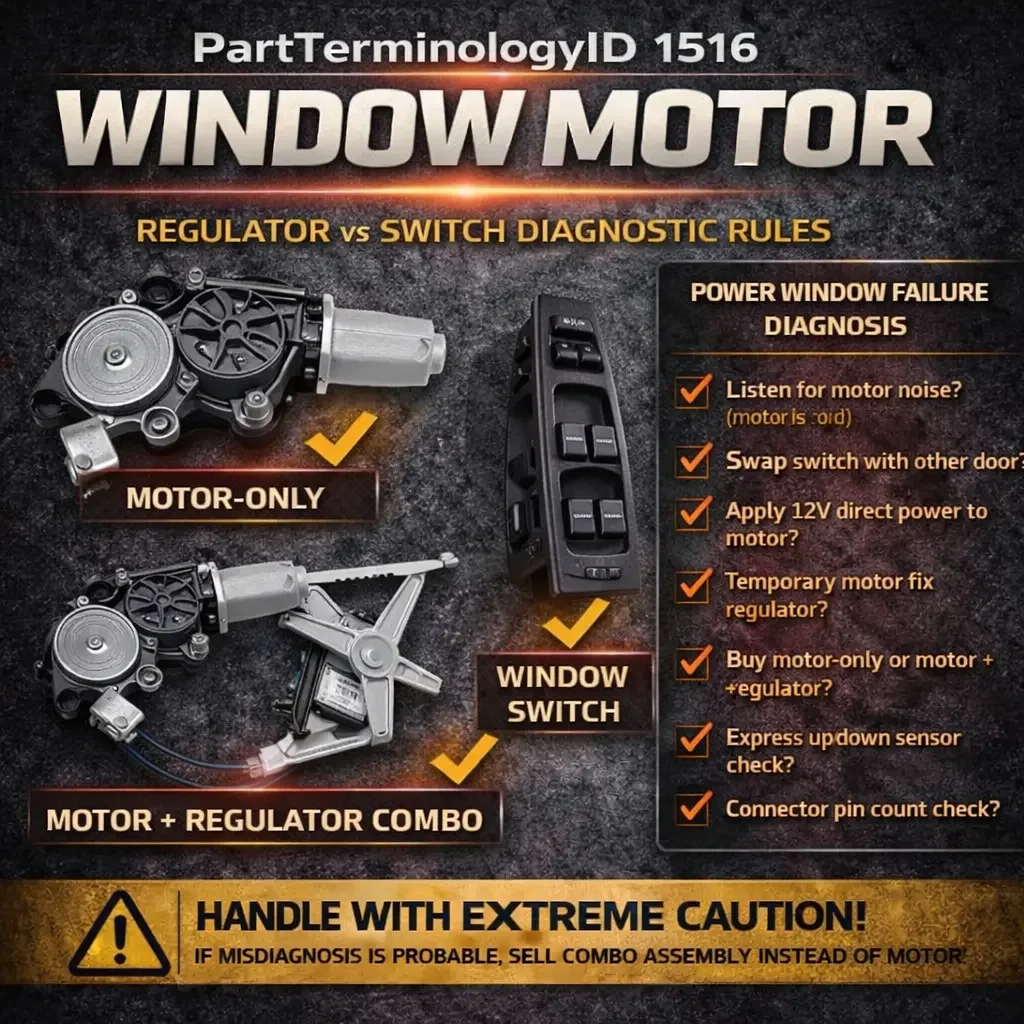
Window Motor (PartTerminologyID 1516) refers to the electric motor that drives the window regulator to raise and lower the window glass.
In catalog reality, this covers:
Window motor only. The electric motor assembly without the regulator. The motor bolts to the regulator and drives it via a gear or spline interface. This is the correct product when the motor has failed but the regulator mechanism is intact. The buyer removes the old motor from the existing regulator and installs the new motor.
Window motor with regulator (combo assembly). The motor pre-attached to a new regulator. This is the most commonly sold product form in the aftermarket because it eliminates the need to separate and reattach the motor, ensures the motor and regulator are compatible, and replaces both potential failure points at once. Many buyers and shops prefer the combo to avoid diagnosing which component failed.
Window motor gear / motor repair kit. A small gear (often nylon or plastic) inside the motor housing that is the most common failure point within the motor itself. When this gear strips, the motor spins but does not turn the regulator. Some aftermarket sources sell just the gear as a repair kit. This is a budget option that requires disassembling the motor housing.
What this part does NOT cover
Window regulator (without motor). The mechanical assembly that moves the glass. Different PartTerminologyID. Sold separately on vehicles where the motor and regulator are separate components.
Window switch / power window switch. The button or switch panel on the door. Different PartTerminologyID.
Window glass. The glass pane itself. Different PartTerminologyID.
Manual window regulator / crank. Vehicles with manual (hand-crank) windows do not have a window motor. Different system.
How to Tell If It Is the Motor, the Regulator, or the Switch
This diagnostic content prevents the most common return in the category and should be included in every listing description:
Step 1: Listen. Press the window switch and listen carefully at the door panel.
No sound at all: The problem is likely the switch, the wiring, or a blown fuse. The motor is not receiving power. Check the fuse first. If the fuse is good, test the switch by swapping it with a known working switch from another window, or use a multimeter to verify power at the motor connector.
A clicking or humming sound from inside the door: The motor is receiving power and trying to run, but the regulator is jammed or broken. The motor may be fine. The regulator is the likely failure.
A grinding or crunching sound: The motor is running but the internal gear is stripped (motor failure) or the regulator mechanism is binding. This could be either component.
The motor runs but the window does not move: The motor is functional but the regulator cable has snapped, the regulator arm has broken, or the glass has separated from the regulator. The regulator is the failure.
Step 2: Apply direct power. Disconnect the motor connector at the door and apply 12V directly to the motor terminals using jumper wires from the battery. If the motor spins smoothly, the motor is good and the problem is in the switch, wiring, or regulator. If the motor does not spin, or spins weakly, the motor is the failure.
Step 3: If in doubt, buy the motor-and-regulator combo. If diagnosis is uncertain, the combo assembly replaces both the motor and the regulator, covering both failure points. This is more expensive than a motor-only replacement but eliminates the risk of misdiagnosis.
Why the Motor-Regulator Combo Dominates the Market
The combo assembly (motor pre-attached to regulator) outsells the motor-only product by a wide margin in the aftermarket. The reasons are practical:
Eliminates misdiagnosis. As described above, distinguishing motor failure from regulator failure requires diagnostic steps that many buyers and some shops skip. The combo replaces both.
Eliminates compatibility issues. The motor must mate to the regulator via a specific gear or spline interface. Different motor revisions may have different gear tooth counts or spline sizes. A combo ensures the motor and regulator are matched.
Labor savings. Separating the motor from the regulator inside the door is additional labor. On some vehicles, the motor is riveted to the regulator and cannot be easily separated without drilling out the rivets. The combo bolts in as a single unit.
Price. The aftermarket combo assembly is often only $10 to $30 more than the motor alone because the regulator is a stamped metal or injection-molded component with low material cost. The incremental cost is small relative to the labor savings and diagnostic certainty.
For catalog teams, the combo is the primary product to stock and list. The motor-only product should be available for buyers who have confirmed the motor is the failure and whose regulator is in good condition, but the combo should be the default recommendation.
Inside the Motor: What Fails and Why
Understanding the internal components of a window motor helps catalog teams write better descriptions and helps buyers understand what they are replacing:
Brushes. Window motors are permanent-magnet DC motors with carbon brushes that press against a rotating commutator. Over time (typically 50,000 to 100,000+ cycles), the brushes wear down and lose contact with the commutator. The motor becomes intermittent (works sometimes, not others), slow (reduced contact area means less current transfer), and eventually stops working entirely. Brush wear is the most common motor failure on high-mileage vehicles.
Armature. The rotating core of the motor. The armature can develop shorted windings from heat damage, causing the motor to draw excessive current, blow fuses, or run at reduced power. A shorted armature often manifests as a motor that runs but is noticeably weaker than normal.
Internal gear. Most window motors include a worm gear reduction inside the motor housing. The motor shaft turns a worm gear, which drives a larger gear that provides high torque at low speed to move the heavy window glass. The driven gear is often made of nylon or plastic to reduce noise. This gear is the weakest structural component inside the motor. When it strips, the motor shaft spins freely (you can hear it running) but the output shaft does not turn. This is the single most common failure mode inside the motor itself and the failure that the aftermarket gear repair kit addresses.
Thermal protection. Some window motors include a thermal circuit breaker or PTC (positive temperature coefficient) element that disconnects the motor if it overheats. This protects the motor from burnout when the window is stalled against an obstruction or ice. If the thermal protector trips, the motor stops working temporarily and resumes after cooling down. A motor that works intermittently (works for a while, stops, then works again after a rest period) may have a tripping thermal protector, which indicates the motor is overheating from excessive friction in the regulator, a binding window channel, or a motor that is drawing too much current due to internal wear.
Magnets. Permanent magnets inside the motor housing provide the magnetic field. On very old motors, these magnets can weaken (demagnetize) from heat exposure, reducing the motor's power output. The window moves slower and slower over time, and eventually the motor cannot overcome the friction of the regulator and window channel. This is more common on vehicles older than 15 to 20 years.
Duty Cycle and Why Window Motors Burn Out
Window motors are not designed for continuous operation. They are designed for intermittent duty: raise the window (5 to 10 seconds of operation), stop, lower the window (5 to 10 seconds), stop. Each cycle is followed by a rest period where the motor cools.
When a motor is forced to operate beyond its duty cycle, it overheats. Common scenarios:
Window binding in the channel. Dirt, debris, worn window channel seals, or misaligned glass create friction that forces the motor to work harder and run longer to move the window. The motor heats up faster than it can cool down.
Ice and snow. Attempting to lower a window that is frozen shut forces the motor to stall against the ice. A stalled motor draws maximum current and generates maximum heat. Repeated attempts to force a frozen window can burn out the motor in minutes.
Children playing with the switch. Repeatedly cycling the window up and down in quick succession exceeds the duty cycle. The motor overheats and either the thermal protector trips or the motor burns out.
Aftermarket tint or thick glass. Heavier-than-stock glass or additional material (thick tint film, laminated security film) increases the load on the motor. The motor runs longer and works harder for each cycle.
Including a note about ice and frozen windows in the listing description is a practical value-add: "Do not force a window that is frozen shut. Attempting to operate the window motor against a frozen window can burn out the motor. Defrost the window and clear ice from the window channel before operating."
OEM vs. Aftermarket vs. Recycled
OEM
Exact fit, correct torque output, correct duty cycle rating, correct connector, correct express up/down sensor calibration. The most expensive option. For express up/down systems, OEM motors are the most reliable because the position sensor calibration matches the vehicle's BCM programming.
Aftermarket
Available for most high-volume applications. The motor-and-regulator combo is the dominant aftermarket product. Quality varies significantly in this category. Common aftermarket quality issues include:
Insufficient torque. The motor does not produce enough force to reliably raise the window, especially on vehicles with large or heavy glass (trucks, SUVs, coupe doors with frameless windows). The window moves slowly, stalls partway up, or cannot overcome the resistance of the window seals near the top of travel.
Short service life. Lower-quality motors use thinner brush material, weaker magnets, or inferior gears that fail significantly faster than OEM. A buyer who installs an aftermarket motor that fails again in 6 months has a worse experience than the original failure.
Express up/down incompatibility. Aftermarket motors may not include the position sensor, or may include a sensor with a different calibration than the OEM motor. The express function may not work, may not calibrate correctly, or may trigger an error in the BCM.
Noise. Lower-quality gearboxes and motor assemblies can be noticeably noisier than OEM. The whining or grinding sound every time the window operates is an ongoing annoyance.
For catalog teams, noting quality tier matters in this category more than in many others because a window motor that fails prematurely is a highly visible, daily-use failure that the buyer notices immediately and blames on the part (and the seller).
Recycled
OEM motors from salvage vehicles. Correct fit and quality, lower price. The risk is unknown remaining life: the motor may have 80% of its brush life remaining, or it may be near the end. No way to determine this non-destructively. Recycled motors are a gamble on remaining service life.
Fitment Variables
Door position and side
The window motor and regulator are specific to each door position: front left (driver), front right (passenger), rear left, and rear right. The motor mounting angle, the regulator geometry, and the cable routing are different for each door because the door shape and window glass curvature are different. They are not interchangeable between positions.
Motor attachment method
Bolt-on. The motor attaches to the regulator with 3 or 4 bolts. The motor can be removed and replaced independently. This is the design that supports motor-only replacement.
Rivet-on. The motor is factory-riveted to the regulator. Separating them requires drilling out the rivets and bolting the new motor with nuts and bolts. This is doable but adds labor. The combo assembly eliminates this issue.
Integrated. On some designs, the motor and regulator are a fully integrated unit that cannot be separated at all. Motor-only replacement is not possible. Only the combo is available.
Regulator type
Cable-type regulator. The motor drives a drum that winds and unwinds cables attached to the window glass carrier. This is the most common type on modern vehicles. Cable regulators are lighter and less expensive than scissors-type but the cables can snap (the most common regulator failure).
Scissors-type regulator (X-arm). The motor drives a gear that rotates an arm mechanism in an X pattern, raising and lowering the glass. More robust than cable-type but heavier and more expensive. Common on older vehicles and some trucks.
Single-rail regulator. The glass rides on a single vertical rail with a cable or gear drive. Common on some compact cars.
The motor must be compatible with the regulator type. A motor designed for a cable-type regulator has a different output shaft/gear than one designed for a scissors-type.
Express up/down (auto up/down)
Some vehicles have an express (auto) function where pressing the window switch once fully raises or lowers the window without holding the switch. This function is sometimes controlled by the motor (which contains a sensor for position and speed feedback) and sometimes by the window switch or BCM. On vehicles where the motor contains the position sensor, the motor must be matched to the express up/down system. A motor without the sensor will move the window but the express function will not work.
Two-pin versus six-pin connectors
Basic window motors have a simple two-pin connector (power and ground, reversible for up/down). Motors with express up/down sensors, thermal protection circuits, or integrated electronics may have 4-pin or 6-pin connectors. The connector must match the door wiring harness.
Common Buyer Scenarios
Scenario 1: Motor replaced, window still does not work
A buyer orders a window motor for their 2014 Chevy Cruze because the driver window stopped working. They install the new motor. The window still does not move. They pull the door panel again and discover the regulator cable is snapped. The old motor was fine. The regulator was the failure.
What went wrong: No diagnosis before ordering. The buyer assumed "window doesn't work = motor failure."
What helps: Diagnostic content in the listing. The listen test and direct power test would have identified the regulator as the failure. Recommending the motor-and-regulator combo would have covered both failure points.
Scenario 2: Aftermarket motor too weak for truck window
A shop installs an aftermarket window motor on a 2018 Ford F-150 crew cab rear window. The motor runs but struggles to raise the heavy glass, especially when the vehicle is cold and the window seals are stiff. The window stalls at three-quarters up and the motor thermal protector trips. The shop replaces the aftermarket motor with an OEM motor and the window operates normally.
What went wrong: The aftermarket motor did not produce sufficient torque for the application. Truck and SUV windows are significantly heavier than sedan windows, and the motor must overcome stiffer seals and longer travel distances.
What helps: Quality tier matters. For trucks, SUVs, and vehicles with heavy or oversized glass, OEM or a quality-verified aftermarket motor is recommended. Note in listings: "For vehicles with large or heavy window glass (trucks, SUVs, coupes with frameless windows), verify motor torque is rated for the application."
Scenario 3: Express up/down lost after motor replacement
A buyer replaces the driver window motor on their 2016 Honda Accord. The window goes up and down with the switch, but the express (auto) up/down function no longer works. The new motor does not include the position sensor that the vehicle's BCM requires for express operation.
What went wrong: The replacement motor was a basic two-pin motor without the express up/down sensor. The original motor had a multi-pin connector with a Hall effect sensor for position feedback.
What helps: "With Express Up/Down Sensor" in the title. Specify connector pin count. For vehicles with express up/down, the motor must include the position sensor.
Top Return Causes
1) Motor ordered when the regulator was the actual failure
The motor is fine but the regulator cable snapped or the mechanism jammed.
Prevention: Diagnostic content in the listing (the listen/direct-power test described above). Recommend the motor-and-regulator combo: "If unsure whether the motor or regulator has failed, order the motor-and-regulator combo assembly to replace both."
2) Motor ordered when the switch was the actual failure
No power reaching the motor. The switch or wiring is the problem.
Prevention: "If no sound is heard when pressing the window switch, check the fuse and test the switch before replacing the motor."
3) Wrong door position
Motor for front left ordered for rear right, or similar mismatch.
Prevention: Door position in the title: "Front Left (Driver Side)" or "Rear Right (Passenger Side)."
4) Motor does not mate to existing regulator
Motor gear or spline does not match the regulator's input. Different revision or different regulator type.
Prevention: OEM part number cross-reference. Specify motor output type (gear tooth count, spline count). Recommend the combo to avoid this issue.
5) Express up/down function lost after motor replacement
New motor does not include the position sensor required for the express function.
Prevention: "With Express Up/Down Sensor" or "Without Express Up/Down (Basic Motor)" in the title. Tie to vehicle equipment in fitment data.
Compatibility Checklist for Buyers
1) Diagnose before ordering. Listen test, direct power test. Is it the motor, the regulator, or the switch?
2) If unsure, order the motor-and-regulator combo. It replaces both potential failure points.
3) Confirm door position. Front/rear, left/right.
4) Confirm express up/down. Does your vehicle have auto up/down? If so, the motor must include the position sensor.
5) Confirm connector pin count. 2-pin (basic) or multi-pin (with sensor/electronics).
6) Confirm attachment method. Bolt-on, rivet-on, or integrated. If rivet-on, consider the combo.
7) Confirm full vehicle details. Year, make, model, submodel, trim level.
Catalog Checklist for Attributes
Core taxonomy: Product form (motor only, motor with regulator combo, motor gear repair kit). Separate from Window Regulator (without motor), Window Switch, Window Glass, and Manual Window Crank.
Fitment: Year, make, model, submodel, trim. Door position: front left, front right, rear left, rear right. Express up/down equipped (yes/no). OEM part number cross-reference.
Physical specs: Motor output type (gear, spline). Attachment method (bolt-on, rivet, integrated). Connector pin count. Motor voltage (12V). Express sensor included (yes/no).
Package contents: Motor (or motor with regulator), mounting bolts/hardware, connector pigtail (if included).
Images: Motor from output shaft side showing gear/spline, motor from connector side showing pin count, combo assembly showing motor attached to regulator, mounting bolt pattern, and connector close-up.
FAQ
Should I replace just the motor or the motor-and-regulator combo?
If you have confirmed the motor is the failure (direct power test) and the regulator moves freely, motor-only is fine. If you are unsure, or if the regulator has high mileage, the combo is the safer and often more cost-effective choice.
Why does my window move slowly?
A slow window usually indicates a dying motor (worn brushes, weak magnets) or a binding regulator (dry or corroded tracks, fraying cables). If the motor spins freely when disconnected from the regulator, the regulator is binding. If the motor is sluggish even disconnected, the motor is failing.
My window goes down but not up. Is it the motor?
Not necessarily. The motor uses the same winding for both directions (polarity is reversed by the switch). If it works one direction but not the other, the switch may have a failed contact on one side, or the regulator may be binding in one direction. Test the switch and regulator before replacing the motor.
Final Take for Aftermarket Teams
Window Motor (PartTerminologyID 1516) is a category where diagnostic content in the listing prevents more returns than any fitment specification. The buyer who orders a motor when the regulator is broken wastes money and still has a broken window. The catalog teams that win here include the listen test and direct power test in the description, recommend the motor-and-regulator combo as the default product, specify door position and express up/down as mandatory fitment attributes, and clearly distinguish motor-only from combo assembly in the title. The window motor is a simple part with a complex diagnostic path. The listing must simplify that path for the buyer.