
Written by Arthur Simitian | PartsAdvisory
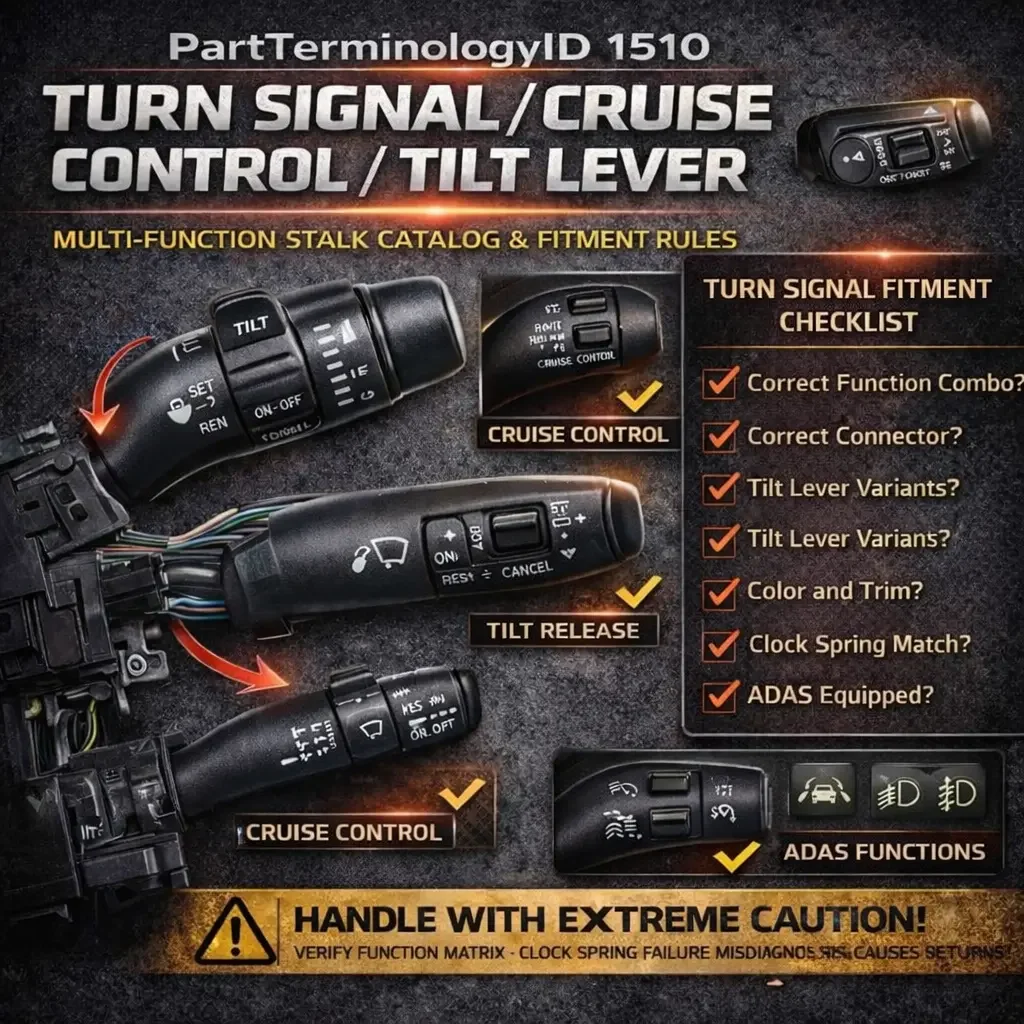
The lever on the left side of the steering column does more than signal turns. Depending on the vehicle, this single stalk may control the turn signals, the headlight dimmer (high beam / low beam), the flash-to-pass function, the windshield wipers, the windshield washer, the cruise control, the steering column tilt release, and on some vehicles, the lane departure warning or adaptive cruise control settings. It is one of the most frequently operated controls in any vehicle, used dozens of times per drive, and when any one of its functions fails, the entire multi-function stalk typically needs to be replaced.
The PartTerminologyID name reflects this multi-function reality: Turn Signal / Cruise Control / Tilt Lever. It is a single part that combines multiple control functions into one stalk, and the specific combination of functions varies by vehicle, by trim level, and by equipment options. That variation is what makes this category a catalog challenge. Two vehicles that look identical on the outside can have different multi-function stalks because one has cruise control and the other does not, or one has automatic headlights and the other has manual, or one has a tilt steering column and the other has a fixed column.
This post is built for aftermarket catalog teams, marketplace sellers, and buyers who want fewer mistakes and fewer returns.
Status in New Databases
Status in New Databases
Current: PIES 7.2 + PCdb Future: PIES 8.0 + PCdb 2.0 Status: No change
What Turn Signal / Cruise Control / Tilt Lever Means in the Aftermarket
PartTerminologyID 1510 refers to the steering column-mounted multi-function lever (stalk) that operates the turn signals and may also integrate cruise control, headlight dimmer, tilt column release, wiper/washer controls, or other functions.
In catalog reality, this covers a range of configurations:
Turn signal lever only. The most basic configuration. The stalk operates the left and right turn signals and may include the headlight dimmer (push forward for high beam, pull back for low beam). No cruise control, no tilt, no wipers. Found on base trims and older vehicles where each function had its own dedicated control.
Turn signal with cruise control. The stalk combines turn signals and cruise control buttons (Set, Resume, Cancel, and sometimes Accel/Decel). The cruise control buttons may be on the end of the stalk, on the stalk body, or on a rotating ring at the base of the stalk. This is a different part from the turn-signal-only version because the stalk has additional wiring and switch contacts for the cruise control circuits.
Turn signal with tilt release. On some vehicles (particularly GM trucks and SUVs from the 1990s through 2010s), the turn signal lever doubles as the tilt steering column release. The driver pushes the lever down (or pulls it toward themselves) to unlock the tilt mechanism, adjusts the column, and releases the lever to lock it in position. This combined function means the stalk has a mechanical linkage to the tilt mechanism in addition to its electrical switching functions.
Turn signal with cruise control and tilt release. All three functions in one stalk. Common on GM full-size trucks and SUVs. This is a high-volume aftermarket application because the mechanical tilt release function wears out the stalk faster than a purely electrical stalk.
Turn signal with headlight controls. On some vehicles, the turn signal stalk also controls the headlight on/off switch, the automatic headlight sensor, the parking lights, and the fog light activation. This adds more switch positions and more wiring to the stalk.
Turn signal with wiper/washer controls. On most vehicles, the wipers and washer are controlled by a separate stalk on the right side of the column. But on some European vehicles and some older American vehicles, the wiper and washer functions are integrated into the left stalk alongside the turn signals. This creates a different part from the standard North American configuration.
Multi-function lever with ADAS controls. On newer vehicles with advanced driver assistance systems, the stalk may include controls for adaptive cruise control (following distance adjustment), lane departure warning on/off, or other ADAS features. These stalks have more buttons, different connector pinouts, and additional wiring compared to non-ADAS versions.
What this part does NOT cover
Wiper/washer stalk (right side). On most North American vehicles, the wiper and washer controls are on a separate stalk on the right side of the column. Different PartTerminologyID (unless integrated into the left stalk on specific vehicles).
Steering column. The column assembly itself. Different PartTerminologyID.
Clock spring / spiral cable. The ribbon cable that maintains electrical connection through the steering column. Different PartTerminologyID. However, a failed clock spring can mimic multi-function stalk symptoms (no turn signals, no cruise control, no horn) and should be diagnosed before replacing the stalk.
Cruise control module. The electronic control unit that processes cruise control inputs from the stalk. Different PartTerminologyID.
Steering wheel controls. Buttons on the steering wheel face (volume, phone, voice command). These are separate from the column-mounted stalk.
Why This Category Creates So Many Returns
The function combination matrix
This is the core catalog problem. The specific combination of functions integrated into the stalk varies by:
Cruise control equipped (yes/no). Different stalk.
Tilt column equipped (yes/no). Different stalk (on vehicles where the stalk includes tilt release).
Automatic headlights (yes/no). Different switch positions on the stalk.
Fog lights equipped (yes/no). Stalk may have an additional pull or twist ring for fog light activation.
Adaptive cruise / ADAS (yes/no). Additional buttons and wiring.
Wiper/washer integration (yes/no). Different on vehicles that combine wipers into the left stalk.
On a single vehicle platform, the combination of cruise (yes/no), tilt (yes/no), auto headlights (yes/no), and fog lights (yes/no) creates up to 16 possible stalk variants. In practice, not all combinations exist because trim level packages bundle features, but 4 to 8 distinct stalk part numbers per vehicle platform is common.
A listing that says "turn signal lever for 2012 Chevy Silverado" without specifying cruise, tilt, auto headlights, and fog lights will match some trucks and not others. The return rate on under-specified listings is extremely high.
The GM tilt column problem
The GM full-size truck and SUV platform (Silverado, Sierra, Tahoe, Suburban, Yukon) deserves special mention because it is one of the highest-volume applications in this category and because the tilt-release function in the multi-function stalk creates a unique failure mode.
On these vehicles, the turn signal stalk also releases the tilt steering column. Every time the driver adjusts the column, they push down on the stalk with mechanical force. Over years and thousands of tilt adjustments, the mechanical linkage inside the stalk wears out. The tilt function becomes loose, sloppy, or stops holding position. When the tilt portion fails, the entire multi-function stalk must be replaced because the tilt mechanism is integrated.
This makes the GM multi-function stalk with tilt release one of the most frequently replaced parts in this PartTerminologyID. Catalog teams should prioritize accurate fitment for GM truck and SUV applications.
Color
Multi-function stalks come in different colors to match the interior: typically black, gray, and tan/beige. The stalk is a visible interior component. A black stalk on a tan interior is an obvious mismatch.
Connector pinout
Different function combinations mean different numbers of wires and different connector pinouts. A stalk with cruise control has more pins in its connector than a stalk without cruise control. The connector must match the vehicle's steering column wiring harness. Even if the stalk looks physically identical, a connector with the wrong pinout will not function correctly.
Common Failure Modes
Turn signal self-cancel mechanism wears out. The turn signal lever returns to center after the steering wheel straightens (self-cancel). The self-cancel cam wears over time, and the signal either does not cancel or cancels too easily (cancels during lane changes without completing the turn).
Cruise control buttons fail. The contact pads under the Set, Resume, or Cancel buttons wear out or lose conductivity. Cruise control becomes intermittent or non-functional.
Tilt release mechanism wears out (GM). As described above, the mechanical tilt linkage wears and the column no longer locks in position.
Headlight dimmer switch fails. The stalk no longer toggles between high beam and low beam, or the flash-to-pass function stops working. On stalks where the dimmer is integrated, the entire stalk is replaced.
Wiper/washer switch fails. On stalks with integrated wiper controls, the intermittent wiper setting stops working or the washer button loses contact.
Stalk snaps off. Physical breakage of the stalk, typically at the pivot point where it enters the column housing. Common in cold climates where the plastic becomes brittle, and on vehicles where the stalk is used forcefully (tilt release).
Top Return Causes
1) Wrong function combination
Stalk has cruise control but buyer's vehicle does not (connector does not match), or stalk lacks cruise control but buyer's vehicle has it.
Prevention: Function combination in the title: "Turn Signal Lever with Cruise Control and Tilt Release" or "Turn Signal Lever without Cruise Control, without Tilt." List all functions the stalk includes and excludes.
2) Wrong color
Black stalk ordered for a gray or tan interior.
Prevention: Color in the title: "Black" or "Gray" or "Tan."
3) Stalk ordered when the clock spring is the actual failure
Turn signals, cruise control, and horn all stop working simultaneously. The buyer assumes the stalk has failed. The actual failure is the clock spring (spiral cable) in the steering column, which carries the electrical signals from the stalk through the rotating steering column. When the clock spring breaks, all stalk functions and the horn stop working at once.
Prevention: Diagnostic note: "If your turn signals, cruise control, AND horn all stopped working at the same time, the clock spring (spiral cable) in the steering column may be the failure rather than the multi-function lever. The clock spring carries the electrical signals from the stalk and steering wheel controls. Test or inspect the clock spring before replacing the lever."
4) Wrong connector pinout
Stalk looks correct but has the wrong connector for the vehicle's harness. Cannot be plugged in or functions do not work.
Prevention: Full ACES fitment with all equipment options specified. OEM part number cross-reference. Include a photo of the connector.
5) Wrong generation or facelift
Stalk from pre-facelift does not fit post-facelift because the column housing or connector changed.
Prevention: Exact year ranges with generation awareness. Note mid-cycle changes.
6) ADAS stalk ordered for non-ADAS vehicle (or vice versa)
Stalk has adaptive cruise or lane departure buttons that the vehicle's system does not support, or stalk lacks buttons the vehicle expects.
Prevention: "With Adaptive Cruise Control" or "Without Adaptive Cruise Control" in the title.
Compatibility Checklist for Buyers
1) Confirm all functions on your current stalk. Turn signals, high/low beam dimmer, cruise control (yes/no), tilt release (yes/no), automatic headlights (yes/no), fog light control (yes/no), adaptive cruise / ADAS (yes/no), wiper/washer (yes/no).
2) Confirm stalk color. Match to your interior.
3) Rule out the clock spring. If turn signals, cruise, AND horn all failed simultaneously, the clock spring is the likely failure, not the stalk.
4) Confirm full vehicle details. Year, make, model, submodel, trim level. All equipment options that affect the stalk.
5) Check the OEM part number. The dealer can look it up by VIN. This is the most reliable way to identify the correct multi-function lever.
6) Compare the connector. If possible, photograph the connector on your old stalk and compare to the listing photos.
Catalog Checklist for Attributes
Core taxonomy: Product form (complete multi-function stalk assembly). Separate from Wiper/Washer Stalk (if separate on the vehicle), Steering Column, Clock Spring, Cruise Control Module, and Steering Wheel Controls.
Fitment: Year, make, model, submodel, trim level. Equipment options: cruise control (yes/no), tilt column (yes/no), automatic headlights (yes/no), fog lights (yes/no), adaptive cruise/ADAS (yes/no), integrated wipers (yes/no). OEM part number cross-reference.
Physical specs: Stalk color. Connector type and pin count. Functions included (list all).
Package contents: Stalk assembly, mounting screws (if included).
Images: Stalk from multiple angles showing all buttons and controls, connector close-up showing pin count, any labels or markings on the stalk, and installed reference.
FAQ
Why are there so many versions of this stalk for my truck?
Because each feature (cruise control, tilt release, auto headlights, fog lights) creates a different stalk with different switches, wiring, and connectors. A Silverado WT (base) without cruise and without fog lights has a different stalk than a Silverado LTZ with cruise, fog lights, and auto headlights. The function combination determines the part number.
My turn signals and cruise control stopped working but the wipers still work. Is it the stalk?
Possibly, but also check the clock spring. On most vehicles, the turn signal stalk and cruise control share the clock spring circuit, while the wipers are on a separate stalk with a direct connection (no clock spring). If the turn signals, cruise, and horn all failed together but the wipers still work, the clock spring is the likely cause.
Can I upgrade from a non-cruise stalk to a cruise stalk?
Physically, the stalk may fit. But the cruise control function requires more than just the stalk: it requires the cruise control module, the wiring from the stalk to the module, the brake pedal cruise cancel switch, and possibly ECU programming to enable cruise control. Simply swapping the stalk does not add cruise control to a vehicle that was not equipped with it.
Final Take for Aftermarket Teams
Turn Signal / Cruise Control / Tilt Lever (PartTerminologyID 1510) is a multi-function component where the function combination is the fitment. Every function integrated into the stalk (cruise, tilt, auto headlights, fog lights, ADAS) creates a different part number with different switches, different wiring, and a different connector. The catalog teams that reduce returns in this category list every included and excluded function in the title, specify stalk color, include the clock spring diagnostic note to prevent misdiagnosis, and use full equipment-option-aware ACES fitment with OEM part number cross-references. The stalk is the most-used control in the vehicle. The listing must account for every function it controls.