
Written by Arthur Simitian | PartsAdvisory
Every part covered in this blog series carries some degree of fitment risk, return cost, or installation complexity. The Air Bag Module is in a different category entirely. This is the one part where a mistake does not result in a bad fit, a return, or a cosmetic defect. A mistake with an air bag module can result in death, disfigurement, serious injury, or a lawsuit that ends a business.
An air bag module is a pyrotechnic device. It contains a chemical propellant that ignites with explosive force to inflate the air bag in milliseconds during a collision. It is, in the most literal sense, a controlled explosive mounted inches from the driver's face, the passenger's face, the occupant's torso, or the occupant's head. When the crash sensors detect an impact, the air bag control module sends an electrical firing signal to the air bag module's initiator (squib), which ignites the propellant. The bag inflates in 20 to 50 milliseconds. The inflation force is enormous. An air bag deploying into an occupant who is too close, out of position, or unbelted can cause fatal injuries.
This explosive nature is what makes the air bag module the most regulated, most controlled, and most liability-exposed part in the aftermarket. It is also why selling air bag modules requires platform approvals, regulatory compliance, proper handling procedures, and a level of catalog and operational diligence that no other part demands.
This post is not just about fitment and catalog accuracy. It is about the legal, safety, operational, and platform requirements that any business must understand before selling air bag modules. If you sell parts online and you are considering adding air bag modules to your catalog, read this post completely before listing your first unit.
This post is built for aftermarket catalog teams, marketplace sellers, and buyers who want fewer mistakes, fewer returns, and zero safety incidents.
Status in New Databases
Status in New Databases
Current: PIES 7.2 + PCdb Future: PIES 8.0 + PCdb 2.0 Status: No change
What Air Bag Module Means in the Aftermarket
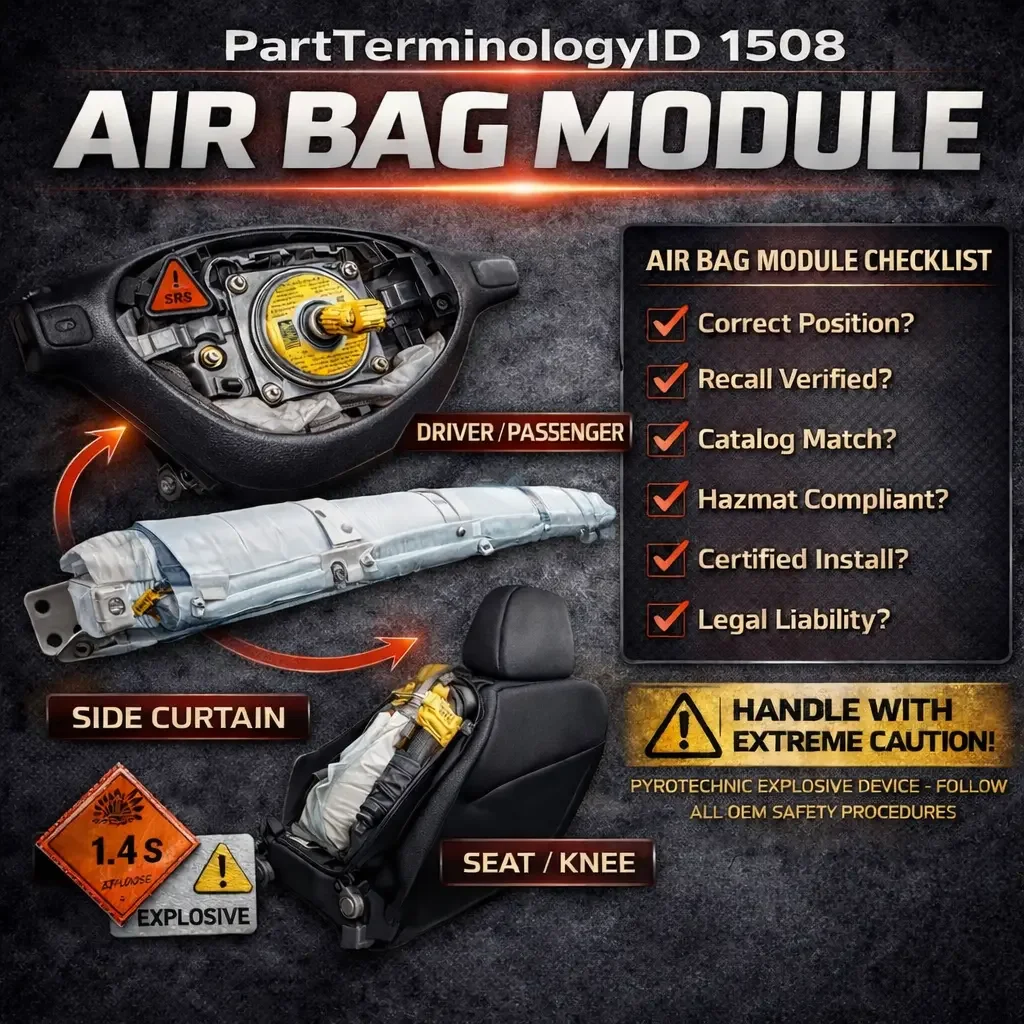
Air Bag Module (PartTerminologyID 1508) refers to the inflatable restraint device that deploys during a collision to protect the vehicle occupant. The "module" is the complete assembly: the inflator (containing the propellant charge), the air bag (the fabric cushion), the module housing (the container that holds the inflator and folded bag), and the electrical connector for the firing circuit.
In catalog reality, this covers multiple positions and types:
Driver front air bag module. Mounted in the center of the steering wheel. Deploys toward the driver's face and chest during a frontal collision. This is the most commonly replaced air bag module because steering wheel replacement, collision repair, and air bag recall work all require handling this module.
Passenger front air bag module. Mounted in the dashboard on the passenger side, typically behind a panel that splits open during deployment. Larger than the driver module because it must cover a greater distance between the dashboard and the passenger.
Side air bag module (torso). Mounted in the outboard side of the front seat or in the door panel. Deploys between the occupant and the door during a side impact. Protects the torso and pelvis.
Side curtain air bag module (head). Mounted in the headliner along the roofline above the side windows. Deploys downward like a curtain to protect the occupant's head during a side impact or rollover. Covers the front and sometimes rear side windows.
Knee air bag module. Mounted in the lower dashboard area below the steering column (driver) or below the glove box (passenger). Deploys to protect the knees and lower legs from impact with the dashboard structure.
Rear seat air bag module. Some vehicles include air bags for rear seat occupants, mounted in the back of the front seats or in the rear door panels.
Seat belt pretensioner with inflator. While not technically an air bag, seat belt pretensioners use a similar pyrotechnic charge to retract the seat belt and tighten it against the occupant during a collision. Some catalog systems group pretensioners with air bag modules.
What this part does NOT cover
Air bag control module / SRS module. The electronic computer that monitors crash sensors and sends the deployment signal. Different PartTerminologyID. This is the brain. The air bag module is the device it commands.
Clock spring / spiral cable. The electrical ribbon cable in the steering column that maintains the electrical connection to the driver air bag as the steering wheel turns. Different PartTerminologyID.
Crash sensor. The impact sensor mounted in the vehicle structure. Different PartTerminologyID.
Seat belt. The restraint belt itself. Different PartTerminologyID.
Steering wheel. The wheel itself, which houses the driver air bag module. Different PartTerminologyID.
Air bag cover or trim. The cosmetic cover over a deployed or removed air bag. Some vehicles sell the cover separately, but on most vehicles the cover is part of the module assembly.
Platform Approval Requirements: You Cannot Just Start Selling Air Bags
This is the first thing any seller needs to understand. Unlike brake pads, oil filters, or headlight assemblies, you cannot simply create a marketplace listing for an air bag module and start selling. Most major online selling platforms require pre-approval before you can list air bag modules, and some platforms prohibit their sale entirely.
Why platforms gate air bag sales
Air bag modules are federally regulated safety devices. The National Highway Traffic Safety Administration (NHTSA) regulates air bags under Federal Motor Vehicle Safety Standard 208 (FMVSS 208). Counterfeit, salvaged-but-undisclosed, recalled, or improperly handled air bag modules have been linked to deaths and injuries. The Takata air bag recall, the largest automotive recall in history, involved air bag inflators that could rupture during deployment, sending metal shrapnel into the occupant. Over 100 million inflators were recalled worldwide, with deaths and injuries reported in multiple countries.
Because of this history, platforms implement approval gates to ensure sellers are dealing in legitimate, properly sourced, non-recalled air bag modules. Selling a recalled Takata air bag module to a buyer who installs it in their vehicle creates catastrophic liability for the seller, the platform, and everyone in the supply chain.
What platform approval typically involves
While specific requirements vary by platform and change over time, sellers should expect some or all of the following before being approved to list air bag modules:
Business verification. The platform verifies the seller's business identity, location, and legitimacy. This is more rigorous than standard seller verification.
Supply chain documentation. The seller must demonstrate where the air bag modules are sourced: OEM, authorized recycler, or certified aftermarket manufacturer. The platform may require invoices, supplier certifications, or proof of authorized distribution.
Recall compliance commitment. The seller must commit to checking every air bag module against NHTSA recall databases before listing and before shipping. A module subject to an active recall cannot be sold.
Quality and condition requirements. Recycled (salvage) air bag modules must be from vehicles with documented history. The module must be undeployed, undamaged, and properly stored. The module's pyrotechnic device must be within its service life (air bag modules have a service life, typically 10 to 15 years, after which the manufacturer recommends replacement regardless of deployment status).
Liability insurance. The seller may need to carry product liability insurance at a specified minimum level. Air bag modules create liability exposure that general business insurance may not cover. The platform may require proof of coverage.
Return and refund policies. Platforms may require specific return handling procedures for air bag modules because they are pyrotechnic devices that cannot be handled like ordinary returns.
Platforms that may restrict or prohibit air bag sales
Some platforms prohibit air bag module sales entirely. Others allow them only for pre-approved sellers. Others allow them with restrictions (OEM only, no recycled, no aftermarket). Before investing in air bag inventory, verify the current policy of every platform you sell on. Policies change, and a policy that allowed air bag sales last year may restrict them this year.
The Liability Landscape
Selling air bag modules creates a level of product liability that no other aftermarket part approaches. A defective brake pad causes extended stopping distance. A defective air bag kills the occupant it was supposed to protect.
Strict liability applies. In most jurisdictions, sellers of defective products are strictly liable for injuries caused by those products regardless of fault or negligence. If a seller sells a recycled air bag module that fails to deploy (or deploys improperly) and the occupant is injured or killed, the seller is liable even if the seller had no way of knowing the module was defective.
Counterfeit air bags are a real problem. Counterfeit air bag modules have been found in the aftermarket. These modules look like OEM units but contain substandard or non-functional inflators. Some counterfeit modules have been found with no propellant at all. Others have been found with the wrong propellant. A counterfeit air bag module that does not deploy during a collision is indistinguishable from not having an air bag, except the occupant and vehicle believe the protection is there.
Recalled modules that re-enter the supply chain. Takata inflators subject to recall have been found for sale in the aftermarket after being removed from vehicles and resold. Selling a recalled air bag module is a federal violation and creates enormous liability.
Improperly stored modules. Air bag modules are sensitive to environmental conditions. Exposure to extreme heat, moisture, or physical impact can compromise the pyrotechnic charge. A module stored in an uncontrolled warehouse, exposed to temperature extremes, or dropped during handling may not deploy correctly. There is no way to test an air bag module without deploying it (destroying it), so storage and handling discipline is the only quality assurance.
The Installation Reality: This Must Be Done by a Certified Mechanic
This section cannot be stated strongly enough. Air bag module replacement is not a DIY job. It is not a job for an inexperienced mechanic. It is not a job to be performed without the proper training, tools, and procedures. The consequences of improper installation range from a non-functional air bag (which the occupant does not know is non-functional until a collision) to accidental deployment during installation (which can cause severe injury or death to the installer).
Why professional installation is essential
Accidental deployment risk. An air bag module is a live pyrotechnic device. If the firing circuit is energized while the installer is handling the module, the module deploys with explosive force. An air bag deploying on a workbench or in an installer's hands can cause severe facial injuries, broken bones, burns, and hearing damage. The deployment force is designed to stop a human body traveling at collision speed. It is not survivable at point-blank range in many scenarios.
Disarming the SRS system. Before removing or installing any air bag module, the SRS (Supplemental Restraint System) must be properly disarmed. This requires disconnecting the vehicle battery and waiting a specified period (typically 1 to 3 minutes, but some manufacturers specify up to 10 minutes) for the SRS backup capacitor to discharge. The backup capacitor stores enough energy to deploy the air bags even after the battery is disconnected, specifically to allow air bag deployment in a collision that severs the battery connection. If the installer does not wait for the capacitor to discharge, the module can deploy during handling.
Connector handling. The air bag module connector contains a shorting bar that prevents static electricity from accidentally firing the squib when the module is disconnected. The shorting bar must be in place whenever the module is not connected to the vehicle. If the shorting bar is missing or damaged, static discharge can fire the module. Handling the module connector without proper ESD (electrostatic discharge) precautions is dangerous.
Torque specifications. Air bag modules are mounted with specific torque specifications that must be followed exactly. Under-torqued mounting bolts can allow the module to detach during deployment, turning it into a projectile. Over-torqued bolts can crack the module housing. Both scenarios are life-threatening.
Post-installation system verification. After installation, the SRS system must be verified with a scan tool. The SRS warning light must be cleared. If the SRS light remains on, the system has a fault and the air bag may not deploy in a collision. A mechanic who installs an air bag module and does not verify the system with a scan tool has left the vehicle in an unknown safety state.
Proper module orientation and alignment. The air bag must be oriented correctly so that it deploys toward the occupant in the designed manner. A module installed upside down, rotated, or misaligned will deploy in the wrong direction, providing no protection or causing additional injury.
The cost of getting it wrong
An accidental deployment during installation typically requires replacing the deployed module ($300 to $2,000+ depending on the position), potentially repairing damage to the steering wheel or dashboard caused by the uncontrolled deployment, and if the installer is injured, medical costs and workers' compensation claims. A single accidental deployment in a shop can cost $5,000 to $20,000 or more when all costs are tallied.
A module that is installed incorrectly and fails to deploy in a subsequent collision creates liability that can reach millions of dollars in personal injury or wrongful death claims.
The catalog listing, the product description, and every communication with the buyer should strongly recommend professional installation by a certified mechanic experienced with SRS systems. This is not a suggestion. It is a risk management imperative for the seller.
Fitment Variables and Catalog Requirements
Vehicle-specific in every dimension
Air bag modules are completely vehicle-specific. The module housing shape, the mounting bolt pattern, the connector pinout, the bag volume, the inflation rate, the deployment timing, and the tether lengths are all designed for the specific vehicle's interior geometry, seating position, and crash structure. A driver air bag module from a 2018 Camry does not fit a 2018 Accord. A driver module from a 2018 Camry does not fit a 2020 Camry if the steering wheel design changed. There are no universal air bag modules.
Steering wheel design drives the driver module
The driver air bag module is shaped to fit inside the specific steering wheel. If the steering wheel design changed (different shape, different spoke layout, different controls), the air bag module changed with it. Steering wheel changes are common at mid-cycle refreshes and trim-level variations.
Trim level and equipment
Some vehicles offer different air bag modules by trim level. Higher trims may have multi-stage air bags (that deploy with variable force depending on crash severity and occupant size) while base trims may have single-stage air bags. The module is physically different. A single-stage module in a multi-stage application (or vice versa) will not communicate correctly with the SRS control module.
Color
The driver air bag module cover is visible as the center of the steering wheel. The cover color must match the steering wheel and interior color. A black air bag cover on a tan steering wheel is an obvious mismatch. Cover colors are typically black, gray, tan, brown, or ivory, matching the interior trim.
Production date
Air bag module designs can change during a model year due to safety recalls, engineering updates, or supplier changes. Two vehicles with the same year, make, model, and trim may require different air bag modules if they were built on different sides of a production date split. VIN-based or production-date-based fitment is sometimes necessary.
Recall status
Every air bag module must be checked against NHTSA recall databases before sale. The seller must verify that the specific module (by part number or by the donor vehicle's VIN for recycled modules) is not subject to an active recall. This is not optional. This is a legal requirement and a life-safety requirement.
OEM vs. Recycled vs. Aftermarket
OEM (new)
The safest and most expensive option. The module is manufactured to the original specification, tested to federal safety standards, and backed by the vehicle manufacturer's warranty. For collision repair covered by insurance, OEM is the standard specification.
Recycled (salvage)
OEM modules removed from wrecked or end-of-life vehicles. The module must be undeployed, undamaged, from a non-recalled vehicle, and properly stored. Recycled air bag modules are significantly less expensive than new OEM and are commonly used in collision repair. The risk is the unknown history: the module may have been exposed to extreme heat, moisture, or impact in the donor vehicle's accident. There is no non-destructive test to verify pyrotechnic integrity.
Recycled module sellers must verify: the module is undeployed, the module is not subject to recall, the module has been stored in a climate-controlled environment, the connector and shorting bar are intact, and the module is within its service life.
Aftermarket (non-OEM manufactured)
Aftermarket air bag modules exist but are far less common than aftermarket brake parts or body panels. The barrier to entry for manufacturing air bag modules is extremely high due to federal safety certification requirements. Any aftermarket air bag module must meet FMVSS 208 performance requirements. Non-certified aftermarket modules are illegal to sell in the United States.
Counterfeit (never acceptable)
Counterfeit air bag modules are illegal, dangerous, and potentially lethal. They are sometimes disguised as OEM units with fake branding and packaging. The only defense against counterfeits is a verified, documented supply chain from the manufacturer or authorized distributor to the seller.
Shipping and Handling Requirements
Air bag modules are classified as hazardous materials for shipping purposes because they contain pyrotechnic devices. Shipping requirements include:
DOT hazardous materials classification. Air bag modules are classified as Class 9 (Miscellaneous Dangerous Goods) or Class 1.4S (explosives, small quantities) depending on the carrier and the specific module. The classification determines packaging, labeling, and documentation requirements.
Proper packaging. Modules must be packed in rigid containers that prevent physical impact to the inflator. The module must be oriented so that accidental deployment (if it were to occur) directs the inflation force into the packaging material rather than outward through the container. The shorting bar must be in place on the connector.
Carrier restrictions. Some carriers restrict air bag module shipments to ground only (no air freight). Some carriers require special hazmat documentation. Some carriers will not accept air bag modules at all. Verify carrier policies before shipping.
Storage. Air bag modules must be stored in a climate-controlled environment away from extreme heat, extreme cold, moisture, and sources of electromagnetic interference that could theoretically energize the firing circuit. Modules should be stored in their original packaging until installation.
Disposal of Deployed or Expired Modules
Air bag modules that have deployed (fired), that have expired beyond their service life, or that are damaged and cannot be sold require proper disposal. You cannot throw a live (undeployed) air bag module in the trash. It is a pyrotechnic device that can deploy if exposed to heat (such as in a trash compactor or incinerator) or electrical energy.
Deployed modules. Once an air bag module has deployed, the pyrotechnic charge is spent. The deployed module can be disposed of as scrap, though local regulations may require documentation. The inflator canister may contain residual chemical byproducts that require handling per local hazardous waste regulations.
Undeployed modules requiring disposal. Undeployed modules that cannot be sold (recalled, expired, damaged) must be deployed in a controlled manner before disposal. This is typically done by a licensed pyrotechnic disposal company, an automotive recycler with proper equipment, or through a manufacturer take-back program. Some manufacturers offer disposal services for recalled modules. Intentionally deploying an air bag module outside of a vehicle requires specific safety equipment and procedures. It should never be attempted by untrained personnel.
Record keeping. Document every module's lifecycle: sourcing (where it came from, donor VIN for recycled), recall check (date, result), storage conditions, sale (buyer information), or disposal (method, date, company). This documentation is your defense in any future liability claim.
Common Buyer Scenarios
Scenario 1: DIY buyer attempts installation, accidental deployment
A buyer orders a driver air bag module for their 2017 Honda Civic to fix an SRS light. They disconnect the battery but do not wait for the backup capacitor to discharge. While connecting the new module's electrical connector, the residual charge fires the squib. The module deploys on the workbench with explosive force, destroying the module and causing burns and a broken finger to the installer.
What went wrong: The buyer did not follow the SRS disarming procedure. The backup capacitor retained enough energy to fire the squib.
What helps: Every listing must state: "Disconnect the battery and wait a MINIMUM of [manufacturer-specified time, typically 1 to 10 minutes] for the SRS backup capacitor to fully discharge before handling any air bag module connector. PROFESSIONAL INSTALLATION IS STRONGLY RECOMMENDED."
Scenario 2: Recycled module from recalled population
A collision shop orders a recycled driver air bag module for a 2008 Honda Accord. The module arrives, the shop installs it, and the repair is complete. Six months later, the vehicle owner receives a recall notice for the vehicle's air bag inflator (Takata recall). The installed recycled module is from the same recalled population. The module must be removed and replaced again under the recall, and the shop faces questions about why a recalled module was installed.
What went wrong: The recycled module seller did not check the donor vehicle's VIN against the NHTSA recall database, or the module's part number was within the recalled range and was not identified.
What helps: Recall verification for every recycled module. Document the donor VIN, the recall check date, and the result. Include the verification in the shipping documentation.
Scenario 3: Wrong stage type causes SRS fault
A buyer orders a driver air bag module for their 2019 Toyota RAV4. The vehicle has a dual-stage (multi-stage) air bag system that adjusts deployment force based on crash severity and occupant size. The replacement module is a single-stage unit from a lower trim level. The module installs physically but the SRS control module detects a resistance mismatch on the firing circuit (dual-stage squibs have different resistance than single-stage). The SRS light illuminates and the system is faulted. The air bags will not deploy in a collision.
What went wrong: The listing did not specify stage type, or the buyer did not confirm single-stage versus dual-stage for their trim.
What helps: Stage type as a mandatory fitment attribute. "Dual-Stage Air Bag Module. For vehicles with advanced (multi-stage) SRS system. Not compatible with single-stage SRS applications."
Scenario 4: Counterfeit module does not deploy in collision
A repair shop sources a "new OEM" driver air bag module from an unauthorized online seller at 60% below retail price. The module appears genuine with OEM branding and packaging. The module is installed in a customer's vehicle. Months later, the vehicle is involved in a frontal collision. The driver air bag does not deploy. The driver suffers severe facial and chest injuries that would have been prevented by a functioning air bag. Investigation reveals the module was counterfeit with a non-functional inflator.
What went wrong: The module was sourced from an unauthorized supplier. The counterfeit was not detected because no supply chain verification was performed.
What helps: Source modules only from OEM manufacturers, authorized distributors, or verified licensed recyclers. If a price seems too good to be true for an air bag module, it almost certainly is. Document the supply chain for every module sold.
Top Return Causes
1) Wrong vehicle application
Module does not fit the steering wheel, dashboard, seat, or headliner of the buyer's vehicle.
Prevention: Exact ACES fitment with year, make, model, submodel, trim, and steering wheel type. OEM part number cross-reference is essential. Production date qualifier where applicable.
2) Wrong color
Module cover does not match the interior.
Prevention: Interior color in the title: "Driver Air Bag Module, Black" or "Driver Air Bag Module, Tan." Specify interior color code.
3) Module is from a recalled population
Buyer discovers (or is told by their mechanic) that the module is subject to an active recall.
Prevention: Check every module against NHTSA recall databases before listing and before shipping. Document the recall check. Never sell a recalled module.
4) Buyer cannot install it themselves
Buyer orders the module planning a DIY installation, then realizes the SRS disarming, connector handling, and scan tool verification are beyond their capability.
Prevention: Prominent installation note: "PROFESSIONAL INSTALLATION BY A CERTIFIED MECHANIC IS STRONGLY RECOMMENDED. Air bag modules are pyrotechnic devices. Improper handling can cause accidental deployment resulting in serious injury or death. SRS system must be properly disarmed before removal or installation. Scan tool verification required after installation."
5) Module position confusion
Buyer orders a driver module when they need a passenger module, or orders a side curtain when they need a seat-mounted side torso module.
Prevention: Module position in the title: "Driver Front Air Bag Module" or "Passenger Side Curtain Air Bag Module" or "Driver Knee Air Bag Module." Specify the exact position clearly.
6) Single-stage ordered for multi-stage application (or vice versa)
Module communicates incorrectly with the SRS control module, triggering an SRS fault.
Prevention: Specify stage type: "Single-Stage Air Bag Module" or "Dual-Stage (Multi-Stage) Air Bag Module." Tie to trim level in fitment data.
Compatibility Checklist for Buyers
1) This part must be installed by a certified mechanic experienced with SRS systems. Do not attempt DIY installation. Accidental deployment during handling can cause serious injury or death.
2) Confirm exact vehicle application. Year, make, model, submodel, trim, steering wheel type (for driver module), interior color. OEM part number match is the most reliable identification.
3) Confirm module position. Driver front, passenger front, side torso (left/right), side curtain (left/right), knee (driver/passenger).
4) Confirm single-stage versus multi-stage. Must match the vehicle's SRS control module programming.
5) Confirm the module is not subject to an active recall. Ask the seller for recall verification. Check nhtsa.gov/recalls by VIN or part number.
6) Confirm interior color match (driver module). The module cover is visible on the steering wheel. Color must match.
7) Plan for professional installation and SRS scan tool verification. Budget for the installation labor and the diagnostic verification. The SRS light must be cleared and the system verified as functional after installation.
8) Confirm the module is within its service life. Air bag modules have a recommended service life (typically 10 to 15 years). An expired module may not deploy correctly.
Catalog Checklist for Attributes
Core taxonomy: Product form (complete module assembly, module with cover, module cover only). Module position: driver front, passenger front, side torso (left, right), side curtain (left, right), knee (driver, passenger), rear. Stage type: single-stage, dual-stage/multi-stage. Separate from SRS Control Module, Clock Spring, Crash Sensor, Seat Belt, Steering Wheel, and Seat Belt Pretensioner.
Fitment: Year, make, model, submodel, trim level. Steering wheel type/option (for driver module). Interior color code. Production date (where applicable). OEM part number cross-reference (mandatory for this category).
Condition (recycled): Undeployed, undamaged, non-recalled (verified), storage condition (climate-controlled), service life status, donor vehicle VIN (for recall verification).
Regulatory: FMVSS 208 compliance. Recall status verified (date checked). DOT shipping classification.
Physical specs: Module cover color. Connector type and pin count. Mounting bolt pattern.
Package contents: Module assembly, shorting bar (must be in place), mounting hardware (if included).
Images: Module front showing cover color and shape, module rear showing connector and mounting points, connector close-up showing shorting bar, and installed reference showing the module in position in the vehicle.
Required listing language: Professional installation recommended. Pyrotechnic device warning. SRS disarming procedure reference. Scan tool verification required. Recall verification statement.
FAQ
Can I install an air bag module myself?
It is strongly recommended that you do not. Air bag modules are pyrotechnic devices that deploy with explosive force. Accidental deployment during handling can cause severe injury or death. The SRS system must be properly disarmed (battery disconnected, backup capacitor discharged), the module must be handled with ESD precautions, and the system must be verified with a scan tool after installation. Have a certified mechanic experienced with SRS systems perform the work.
How do I know if the air bag module is recalled?
Check nhtsa.gov/recalls using your vehicle's VIN. If the vehicle is subject to an air bag recall and the recall remedy has not been completed, the air bag module may need to be replaced under the recall at no cost. If purchasing a recycled module, ask the seller for the donor vehicle's VIN and check that VIN for recalls as well.
What happens if the SRS light stays on after installation?
The air bag system has a fault and the air bags may not deploy in a collision. The vehicle must be scanned with an SRS-capable scan tool to read the fault code, diagnose the issue, and clear the light. Do not drive the vehicle assuming the air bags will work if the SRS light is illuminated. Have a certified mechanic diagnose and resolve the fault.
Why are air bag modules so expensive?
Air bag modules are pyrotechnic safety devices manufactured to federal safety standards (FMVSS 208). They require precision engineering, tested propellant charges, certified inflator assemblies, and quality control that ensures every unit deploys correctly in a collision. The manufacturing, testing, certification, and liability costs are reflected in the price. OEM driver air bag modules typically cost $300 to $1,500 depending on the vehicle. Side curtain modules can cost $500 to $2,000+.
Can I sell air bag modules on online marketplaces?
Most major platforms require pre-approval before you can list air bag modules. Approval typically involves business verification, supply chain documentation, recall compliance commitment, and possibly proof of product liability insurance. Some platforms prohibit air bag module sales entirely. Check the specific platform's current policy before listing.
Final Take for Aftermarket Teams
Air Bag Module (PartTerminologyID 1508) is the most dangerous, most regulated, and most liability-exposed part in the aftermarket catalog. No other part in this blog series carries the same combination of explosive physical risk (accidental deployment), catastrophic failure consequences (non-deployment in a collision), federal regulatory requirements (FMVSS 208, NHTSA recall compliance), platform sales restrictions (pre-approval required), shipping regulations (hazardous materials classification), and installation complexity (SRS disarming, certified mechanic, scan tool verification).
The catalog teams and sellers that operate in this category must do everything at a higher standard than any other part category. Fitment must be exact (OEM part number cross-reference, not approximate year ranges). Recall status must be verified for every unit. Supply chain must be documented. Listings must include professional installation language, pyrotechnic handling warnings, and SRS verification requirements. Shipping must comply with DOT hazardous materials regulations. Storage must be climate-controlled.
The margin on an air bag module can be attractive. The liability on a mishandled air bag module can be business-ending. The sellers who succeed in this category are the ones who treat every air bag module with the seriousness that a device designed to save a human life demands.